3.62亿美元去哪了?Hyperliquid反击FUD,一场对账背后的去中心化路线之争

marsbitPublicado em 2025-12-24Última atualização em 2025-12-24

Resumo

2025年12月20日,一篇技术文章《Reverse Engineering Hyperliquid》通过逆向工程指控Hyperliquid存在9项严重问题,包括3.62亿美元资金缺口及“上帝模式后门”,称其是“伪装成区块链的中心化交易平台”。Hyperliquid官方迅速回应,澄清资金缺口实为用户资产从Arbitrum跨链桥迁移至HyperEVM原生链的账面差异,总储备金43.51亿USDC与用户余额完全吻合。 官方部分澄清了技术质疑,如“CoreWriter”权限受限、测试网残留代码已隔离、8个广播地址为抗MEV措施等,但未正面回应治理提案不可查询及跨链桥无强制提款机制的问题。回应中,Hyperliquid还罕见批评竞品Lighter、Aster等依赖“中心化排序器”,强调自身“全状态上链”的透明度优势。 此外,团队承认近期做空HYPE代币的地址属于前员工个人行为,与现团队无关。此次事件凸显了DeFi协议架构复杂化下的审计挑战,也反映出Hyperliquid在去中心化演进中仍需平衡性能、透明与权限分散。

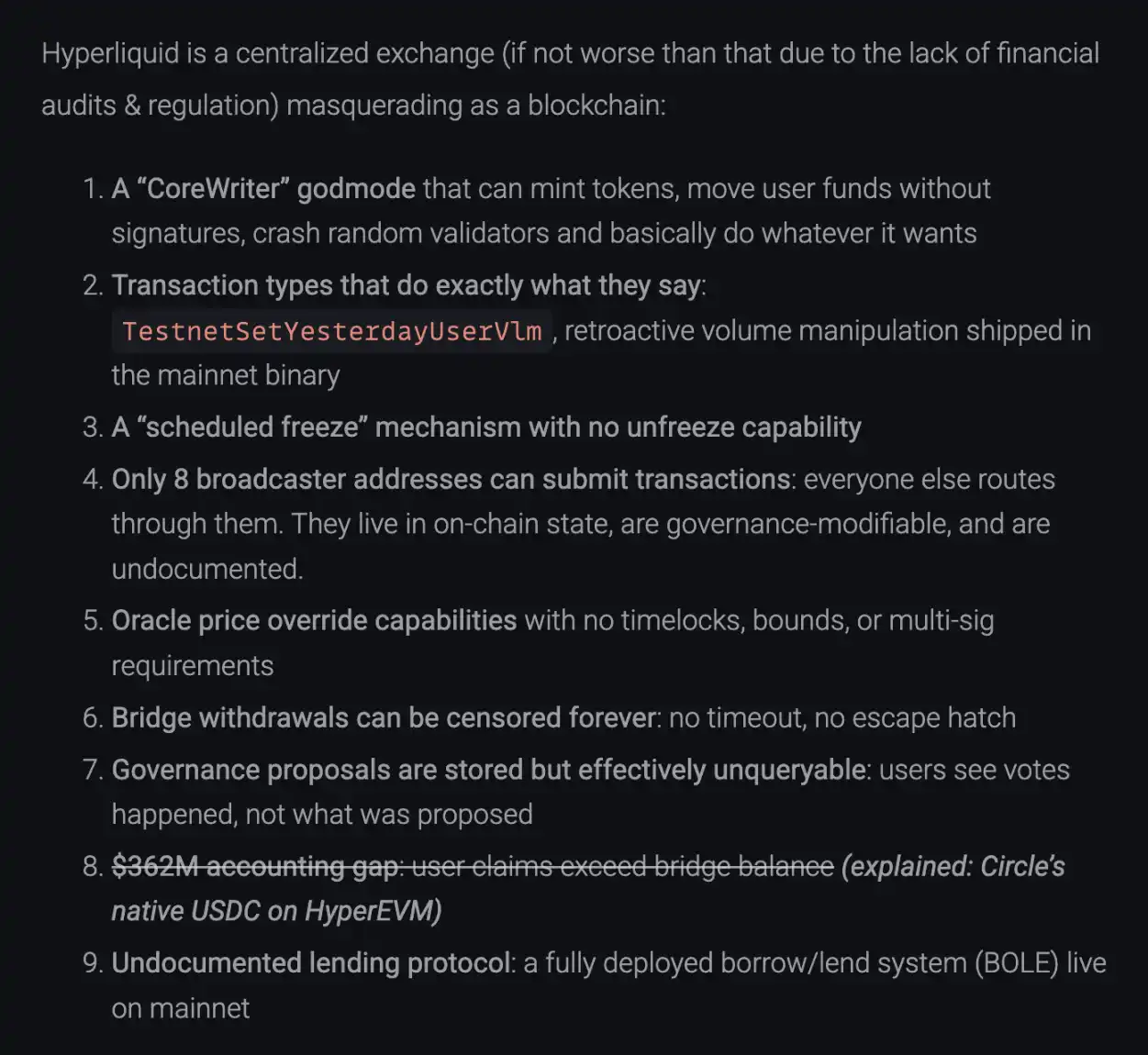
2025 年 12 月 20 日,一篇发布在 blog.can.ac 上的技术文章《Reverse Engineering Hyperliquid》,通过逆向工程直接拆解了 Hyperliquid 的二进制文件,指控其存在从「资不抵债」到「上帝模式后门」等 9 项严重问题。文章直言:

「Hyperliquid 是一个伪装成区块链的中心化交易平台。」

面对 FUD,Hyperliquid 官方发布长文回应,或许这不仅是一次单纯的辟谣,更是一场关于「谁才是真正去中心化交易设施」的路线宣战。虽然官方成功澄清了资金安全问题,但在去中心化的某些敏感地带,仍留下了耐人寻味的「留白」。

3.62 亿美元去哪了?「双账本」下的审计盲区

指控中最具杀伤力的一点是:Hyperliquid 系统内的用户资产比链上储备少了 3.62 亿美元。如果属实,这意味着这是一家部分准备金运行的「链上 FTX」。

但经过核查,这是一个因为「架构升级」导致的信息不对称误读。质疑者的审计逻辑是:Hyperliquid 储备金 = Arbitrum 跨链桥上的 USDC 余额。根据这一逻辑,他查看了跨链桥地址,发现余额确实少于用户总存款。

Hyperliquid 回应称,正在经历从「L2 AppChain」向「独立 L1」的完全体进化。在这个过程中,资产储备变为了双轨制:

指控者完全忽略了位于 HyperEVM 上的原生 USDC,根据链上数据(截至发稿时):

· Arbitrum 跨链余额: 39.89 亿 USDC(Arbiscan 可查)

· HyperEVM 原生余额: 3.62 亿 USDC(Hyperevmscan 可查)

· HyperEVM 合约余额: 0.59 亿 USDC

总偿付能力 = 39.89 亿 + 3.62 亿 + 0.59 亿 ≈ 43.51 亿 USDC

这一数字与 HyperCore 上的用户总余额(Total User Balances)完全吻合。所谓的「3.62 亿缺口」,恰恰就是已经迁移至 HyperEVM 的原生资产。这并非资金消失,而是资金在不同账本间的流转。

9 点指控对账单:澄清了什么?回避了什么?
已澄清的指控

指控:「CoreWriter」上帝模式: 指控称其能凭空印钞、挪用资金。

回应: 官方解释这是 L1 与 HyperEVM 交互的接口(如质押),权限受限,并无挪用资金能力。

指控:3.62 亿资金缺口。

回应: 如上文所述,系未计算 Native USDC。

指控:未公开的借贷协议。

回应: 官方指出现货 / 借贷功能(HIP-1)文档已公开,处于预发布阶段,并非秘密运行。

已承认但有合理解释的指控

指控:二进制文件含「修改交易量」代码(TestnetSetYesterdayUserVlm)。

回应: 承认存在。但解释为测试网(Testnet)残留代码,用于模拟费率逻辑,主网节点已物理隔离该路径,无法执行。

指控:只有 8 个广播地址能提交交易。

回应: 承认。解释为抗 MEV(最大可提取价值)措施,防止用户被抢跑。承诺未来会实行「多提议者」机制。

指控:链可以被「计划性冻结」且无撤销功能。

回应: 承认。解释这是网络升级(Upgrade)的标准流程,必须全网暂停切换版本。

指控:预言机价格可被瞬间覆盖。

回应: 解释为系统安全性设计。为了在类似 10/10 的极端波动中及时清算坏账,验证者预言机确实没有设置时间锁。

回应缺失 / 模糊

在我们的核对中,有两点指控在官方回应中未被正面提及或完全解决:

指控:治理提案不可查询(Governance proposals are unqueryable),用户只能看到投票发生了,但链上数据不包含提案的具体文本内容。

回应: 官方未在长文中回应此点。这意味着 Hyperliquid 的治理目前对普通用户而言仍是一个「黑盒」,你只能看到结果,看不到过程。

指控:跨链桥无「逃生舱」(No Escape Hatch),提现可能被无限期审查,用户无法强制提款回 L1。

回应: 官方虽然解释了 POPCAT 事件中锁定桥是为了安全,但未反驳「无逃生舱」这一架构事实。这表明在当前阶段,用户资产进出高度依赖验证者集的放行,不具备 L2 Rollup 那样的抗审查强制提款能力。

「拉踩」竞品

这次风波最有趣的地方,在于它逼迫 Hyperliquid 亮出了自己的底牌,也让我们有机会重新审视 Perp 赛道的格局。官方在回应中罕见地「拉踩」了竞品,将枪口对准了 Lighter、Aster 甚至行业巨头 Binance。

其表示,「Lighter 使用单一的中心化序列器,其执行逻辑和零知识证明(ZK)电路均不公开。Aster 使用中心化撮合,甚至提供暗池交易,而暗池交易只有在单一的中心化序列器且执行过程不可验证的情况下才能实现。其他一些包含开源合约的协议则没有可验证的序列器。」

Hyperliquid 直言不讳地将这些竞争对手归为一类,称它们均依赖「中心化排序器(Centralized Sequencer)」。官方强调:在这些平台上,除了排序器运营者,没有任何人能看到完整的状态快照(包括订单簿历史、仓位细节)。相比之下,Hyperliquid 试图通过让所有验证者执行相同的状态机来消除这种「特权」。

而这波「拉踩」或许也正是因为 Hyperliquid 对当前的市场份额产生了担忧,根据 DefiLlama 过去 30 天的交易量数据,市场格局已呈三足鼎立之势:
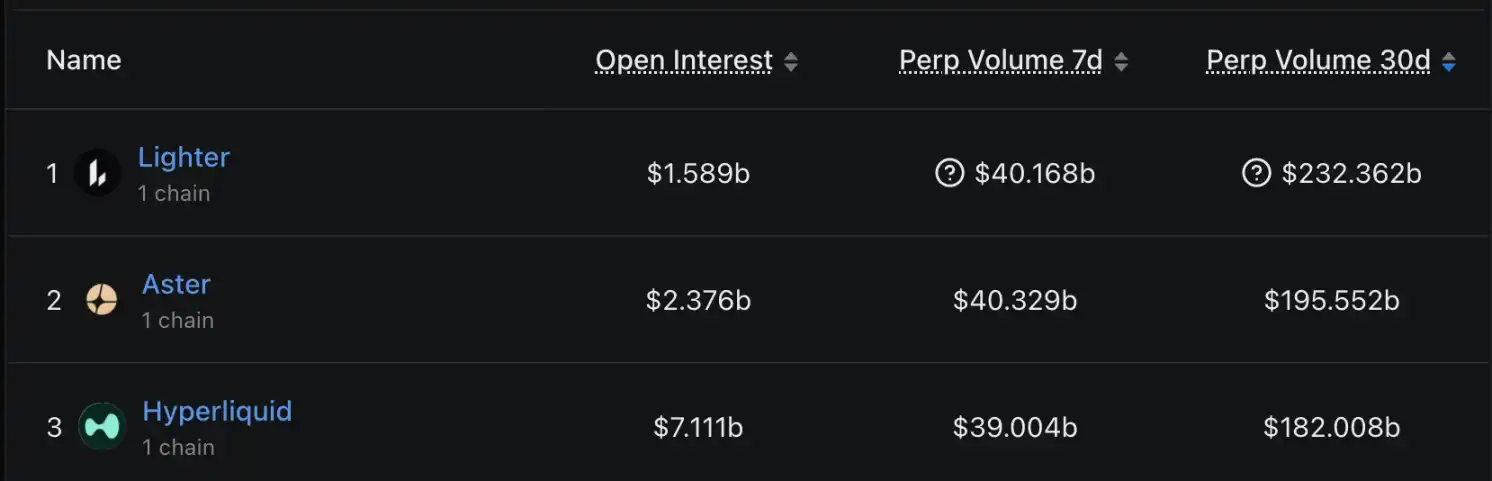
· Lighter:交易量 2323 亿美元,暂居榜首,占比约 26.6%。

· Aster:交易量 1955 亿美元,位居第二,占比约 22.3%。

· Hyperliquid:交易量 1820 亿美元,位居第三,占比约 20.8%。

面对 Lighter 和 Aster 后来者居上的交易量,Hyperliquid 试图打出「透明度」这张牌——即「虽然我有 8 个中心化广播地址,但我全状态上链可查;而你们连查都没法查」。不过值得注意的是,虽然在交易量上 Hyperliquid 略逊于前两名,但在持仓量(Open Interest, OI)上,Hyperliquid 呈现碾压态势。

舆情回应:谁在做空 HYPE?

除了技术与资金问题,社区最为关切的还有近期 HYPE 代币疑似被「内部人士」做空砸盘的传闻。对此,Hyperliquid 团队成员在 Discord 首次给出了定性回应:「0x7ae4 开头做空地址属于一名前员工」,该人员曾是团队成员,但已于 2024 年初被解雇。该前员工的个人交易行为与 Hyperliquid 现有团队无关。平台强调,目前对所有在职员工和承包商实行极其严格的 HYPE 交易限制与合规审查,严禁利用职务之便进行内幕交易。

这一回应试图将「团队作恶」的指控降级为「前员工个人行为」,但在代币分发与解锁机制的透明度上,社区或许仍期待更详尽的公示。

Don't Trust, Verify

Hyperliquid 的这次澄清推文,堪称教科书级别的危机公关——不是靠情绪输出,而是靠数据、代码链接和架构逻辑。它没有止步于自证清白,而是反守为攻,通过对比竞品的架构,强化了自身「全状态上链」的品牌和优势。

虽然 FUD 被证伪,但这次事件给行业留下的思考是深远的。随着 DeFi 协议向独立应用链(AppChain)演进,架构越来越复杂,资产分布越来越碎片化(Bridge + Native)。传统的「看一眼合约余额」的查账方式已经失效。

对于 Hyperliquid 而言,证明了「钱在」只是第一步。如何在保持高性能和抗 MEV 的优势下,逐步移交那 8 个提交地址的权限,真正实现从「透明的中心化」到「透明的去中心化」的跨越,才是它通往「终极 DEX」的必经之路。

而对于用户,这次风波再次印证了加密世界的那条铁律:不要相信任何叙事,去验证每一个字节。

Perguntas relacionadas

Q针对Hyperliquid的3.62亿美元资金缺口指控,官方是如何回应的?

A官方回应称,所谓的3.62亿美元资金缺口是由于Hyperliquid正在从L2 AppChain向独立L1升级,资产储备采用双轨制。质疑者仅计算了Arbitrum跨链桥上的USDC余额,但忽略了已迁移至HyperEVM的原生USDC。根据链上数据,总偿付能力(Arbitrum跨链余额 + HyperEVM原生余额 + HyperEVM合约余额)与用户总余额完全吻合,不存在资金缺口。

Q在9项指控中,哪些被Hyperliquid官方完全澄清?

A官方完全澄清了以下指控:1. 'CoreWriter'上帝模式:解释为L1与HyperEVM交互的受限接口,无挪用资金能力;2. 3.62亿美元资金缺口:系未计算Native USDC导致的误读;3. 未公开的借贷协议:指出现货/借贷功能(HIP-1)文档已公开,处于预发布阶段。

QHyperliquid在回应中承认了哪些指控但提供了合理解释?

A官方承认但提供合理解释的指控包括:1. 二进制文件含'修改交易量'代码:解释为测试网残留代码,主网已物理隔离;2. 只有8个广播地址能提交交易:解释为抗MEV措施,承诺未来实行多提议者机制;3. 链可被'计划性冻结':解释为网络升级的标准流程;4. 预言机价格可被瞬间覆盖:解释为应对极端波动的安全设计。

QHyperliquid在回应中未正面解决哪些指控?

A官方未正面解决两点指控:1. 治理提案不可查询:用户只能看到投票结果,无法查看提案具体内容,治理过程仍为'黑盒';2. 跨链桥无'逃生舱':未反驳提现可能被审查的架构事实,用户资产进出依赖验证者放行,缺乏抗审查强制提款能力。

QHyperliquid在回应中如何通过'拉踩'竞品突出自身优势?

A官方通过对比竞品强调自身'全状态上链'的透明度优势:指责Lighter使用中心化序列器且执行逻辑不公开,Aster依赖中心化撮合和暗池交易,而其他协议缺乏可验证序列器。Hyperliquid声称其通过所有验证者执行相同状态机消除'特权',尽管当前使用8个广播地址,但全状态可查,竞品则无法提供同等透明度。

Leituras Relacionadas

Fed's Internal Doves Flock to Hawkish Stance, Warsh's Debut "Between a Rock and a Hard Place"

U.S. Federal Reserve officials who previously advocated for rate cuts, including Governor Christopher Waller, have recently shifted their stance, with many now not ruling out the possibility of future rate hikes. This sets a challenging stage for new Fed Chair Kevin Warsh's first policy meeting. Appointed by President Trump based on his dovish views, Warsh now faces a committee where the debate has pivoted from "when to cut" to "whether to hike," driven by persistent inflation above 3%, a strong labor market, and supply-side pressures from AI infrastructure demands and geopolitical tensions. Key figures illustrate the shift. Governor Waller, once concerned about employment, now says data has pushed him toward considering rate increases. Even moderate voices like Governor Lisa Cook, while expecting inflation to ease, have indicated readiness to hike if it fails to do so. Long-time hawks such as regional Fed presidents Beth Hammack, Lorie Logan, and Neel Kashkari have grown more vocal, arguing that the real policy rate is effectively falling and that action may soon be needed. The upcoming Fed meeting is expected to keep rates steady but will likely remove the "easing bias" from its statement, signaling a neutral stance between cuts and hikes. The quarterly "dot plot" is anticipated to show most officials projecting no cuts this year, with some potentially indicating hikes. Chair Warsh, a critic of the Fed's reliance on forward guidance like the dot plot, must navigate communicating this pivot using tools he has questioned, all while steering policy in a direction counter to the preferences of the president who appointed him. The consensus suggests the Fed's next move could well be a rate increase.

marsbitHá 25m

Fed's Internal Doves Flock to Hawkish Stance, Warsh's Debut "Between a Rock and a Hard Place"

marsbitHá 25m

The Trillion-Yuan Market Cap 'Yi Zhong Tian': Who is the True Value King?

The article analyzes the three leading Chinese optical module companies, collectively nicknamed "Yi Zhong Tian": Xinyisheng, Zhongji Innolight, and TFC Optical Communication. It evaluates their "cost-performance" not by current stock price, but through three lenses: PEG ratio (growth vs. valuation), earnings quality, and premium/discount for certainty. Xinyisheng shows the most attractive PEG ratio and high profitability, but its valuation reflects discounts for risks like high customer concentration and reliance on overseas markets. Zhongji Innolight, the most expensive, commands a premium for its market leadership, dominant share in key products like 800G/1.6T modules, and higher earnings certainty, though it faces geopolitical risks. TFC Optical, as an upstream component supplier ("water seller"), has the highest gross margin and bets on the long-term CPO/NPO architecture trend, but trades at a high valuation with more stable, less explosive growth. The core argument is that while these companies dominate module assembly, the true profit pool and technological moat lie upstream in laser and switch chips, currently controlled by U.S. firms like Lumentum and Coherent. The long-term "cost-performance" for these Chinese leaders hinges on whether the domestic industry, exemplified by companies like Yuanjie Technology, can successfully move up the value chain into high-power laser chips. Otherwise, their high growth may remain confined to the lower-margin assembly segment.

marsbitHá 35m

The Trillion-Yuan Market Cap 'Yi Zhong Tian': Who is the True Value King?

marsbitHá 35m

Has the Crypto Market Bottomed? Here's What Institutions Think

The crypto market is in a period of significant debate, with leading institutions offering differing views on whether a bottom has been reached. Three prominent firms have published detailed analyses: * **Galaxy Digital** argues Bitcoin has **not yet bottomed**. Their analysis of 13 historical indicators across six dimensions (valuation, profit-taking, miner pressure, etc.) shows only four are fully met. They project a potential bottom range between $30k and $54k. * **NYDIG** states a bottom is **possible but not likely**. While metrics are close to historic bear market extremes, they note the absence of a classic panic-selling event. They also suggest increased institutional adoption may have structurally altered the market cycle, potentially leading to a shallower downturn. * **Standard Chartered Bank** asserts the **bottom has already occurred** at around $59k. They cite two key factors: potential US-Iran diplomatic progress and the anticipated SpaceX IPO, which they believe absorbed capital and caused ETF selling pressure that is now subsiding. They forecast a year-end price target of $100k. Despite the surface-level disagreement, the reports share critical common ground more valuable for long-term investors: 1. All three believe the market bottom will form **within this year**. 2. All agree the current price is **closer to the bottom than to previous highs**. 3. All maintain a **bullish long-term outlook** for Bitcoin and a new cycle. The core takeaway is that while the exact bottom price ($40k, $50k, or $60k) is debated, the consensus is that a bottom is imminent. For long-term holders, the primary focus should not be pinpointing the absolute low, but on the future potential for prices to reach $100k, $200k, or higher. The fundamental thesis for Bitcoin—sovereign debt accumulation, inflation, declining trust in centralized institutions, global digitization, and improved accessibility—remains intact and is arguably strengthening. The overall landscape is viewed as more favorable than in previous crypto winters.

marsbitHá 46m

Has the Crypto Market Bottomed? Here's What Institutions Think

marsbitHá 46m

The 'Chip' Challenge and Breakthroughs in China's Optical Industry Chain

China's Photonics Industry: Bottlenecks and Breakthroughs In the global AI race, computing chips dominate the narrative, but the underlying bottleneck increasingly defining the scale of AI clusters is light—or more specifically, optical connectivity. Optical modules, which translate electrical signals to light and vice versa, are crucial for connecting thousands of GPUs in AI data centers, preventing data congestion and ensuring efficient model training. High-speed modules (800G, 1.6T) are now standard, with performance hinging on advanced DSP (Digital Signal Processor) chips. This is where a critical dependency lies. Two US giants—Marvell and Broadcom—collectively dominate over 90% of the high-end DSP chip market. Chinese optical module leaders like Zhongji Innolight and Eoptolink rely on these chips to manufacture modules for overseas AI customers, primarily in North America. While this creates a supply chain vulnerability, complete decoupling is difficult. Marvell derives over half its revenue from Greater China, and the US firms depend on Chinese partners for chip packaging and optical components. The risk from laser chips (e.g., from Lumentum), another key component, is considered more manageable due to multiple global suppliers and faster progress in domestic alternatives from companies like YOFC and Accelink. To mitigate risks, China's industry is pursuing a multi-pronged strategy: diversifying supply chains and locking in long-term orders; fostering a domestic market ecosystem to adopt homegrown DSPs from firms like Huawei HiSilicon and CETC; accelerating R&D in high-speed DSPs and advanced packaging; and investing in next-gen technologies like silicon photonics and Co-Packaged Optics (CPO) to reduce reliance on discrete DSPs. The ultimate solution lies not in short-term博弈 but in persistent advancement of domestic high-end chip R&D and manufacturing. While challenges remain in performance, certification, and ecosystem building, China's vast domestic market and manufacturing base provide a crucial buffer, buying time for the industry to achieve greater technological independence.

marsbitHá 59m

The 'Chip' Challenge and Breakthroughs in China's Optical Industry Chain

marsbitHá 59m

Trading

Spot
Futuros

Artigos em Destaque

O que é ATWO

I. Introdução ao ProjetoArena Two é uma plataforma interativa descentralizada que permite aos fãs desempenhar um papel ativo e tokenizado nos resultados de eventos em tempo real. Ao contrário dos modelos tradicionais de transmissão que reduzem os fãs a espectadores passivos, a Arena Two utiliza a tecnologia blockchain para permitir que os fãs votem diretamente em tempo real e influenciem os resultados em campo.II. Informação sobre o TokenNome do token: ATWO(Arena Two)III. Links RelacionadosWebsite:https://arenatwo.com/Exploradores:https://basescan.org/token/0x499D35eBE6cEe9B2Ac35Fd003fcBbeeB9CFc7B32Twitter:https://x.com/arenatwoXNota: A introdução ao projeto provém dos materiais publicados ou fornecidos pela equipa oficial do projeto, que é apenas para referência e não constitui aconselhamento de investimento. A HTX não se responsabiliza por quaisquer perdas diretas ou indiretas resultantes.

259 Visualizações TotaisPublicado em {updateTime}Atualizado em 2026.06.02

O que é ATWO

Como comprar ATWO

Bem-vindo à HTX.com!Tornámos a compra de Arena Two (ATWO) simples e conveniente.Segue o nosso guia passo a passo para iniciar a tua jornada no mundo das criptos.Passo 1: cria a tua conta HTXUtiliza o teu e-mail ou número de telefone para te inscreveres numa conta gratuita na HTX.Desfruta de um processo de inscrição sem complicações e desbloqueia todas as funcionalidades.Obter a minha contaPasso 2: vai para Comprar Cripto e escolhe o teu método de pagamentoCartão de crédito/débito: usa o teu visa ou mastercard para comprar Arena Two (ATWO) instantaneamente.Saldo: usa os fundos da tua conta HTX para transacionar sem problemas.Terceiros: adicionamos métodos de pagamento populares, como Google Pay e Apple Pay, para aumentar a conveniência.P2P: transaciona diretamente com outros utilizadores na HTX.Mercado de balcão (OTC): oferecemos serviços personalizados e taxas de câmbio competitivas para os traders.Passo 3: armazena teu Arena Two (ATWO)Depois de comprar o teu Arena Two (ATWO), armazena-o na tua conta HTX.Alternativamente, podes enviá-lo para outro lugar através de transferência blockchain ou usá-lo para transacionar outras criptomoedas.Passo 4: transaciona Arena Two (ATWO)Transaciona facilmente Arena Two (ATWO) no mercado à vista da HTX.Acede simplesmente à tua conta, seleciona o teu par de trading, executa as tuas transações e monitoriza em tempo real.Oferecemos uma experiência de fácil utilização tanto para principiantes como para traders experientes.

141 Visualizações TotaisPublicado em {updateTime}Atualizado em 2026.06.02

Como comprar ATWO

O que é ZEST

I. Introdução ao Projeto1. O que é o Zest Protocol?O Zest Protocol é um protocolo de empréstimos nativo do Bitcoin construído na camada 2 do Stacks que permite aos utilizadores ganhar rendimento com BTC ou emprestar ativos colateralizando BTC. Os contratos inteligentes do protocolo são escritos na linguagem Clarity, operam totalmente em cadeia e são de código aberto, com um design inspirado no Aave v3. O Zest é atualmente o maior protocolo DeFi no Stacks, com mais de 800 BTC depositados e um pico de TVL superior a 100 milhões de dólares. Em maio de 2026, o protocolo introduziu ainda os Cofres de Colateral em Bitcoin, estendendo as capacidades de empréstimo do Stacks para a rede principal do Bitcoin. Isso permite que os utilizadores emprestem stablecoins sem mover BTC da rede Bitcoin, possibilitando empréstimos com custódia própria.2. Como funciona o Zest Protocol?O Zest Protocol consiste em dois mercados. O mercado do Stacks é construído sobre o Aave v3, permitindo que os utilizadores depositem ativos como sBTC, STX e USDC para ganhar rendimento ou contrair empréstimos sobre-colateralizados. O LTV máximo padrão é de 50% (70% para sBTC). O mercado do Bitcoin opera através dos recém-lançados Cofres de Colateral em Bitcoin. Os utilizadores emprestam stablecoins ao bloquear BTC em cofres de custódia própria na cadeia do Bitcoin. O colateral permanece na rede principal do Bitcoin durante todo o processo, e os utilizadores mantêm a custódia, a menos que a posição seja liquidada.3. Quem fundou o Zest Protocol?Tycho Onnasch (Co-Fundador): Formado na Universidade de Oxford. Envolvido em pesquisa e subsídios para a Stacks Open Internet Foundation. Antigo Gestor na Trust Machines e Fundador da Deedmob. Perfil do LinkedIn: https://www.linkedin.com/in/tychokoonnasch/.Fernando Foy (Co-Fundador): Trabalhou anteriormente em consultoria de TI na Objectif Emploi. Perfil do LinkedIn: https://www.linkedin.com/in/fernando-foy/.Emil E. (Co-Fundador): Possui um Mestrado em Física pela Universidade de Warwick. Antigo Partner de Engenharia na Trust Machines, Desenvolvedor Full-Stack para projetos Web3 e Cientista de Dados no HSBC. Perfil do LinkedIn: https://www.linkedin.com/in/emil-e-49771a145/.Detalhes de Financiamento: Em maio de 2024, o Zest Protocol anunciou a conclusão de uma ronda de financiamento inicial de 3,5 milhões de dólares liderada por Tim Draper, com a participação da Binance Labs, Flow Traders, Trust Machines, entre outros.4. Tokenomics do $ZEST$ZEST é o token nativo do Zest Protocol com um fornecimento total fixo de 1 mil milhões de tokens e sem mecanismo inflacionário.Comunidade (27,83%): Usado para airdrops e incentivos aos utilizadores;Desenvolvimento do Ecossistema (24,82%): Usado para liquidez, parcerias, marketing, listagens em bolsas, etc.;Investidores (22,35%): Apoio às partes investidoras que apoiaram o desenvolvimento inicial do Zest Protocol;Equipa (25%): Alocado para colaboradores principais.Calendário de Vesting: Os tokens da Equipa e dos Investidores estão sujeitos a um período de bloqueio de 1 ano, seguido de 3 anos de desbloqueio linear.5. Cronologia dos Principais Marcos2022: O Zest Protocol é oficialmente fundado.Março de 2024: Concluída a auditoria de segurança e lançado o mercado de empréstimos do Stacks na rede principal.Em fevereiro de 2026, é lançado o Stacks Market V2, introduzindo Grupos de Risco.Em maio de 2026, foram introduzidos os Cofres de Colateral em Bitcoin, e um protótipo operacional da rede principal está agora disponível. Isso permite que os utilizadores utilizem BTC com custódia própria na L1 do Bitcoin como colateral para emprestar stablecoins em cadeias EVM, encerrando a necessidade de bridging, wrapping e custódia de terceiros. Este lançamento é dividido em duas fases. Fase 1: Utiliza transações pré-assinadas para restringir o movimento de BTC; Fase 2: Utiliza BitVM para verificação. II. Informações sobre o TokenNome do token: ZEST (Zest Protocol)III. Links RelacionadosWebsite: https://www.zestprotocol.com/Exploradores: https://bscscan.com/token/0x5506599c722389a60580b5213ea1da60d64754a1Twitter: https://twitter.com/ZestProtocolNota: A introdução ao projeto provém dos materiais publicados ou fornecidos pela equipa oficial do projeto, que é apenas para referência e não constitui aconselhamento de investimento. A HTX não se responsabiliza por quaisquer perdas diretas ou indiretas resultantes.

208 Visualizações TotaisPublicado em {updateTime}Atualizado em 2026.06.02

O que é ZEST

Discussões

Bem-vindo à Comunidade HTX. Aqui, pode manter-se informado sobre os mais recentes desenvolvimentos da plataforma e obter acesso a análises profissionais de mercado. As opiniões dos utilizadores sobre o preço de A (A) são apresentadas abaixo.

活动图片