Tether заморозила 13,4 млн USDT на 22 криптоадресах

cryptonews.ruPublicado em 2025-05-16Última atualização em 2025-10-17

Компания Tether, эмитент стейблкоина USDT, заблокировала 22 подозрительных аккаунта с активами на $13,4 млн в сетях Эфириума и Tron, сообщили эксперты аналитической платформы MistTrack.

По данным аналитической платформы MistTrack, среди всех заблокированных аккаунтов выделяются два адреса:: 0xecbd85e318e83f0358b404b41fb73daaacbeb59e с балансом в $10,3 млн USDT и TRON-адрес TYzDebkjMofvfWR6v7Ay1rcH7r9JjYMxQV с балансом в 1,4 млн USDT.
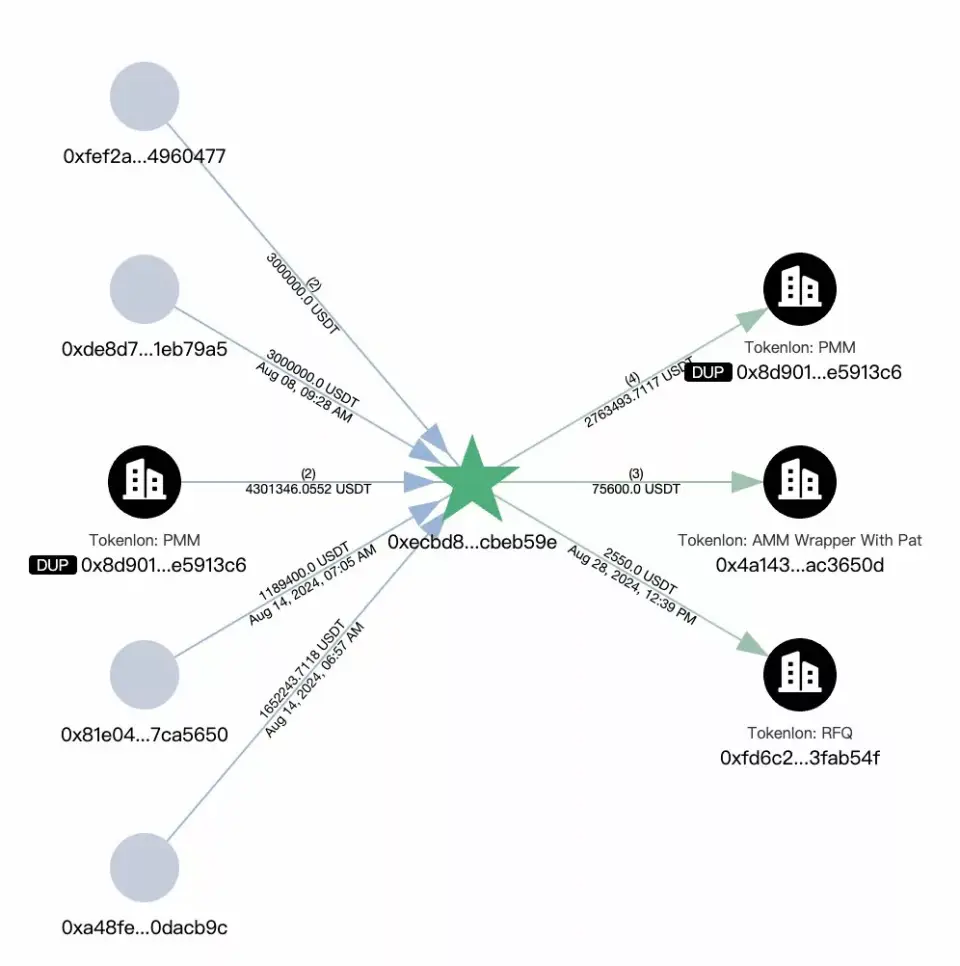
354.png

В Tether не раскрывают причины блокировки активов, однако по исторически сложившейся практике сотрудничества компании с правоохранительными органами можно предположить, что заморозка затронула подозрительные адреса, связанные с потенциально незаконной деятельностью. Поэтому событие вписывается в общую тенденцию роста мер противодействия незаконным операциям в криптоотрасли.

Например, с 2016 года, когда Tether объявила об обновлении политики блокировки подозрительных аккаунтов, в «черный» список компании попало более 5188 адресов, на которых может храниться до $3 млрд в стейблкоинах USDT.

Ранее Министерство обороны Израиля потребовало конфисковать $1,5 млн в стейблкоинах USDT со 187 кошельков, связанных с Корпусом стражей исламской революции (КСИР) Ирана.


Leituras Relacionadas

Robotic GPT-3 Moment Shakes Silicon Valley: Zero Lines of Code, Learns Instantly, with Investments from Jensen Huang and Fei-Fei Li

Generalist AI's newly released robot foundation model GEN-1.5 is being hailed as the "GPT-3 moment" for embodied AI. The model demonstrates remarkable one-shot and few-shot learning capabilities in physical manipulation tasks. By watching a single 3-12 second demonstration video (physical prompting) without any training or code, the robot can attempt the task with a 59% average success rate across 10 tasks. With just 5 minutes of demonstration data and minimal fine-tuning (10 gradient steps), the success rate jumps to 83%. The most significant breakthrough is the emergence of spontaneous, improvisational problem-solving abilities not present in the training data. For instance, after learning to sweep blocks with a brush, the robot can adapt to use a banana similarly or switch to a completely new "scoop-and-pour" strategy when given a dustpan. Other emergent behaviors include removing obstacles, correcting errors, and spontaneously sorting objects. These capabilities stem from over 8 months of large-scale pre-training on physical interaction data, suggesting the existence of a Scaling Law for embodied intelligence—where model generalization improves with more data and training time. This approach drastically reduces the cost and expertise needed to teach robots new skills, potentially democratizing robot programming. The release coincides with a surge in the humanoid robotics sector, marked by events like the World Robot Conference and significant investments. While the demonstrated tasks are still relatively simple, the scaling trend and emergent behaviors point toward a future where general-purpose robot "brains" could be easily adapted to various hardware "bodies," reshaping the industry's competitive landscape.

marsbitHá 36m

Robotic GPT-3 Moment Shakes Silicon Valley: Zero Lines of Code, Learns Instantly, with Investments from Jensen Huang and Fei-Fei Li

marsbitHá 36m

Semiconductor Industry Sees a New Wave of Price Hikes, with STMicroelectronics, Maxscend and Others Increasing Prices Intensively

The semiconductor industry is experiencing a new wave of price increases driven by supply-demand dynamics and rising costs. Throughout August, multiple international and domestic semiconductor companies have issued price adjustment notices to clients, with a focus on analog and RF chips. Key companies adjusting prices include STMicroelectronics, which is implementing its third price hike in 2026 effective August 23, citing sustained demand pressure and rising costs across the supply chain. Analog Devices, Inc. (ADI) has also announced a second price increase for 2026, effective September 13, due to "unprecedented" demand growth and escalating manufacturing costs. In China, RF chip leader Zhuosheng Microelectronics issued a price adjustment notice for its full RF product line, effective September 1, its first hike this year, attributing it to rising raw material and foundry costs. Additionally, Chinese MCU manufacturer Nations Technologies announced a 10-20% price increase for some products from October 1. This new round of price hikes has shifted its focus to mature process nodes (e.g., analog, RF, power, MCUs), partly due to AI computing demand consuming 8-inch wafer capacity. This contrasts with the first half of 2026, when the surge was led by AI memory chips like HBM and server DRAM. Analysts note that the long lead time for expanding analog/power semiconductor capacity (18-24 months) may sustain price resilience in the short term. However, downstream manufacturers' cost tolerance and fluctuating global demand could become constraints, potentially limiting further significant price increases. Companies have linked the hikes to ensuring future supply stability by funding capacity expansion.

marsbitHá 39m

Semiconductor Industry Sees a New Wave of Price Hikes, with STMicroelectronics, Maxscend and Others Increasing Prices Intensively

marsbitHá 39m

Trading

Spot
活动图片