Global Watchdog FSB To Address Stablecoin-Related Risks With Surveillance Overhaul – Report

bitcoinistPublished on 2025-10-14Last updated on 2025-10-14

Abstract

Financial Stability Board (FSB), an international body that monitors and makes recommendations about the global financial system, has reportedly vowed...

Trusted Editorial content, reviewed by leading industry experts and seasoned editors. Ad Disclosure

Financial Stability Board (FSB), an international body that monitors and makes recommendations about the global financial system, has reportedly vowed to address the evolving threats from private finance and the growing use of stablecoins.

Global Watchdog Plans Surveillance Overhaul

On Monday, Bank of England (BoE) Governor and FSB Chairman Andrew Bailey promised to increase the global watchdog’s policy response to the emerging risks related to the private finance sector and stablecoins.

According to Bloomberg, Bailey pledged to overhaul the FSB’s surveillance in a letter delivered ahead of this week’s Group of 20 (G20) meetings, seeking to make it “more flexible and quicker to recognise, and respond to, emerging vulnerabilities.”

“Whether it is the rise of private finance, the implications of geopolitical tensions, or the increasing role of stablecoins for payment and settlement purposes, our ability to detect and address emerging risks is critical,” he wrote in the letter.

In June, the Financial Action Task Force (FATF) raised concerns about the “increasing risks” associated with the adoption of stablecoins, noting that the growing use of these digital assets by illicit parties poses a challenge to global financial security.

The FATF emphasized that mass adoption of stablecoins could increase these risks given the “inconsistent application” of its standards across various jurisdictions. Similarly, Bailey considers there is potential for “regulatory arbitrage” due to gaps in addressing financial stability risks and the low number of finalized regulatory frameworks for global stablecoin arrangements.

He affirmed that the FSB will have “open and frank discussions among members” about the next steps for the international watchdog, and will “increase outreach to the private sector to benefit from their expertise and perspectives on risks and vulnerabilities.”

The FSB chair also warned that the global deregulatory trend has “raised concerns that reform efforts may be weakening.” Notably, Bailey has previously shared a skeptical perspective on the sector, cautioning that stablecoins threaten to destabilize the public’s trust in money.

However, he has recently shared a seemingly softer approach, affirming that it would be “wrong to be against stablecoins as a matter of principle,” which could suggest a shift from his highly criticized approach.

Stablecoin Regulation Faces Challenges

Amid stablecoin’s growing momentum, driven by the US regulatory efforts, Europe’s top financial stability watchdog is reportedly pushing for stricter regulations for the sector, which could impact how issuers like Circle and Paxos operate across borders.

As reported by Bitcoinist, the European Central Bank (ECB) has called for a ban on multi-issuance stablecoins in the bloc and other jurisdictions, following a recently passed recommendation by the European Systemic Risk Board (ESRB) to ban jointly issued stablecoins.

Despite being supported by a high-powered board of central bank governors and European Union (EU) officials, the ESRB guidance is not legally binding. However, it will likely pressure authorities to “implement the restrictions or explain how financial stability can be preserved in their absence.”

Meanwhile, the EU is reportedly planning to shift oversight power of key financial market areas, like crypto, from national authorities to a centralized supervisory authority, aiming to boost the bloc’s capital markets and address the continued fragmentation in markets.

The Chair of the European Securities and Markets Authority (ESMA), Verena Ross, affirmed that the European Commission is preparing new rules that would shift the supervision of stock exchanges, crypto companies, and clearing houses from local authorities to ESMA to “create more of a single market for capital in Europe.”

Nonetheless, smaller EU nations, such as Luxembourg, Ireland, and Malta, have criticized the proposal, arguing that a single financial regulator would become a “monster” and questioning the watchdog’s ability to oversee the rapidly growing crypto market.
stablecoin, btc, btcusdt, bitcoin

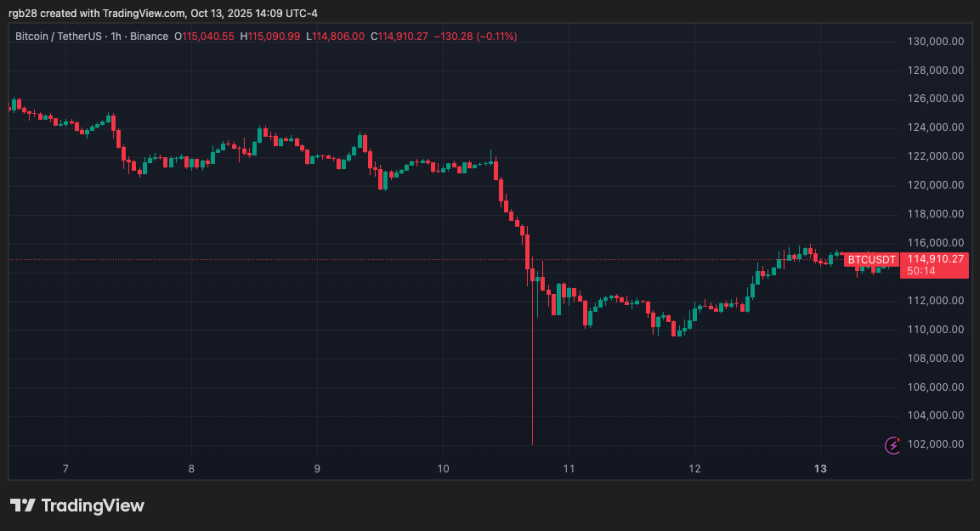
Bitcoin (BTC) trades at $114,910 in the one-week chart. Source: BTCUSDT on TradingView
Featured Image from Unsplash.com, Chart from TradingView.com
Editorial Process for bitcoinist is centered on delivering thoroughly researched, accurate, and unbiased content. We uphold strict sourcing standards, and each page undergoes diligent review by our team of top technology experts and seasoned editors. This process ensures the integrity, relevance, and value of our content for our readers.

Rubmar is a crypto enthusiast who likes learning and improving constantly. She enjoys reporting on the latest news and developments in the crypto industry. Rubmar also enjoys scrapbooking, crafting, simulation games, and watching football.

Related Reads

From Suppliers to Shareholders: The Big Three Memory Chip Giants Jointly Invest in Anthropic, AI Supply Chain Power Structure Undergoing Reshuffle

For the first time, memory chip giants Micron, Samsung, and SK hynix have jointly invested in the same AI company, Anthropic, as part of its massive $65 billion Series H funding round. This strategic move, positioning the three rival HBM suppliers as "strategic infrastructure partners," highlights a fundamental shift in the AI industry's power dynamics. With HBM (High Bandwidth Memory) being a critically scarce resource essential for AI model training and inference, securing a stable supply has become a key competitive differentiator. By making these chipmakers shareholders, Anthropic aims to lock in this vital component for its rapid expansion, which includes securing major compute commitments from Amazon, Google, and others. For the memory trio, this investment represents a strategic bet on defining the future of AI hardware. Each company gains: SK hynix reinforces its dominant position in the NVIDIA supply chain; Samsung diversifies its client base beyond NVIDIA; and Micron leverages its geopolitical significance as the sole US-based HBM maker. Their collective move signals that competition in AI is evolving beyond model capability to encompass control over the entire compute supply chain—from chips and memory to power and networking. This vertical integration trend, where infrastructure providers become direct stakeholders in AI firms, marks the industry's maturation as AI transforms from a research project into essential global infrastructure, setting the stage for a new era of ecosystem competition.

marsbit1h ago

From Suppliers to Shareholders: The Big Three Memory Chip Giants Jointly Invest in Anthropic, AI Supply Chain Power Structure Undergoing Reshuffle

marsbit1h ago

Investment Philosophy of Gavin Baker, an Early Nvidia Investor: Long AI Infrastructure Bottlenecks, Short Overall Market Risk

Gavin Baker, an early investor in Nvidia and founder of Atreides Management, outlines his investment philosophy: going long on AI infrastructure bottlenecks while hedging against broader market risk. He argues AI is not a bubble but a supercycle driven by constraints in power, wafers (semiconductors), and compute efficiency (tokens per watt). True alpha, he believes, lies not in application-layer companies like OpenAI but in "picks and shovels" providers—companies solving physical bottlenecks in GPU connectivity (e.g., Astera Labs), memory (Micron), inference chips (Cerebras, Positron), advanced manufacturing (TSMC, ASML), and energy supply. His portfolio reflects this barbell strategy: concentrated bets on key infrastructure players alongside a significant put position on the QQQ ETF to hedge overall market downside. Baker contends this cycle differs from the dot-com bubble because demand is fueled by the strong balance sheets of hyperscalers (Google, Meta, Amazon, Microsoft), not debt, and physical supply constraints (e.g., chip manufacturing capacity) prevent runaway overinvestment. He highlights the growing importance of inference (vs. pre-training), vertical/small language models, sovereign infrastructure deployment speed, and the convergence of energy and space (e.g., orbital compute). His long-term view is that performance-per-watt and token cost reduction will dictate winners as AI scaling hits fundamental physical limits.

marsbit2h ago

Investment Philosophy of Gavin Baker, an Early Nvidia Investor: Long AI Infrastructure Bottlenecks, Short Overall Market Risk

marsbit2h ago

Trading

Spot
Futures
活动图片