SWIFT Unveils Blockchain Ledger: 30+ Global Banks Back Push for 24/7 Cross-Border Payments

bitcoinistPublicado em 2025-09-30Última atualização em 2025-09-30

Resumo

Payments giant SWIFT is developing a blockchain-based ledger with 30+ top banks and Consensys, aiming to enable 24/7 cross-border payments....

Trusted Editorial content, reviewed by leading industry experts and seasoned editors. Ad Disclosure

Payments giant SWIFT is developing a blockchain-based ledger with 30+ top banks and Consensys, aiming to enable 24/7 cross-border payments.

SWIFT Is Working With 30+ Global Financial Institutions On A Blockchain Ledger

As revealed in a press release, SWIFT is planning to add a blockchain-based ledger to its infrastructure stack, in collaboration with a group of more than 30 major financial institutions. SWIFT, short for the Society for Worldwide Interbank Financial Telecommunication, is a Belgium-based cooperative that connects banks around the world with a secure messaging network for initiating international payments.

SWIFT covers more than 11,500 institutions across over 220 countries and territories, and facilitates an estimated $150 trillion in cross-border transactions every year. The payments messaging giant is now taking its infrastructure a step further with the integration of a ledger system based on the blockchain, the same underlying technology that powers cryptocurrencies like Bitcoin.

The goal behind the system is to provide real-time 24/7 cross-border payments. The press release noted that SWIFT has already begun working with major global banks to design and build the ledger, starting with a conceptual prototype by Consensys. Consensys, a blockchain software company founded by Ethereum co-founder Joseph Lubin, is best known as the developer of Metamask and a contributor to major ETH network upgrades.

SWIFT CEO Javier Pérez-Tasso said:

Through this initial ledger concept we are paving the way for financial institutions to take the payments experience to the next level with Swift’s proven and trusted platform at the centre of the industry’s digital transformation.

Currently, banks from 16 countries are providing feedback on the ledger system. Following successful development, SWIFT plans to work with its global community on implementation. Among the major institutions already on board are several Global Systemically Important Banks (G-SIBs), including JPMorgan Chase, Bank of America, and Citigroup.

Gayathri Vasudev, Global Head of Core Payment Rails at JP Morgan, the bank considered the most critical to global economic stability by the Financial Stability Board (FSB), said:

We look forward to engaging with this coalition to help evaluate a shared ledger designed for the next generation of global payments, leveraging our expertise to help advance instant, secure and efficient cross-border payments.

According to the press release, SWIFT will also add interoperability capabilities, allowing banks to seamlessly move between existing fiat rails and emerging systems.

The payments messaging platform added:

These developments are part of Swift’s overall strategy to power a best-in-class payments experience however value moves, with parallel tracks of innovation to upgrade the experience over existing ‘fiat’ rails, as well as to ready the industry for digital finance.

Bitcoin Price Has Made Some Recovery

Bitcoin ended last week with a plummet to lows, but the cryptocurrency appears to have kicked off Monday with another shift as its price has bounced back to $112,300.

Bitcoin Price Chart

The trend in the BTC price over the last five days | Source: BTCUSDT on TradingView

The rebound across Bitcoin and other digital assets has resulted in a significant amount of liquidations for bearish bets on derivatives exchanges.
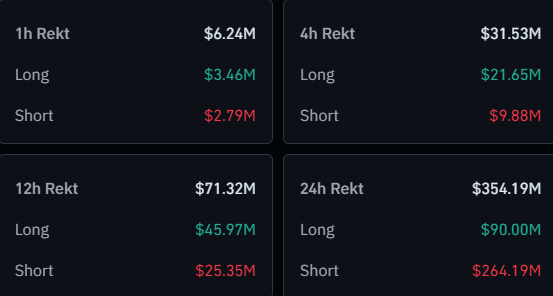
Bitcoin & Crypto Liquidations

The data for the liquidations that occurred over the past day | Source: CoinGlass
Featured image from Dall-E, CoinGlass.com, chart form TradingView.com
Editorial Process for bitcoinist is centered on delivering thoroughly researched, accurate, and unbiased content. We uphold strict sourcing standards, and each page undergoes diligent review by our team of top technology experts and seasoned editors. This process ensures the integrity, relevance, and value of our content for our readers.

Keshav is a Physics graduate who has been employed as a writer with Bitcoinist since June 2021. He is passionate about writing and through the years, he has gained experience working in a variety of niches. Keshav holds an active interest in the cryptocurrency market, with on-chain analysis being an area he particularly likes to research and write about.

Criptomoedas em alta

Leituras Relacionadas

Major Altcoin Market Players Did This During the Massive Rally!

As the cryptocurrency bull market intensifies, large-scale transactions by crypto 'whales' are drawing significant attention. Blockchain data reveals multi-million dollar positions opened and closed in Bitcoin ($BTC), Ethereum ($ETH), and Hyperliquid ($HYPE). A major investor, likely tied to Matrixport, closed a 40,000 $ETH long position worth ~$100.5M for a $9.9M profit. The investor still holds 80,000 $ETH (~$201M) and 500 $BTC (~$39M), with an unrealized profit of ~$22.9M. This turned their previous $92.5M total loss into an approximate $32.8M overall profit. On Hyperliquid, a trader known as loracle.hl reportedly lost over $70M trading $HYPE in the past three months. The investor currently holds ~$54.88M in $HYPE short positions, at risk of liquidation if $HYPE's price reaches $101.15. Notorious trader Machi Big Brother, who reportedly survived 500 liquidations, capitalized on the recent rally. He grew his portfolio from $152K to $12.72M in just three days, yielding over $12.5M in profit. While $HYPE hits a new all-time high, Multicoin Capital has deposited 427,422 $HYPE (~$31.74M) to Coinbase Prime over three days, raising speculation about a potential sale or portfolio rebalance. In Bitcoin markets, an anonymous whale stands out, selling ~2,700 $BTC (~$211.8M) in a recent transaction. Over three days, this whale sold a total of 7,700 $BTC, valued at approximately $576.6M.

cryptonews.ruHá 23m

Major Altcoin Market Players Did This During the Massive Rally!

cryptonews.ruHá 23m

Goldman Sachs' Summary After Silicon Valley Investigation: Agents Enter the Execution Era, AI Competition Shifts to Workflows, World Models Rise

Based on a recent field research in Silicon Valley, Goldman Sachs highlights a key shift in the AI industry: moving from systems that "answer questions" to autonomous AI agents that "execute tasks." Commercial models are transitioning from per-seat subscriptions to usage- and outcome-based pricing. The competition is shifting from raw model capability to mastery over specific business workflows, with value accruing to proprietary data, domain context, and operational expertise. A major hurdle for enterprise Agent deployment is not technical ability but "controllability"—issues of accountability, auditability, and error correction, especially in regulated fields. Workflows with clear rules, verifiable outcomes, and reversible actions (e.g., invoice processing) are being automated first. The model landscape is evolving toward a division of labor. Frontier models (like GPT-4) are expected to handle high-value, high-reliability core tasks, while improving open-source models will likely capture the majority (~90%) of inference tokens for standardized, high-volume tasks due to cost advantages. Finally, attention is moving from Large Language Models (LLMs) to "World Models," which understand physical environments, causality, and dynamic interactions. This shift elevates the importance of proprietary, real-world data (from industrial, scientific, and robotic systems) and could drive a second wave of compute demand. Goldman Sachs projects compute needs could grow ~24x over five years, benefiting cloud and infrastructure providers.

marsbitHá 1h

Goldman Sachs' Summary After Silicon Valley Investigation: Agents Enter the Execution Era, AI Competition Shifts to Workflows, World Models Rise

marsbitHá 1h

Fidelity Warns: The Boom in AI Agents May Not Be a Feast for Public Blockchains

Fidelity Digital Assets cautions that the anticipated boom in AI agents does not automatically guarantee a corresponding surge in public blockchain adoption or token value. While AI agents that can autonomously perform tasks like payments and data calls could theoretically utilize blockchain for settlement, a significant gap exists between "can use" and "must use." The analysis highlights six key risks. First, many AI agents, especially in corporate settings, may prefer closed, permissioned systems over public blockchains due to needs for speed, cost, compliance, and control. Second, increased on-chain transactions from AI-driven micropayments may not benefit native tokens if fees remain low or if value is captured by stablecoins and payment service providers instead. Third, while AI lowers development costs and increases the number of projects, more code does not equal more economic value and can lead to market oversaturation. Fourth, AI commoditizes coding, making pure technological advantage less of a sustainable moat; competition may shift to brand, liquidity, and user networks. Fifth, AI can also lower the cost of attacks by making vulnerability discovery easier, potentially outpacing security auditing and increasing ecosystem risk. Sixth, institutions may require "controlled blockchain" systems with robust identity, permissioning, and audit trails, conflicting with the permissionless nature of public chains. Ultimately, Fidelity argues against simply equating AI growth with blockchain prosperity. The narrative requires moving from speculation to a concrete analysis of which infrastructures can convert real AI agent needs into sustainable economic value, critically examining each step of the assumed value chain.

marsbitHá 1h

Fidelity Warns: The Boom in AI Agents May Not Be a Feast for Public Blockchains

marsbitHá 1h

Telegram Introduces WEB-Proxy Technology: Masks Traffic as Regular Website Visits

Telegram has introduced a new experimental WEB-Proxy technology designed to circumvent blocking by disguising messenger traffic as regular, secure website visits. Announced on August 21, 2026, the technology routes MTProxy data through an in-app WebView using HTTPS or WebSocket transport, making the data stream indistinguishable from legitimate web surfing. The core innovation is a multiplexed stream sent through a single WebView session. It uses special frame formats to pack multiple logical Telegram connections into one encrypted channel that externally resembles loading a web page. A server-side relay receives this stream, separates it into individual connections for the standard MTProxy, without decrypting content or knowing final destinations, thus preserving privacy. The WEB-Proxy operates on a standard HTTPS domain that also hosts a public website. The proxy bridge page is only activated by a specific URL parameter derived via HMAC-SHA256 from the proxy configuration; all other requests receive the normal site homepage. This provides reliable cover against automated detection systems. Currently a proof-of-concept, the system includes a desktop implementation, an experimental Android client, and plans for iOS support. The technology represents a shift towards more sophisticated integration with legitimate web infrastructure, complicating filtering systems that must choose between blocking HTTPS traffic entirely or allowing service access. Its long-term value will depend on resilience to adaptive traffic analysis and scalability without performance loss.

cryptonews.ruHá 1h

Telegram Introduces WEB-Proxy Technology: Masks Traffic as Regular Website Visits

cryptonews.ruHá 1h

Trading

Spot

Artigos em Destaque

Como comprar PUSH

Bem-vindo à HTX.com!Tornámos a compra de Push Protocol (PUSH) simples e conveniente.Segue o nosso guia passo a passo para iniciar a tua jornada no mundo das criptos.Passo 1: cria a tua conta HTXUtiliza o teu e-mail ou número de telefone para te inscreveres numa conta gratuita na HTX.Desfruta de um processo de inscrição sem complicações e desbloqueia todas as funcionalidades.Obter a minha contaPasso 2: vai para Comprar Cripto e escolhe o teu método de pagamentoCartão de crédito/débito: usa o teu visa ou mastercard para comprar Push Protocol (PUSH) instantaneamente.Saldo: usa os fundos da tua conta HTX para transacionar sem problemas.Terceiros: adicionamos métodos de pagamento populares, como Google Pay e Apple Pay, para aumentar a conveniência.P2P: transaciona diretamente com outros utilizadores na HTX.Mercado de balcão (OTC): oferecemos serviços personalizados e taxas de câmbio competitivas para os traders.Passo 3: armazena teu Push Protocol (PUSH)Depois de comprar o teu Push Protocol (PUSH), armazena-o na tua conta HTX.Alternativamente, podes enviá-lo para outro lugar através de transferência blockchain ou usá-lo para transacionar outras criptomoedas.Passo 4: transaciona Push Protocol (PUSH)Transaciona facilmente Push Protocol (PUSH) no mercado à vista da HTX.Acede simplesmente à tua conta, seleciona o teu par de trading, executa as tuas transações e monitoriza em tempo real.Oferecemos uma experiência de fácil utilização tanto para principiantes como para traders experientes.

764 Visualizações TotaisPublicado em {updateTime}Atualizado em 2026.06.02

Como comprar PUSH

Discussões

Bem-vindo à Comunidade HTX. Aqui, pode manter-se informado sobre os mais recentes desenvolvimentos da plataforma e obter acesso a análises profissionais de mercado. As opiniões dos utilizadores sobre o preço de PUSH (PUSH) são apresentadas abaixo.

活动图片