Bitcoin’s Global Adoption Will Explode Soon, With Bitcoin Hyper’s $18.6M Making Massive Gains

bitcoinistPublished on 2025-09-28Last updated on 2025-09-28

Abstract

Bitcoin’s global adoption numbers are about to explode, according to Jan3 founder Samson Mow. Mow’s statement came during an interview...

Trusted Editorial content, reviewed by leading industry experts and seasoned editors. Ad Disclosure

Bitcoin’s global adoption numbers are about to explode, according to Jan3 founder Samson Mow.

Mow’s statement came during an interview with What Bitcoin Did’s Danny Knowles, where he said that the current cycle is behind schedule and that we should’ve had a bull run by now.

He also said that the current bear cycle could expand into 2026, but that, eventually, we’ll get a massive push, driven by institutional FOMO:

I believe it’s simply a matter of time before we see a massive runup and we see a massive nation-state FOMO panic.

Samson Mow, What Bitcoin Did interview

Mow believes that Bitcoin’s growth is inevitable and it’s all due to US’s pro-crypto legislation, with the GENIUS Act at the core of it.

Bitcoin Hyper ($HYPER) will also contribute to Bitcoin’s long-term success. As Bitcoin’s Layer 2 upgrade, Hyper promises faster and cheaper transactions, making the Bitcoin network more feasible for institutional investors.

Bitcoin Flatlines at $109K as Talks of Global Adoption Ramp Up

Bitcoin has been flatlined at little over $109K for three days now and it shows no signs of recovery.

However, the fact that the downward momentum stopped, following the brutal dip after the last FOMC meeting is already bullish.

This hints at a consolidation period, which will likely ramp up during Q4, especially with more nation-states ramping up their hoarding.

As Mow was declaring back in March 2023, every nation state should have at least 200,000 $BTC in their treasuries. The argument was that it’s unacceptable that Strategy, with its reserve of 132,500 Bitcoins, dwarfs nation-states.

Samson Mow’s 2023 X post urging nation-states to buy more $BTC

The disparity has increased since then, with Strategy now holding 639,835 $BTC, valued at over $73B. According to data from Bitcoin Treasuries, this places it first on the list of companies with the largest Bitcoin reserves.

By comparison, the US currently holds 198,012 Bitcoins after selling 9,177 of them in December, 2024.

Fortunately, things are changing fast. A report by Fidelity Digital Assets titled ‘2025: Look Ahead’ stated that:

[…=] It may be too late for the speculators that want another frenzy. However, we believe we are still incredibly early in terms of this new era of sustainable adoption, diffusion, and integration.

Fidelity Digital Assets, 2023: Look Ahead

With Bitcoin still far from reaching its true potential, we also need to look at Bitcoin Hyper ($HYPER) and how it promises to change the Bitcoin ecosystem.

How Bitcoin Hyper Lifts Bitcoin to New Performance Standards

Bitcoin Hyper ($HYPER) aims to solve Bitcoin’s performance limitation, currently at seven transactions per second (TPS), and remove the fee-based priority system, which sometimes raises confirmation times to hours.

In its quest for a faster and cheaper Bitcoin network, Hyper relies on tools like Solana Virtual Machine (SVM) and the Canonical Bridge to improve scalability, lower finality times to seconds, and eliminate network congestion.

The Canonical Bridge is at the core of it, connecting Hyper to the Bitcoin ecosystem and minting the users’ tokens into Hyper’s Layer 2. The wrapped Bitcoins are available for use on Layer 2 indefinitely, or until users decide to withdraw them to Bitcoin’s native layer.

Together with the Bitcoin Relay Program, which verifies and confirms incoming transactions near instantly, the Bridge makes the Bitcoin network more responsive and performant for faster and cheaper transactions.
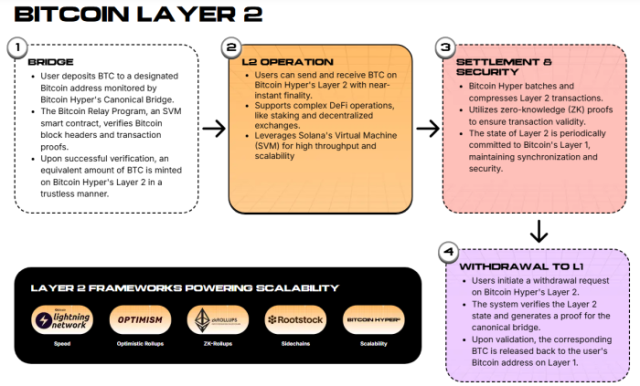
How Hyper’s Canonical Bridge works

This translates to sky-high scalability, which is the real prize. The increased scalability removes the fee-based priority system, which currently prioritizes larger and more fee-heavy transactions, with the smaller and cheaper ones often experiencing confirmation times of hours.

Long-term, Hyper plans to make Bitcoin a more feasible option for institutional investors and open the road to mainstream adoption.

The presale is growing fast, having raised over $18.6M so far with $HYPER valued at $0.012985.

Based on its utility and long-term roadmap, $HYPER could reach $0.32 by the end of the year. Our five-year price prediction for $HYPER is $1.50, given successful implementation and community support.

If you want to invest, learn how to buy $HYPER here, then go to the presale page and get your tokens today. Based on the presale numbers, we believe $HYPER to be the best crypto to buy in 2025.

This isn’t financial advice. Do your own research (DYOR) and invest wisely.

Authored by Patru Bogdan, Bitcoinist: https://bitcoinist.com/global-bitcoin-adoption-ramps-up-as-bitcoin-hyper-makes-big-gains

Editorial Process for bitcoinist is centered on delivering thoroughly researched, accurate, and unbiased content. We uphold strict sourcing standards, and each page undergoes diligent review by our team of top technology experts and seasoned editors. This process ensures the integrity, relevance, and value of our content for our readers.

As a crypto writer, Bogdan’s responsibilities are split between researching and writing articles and entertaining the team with his humor bordering on the politically incorrect, an aspiring Bill Burr, if you will. Thanks to his 12+ years of writing experience in just as many fields, including tech, cybersecurity, modelling, fitness, crypto, and other topics-that-shall-not-be-named, he's become a genuine asset to the team. While his position as a senior writer at PrivacyAffairs thought him valuable lessons about the power of self-management, his entire writing career was and is an exercise in self-improvement. Now, he's ready to sink his teeth into crypto and teach people how to take control of their own money on the blockchain. With fiat as an eternally devaluing currency, Bitcoin and altcoins seem like the best-fitting alternative for Bogdan. Bogdan’s biggest professional accomplishment, aside from securing a position as a main writer for Bitcoinist, was his 5-year run as a writing manager at Blackwood Productions, where he coordinated a team of four writers. During that time, he learned the value of teamwork and that of creating a working environment that breeds efficiency, positivity, and friendship.

Trending Cryptos

Related Reads

Deep Insight: Decentralized Inference is Not Hype, but a Key Track for AI to Break Through Centralized Monopoly

Decentralized Reasoning: Beyond the Hype, a Key to Breaking AI's Centralized Monopoly A future scenario where a powerful AI model is banned by a major government illustrates the core value proposition of decentralized AI: resistance to censorship. The core bet of decentralized inference networks is mitigating this risk, with other benefits like cost being secondary. The path is extremely difficult, involving four key challenges: 1. **Running Massive Models:** Distributing a single model across a decentralized GPU swarm requires sophisticated techniques like pipeline and speculative decoding to overcome crippling network latency, aiming for usable speeds (e.g., 30-40 tokens/second). 2. **Proving Model Integrity:** Verifying that a node runs the correct model is critical. Solutions range from cryptographically secure but slow ZKML to faster, economically-secure methods like statistical fingerprints, deterministic re-execution, or live-weight proofs, each involving trade-offs between integrity, latency, and cost. 3. **Ensuring Prompt Privacy:** Simply sharding a model does not protect user inputs from nodes. Robust solutions currently require trusted hardware (TEEs) or advanced cryptography (FHE), which are not yet widely deployed in consumer swarms. 4. **Building a Real Market:** Identifying the ideal customer is tough. Beyond speculative AI agents, the viable market currently consists of startups embedding AI and projects needing batch processing (e.g., synthetic data generation), where decentralized aggregation can be an advantage over low-latency needs. The article analyzes several projects tackling these problems, such as Dolphin Network (live-weight proofs), Inference.net (statistical verification), Morpheus (TEE-based), and Darkbloom (Apple Secure Enclave). It provides a framework: decentralization is a "tax" for latency-sensitive applications (e.g., chat) but a potential supply-side advantage for throughput-oriented tasks (e.g., batch processing). The long-term vision is a closed data loop where decentralized inference generates valuable data (traces, preferences) to feed decentralized training networks, which in turn produce better open-weight models for the inference networks. A due diligence checklist advises focusing on projects that: are truly decentralized at specific layers; have a credible integrity method; offer real cost benefits; ensure genuine privacy; handle node reliability; have paying users; and are built by teams with deep AI expertise. The ultimate goal should be products that appeal beyond the crypto-native audience, using crypto mechanisms invisibly to deliver better cost, performance, or privacy.

Foresight News28m ago

Deep Insight: Decentralized Inference is Not Hype, but a Key Track for AI to Break Through Centralized Monopoly

Foresight News28m ago

The Final Piece of Franklin Templeton's Crypto Ambition

Franklin Templeton Completes Crypto Ambition with Acquisition of 250 Digital On June 22, Franklin Templeton announced the acquisition of 250 Digital and established Franklin Crypto, a new division focused on actively managed cryptocurrency strategies for institutional investors. The unit is led by Christopher Perkins and Seth Ginns. This acquisition marks a key piece in Franklin Templeton's multi-year crypto strategy, which began in 2018 with a digital assets team. The firm's crypto product suite now spans three layers: tokenized funds like the blockchain-based money market fund BENJI (~$831M AUM); a series of passive ETFs including Bitcoin (EZBC, ~$368M), Ethereum (EZET), XRP (XRPZ, ~$252M), Solana (SOEZ), and a multi-crypto index fund (EZPZ); and the newly added active management strategies from Franklin Crypto. The company has also expanded its crypto ecosystem through investments in projects like Ethena and Crossmint, and collaborations with blockchains such as Aptos and Sui. With approximately $18B in digital asset AUM and a total firm AUM of ~$1.78T, Franklin Templeton is positioning itself as a comprehensive crypto asset manager for pensions and sovereign wealth funds. In contrast, competitor Fidelity Investments has taken a different path, focusing early on building its own custody and trading infrastructure. Fidelity's Bitcoin ETF (FBTC) holds over $11B, significantly larger than Franklin Templeton's equivalent offering. Both giants' moves underscore the deepening trend of traditional finance entering the crypto space.

Foresight News52m ago

The Final Piece of Franklin Templeton's Crypto Ambition

Foresight News52m ago

Trading

Spot
Futures

Hot Articles

Discussions

Welcome to the HTX Community. Here, you can stay informed about the latest platform developments and gain access to professional market insights. Users' opinions on the price of S (S) are presented below.

活动图片