Палата представителей США добавила запрет на CBDC в масштабный законопроект об оборонной политике

cryptonews.ruPublished on 2025-04-21Last updated on 2025-08-22

Палата представителей США добавила положение, запрещающее Федеральному резерву выпускать цифровую валюту центрального банка (CBDC), в почти 1300-страничный законопроект, определяющий оборонную политику страны на 2026 финансовый год.

В четверг Комитет по регламенту Палаты представителей опубликовал новую редакцию законопроекта HR 3838, вступающего в силу в Палате представителей и предусматривающего введение Закона о национальной обороне. В него были включены положения, запрещающие Федеральному резерву изучать или создавать цифровую валюту.

В июле Палата представителей приняла аналогичный законопроект, поддержанный республиканцами, — Закон о государственном надзоре за использованием цифровых валют центрального банка (Anti-CBDC Surveillance State Act), — с небольшим перевесом голосов (219 «за» и 210 «против»). Теперь его будущее в Сенате неопределенно.

Закон о национальной обороне и связанные с ним законопроекты об ассигнованиях рассматриваются как обязательные к принятию законодательные акты в сфере национальной безопасности, поскольку они определяют, как будут финансироваться военные и как будут расходоваться бюджетные средства.

Для законодателей типично добавлять положения, не связанные с обороной, которые в противном случае могли бы быть приостановлены или существенно пересмотрены, если бы были приняты в качестве отдельного законопроекта.

Лидеры Палаты представителей пообещали запретить CBDC в законопроекте об обороне

Топовые республиканцы Палаты представителей пообещали включить запрет CBDC в обязательный для принятия законопроект о военных расходах в рамках соглашения с консервативными сторонниками жесткой линии в июле.

Группа республиканцев, не согласных с принятием законопроекта, отказалась продвигать три законопроекта о криптовалютах, если не будет гарантировано принятие запрета CBDC, что привело к затягиванию голосования и началу дебатов по законопроектам, которые длились более девяти часов — самых длительных в истории Палаты представителей.

В то время принятие Палатой представителей законопроекта о запрете CBDC само по себе считалось маловероятным из-за отсутствия поддержки. Дебаты по законопроектам в конечном итоге продвинулись после того, как лидер большинства в Палате представителей Стив Скалисе заявил, что запрет CBDC будет добавлен к Закону о национальной обороне.
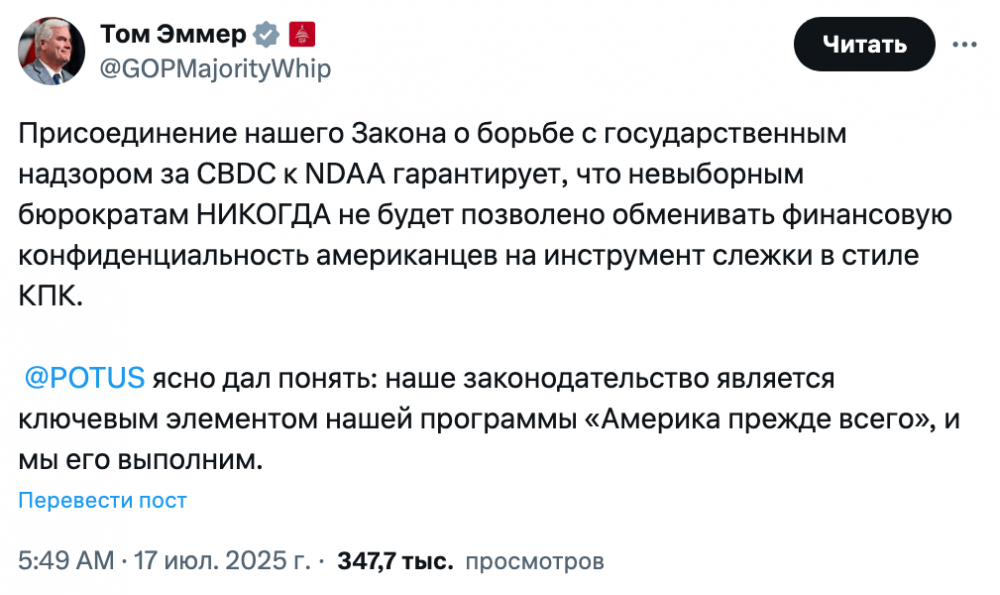

Источник: Том Эммер

Позже Палата представителей приняла законопроект о запрете CBDC с небольшим перевесом, и теперь его будущее в Сенате неопределенно.

Это положение запретит выпуск цифровой валюты ФРС

Положение законопроекта об оборонной политике запретит ФРС выпускать любую цифровую валюту или актив, а также не позволит центральному банку предлагать финансовые продукты или услуги напрямую физическим лицам.

В нем также говорится, что центральный банк не может «тестировать, изучать, разрабатывать, создавать или внедрять» цифровую валюту или актив, но допускает исключение для стейблкоинов, указывая, что законопроект не запрещает «любую валюту, номинированную в долларе, которая является открытой, не требующей разрешения и частной».

Законопроект о CBDC был отклонен в прошлом Конгрессе

Республиканцы в Палате представителей уже некоторое время пытаются запретить CBDC.

Лидеры партии в Палате представителей стремились принять законопроект о запрете CBDC на последней сессии Конгресса.

Законопроект с аналогичным названием, «Закон о борьбе с государственным надзором за CBDC», был внесен членом Палаты представителей Томом Эммером в начале 2023 года, но не получил дальнейшего развития и был отклонен Конгрессом предыдущего созыва.

Эммер вновь внес законопроект в нынешний Конгресс, и республиканцы поддержали эту инициативу, поскольку она соответствует указу президента Дональда Трампа, изданному в январе и запрещающему CBDC.
Related Reads

Report Interpretation: J.P. Morgan Details Micron's Pre-Earnings Sentiment, Current Hardware Sector Dynamics

Morgan Stanley analyst Joshua Meyers' report (June 21, 2026) highlights key trends in the hardware and semiconductor sector ahead of Micron's earnings. The core takeaways are: 1. **Micron & Memory:** Memory remains a high-conviction long theme, driven by strong AI demand and rising ASPs. However, investor focus is shifting to the sustainability of Micron's >80% gross margins and the specifics of potential new long-term supply agreements (SCAs). 2. **Hardware Supply Chain:** AI-related demand for servers, networking, and storage remains robust, but company performance is diverging. Celestica (CLS) shows improved margin confidence, Western Digital and Seagate benefit from pricing, Fabrinet (FN) sees predictable AI optics growth, and Teradyne (TER) anticipates a new Google customer. 3. **AI Capex & WFE Forecasts:** JPMorgan increased its Wafer Fab Equipment (WFE) market growth forecasts to 28% in 2026 and 29% in 2027. AI infrastructure financing is evolving, with higher project-level debt reducing constraints on capex expansion. The report signals that while the AI-driven hardware cycle is strong, the market is entering a phase focused on execution verification (e.g., Micron's SCA details, Fabrinet's ramp with Amazon) and valuation sustainability. Key near-term signals include Micron's guidance, Arista Networks' outlook, and the pace of demand normalization post potential tariff-related pull-ins.

marsbit6h ago

Report Interpretation: J.P. Morgan Details Micron's Pre-Earnings Sentiment, Current Hardware Sector Dynamics

marsbit6h ago

Research Report Analysis: The Fed's New Chair's Debut – New Leader, But Same Script?

Report Analysis: Federal Reserve's New Chair Debut – A New Captain, But the Same Script? Morgan Stanley's chief global economist Seth B. Carpenter analyzes the first FOMC meeting under new Fed Chair Kevin Warsh in a June 21 report. Warsh deliberately avoided providing forward guidance on interest rates, aligning with his philosophy. However, market expectations for a rate hike this year were reinforced. Key signals lie elsewhere: inflation may fall more than expected, and quantitative tightening (QT) could be more aggressive than anticipated. The FOMC's "dot plot" suggests only one rate hike in 2026. Carpenter argues that if inflation undershoots forecasts, the logic for even a single hike weakens, especially as projections indicate potential rate cuts in 2027. On QT, Warsh's stance is clear. Carpenter notes that measures like halving the Treasury's account balance could shrink the Fed's balance sheet by around $500 billion with minimal market impact. Combined with adjustments to reserve interest and liquidity rules, the ultimate QT scale may exceed expectations, though its market effect might be less disruptive unless the Fed actively sells Mortgage-Backed Securities (MBS). While Warsh initiated a review of the Fed's policy framework, the 2% inflation target remains intact for now. The report concludes that the market may be overestimating the significance of reduced forward guidance and the near-term rate hike risk, while potentially underestimating the scope and manageable nature of the coming balance sheet reduction. The key debates will hinge on upcoming core PCE data, the specifics of the QT path, and the framework review's findings.

marsbit6h ago

Research Report Analysis: The Fed's New Chair's Debut – New Leader, But Same Script?

marsbit6h ago

Critical Game Week: BTC Retracement Confirmation vs. HYPE Support Battle | Guest Analysis

This weekly analysis outlines a critical juncture for BTC and HYPE markets, focusing on key price level confirmations. **BTC Analysis:** BTC is at a pivotal point after a five-wave rally from the June 5th low of $59,100. The price has broken below a short-term rising channel's lower boundary, with the current move seen as a pullback to test this breakdown. Failure to reclaim this level could lead to a retest of the $59,000-$60,000 support zone. The core scenario hinges on this channel retest outcome. * **Key Levels:** Resistance at $64,500-$65,000 (channel boundary) and $69,500-$70,500. Support at $59,000-$60,000 and $55,000. * **Strategy:** A core bearish stance is maintained (20% short from last week), with short-term plans for tactical trades. Three detailed contingency plans (A/B/C) are provided for short positions on resistance tests or breakdowns, emphasizing strict stop-loss discipline. **HYPE Analysis:** HYPE shows strong momentum but is currently in a corrective phase after hitting a new high of $76.94. The price is retesting the crucial $64-$66 support area. * **Key Levels:** Resistance near $77 and $80-$82. Support at $64-$66 and $52-$54. * **Strategy:** The short-term approach is "buy on dips, avoid chasing rallies." A long position is considered only if clear stabilization signals appear at the $64-$66 or deeper $52-$54 support zones, with tight risk controls. **General Risk Management:** A standardized trailing stop-loss protocol is emphasized: set initial stop, breakeven at +1% profit, then trail stops upward to lock in gains. *Disclaimer: All analysis is presented as a personal trading framework, not investment advice. Market conditions are complex and require dynamic adjustment.*

marsbit6h ago

Critical Game Week: BTC Retracement Confirmation vs. HYPE Support Battle | Guest Analysis

marsbit6h ago

Trading

Spot
Futures
活动图片