Правила Базельского комитета создают «узкое место» для криптовалют

cryptonews.ruPublicado a 2025-03-17Actualizado a 2025-08-18

Действующие требования к резервированию капитала делают хранение криптовалют слишком затратным для банков, что сдерживает развитие сектора.

Крис Перкинс, президент инвестиционной компании CoinFund, заявил, что нормативы Базельского комитета по банковскому надзору (BCBS), разрабатывающего международные банковские стандарты, формируют искусственное «узкое место», ограничивающее рост криптоиндустрии.

По его словам, текущие правила снижают рентабельность собственного капитала (ROE) банков — ключевой показатель прибыльности в этой сфере. Это происходит из-за повышенных требований к резервам при работе с криптовалютами, что делает такую деятельность экономически невыгодной.

«Это скрытое узкое место, поскольку оно действует не напрямую. Это изощренный способ подавления активности: банки просто отказываются от операций, которые становятся для них слишком дорогими», — пояснил Перкинс.

«Если у меня есть капитал для инвестиций, я вложу его в активы с высокой, а не низкой доходностью», — добавил он.

В апреле Перкинс раскритиковал Банк международных расчетов (БМР) за предложение распространить правила «Знай своего клиента» (KYC) и другие устаревшие банковские нормы на протоколы децентрализованных финансов (DeFi) и стейблкоины. По его мнению, это противоречит фундаментальным принципам публичных блокчейн-сетей.

«Реальный системный риск исходит из асимметрии: публичные децентрализованные сети работают круглосуточно, обеспечивая мгновенные расчеты, тогда как традиционная финансовая инфраструктура отключается по ночам и выходным, отказываясь адаптироваться к технологиям», — подчеркнул он.

Банк международных расчетов сохраняет жесткую позицию против криптовалют

БМР, выполняющий функции центрального банка для национальных регуляторов и координирующий работу BCBS, в апрельском докладе утверждал, что криптовалюты угрожают стабильности финансовой системы.

Авторы документа также связали рост крипторынка с увеличением разрыва в благосостоянии и призвали к усилению государственного контроля.

В июне БМР опубликовал новый отчет — «Рост стейблкоинов: вызовы и политические подходы». В нем утверждается, что стейблкоины не могут считаться деньгами и несут системные риски.

«Рыночная капитализация стейблкоинов и их интеграция с традиционными финансами достигли уровня, когда негативные последствия для системы уже неизбежны», — говорится в докладе.

БМР последовательно продвигает цифровые валюты центральных банков (CBDC) и другие централизованные решения как альтернативу частным и децентрализованным криптовалютам.
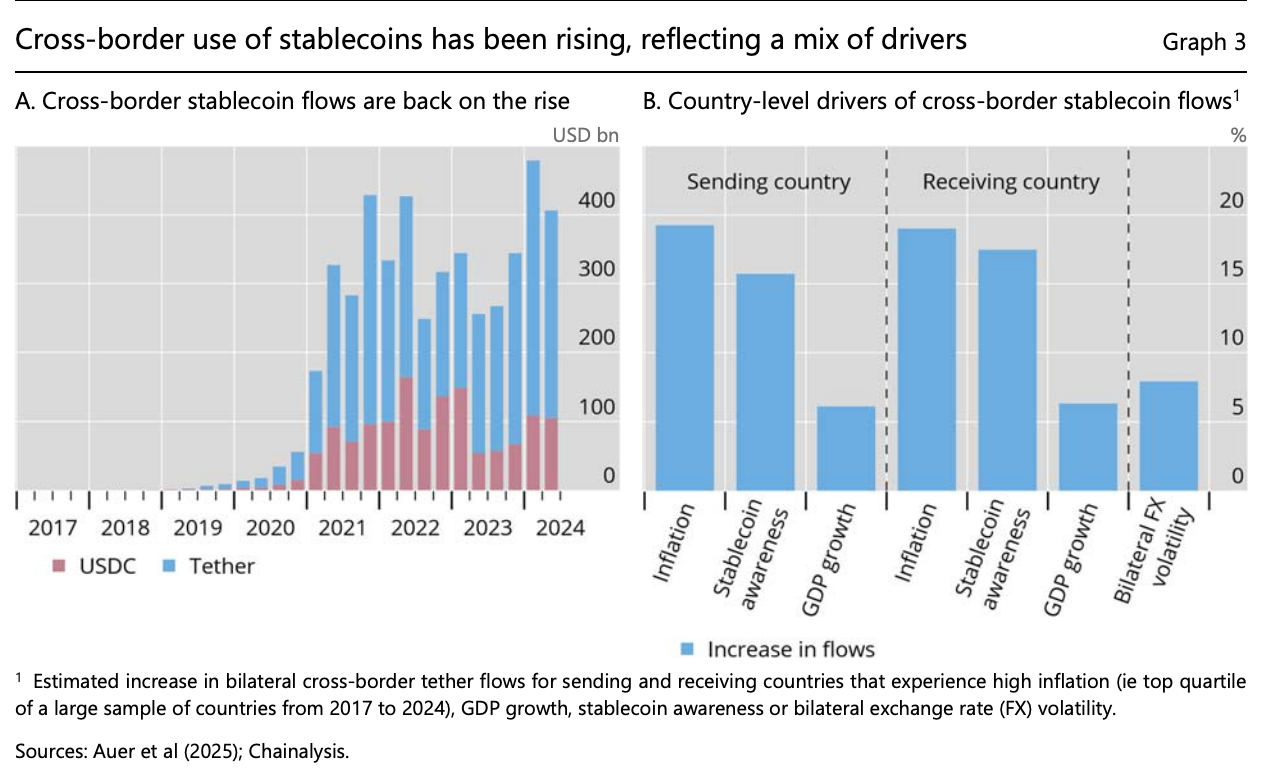

Трансграничное использование стейблкоинов расширяется. Источник: BIS

Lecturas Relacionadas

Arthur Hayes Ten Thousand Words Interview: ETH to $30,000; FLOP Will Surpass ETH

Arthur Hayes Interview Summary: In a wide-ranging interview, Arthur Hayes discusses macroeconomic drivers for crypto, bullish predictions for ETH and BTC, and details his new project, Flop Network. On Macroeconomics & Market Outlook: Hayes argues that unsustainable US debt and potential Yield Curve Control (YCC) will drive massive liquidity into hard assets like Bitcoin. He views recent Treasury bond回购 operations as a key signal, comparing the current environment to the 2008 financial crisis that birthed Bitcoin. He predicts Bitcoin will break its all-time high, reaching around $126,000 by year-end, and could soar to $500,000 if the Fed removes limits on its FEMA repo facility. On Ethereum & Altcoins: Hayes is particularly bullish on ETH, calling it his top large-cap altcoin pick. He believes it will significantly outperform in this cycle, potentially reaching $20,000-$30,000, as it hasn't yet broken its 2021 high unlike other major assets. He values ETH for its established developer community and Lindy effect. On Regulation: He dismisses the US Clarity Act as irrelevant for crypto's core value proposition, stating that macroeconomic liquidity, not regulation, is the primary driver. On Flop Network: Hayes unveils his new project, Flop Network, designed to be a native currency for the AI Agent economy. The core thesis is that AI Agents need a货币 that can be directly converted into compute power (measured in FLOPs - Floating Point Operations). The network will use a "Proof of Useful Inference" consensus where miners earn FLOP tokens for processing AI推理 tasks. It will also provide decentralized storage for AI memory/context. The token will be distributed via a massive airdrop (targeting 20% of the 10-year supply) to early testnet participants and users, with no VC预售 or public sale. Mainnet is slated for Q1 2025. Hayes believes FLOP has a "binary" outcome: it could become the base money for the AI economy and rival Bitcoin, or it could fail.

Odaily星球日报Hace 18 min(s)

Arthur Hayes Ten Thousand Words Interview: ETH to $30,000; FLOP Will Surpass ETH

Odaily星球日报Hace 18 min(s)

Goldman Sachs Research Report Analysis: Samsung Electronics' Shareholder Returns Fall Short of Expectations, FCF Expansion Supports Valuation Recovery

Gold Sachs research report analysis indicates Samsung Electronics' announced shareholder return pool for 2026 (projected 90-110 trillion KRW) fell short of market expectations for a larger one-time payout. However, Goldman emphasizes that sustained Free Cash Flow (FCF) expansion and a stable, phased return mechanism are the true drivers for valuation repair, not a single event. The report maintains a Buy rating on Samsung ordinary shares with a 740,000 KRW target price, implying 74% upside. Samsung plans a ~30 trillion KRW dividend in Q3 2024, with the remaining returns from the 2026 pool executed post-January 2027 earnings via dividends and share buybacks/cancellations. Goldman estimates 2024-2026 cumulative FCF at ~270 trillion KRW. Assuming a 50% return ratio, total shareholder returns would be ~135 trillion KRW. After accounting for 2024-2025 payouts, the 2026 return is estimated near 106 trillion KRW, at the high end of guidance. While Samsung's short-term return scale lags peers like SK Hynix, its future return capacity is underpinned by robust FCF growth from memory and HBM businesses. Goldman forecasts FCF will significantly rise in 2027-2028, potentially boosting annual return pools to 179 trillion and 232 trillion KRW respectively under the existing policy, potentially matching or exceeding peers. Samsung's current valuation (1.7x P/B for 2027) is seen as attractive given high ROE projections (40%-50%). The core thesis is that Samsung's shareholder return story represents a structural improvement based on durable cash flow generation, not a one-time event.

marsbitHace 25 min(s)

Goldman Sachs Research Report Analysis: Samsung Electronics' Shareholder Returns Fall Short of Expectations, FCF Expansion Supports Valuation Recovery

marsbitHace 25 min(s)

Trading

Spot
活动图片