SEC acknowledges Grayscale Solana ETF filing in ‘notable’ step

CointelegraphPublished on 2025-02-07Last updated on 2025-02-07

Abstract

It’s one more development reflecting a change in approach from the US Securities and Exchange Commission toward crypto.

The US Securities and Exchange Commission has made a “notable” step toward approving spot Solana exchange-traded funds in the US after acknowledging Grayscale’s amended application — in what analysts say is a first for SOL ETFs.

“This is actually newsworthy because the SEC had refused to do this in recent filing attempts for SOL,” Bloomberg ETF analyst James Seyffart said of Grayscale’s Feb. 6 amended 19b-4 filing for a spot Solana ETF.

Fellow Bloomberg ETF analyst Eric Balchunas said it was a “notable” development, adding: “We are now in new territory, albeit just a baby step, but seemingly the direct result of leadership change.”

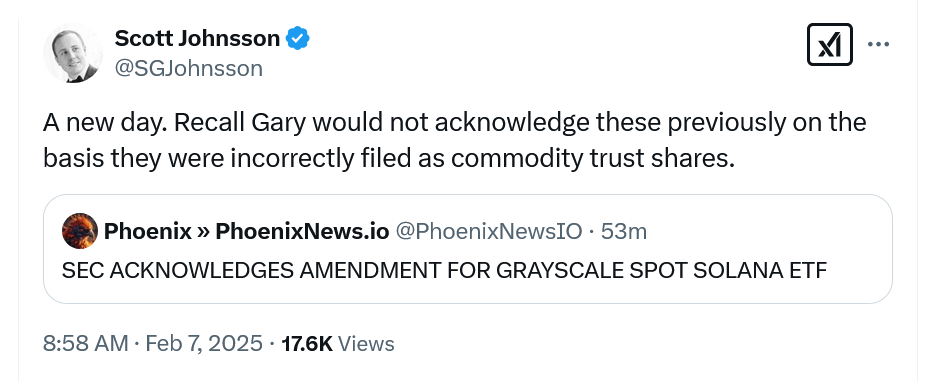
The SEC reportedly refused these spot Solana ETFs under Gensler’s watch because they believed they were incorrectly filed as commodity trust shares, finance lawyer Scott Johnsson explained.
In January, Seyffart said it may take until 2026 for the SEC to approve a spot Solana ETF, and that the review process was further complicated by ongoing lawsuits against the likes of Binance and Coinbase, which alleges SOL constitutes an unregistered security.

“The SEC’s Division of Enforcement is calling Solana a security, which prevents other SEC divisions from analyzing it for a commodities ETF wrapper,” Seyffart said at the time.

The final deadline for Grayscale’s spot Solana ETF application is now around Oct. 11, Seyffart said.

A spree of crypto ETF filings has hit the SEC’s desk over the last few weeks as ETF issuers test which products could be approved under the Mark Uyeda-led SEC.

21Shares, Bitwise, VanEck and Canary Capital are also in the running to list spot Solana ETF after Cboe BZX Exchange refiled 19b-4s on their behalf on Jan. 28, while Bitwise even proposed to list a spot Dogecoin ETF on the same day.

Cboe BZX also filed forms for Canary Capital, WisdomTree, 21Shares and Bitwise to list a spot XRP ETF in the US on Feb. 6.

Litecoin still looks like it’s next in line

The SEC on Feb. 6 acknowledged Grayscale’s 19b-4 filing to list a spot Litecoin ETF, which Seyffart believes is next in line to win SEC approval, following Bitcoin and Ethereum.

The Bloomberg ETF analysts hold this view because Canary’s S-1 filing for a spot Litecoin ETF is already being actively reviewed by the regulator, while applicants for other crypto ETFs have been slower to submit their S-1s.

Financial services firm JPMorgan estimated an approved spot Solana ETF could attract between $3 billion and $6 billion in net assets over the first year — a prediction Balchunas said was a fairly “reasonable guess.”

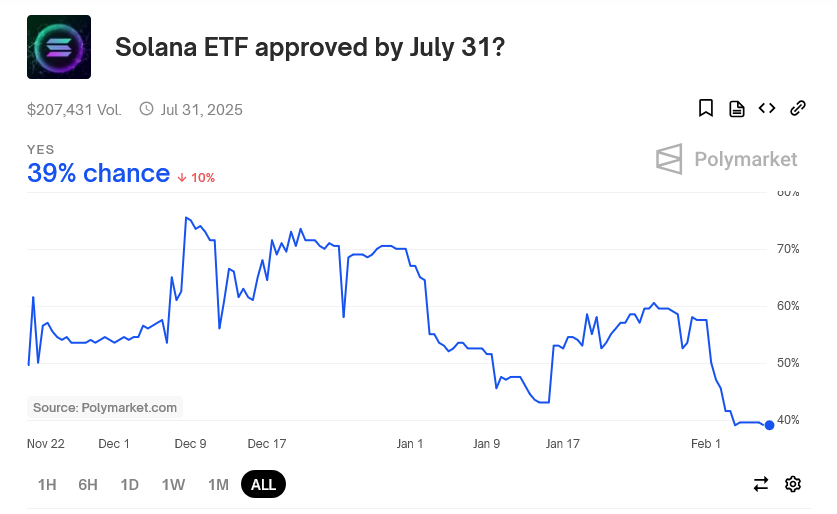
Predictions market platform Polymarket estimates there’s a 39% chance that a spot Solana ETF will be approved by the SEC before July 31.

Related Reads

DeepSeek Announces Permanent Price Cut, But Liang Wenfeng Is Not Trying to Be a "Cyber Bodhisattva"

DeepSeek has announced a permanent 75% discount on its V4-Pro API, significantly reducing its token prices. This move stands out as a major industry-wide price cut while competitors like Anthropic, OpenAI, and Google have been quietly raising theirs. The article contrasts this strategy with the broader trend of AI becoming more expensive, citing examples of companies like Microsoft and Uber struggling with high token costs as usage soars. While CEO Liang Wenfeng is hailed by some as a "Cyber Bodhisattva" for this普惠 approach, the article argues this is a strategic business choice, not mere altruism. DeepSeek's ability to maintain low prices is attributed to several structural advantages: lower-cost AI talent in China, the impending use of domestic昇腾 hardware for further cost reductions, and, most critically, access to China's cheaper and more abundant energy infrastructure, which drastically reduces the electricity costs dominating AI operations. The analysis suggests that for many commercial applications, a "good enough" model that is radically cheaper (e.g., 1% to 11% of GPT-5.5's cost) is more valuable than the absolute top-tier model. This allows for vastly more experimentation and iteration within a budget. Therefore, as AI generally becomes more expensive, DeepSeek's cost-competitiveness—rooted in China's energy and talent advantages—becomes its core strategic value and differentiator in the global market.

marsbit3h ago

DeepSeek Announces Permanent Price Cut, But Liang Wenfeng Is Not Trying to Be a "Cyber Bodhisattva"

marsbit3h ago

The Veil of Mythos Becomes Anthropic's Lever to Move Trillions

The article discusses Anthropic's reported upcoming $30 billion funding round, which would value the company at over $900 billion. It analyzes how the company has leveraged strategic narratives around its unreleased "Mythos" model, rather than just its publicly available products, to drive this massive valuation. Key points include Google's surprising $40 billion investment in a competitor, suggesting it is buying strategic positioning. Anthropic's "Glasswing" cybersecurity project and the unreleased Mythos model are portrayed not through direct proof, but through carefully crafted narratives of being "too powerful for public release," creating an aura of exclusive, high-level capability. This is bolstered by reports of the White House and NSA seeking access to Claude/Mythos despite previous security concerns, implying indispensable technology. Furthermore, Anthropic's reported rapid revenue growth—from a $1 billion annual run-rate in late 2024 to over $30 billion by April 2026, largely driven by enterprise API and Claude Code—provides a financial story for investors. The article concludes that Anthropic's core business model is effectively converting unverifiable technical potential, government interest, and future revenue projections into a compelling narrative that secures immense capital, using the actions of wealthy investors and powerful institutions as the ultimate validation of its worth.

marsbit5h ago

The Veil of Mythos Becomes Anthropic's Lever to Move Trillions

marsbit5h ago

Google CEO Admits Lagging Behind in Coding

Google CEO Sundar Pichai acknowledged in a recent interview that Google's Gemini AI models are currently "lagging behind" in coding capabilities, particularly for complex, long-horizon tasks requiring advanced developer expertise. He noted the field is advancing at an "unprecedented" pace, where 30-60 days now brings changes equivalent to five years in the past. Pichai expressed that achieving Artificial General Intelligence (AGI) now seems closer than previously imagined due to rapid progress. While highlighting strengths in text, multimodal, and reasoning tasks, Pichai admitted competitors like Anthropic and OpenAI have focused more intently on coding. He emphasized Google's commitment to catching up, citing internal tools like Antigravity 2.0 and the newly released Gemini 3.5 Flash, which aims to address previous shortcomings. Regarding Google Search's AI-driven overhaul, Pichai stated changes will be gradual to align with user needs, not disrupt the core search experience or its advertising model. He addressed public AI anxiety as understandable, given the technology's potential to reshape jobs and society, but remained optimistic about AI augmenting human capabilities and creating new opportunities. Pichai stressed the need for broad societal dialogue and responsible development as AI approaches more advanced, potentially recursive self-improvement stages. He affirmed Google's long-term commitment to leading in AI while navigating its profound implications responsibly.

marsbit7h ago

Google CEO Admits Lagging Behind in Coding

marsbit7h ago

Trading

Spot
Futures

Hot Articles

Discussions

Welcome to the HTX Community. Here, you can stay informed about the latest platform developments and gain access to professional market insights. Users' opinions on the price of SOL (SOL) are presented below.

活动图片