Ethereum 2.4-Year Average Holding Time Signals Confidence From Long-Term Holders – Details

bitcoinistPublished on 2025-02-02Last updated on 2025-02-02

Abstract

Ethereum (ETH) has surged from $3,050 to $3,400 in less than three days, igniting fresh optimism among investors who believe...

Ethereum (ETH) has surged from $3,050 to $3,400 in less than three days, igniting fresh optimism among investors who believe ETH is poised for significant gains this year. After weeks of uncertainty and selling pressure, Ethereum’s latest price action has renewed bullish sentiment, with analysts predicting further upside.

Key on-chain metrics from IntoTheBlock support this outlook, revealing that Ethereum has an average holding time of 2.4 years, signaling strong confidence from long-term holders. This data suggests that despite short-term volatility, Ethereum investors remain committed, reinforcing the idea that ETH could see a sustained rally as market conditions improve.

With bullish momentum building, all eyes are now on critical resistance levels, which, if broken, could push Ethereum toward multi-month highs. However, investors remain cautious, as Ethereum still needs to reclaim its previous all-time highs to fully confirm a new bullish phase. The coming weeks will be crucial in determining whether ETH can maintain its uptrend and outperform the broader market in 2024.

Ethereum Faces Uncertainty But LTHs Show Confidence

Ethereum has been in a persistent downtrend since late December, with its price falling over 28% from local highs of $4,100. Compared to Bitcoin’s performance, ETH has underwhelmed investors, leading to speculation that 2024 could be another “bad year” for the second-largest cryptocurrency.

Despite these concerns, on-chain data from IntoTheBlock suggests a different outlook. Metrics reveal that Ethereum’s average holding time is 2.4 years, highlighting strong confidence from long-term holders. This indicates that despite the current price struggles, ETH investors continue to accumulate and hold, anticipating future gains.

Ethereum Holders by Time held | Source: IntoTheBlock on X

However, Ethereum’s growth potential appears somewhat tempered as Layer 2 solutions (L2s) and alternative Layer 1 (L1) blockchains continue to fragment attention and adoption. Newer investors and developers are exploring competing ecosystems, leading to a lack of fresh short-term participants in ETH’s network. This shift has created uncertainty around whether ETH can maintain its dominant position in the altcoin space.

The coming weeks will be crucial for ETH, as February has historically been a bullish month for the asset. If Ethereum can reclaim key resistance levels and attract new demand, a reversal could be on the horizon, offering investors renewed confidence in its long-term potential.

ETH Price Outlook: Key Levels To Watch

Ethereum (ETH) is currently trading at $3,320 after a volatile Friday that saw the price surge to $3,448 before retracing below $3,300. Despite the price swings, ETH looks strong and poised to break out of its downtrend.

If bulls can hold above the $3,300 mark and push past $3,500 over the weekend, ETH could enter a massive rally toward the $4,000 level. This would signal a trend reversal, attracting fresh demand and reigniting investor confidence.
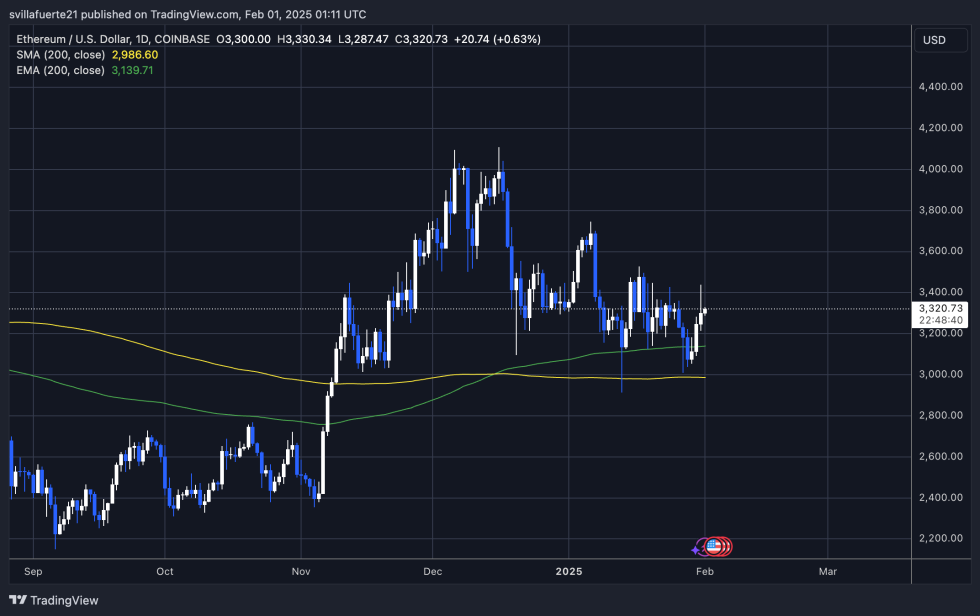
ETH pushing above key levels | Source: ETHUSDT chart on TradingView

However, the risk of further consolidation or even a correction remains. If ETH fails to maintain current support levels, it could lead to increased selling pressure, pushing the price back to test lower demand zones. Losing the $3,200 mark would indicate weakness, potentially delaying Ethereum’s bullish breakout.

For now, ETH remains at a critical juncture, with investors watching closely to see whether bulls can sustain momentum and reclaim key resistance levels. The weekend price action will be pivotal in determining Ethereum’s next major move, setting the tone for the coming weeks.

Featured image from Dall-E, chart from TradingView

Sebastian Villafuerte

Sebastian Villafuerte

Sebastian's journey into the world of crypto began four years ago, driven by a fascination with the potential of blockchain technology to revolutionize financial systems. His initial exploration focused on understanding the intricacies of various crypto projects, particularly those focused on building innovative financial solutions. Through countless hours of research and learning, Sebastian developed a deep understanding of the underlying technologies, market dynamics, and potential applications of cryptocurrencies. As his knowledge grew, Sebastian felt compelled to share his insights with others. He began actively contributing to online discussions on platforms like X and LinkedIn, focusing on fintech and crypto-related content. His goal was to expose valuable trends and insights to a wider audience, fostering a deeper understanding of the rapidly evolving crypto landscape. Sebastian's contributions quickly gained recognition, and he became a trusted voice in the online crypto community. To further enhance his expertise, Sebastian pursued a UC Berkeley Fintech: Frameworks, Applications, and Strategies certification. This rigorous program equipped him with valuable skills and knowledge regarding Financial Technology, bridging the gap between traditional finance (TradFi) and decentralized finance (DeFi). The certification deepened his understanding of the broader financial landscape and its intersection with blockchain technology. Sebastian's passion for finance and writing is evident in his work. He enjoys delving into financial research, analyzing market trends, and exploring the latest developments in the crypto space. In his spare time, Sebastian can often be found immersed in charts, studying 10-K forms, or engaging in thought-provoking discussions about the future of finance. Sebastian's journey as a crypto analyst and investor has been marked by a relentless pursuit of knowledge and a dedication to sharing his insights. His ability to navigate the complex world of crypto, combined with his passion for financial research and communication, makes him a valuable asset to the industry. As the crypto landscape continues to evolve, Sebastian remains at the forefront, providing valuable insights and contributing to the growth of this revolutionary technology.

Related Reads

The Veil of Mythos Becomes Anthropic's Lever to Move Trillions

The article discusses Anthropic's reported upcoming $30 billion funding round, which would value the company at over $900 billion. It analyzes how the company has leveraged strategic narratives around its unreleased "Mythos" model, rather than just its publicly available products, to drive this massive valuation. Key points include Google's surprising $40 billion investment in a competitor, suggesting it is buying strategic positioning. Anthropic's "Glasswing" cybersecurity project and the unreleased Mythos model are portrayed not through direct proof, but through carefully crafted narratives of being "too powerful for public release," creating an aura of exclusive, high-level capability. This is bolstered by reports of the White House and NSA seeking access to Claude/Mythos despite previous security concerns, implying indispensable technology. Furthermore, Anthropic's reported rapid revenue growth—from a $1 billion annual run-rate in late 2024 to over $30 billion by April 2026, largely driven by enterprise API and Claude Code—provides a financial story for investors. The article concludes that Anthropic's core business model is effectively converting unverifiable technical potential, government interest, and future revenue projections into a compelling narrative that secures immense capital, using the actions of wealthy investors and powerful institutions as the ultimate validation of its worth.

marsbit1h ago

The Veil of Mythos Becomes Anthropic's Lever to Move Trillions

marsbit1h ago

Google CEO Admits Lagging Behind in Coding

Google CEO Sundar Pichai acknowledged in a recent interview that Google's Gemini AI models are currently "lagging behind" in coding capabilities, particularly for complex, long-horizon tasks requiring advanced developer expertise. He noted the field is advancing at an "unprecedented" pace, where 30-60 days now brings changes equivalent to five years in the past. Pichai expressed that achieving Artificial General Intelligence (AGI) now seems closer than previously imagined due to rapid progress. While highlighting strengths in text, multimodal, and reasoning tasks, Pichai admitted competitors like Anthropic and OpenAI have focused more intently on coding. He emphasized Google's commitment to catching up, citing internal tools like Antigravity 2.0 and the newly released Gemini 3.5 Flash, which aims to address previous shortcomings. Regarding Google Search's AI-driven overhaul, Pichai stated changes will be gradual to align with user needs, not disrupt the core search experience or its advertising model. He addressed public AI anxiety as understandable, given the technology's potential to reshape jobs and society, but remained optimistic about AI augmenting human capabilities and creating new opportunities. Pichai stressed the need for broad societal dialogue and responsible development as AI approaches more advanced, potentially recursive self-improvement stages. He affirmed Google's long-term commitment to leading in AI while navigating its profound implications responsibly.

marsbit3h ago

Google CEO Admits Lagging Behind in Coding

marsbit3h ago

The Paradox of Automation: The Stronger the AI, the Busier Humans Become

The Paradox of Automation: The more powerful AI becomes, the more work humans have to do. This article, based on observations from AI-heavy company Every, argues that while AI agents automate tasks like coding, writing, and customer service, they don't eliminate human jobs. Instead, they transform work and create *more* demand for human expertise. AI commoditizes "yesterday's human capabilities" by cheaply generating code, text, and images from past data. This leads to an abundance of similar, generic outputs. Consequently, what becomes scarce and valuable is human judgment in the present moment: knowing *what* is worth doing, *why*, and *how* to do it well. The article identifies two collaboration models: "Agent employees" for delegated tasks and "human-AI collaboration" within tools like Claude Code for complex work. In both cases, humans are essential to set direction, judge quality, and maintain systems. As AI makes execution cheap, human roles shift from executors to designers, reviewers, and meaning-makers. The author addresses "benchmark anxiety" by explaining that AI excels within specific, human-defined problem "frames." As AI masters one frame (e.g., code rewriting), new, more complex frames emerge (e.g., deciding *when* to rewrite). This creates an ongoing cycle where AI chases the frames, but humans remain the "framers." Even with advanced AGI, this dynamic may persist as long as AI lacks true human-like agency and self-directed purpose. The core paradox holds: automation amplifies the need for the very human judgment it seems to replace.

marsbit4h ago

The Paradox of Automation: The Stronger the AI, the Busier Humans Become

marsbit4h ago

Trading

Spot
Futures

Hot Articles

Discussions

Welcome to the HTX Community. Here, you can stay informed about the latest platform developments and gain access to professional market insights. Users' opinions on the price of ETH (ETH) are presented below.

活动图片