Bitcoin Vs. XRP: Will BRICS Influence The US Crypto Reserve?

bitcoinistPublished on 2025-01-27Last updated on 2025-01-27

Abstract

An online confrontation broke out between the Bitcoin and XRP communities over the weekend, fueled by former President Donald Trump’s...

An online confrontation broke out between the Bitcoin and XRP communities over the weekend, fueled by former President Donald Trump’s last weeks’ announcement of a “Digital Asset Stockpile” under his administration’s newly unveiled crypto executive order. Although many observers expected a declaration of a “Bitcoin Strategic Reserve,” the broader term set off debates about whether assets beyond Bitcoin—particularly XRP—would be included in the United States’ national digital asset holdings.

Jason P. Lowery, a US Space Force officer and astronautical engineer known for his well-regarded MIT thesis linking Bitcoin’s Proof-of-Work consensus mechanism to a form of national security infrastructure, has positioned himself to the question if it is likely the the Trump administration will add other crypto assets to its “digital asset stockpile” besides Bitcoin.

Why Bitcoin And Not XRP

In a post on X on Sunday, Lowery expressed skepticism about whether governments like those in the BRICS bloc (Brazil, Russia, India, China, and South Africa) would ever adopt a cryptocurrency that is perceived to be under US jurisdiction. While he did not specifically name XRP, Lowery’s references to “meme coin” or “one controlled by an American CEO” can be interpreted as a veiled nod to XRP or any cryptocurrency managed by a US-based entity.

In his own words: “Do you really think BRICS is interested in adding a meme coin to their reserves, or one controlled by an American CEO? Do you believe they’d choose a USD stablecoin issued by an American company trying to position itself as a neo-Federal Reserve Bank?”

He added, “Or are they far more likely to adopt the coin that has been relentlessly vilified and condemned by the US for over 15 years precisely because it operates beyond US control? The coin that guarantees sovereign access to block space, ensuring transactions cannot be censored or denied, provided they continue to possess the physical power and infrastructure they’ve already invested in.”

Lowery’s remarks underscore his overarching thesis that Bitcoin has strategic properties appealing to nations outside the US sphere of influence, particularly because of its decentralized, censorship-resistant architecture. In his view, this places Bitcoin in a unique position on the global geopolitical chessboard.

Lowery’s critical question revolves less around technological merit and more around geopolitical choice. He contends that, when it comes to forming the next “global reserve asset,” the ultimate deciding factor will be what other nations want to hold—particularly potential competitors and adversaries such as China or Russia. He explained:

“The next global reserve asset, by definition, will be the one chosen by other nations—particularly our global competitors. And BRICS will almost certainly favor the asset that offers the greatest independence from US influence—the one that is demonstrably censorship-resistant, provably decentralized, and sovereign. The one that wasn’t premined. The one that isn’t being shilled by cringey, wannabe American influencers.”

His caution to the US crypto community is explicit: favoring an asset domestically is not enough if adversaries find no strategic reason to adopt it. Lowery emphasized the importance of assessing whether foreign governments would realistically add significant amounts of a given digital asset to their state reserves. Otherwise, he suggests, advocating for any other coin—especially one tied closely to US authorities or corporate entities—may be a futile exercise that could inadvertently “undermine the future security and prosperity of this nation.”

While the Trump administration has yet to clarify whether any crypto beyond Bitcoin will be included in the US “Digital Asset Stockpile,” Ripple advocates remain hopeful. They contend that regulatory clarity around XRP and ongoing partnerships with financial institutions may eventually secure it a position as a recognized strategic asset.

Still, according to Lowery, global trends—and notably BRICS’ actions—might override any domestic optimism. If countries in the BRICS bloc and beyond decide that Bitcoin’s decentralization and resistance to censorship confer a distinct geostrategic advantage, they could choose to adopt it en masse. From Lowery’s perspective, this potential international preference for Bitcoin would force the US to bolster its own holdings or risk strategic disadvantage:

“If you cannot confidently say that nations like China or Russia will add massive amounts of your favored crypto asset to their strategic reserves, then you are being insincere—and you’re undermining the future security and prosperity of this nation.”

At press time, BTC traded at $99,293.
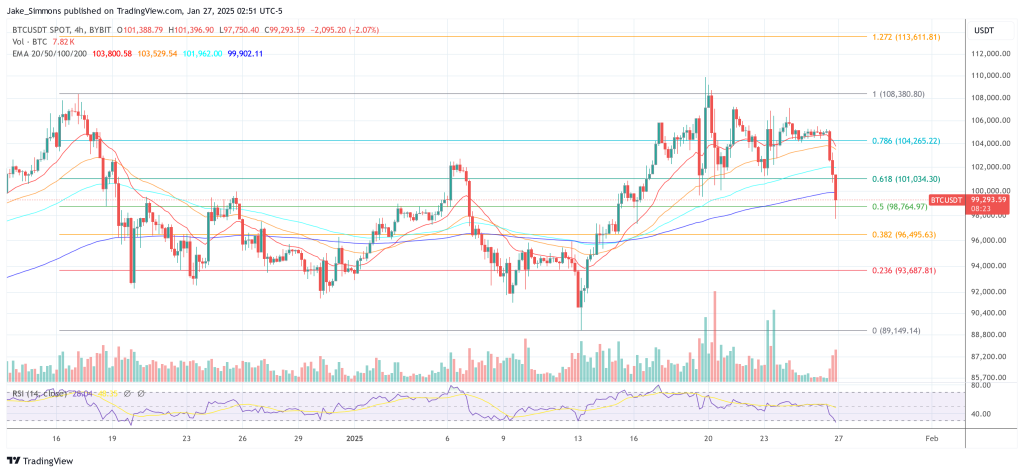
Bitcoin price
Bitcoin price, 4-hour chart | Source: BTCUSDT on TradingView.com
Featured image created with DALL.E, chart from TradingView.com
Jake Simmons

Jake Simmons

Jake Simmons has been a Bitcoin enthusiast since 2016. Ever since he heard about Bitcoin, he has been studying the topic every day and trying to share his knowledge with others. His goal is to contribute to Bitcoin's financial revolution, which will replace the fiat money system. Besides BTC and crypto, Jake studied Business Informatics at a university. After graduation in 2017, he has been working in the blockchain and crypto sector. You can follow Jake on Twitter at @realJakeSimmons.

Related Reads

No Coding Required: Build Your First AI Agent in 2 Days (Complete Tutorial)

A No-Code Guide to Building Your First AI Agent in a Weekend This article presents a weekend, zero-code tutorial for beginners to build a functional AI Agent using tools like Claude. It clarifies the core difference between a chatbot, which responds to queries, and an Agent, which autonomously plans and executes multi-step tasks using tools to deliver a final result. The process is broken into four stages over two days: 1. **Saturday Morning: Understanding Agents.** Learn that an Agent requires a clear Goal, a Plan, necessary Tools, and an execution Loop. Identify a simple, multi-step task from your own work/life as your first project. 2. **Saturday Afternoon: Building with Claude.** Create a one-page "Agent Blueprint" answering: the Goal, sequential Steps, required Tools, the desired Output format, and error-handling rules. Implement this blueprint in Claude (Desktop Cowork or web Projects) and run the Agent for the first time. 3. **Sunday Morning: Debugging & Optimization.** Review the initial (often 60-70% accurate) output. Identify flaws, trace them back to vague instructions in your blueprint, and refine it with more specific criteria and error handling. Iterate this run-review-refine cycle 3-4 times to reach ~90% reliability. 4. **Sunday Afternoon: Expansion.** Apply the learned workflow to quickly build a second, different Agent (e.g., for research, content repurposing, or meeting prep), experiencing the compounding efficiency gains. The core skill is not writing a perfect blueprint initially, but rapidly iterating based on output. By the end of the weekend, you'll have built two usable Agents, moving beyond just chatting with AI to automating multi-step workflows, fundamentally changing how you approach repetitive tasks.

marsbit7h ago

No Coding Required: Build Your First AI Agent in 2 Days (Complete Tutorial)

marsbit7h ago

Trading

Spot
Futures

Hot Articles

What is $BITCOIN

DIGITAL GOLD ($BITCOIN): A Comprehensive Analysis Introduction to DIGITAL GOLD ($BITCOIN) DIGITAL GOLD ($BITCOIN) is a blockchain-based project operating on the Solana network, which aims to combine the characteristics of traditional precious metals with the innovation of decentralized technologies. While it shares a name with Bitcoin, often referred to as “digital gold” due to its perception as a store of value, DIGITAL GOLD is a separate token designed to create a unique ecosystem within the Web3 landscape. Its goal is to position itself as a viable alternative digital asset, although specifics regarding its applications and functionalities are still developing. What is DIGITAL GOLD ($BITCOIN)? DIGITAL GOLD ($BITCOIN) is a cryptocurrency token explicitly designed for use on the Solana blockchain. In contrast to Bitcoin, which provides a widely recognized value storage role, this token appears to focus on broader applications and characteristics. Notable aspects include: Blockchain Infrastructure: The token is built on the Solana blockchain, known for its capacity to handle high-speed and low-cost transactions. Supply Dynamics: DIGITAL GOLD has a maximum supply capped at 100 quadrillion tokens (100P $BITCOIN), although details regarding its circulating supply are currently undisclosed. Utility: While precise functionalities are not explicitly outlined, there are indications that the token could be utilized for various applications, potentially involving decentralized applications (dApps) or asset tokenization strategies. Who is the Creator of DIGITAL GOLD ($BITCOIN)? At present, the identity of the creators and development team behind DIGITAL GOLD ($BITCOIN) remains unknown. This situation is typical among many innovative projects within the blockchain space, particularly those aligning with decentralized finance and meme coin phenomena. While such anonymity may foster a community-driven culture, it intensifies concerns about governance and accountability. Who are the Investors of DIGITAL GOLD ($BITCOIN)? The available information indicates that DIGITAL GOLD ($BITCOIN) does not have any known institutional backers or prominent venture capital investments. The project seems to operate on a peer-to-peer model focused on community support and adoption rather than traditional funding routes. Its activity and liquidity are primarily situated on decentralized exchanges (DEXs), such as PumpSwap, rather than established centralized trading platforms, further highlighting its grassroots approach. How DIGITAL GOLD ($BITCOIN) Works The operational mechanics of DIGITAL GOLD ($BITCOIN) can be elaborated on based on its blockchain design and network attributes: Consensus Mechanism: By leveraging Solana’s unique proof-of-history (PoH) combined with a proof-of-stake (PoS) model, the project ensures efficient transaction validation contributing to the network's high performance. Tokenomics: While specific deflationary mechanisms have not been extensively detailed, the vast maximum token supply implies that it may cater to microtransactions or niche use cases that are still to be defined. Interoperability: There exists the potential for integration with Solana’s broader ecosystem, including various decentralized finance (DeFi) platforms. However, the details regarding specific integrations remain unspecified. Timeline of Key Events Here is a timeline that highlights significant milestones concerning DIGITAL GOLD ($BITCOIN): 2023: The initial deployment of the token occurs on the Solana blockchain, marked by its contract address. 2024: DIGITAL GOLD gains visibility as it becomes available for trading on decentralized exchanges like PumpSwap, allowing users to trade it against SOL. 2025: The project witnesses sporadic trading activity and potential interest in community-led engagements, although no noteworthy partnerships or technical advancements have been documented as of yet. Critical Analysis Strengths Scalability: The underlying Solana infrastructure supports high transaction volumes, which could enhance the utility of $BITCOIN in various transaction scenarios. Accessibility: The potential low trading price per token could attract retail investors, facilitating wider participation due to fractional ownership opportunities. Risks Lack of Transparency: The absence of publicly known backers, developers, or an audit process may yield skepticism regarding the project's sustainability and trustworthiness. Market Volatility: The trading activity is heavily reliant on speculative behavior, which can result in significant price volatility and uncertainty for investors. Conclusion DIGITAL GOLD ($BITCOIN) emerges as an intriguing yet ambiguous project within the rapidly evolving Solana ecosystem. While it attempts to leverage the “digital gold” narrative, its departure from Bitcoin's established role as a store of value underscores the need for a clearer differentiation of its intended utility and governance structure. Future acceptance and adoption will likely depend on addressing the current opacity and defining its operational and economic strategies more explicitly. Note: This report encompasses synthesised information available as of October 2023, and developments may have transpired beyond the research period.

363 Total ViewsPublished 2025.05.13Updated 2025.05.13

What is $BITCOIN

Discussions

Welcome to the HTX Community. Here, you can stay informed about the latest platform developments and gain access to professional market insights. Users' opinions on the price of BTC (BTC) are presented below.

活动图片