A US Court has overturned the Department of the Treasury’s Office of Foreign Assets Control (OFAC) sanctions imposed on crypto mixer Tornado Cash. The move comes after the Court of Appeals ruled in November that OFAC had overstepped its authority.
Crypto Privacy Scores Major Win
In a new victory for the crypto industry, the US District Court for the Western District of Texas reversed the OFAC sanctions against Tornado Cash on Monday for allegedly “facilitating” money laundering.
OFAC sanctioned Tornado Cash in August 2022 for “failing to impose effective controls” that prevented malicious actors from laundering funds through the crypto mixer.
The US Treasury Department argued that the decentralized protocol was used to launder over $7 billion worth of crypto since 2019, including $455 million linked to the North Korean hacking group Lazarus Group.
On November 26, 2024, the Fifth Circuit Court of Appeals ruled that OFAC had “overstepped its congressionally defined authority” by sanctioning the crypto mixing protocol. As reported by Bitcoinist, the court concluded that Tornado Cash’s immutable smart contracts can’t be classified as “property” under federal law, placing them outside the reach of the International Emergency Economic Powers Act (IEEPA).
The court filing, dated January 21, 2025, reads, “It is ordered and adjudged that the judgment of the district court is reversed, and the cause is remanded to the district court for further proceedings in accordance with the opinion of this court.”

Judgment of the US Fifth Circuit Court of Appeals. Source: Courtlistener
Attorney and Executive Director at CoinCenter Peter Van Valkenburgh explained that yesterday’s court ruling is “good news though not the end of the story.” According to the post, the publication of the November opinion and mandate, and remand to the district court for remedies, should “foreclose the possibility of en banc review by Circuit.”
However, Van Valkenburgh noted that the government could still appeal to the Supreme Court, although he considers it unlikely at this point, concluding that:
District Court will still need to decide whether the remedy is nationwide vacatur (anyone in US can use immutable contracts) or more limited relief (plaintiffs can use contracts and other parties may need to bring their own suits). Nationwide vacatur is what we should be rooting for.
‘No Man Left Behind’
Ethereum Founder Vitalik Buterin celebrated the news: “Tornado Cash itself won an important case today.” Buterin has advocated for crypto privacy, using protocols like Railgun and stating that “Privacy is normal.”
Additionally, he commented on the recently issued pardon of Silk Road founder Ross Ulbricht. Buterin stated that no man should be “left behind,” suggesting that Tornado Cash’s co-founder Roman Storm and developer Alexey Pertsev should be next.
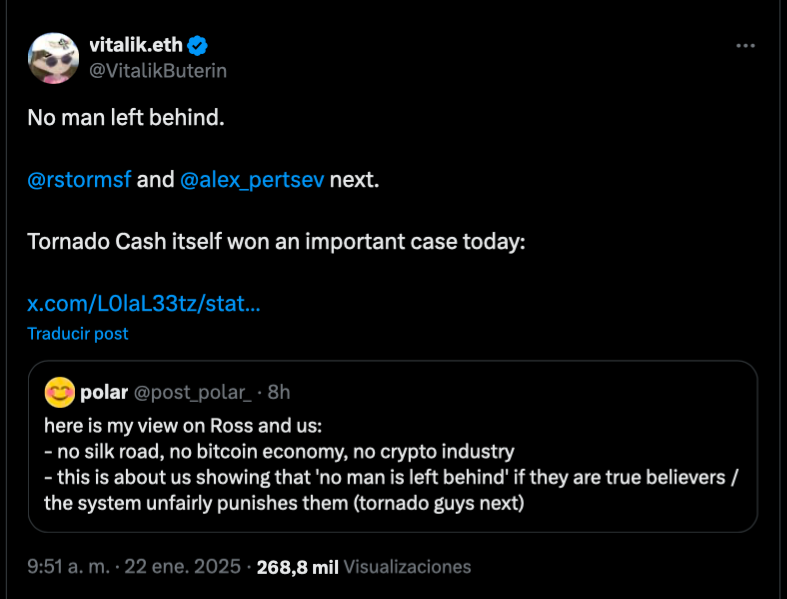
Vitalik calls for the liberation of Storm and Pertsev. Source: Vitalik Buterin on X
Following the OFAC sanctions, Pertsev was detained in the Netherlands in August 2022 and is serving a 5-year sentence after being found guilty of money laundering by the s-Hertogenbosch Court of Appeal in May 2024.
Meanwhile, Storm was arrested in Washington in August 2023 after being charged with money laundering and sanctions violations. The crypto mixer’s co-founder pleaded not guilty to the charges, and his trial has been pushed to April 2025.
Storm responded to Buterin’s message, thanking the Ethereum founder for his help to him and Pertsev over the past two and half years.

Bitcoin trades at $104,984 in the one-week chart. Source: BTCUSDT on TradingView

Related Posts