Was Trump’s Meme Coin Launch Illegal? Lawyer Breaks It Down

BitcoinistPublished on 2025-01-23Last updated on 2025-01-24

Abstract

Donald Trump’s recent foray into the world of cryptocurrency with the launch of his meme coin, TRUMP, has raised questions...

Donald Trump’s recent foray into the world of cryptocurrency with the launch of his meme coin, TRUMP, has raised questions about its legality, sparking widespread debate. A comprehensive analysis by Anonwassielawyer (@wassielawyer), a prominent crypto and finance attorney, has shed light on the issue, explaining why Trump’s launch, while unconventional, adheres to existing US securities laws.


Memecoins: Has Trump Used A Loophole In Securities Law?
Anonwassielawyer begins with a provocative summary: “Trump launched a memecoin that ran to over $70 billion from the US of A. Is crime legal now?” According to his analysis, the legal foundation for such launches has always existed, rooted in the distinction between securities and non-securities in US law. Memecoins, which lack inherent utility or revenue-sharing mechanisms, generally do not meet the criteria of an “investment contract” as outlined in the Howey Test.

For a token to be considered a security, it must meet specific criteria, including an investment of money in a common enterprise with a reasonable expectation of profits derived from the efforts of others. In the case of memecoins like TRUMP, these elements are conspicuously absent. The analysis breaks this down with an example: if a token is sold with the promise that proceeds will fund a project expected to generate profits shared with investors, the token would be considered a security.


However, if a token is sold purely as a speculative asset, with no underlying project or economic value, it falls outside this classification. TRUMP clearly belongs in the latter category. As Anonwassielawyer explains, “If I asked you to buy a memecoin, we aren’t expecting the proceeds to go towards any project. It simply goes to the seller who sells it because he thinks the price will go down. You are simply buying it because you think there’s a next marginal buyer who will take it from you at a higher price. There is no investment contract. There is no underlying value. It’s pure speculation on attention. Thus—not a security.”
While the legal status of memecoins is relatively straightforward, the broader implications for the crypto industry are more complex. Projects designed to create genuine value often face significantly higher regulatory hurdles. Tokens that accrue revenue, offer governance rights, or otherwise resemble traditional financial instruments are far more likely to fall within the purview of securities law. This reality has led to growing frustration within the industry, particularly regarding the enforcement policies of regulators like SEC Chair Gary Gensler. As Anonwassielawyer notes, “A lot of the hatred towards Gary Gensler isn’t because he enforced securities laws; it’s because he claimed everything was a security even though they may not have been.”


The contrasting approaches taken with TRUMP and Trump’s other crypto initiative, World Liberty Finance (WLFI), illustrate this regulatory divide. While TRUMP operates as a speculative memecoin, WLFI adheres to a strict compliance framework designed to satisfy US securities laws. The WLFI token, for instance, is explicitly structured to be non-transferable for at least 12 months, a safeguard to ensure compliance with Regulation D and Regulation S. These regulations govern sales to US accredited investors and non-US persons, respectively.
The terms of WLFI explicitly state, “If transferability of WLFI is sought to be unlocked in the future through protocol governance procedures, such unlock would only be permitted if determined not to contravene applicable law.”


Another layer of complexity involves the use of offshore structures, often misunderstood as tools for regulatory evasion. Anonwassielawyer clarifies that these entities serve legitimate purposes, primarily governance and tax optimization. Securities laws are territorial, meaning that setting up in offshore jurisdictions like the Cayman Islands does not exempt projects from compliance if their tokens are sold to US persons. However, offshore structures can provide tax advantages, particularly by deferring taxable events associated with token generation and disposal until the assets are onshored.


For the crypto industry, the lessons from Trump’s initiatives are clear but sobering. Memecoins may represent the lowest common denominator of the market, but their simplicity shields them from regulatory scrutiny. Meanwhile, projects striving to deliver real utility must navigate an increasingly complex and inconsistent regulatory environment. Anonwassielawyer emphasizes this point, advising caution and compliance: “Memecoins are very cool but no fraud please. Securities analysis should be sensible but can be a bit more relaxed. We still have to be careful when selling tokens with security-like features and follow the usual frameworks for such.”


At press time, TRUMP traded at $39.26.
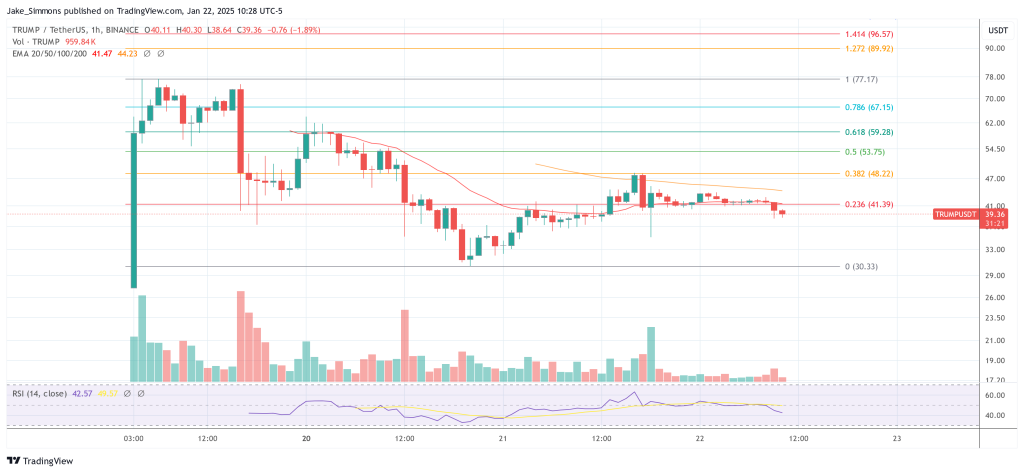
TRUMP price

TRUMP price, 1-hour chart | Source: TRUMPUSDT on TradingView.com Featured image created with DALL.E, chart from TradingView.com

Related Reads

Under the squeeze between giants Tether and Circle, how can foreign exchange stablecoins break through?

In the face of dominance by Tether (USDT) and Circle (USDC), new entrants in the stablecoin space face significant challenges competing directly, especially in the foreign exchange (FX) market. A more viable and efficient path forward is the adoption of synthetic foreign exchange (Forex) built atop existing USD stablecoin rails. The rise of stablecoin neo-banks represents the next major growth area for mass crypto adoption, with FX becoming a core component. However, replicating the vast liquidity, distribution channels, and network effects of USDT/USDC is extremely difficult for new FX stablecoin issuers. The total market cap of all FX stablecoins is a fraction (roughly 1/700th) of USD stablecoins, leading to issues like poor liquidity, peg instability, limited acceptance, and complex compliance hurdles. Instead of issuing spot FX stablecoins, the article advocates for a model inspired by traditional finance's non-deliverable forwards (NDFs). Users would continue to hold underlying USDT/USDC, while their account balances are displayed and economically settled in their preferred local currency through MtM (Mark-to-Market) NDF structures. This approach leverages the deep liquidity and infrastructure of USD stablecoins while providing synthetic forex exposure. Key advantages include strong peg stability via oracles, retained access to USD stablecoin yields and liquidity, high capital efficiency, and easy scalability to new currencies. Primary use cases for this on-chain NDF forex include: 1. Neo-banks, custodians, and wallets offering multi-currency accounts to attract international users and increase deposits. 2. Forex carry trade strategies, potentially offering more stable and scalable yields compared to crypto-native products like Ethena. 3. Global corporate payments, allowing businesses to receive payments in local currencies while hedging forex risk on-chain, similar to services offered by Stripe in traditional finance. This synthetic forex model presents a pragmatic solution to overcome the network effects of incumbents and unlock the next wave of stablecoin utility for global consumers and businesses.

marsbit39m ago

Under the squeeze between giants Tether and Circle, how can foreign exchange stablecoins break through?

marsbit39m ago

Trading

Spot
Futures

Hot Articles

What is TRUMP CAT

Trump Cat Family, $Trump Cat: An Unraveled Mystery Introduction In the constantly evolving landscape of crypto projects and web3 innovations, a curious phenomenon has emerged—one that appears to straddle the line between cryptocurrency and internet meme culture. This is the enigmatic “Trump Cat Family”, also referred to as “$Trump Cat”. Though it might arouse curiosity among crypto enthusiasts, the reality appears far removed from the standard definition of a crypto project. This article aims to explore the concept of Trump Cat Family, bringing to light the context surrounding it and clarifying its status in the crypto realm. What is Trump Cat Family, $Trump Cat? At first glance, one might think that “Trump Cat Family” refers to a legitimate cryptocurrency or web3 project. However, upon deeper investigation, it becomes evident that the term lacks the trappings of a traditional crypto venture. Instead, “Trump Cat” seems to be predominantly associated with the viral meme culture that surged following controversial statements made by former U.S. President Donald Trump regarding Haitian immigrants. The media coverage sparked a myriad of memes, humoristic interpretations, and a wave of social commentary. These memes depict various forms of satire centered on Trump's dialogue, often utilizing cats in comedic and sometimes absurd scenarios. Rather than a structured project aimed at addressing technological advancements or financial transactions, the “Trump Cat Family” concept exists predominantly in the realm of internet humor. Who is the Creator of Trump Cat Family, $Trump Cat? In the investigation of who stands behind the “Trump Cat Family,” it becomes apparent that there exists no identifiable creator or founding figure. The phenomenon seems to have originated from collective internet expression, rather than from a singular visionary with a defined project goal. This anonymity further emphasizes its status as a meme rather than a structured initiative akin to most known crypto projects. Who are the Investors of Trump Cat Family, $Trump Cat? Given that “Trump Cat Family” does not conform to the characteristics of a reputable crypto project, the question of investment becomes moot. There have been no established foundations or organizations expressing support for a project by this name. Instead, what exists are individual contributors to meme culture—hobbyists, artists, and social media users who collectively populate the internet with their interpretations and humor surrounding the term “Trump Cat.” This organic growth within digital human communication reflects more of a social commentary than a financial investment landscape. How Does Trump Cat Family, $Trump Cat Work? If one seeks to establish how “Trump Cat Family” operates, the answer is vastly different from what might be expected of standard crypto projects. There are no operational mechanisms, technological innovations, or unique features inherent to this phenomenon. Instead, it exists through viral spread online, relying upon social media platforms for proliferation. The “how” lies in the realm of culture and communication—its essence derived from the dynamics of social interaction rather than from established crypto protocols or blockchain functionalities. What makes “Trump Cat” unique, if anything, is the way it dramatizes a political dialogue through humor. People utilize engaging visuals, inside jokes, and inventive storytelling to convey sentiments regarding political figures and societal issues. The power of memes transcends traditional communication, encapsulating complex thoughts in a form that resonates widely, yet remains elusive in terms of quantifiable success or structured goals. Timeline of Trump Cat Family, $Trump Cat September 2024: The discourse surrounding Donald Trump's comments about Haitian immigrants allegedly consuming pets gains traction online, leading to a blossoming of memes and parodic interpretations across various platforms. Continuing Impact: Following this period, the “Trump Cat” phenomenon sees continued life as social media users leverage humor to address, critique, or simply celebrate the absurdity of political conversations and events. It is essential to note that as “Trump Cat Family” lacks the formal structure of a traditional project, the timeline consists primarily of anecdotal observation rather than remarkable milestones commonly found in recognized crypto ventures. Key Points Meme Culture: Rather than a structured crypto initiative, “Trump Cat” aligns more with the evolving landscape of internet memes. Origin of the Term: The genesis of “Trump Cat” relates directly to commentary on President Trump's remarks about Haitian immigrants, sparking widespread humoristic representation. Absence of a Project Framework: The term fails to align with any defined project objectives, creators, or investors, marking it as a novel cultural experience rather than a crypto project. Conclusion In summary, the investigation into “Trump Cat Family, $Trump Cat” reveals a phenomenon entrenched in internet meme culture rather than a recognized project within the cryptocurrency or web3 sectors. The virality surrounding the term is birthed from collective user engagement, reflective of modern digital discourse rather than a formalized initiative with structure or strategic foresight. For all the curiosity it may invoke among those seeking the next big crypto project, “Trump Cat Family” serves as a testament to humanity's creativity, humor, and often absurd relationship with politics in the digital age.

2.7k Total ViewsPublished 2025.01.22Updated 2025.01.22

What is TRUMP CAT

TRUMP: Decoding Trump's Crypto "Game of Power"

This article analyzes the underlying mechanics and participation approaches within the $TRUMP ecosystem, examining its technical, narrative, and community aspects.

40.3k Total ViewsPublished 2025.04.23Updated 2025.04.29

TRUMP: Decoding Trump's Crypto "Game of Power"

Discussions

Welcome to the HTX Community. Here, you can stay informed about the latest platform developments and gain access to professional market insights. Users' opinions on the price of TRUMP (TRUMP) are presented below.

活动图片