Lido Staking Woes Continue as stETH Selloff Accelerates

FXEMPIREPublished on 2022-06-15Last updated on 2022-06-15

Abstract

The largest Ethereum liquid staking platform Lido is feeling the pressure as its staked asset has not regained its peg and is started to get liquidated. The Lido stETH token has fallen 5% from its Ethereum price peg. Three Arrows Capital has been liquidating its stETH holdings. The embattled Celsius platform holds more than 400,000 stETH, causing concern.

Staked Ethereum tokens from the Lido network are being liquidated to markets as it has remained below its peg for the past few days.

Lido provides a liquid staking service whereby users can stake Ethereum and receive the equivalent value in a token called stETH. This can then be deposited in other decentralized finance (DeFi) protocols to generate additional yields on top of the staking reward or be used as collateral for loans.

It has several advantages over direct Ethereum staking as there is a flexible limit, and funds can be withdrawn or redeployed. To stake ETH on the Beacon Chain (Ethereum consensus layer) directly, there is a minimum of 32 ETH (worth approximately $38,400), and it remains locked there until after the Merge.

Lido Liquidation

Lido has been wildly popular for those that don’t have the minimum amount of ETH and want more flexibility with their investments. It has 4.2 million ETH staked, about a third of the total Ethereum staked overall (12.8 million ETH).

The problem arises when the stETH token falls below the price of Ethereum, which it is supposed to be pegged to at 1:1. Ethereum is currently trading at $1,217 while stETH is at $1,156, 5% lower, and only worth 0.927 of an ETH.

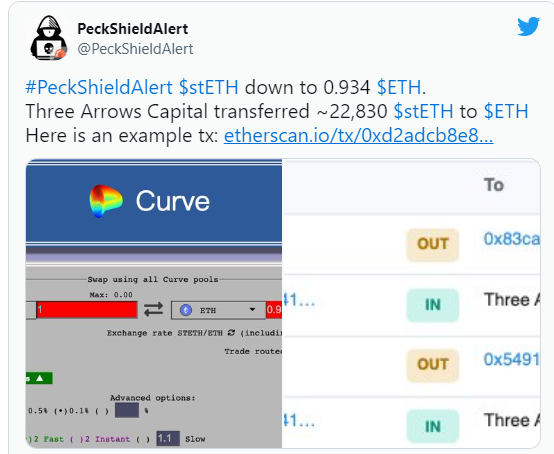
Adding fuel to the fire is the current liquidation of Lido’s staking token. According to a June 14 tweet by blockchain security firm PeckShield, venture capital firm Three Arrows Capital has been offloading stETH. At least 22,830 stETH tokens were converted back into ETH recently, according to the 3AC wallet address.
On June 15, 3AC co-founder Zhu Su attempted to alleviate the concern by tweeting: “We are in the process of communicating with relevant parties and fully committed to working this out.”

The Curve Finance DeFi platform has a liquidity pool for stETH and ETH that should be in balance. However, the de-pegging and stETH selloff has caused an imbalance in the pool. It is currently 78.4% heavy on stETH with just 21.6% in Ethereum.

Liquidity for staked Ether is shrinking, making it very difficult to conduct token swaps and collateralized loans using the Lido token.

The Celsius Concern

The Celsius fiasco has also been a cause for concern because the crypto lending platform holds a large amount of stETH. Earlier this week, Celsius sent millions of dollars worth of crypto to the FTX exchange in an attempt to shore up liquidity.

Celsius currently holds a whopping 409,260 stETH, equivalent to almost $500 million at the time of writing. If this is liquidated, the de-pegging situation will likely get far worse quickly.

On June 15, Bitcoin Magazine’s Dylan LeClair commented: “While everyone is focused on the Celsius collateralized loan, the biggest worry for the market may just be their massive stETH position. No resolution in sight.”


Related Reads

$9.4 Billion: The Largest Robotics Funding This Year Has Emerged

Munich-based humanoid robotics company Neura has completed a $1.4 billion (approximately RMB 94.9 billion) Series C funding round, valuing the company at around $7 billion and positioning it among the global leaders in the sector. The investment round is notable not just for its size—reportedly the largest in robotics this year—but also for its strategic backers, which include tech giants like NVIDIA and Amazon, alongside established industrial players such as German engineering firms Bosch and Schaeffler. This mix of investors signals a significant shift in the industry's focus from technological demonstrations and general-purpose narratives toward practical, industrial deployment and commercialization. Neura's approach centers on developing humanoid robots for defined, high-value industrial tasks rather than pursuing a general-purpose model. Its early validation comes from a partnership with BMW, where its robots are being tested on actual production lines. The involvement of Bosch and Schaeffler, companies deeply embedded in global manufacturing, underscores a growing belief that humanoid robots are transitioning from labs to viable factory-floor solutions. The article highlights two converging trends driving investment: advancements in AI and large language models, which enhance robots' perception and decision-making in unstructured environments, and mounting pressure from labor shortages and rising costs in major manufacturing regions. The funding landscape is now bifurcating between companies like Figure AI, focusing on versatile general-purpose robots, and firms like Neura, targeting specific vertical industrial applications with clearer, shorter paths to ROI. While technical hurdles remain, the core challenges for widespread adoption are increasingly seen as engineering and commercial in nature: managing the high integration and customization costs for different factory environments and establishing robust, localized maintenance and service networks. The record investment in Neura, particularly from industrial capital, indicates the industry's growing confidence in moving from proving feasibility to solving the practical problems of scalability, reliability, and building sustainable business models around humanoid robots in real-world settings like automotive manufacturing and hazardous labor environments.

marsbit8h ago

$9.4 Billion: The Largest Robotics Funding This Year Has Emerged

marsbit8h ago

Trading

Spot
Futures
活动图片