Bitcoin Long-Term Holders Complete Largest Market Sell-Off Since 2021, Is The Top Here?

bitcoinistPublished on 2024-12-16Last updated on 2024-12-16

Abstract

As the Bitcoin price continues its upward momentum, on-chain data reveals that Bitcoin long-term holders are beginning to sell off...

As the Bitcoin price continues its upward momentum, on-chain data reveals that Bitcoin long-term holders are beginning to sell off their assets. Historically, similar market behavior coincided with market tops in the 2021 bull cycle, raising the question of whether the pioneer cryptocurrency is finally approaching its market peak.  

Bitcoin Long-Term Holders Sell, Market Top Ahead?

The price of Bitcoin has been on a strong bullish trend following Donald Trump’s victory in the US Presidential elections. Leading up to its rise to its previous $100,000 ATH, BTC saw a surge in accumulation, with most whales opting to hold rather than sell their holdings. 

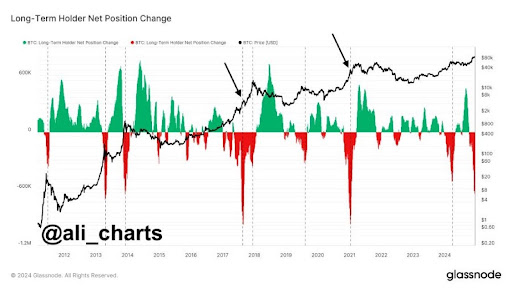
However, on-chain data has revealed that long-term Bitcoin holders have begun offloading their assets. According to prominent crypto analyst Ali Martinez, this unexpected sell-off by long-term holders often aligns with a market top. 
Bitcoin 1
Source: X

The chart shared by Martinez on X (formerly Twitter) illustrates the changes in Bitcoin’s long-term holder net position. The Green areas show that long-term holders are accumulating BTC and increasing their net positions. On the other hand, the red areas show that these holders are selling off their holdings and decreasing their net positions.

Martinez noted  that long-term holders tend to distribute their holdings as BTC approaches a market top. This observation is supported by their behavior during the Bitcoin bull run in 2021

Between 2017 and 2021, the largest red (sell-off) areas occurred shortly after Bitcoin’s final surge to a new all-time high (ATH). After this surge, BTC experienced significant price corrections, signaling the market top and the end of the bull run. 

The recent red area in the chart shows that long-term Bitcoin holders are selling off their holdings again. If historical trends repeat, the current sell-off could indicate that BTC is nearing a peak; however, a last upward rally could still occur. 

While past trends can not guarantee future outcomes, they still provide insights into potential market movements. With Bitcoin experiencing rapid growth and surging past $100,000, a market top could be within sight any time soon. 

BTC Hits New ATH, What’s Next?

Recently, Bitcoin achieved a new ATH, surging past previous resistance levels to reach $106,260. The cryptocurrency’s price had jumped over 4.8% in one day, fueling discussions and excitement in the crypto community. Despite reaching a new ATH, BTC has since corrected to $105,013 as of writing. 

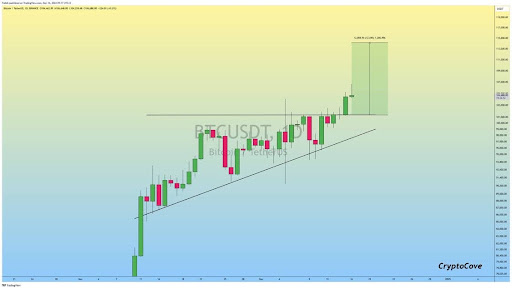
Crypto analyst Captain Faibik on X has also expressed excitement about the new ATH, providing an even more bullish outlook for the pioneer cryptocurrency. According to Faibik, the Bitcoin Ascending Triangle upside breakout has been officially confirmed on the daily timeframe, indicating a potential for an uptrend continuation.
Bitcoin 2
Source: X

The analyst predicts that Bitcoin could retest support levels but expects the cryptocurrency to initiate its next bullish surge afterward. Consequently, Faibik has set his next BTC target between $113,000 and $115,000 before the end of 2024. 

Bitcoin price chart from Tradingview.com
BTC price at $105,000 | Source: BTCUSD on Tradingview.com
Featured image created with Dall.E, chart from Tradingview.com
Scott Matherson

Scott Matherson

Scott Matherson is a leading crypto writer at Bitcoinist, who possesses a sharp analytical mind and a deep understanding of the digital currency landscape. Scott has earned a reputation for delivering thought-provoking and well-researched articles that resonate with both newcomers and seasoned crypto enthusiasts. Outside of his writing, Scott is passionate about promoting crypto literacy and often works to educate the public on the potential of blockchain.

Related Reads

South Korea's Crypto Tax Countdown Begins: Escalating Three-Way Game Between CEXs, Retail Investors, and Regulators

South Korea's National Tax Service has initiated final preparations to implement a virtual asset tax starting January 2027, with reporting for comprehensive income tax due by May 2028. The tax applies a 22% rate on annual profits exceeding 2.5 million KRW from transfers and leasing, affecting an estimated 13.26 million people. To enforce this, authorities plan to collect data from major domestic exchanges like Upbit and Bithumb and launch a comprehensive virtual asset analysis system. This move follows two previous postponements and signifies a shift towards institutionalized management. The plan also involves international data sharing under the OECD's CARF framework from next year to curb capital flight. However, tensions exist between regulators and exchanges over data sharing and new anti-money laundering rules. The industry, represented by DAXA, opposes proposed regulations requiring the reporting of all cross-border transfers over $6,800 as suspicious, arguing it renders AI risk systems useless and creates an impractical administrative burden. Given Korea's market—comprising 30% of global volume with 85% in altcoins and dominated by retail speculation—the tax could reduce short-term speculative trading and stabilize the domestic market by limiting capital outflows. Its implementation may also influence global crypto regulatory and taxation models, serving as a significant case study for other jurisdictions.

marsbit6m ago

South Korea's Crypto Tax Countdown Begins: Escalating Three-Way Game Between CEXs, Retail Investors, and Regulators

marsbit6m ago

55 Billion Dollars: Musk's 'Chip Factory' Becomes a Reality

Elon Musk's "Terafab" Chip Factory Vision Begins with a $55 Billion Bet SpaceX has formally proposed investing $55 billion to initiate construction of a "Terafab" chip manufacturing facility in Grimes County, Texas, with the total cost potentially reaching $119 billion in later phases. This massive project, a joint initiative by SpaceX and Tesla, marks a pivotal step in Elon Musk's strategy of vertical integration for his company ecosystem. The core logic is that Musk's ventures—SpaceX, Tesla, xAI, and future projects like the Optimus robot—consume enormous amounts of AI computing power. Terafab is envisioned not merely as a factory but as a "full-stack AI infrastructure strategy," aiming to bring chip production, energy sourcing, and compute deployment under one umbrella to secure a self-sufficient supply of this critical resource. Analysts describe this as a bold "15-year strategy" with significant execution risks. Building a leading-edge semiconductor fab requires 3-5 years, specialized equipment like ASML's EUV lithography machines, and a skilled workforce, with the earliest chip output not expected until mid-2028 at best. It mirrors a broader industry trend where giants like Microsoft and Google are also pouring billions into custom AI chips, driven by the belief that in the AI era, controlling computing power means controlling the future. Timed alongside SpaceX's impending IPO, the Terafab announcement also serves as a powerful narrative, linking Tesla to SpaceX's and AI's growth story. Whether the vision translates into a functioning foundry remains uncertain, but Musk's move to have a rocket company build chips is redefining industry boundaries once again.

marsbit44m ago

55 Billion Dollars: Musk's 'Chip Factory' Becomes a Reality

marsbit44m ago

Trading

Spot
Futures

Hot Articles

What is $BITCOIN

DIGITAL GOLD ($BITCOIN): A Comprehensive Analysis Introduction to DIGITAL GOLD ($BITCOIN) DIGITAL GOLD ($BITCOIN) is a blockchain-based project operating on the Solana network, which aims to combine the characteristics of traditional precious metals with the innovation of decentralized technologies. While it shares a name with Bitcoin, often referred to as “digital gold” due to its perception as a store of value, DIGITAL GOLD is a separate token designed to create a unique ecosystem within the Web3 landscape. Its goal is to position itself as a viable alternative digital asset, although specifics regarding its applications and functionalities are still developing. What is DIGITAL GOLD ($BITCOIN)? DIGITAL GOLD ($BITCOIN) is a cryptocurrency token explicitly designed for use on the Solana blockchain. In contrast to Bitcoin, which provides a widely recognized value storage role, this token appears to focus on broader applications and characteristics. Notable aspects include: Blockchain Infrastructure: The token is built on the Solana blockchain, known for its capacity to handle high-speed and low-cost transactions. Supply Dynamics: DIGITAL GOLD has a maximum supply capped at 100 quadrillion tokens (100P $BITCOIN), although details regarding its circulating supply are currently undisclosed. Utility: While precise functionalities are not explicitly outlined, there are indications that the token could be utilized for various applications, potentially involving decentralized applications (dApps) or asset tokenization strategies. Who is the Creator of DIGITAL GOLD ($BITCOIN)? At present, the identity of the creators and development team behind DIGITAL GOLD ($BITCOIN) remains unknown. This situation is typical among many innovative projects within the blockchain space, particularly those aligning with decentralized finance and meme coin phenomena. While such anonymity may foster a community-driven culture, it intensifies concerns about governance and accountability. Who are the Investors of DIGITAL GOLD ($BITCOIN)? The available information indicates that DIGITAL GOLD ($BITCOIN) does not have any known institutional backers or prominent venture capital investments. The project seems to operate on a peer-to-peer model focused on community support and adoption rather than traditional funding routes. Its activity and liquidity are primarily situated on decentralized exchanges (DEXs), such as PumpSwap, rather than established centralized trading platforms, further highlighting its grassroots approach. How DIGITAL GOLD ($BITCOIN) Works The operational mechanics of DIGITAL GOLD ($BITCOIN) can be elaborated on based on its blockchain design and network attributes: Consensus Mechanism: By leveraging Solana’s unique proof-of-history (PoH) combined with a proof-of-stake (PoS) model, the project ensures efficient transaction validation contributing to the network's high performance. Tokenomics: While specific deflationary mechanisms have not been extensively detailed, the vast maximum token supply implies that it may cater to microtransactions or niche use cases that are still to be defined. Interoperability: There exists the potential for integration with Solana’s broader ecosystem, including various decentralized finance (DeFi) platforms. However, the details regarding specific integrations remain unspecified. Timeline of Key Events Here is a timeline that highlights significant milestones concerning DIGITAL GOLD ($BITCOIN): 2023: The initial deployment of the token occurs on the Solana blockchain, marked by its contract address. 2024: DIGITAL GOLD gains visibility as it becomes available for trading on decentralized exchanges like PumpSwap, allowing users to trade it against SOL. 2025: The project witnesses sporadic trading activity and potential interest in community-led engagements, although no noteworthy partnerships or technical advancements have been documented as of yet. Critical Analysis Strengths Scalability: The underlying Solana infrastructure supports high transaction volumes, which could enhance the utility of $BITCOIN in various transaction scenarios. Accessibility: The potential low trading price per token could attract retail investors, facilitating wider participation due to fractional ownership opportunities. Risks Lack of Transparency: The absence of publicly known backers, developers, or an audit process may yield skepticism regarding the project's sustainability and trustworthiness. Market Volatility: The trading activity is heavily reliant on speculative behavior, which can result in significant price volatility and uncertainty for investors. Conclusion DIGITAL GOLD ($BITCOIN) emerges as an intriguing yet ambiguous project within the rapidly evolving Solana ecosystem. While it attempts to leverage the “digital gold” narrative, its departure from Bitcoin's established role as a store of value underscores the need for a clearer differentiation of its intended utility and governance structure. Future acceptance and adoption will likely depend on addressing the current opacity and defining its operational and economic strategies more explicitly. Note: This report encompasses synthesised information available as of October 2023, and developments may have transpired beyond the research period.

363 Total ViewsPublished 2025.05.13Updated 2025.05.13

What is $BITCOIN

Discussions

Welcome to the HTX Community. Here, you can stay informed about the latest platform developments and gain access to professional market insights. Users' opinions on the price of BTC (BTC) are presented below.

活动图片