日赚 1300 万美金的 Tether,花掉 1 亿美金进军新市场

深潮Pubblicato 2024-09-09Pubblicato ultima volta 2024-09-09

Tether 投资 1 亿美元收购了阿根廷著名农业公司 Adecoagro 9.8% 的股份。

来源:beincrypto

编译:区块链骑士

世界上最大的稳定币 USDT 的发行商 Tether 正在向农业领域扩张,来进一步实现其业务多元化。此举反映了 Tether 在 USDT 产品之外发展业务的持续战略。

根据最近向 SEC(美国证券交易委员)提交的一份文件,Tether 投资 1 亿美元收购了阿根廷著名农业公司 Adecoagro 9.8% 的股份

这项交易于 2024 年 7 月 29 日至 8 月 16 日期间完成,为 Tether 获得了超过 1000 万股的股份。文件还证实,这笔投资的资金来自 Tether 的营运资金。

Adecoagro 公司估值超过 10 亿美元,在阿根廷、巴西和乌拉圭开展业务。该公司每天生产约 55 万升牛奶,还利用生物发酵罐生产可再生能源。

Tether 的首席执行官 Paolo Ardoino 在 X 平台上发了一个地球表情符号,对这项投资表示认可

虽然对于一家以在稳定币市场占据主导地位而闻名的公司来说,此举似乎出乎意料,但 Tether 在向各个领域扩张方面有着良好的记录。包括在 BTC mining、人工智能和教育领域的显著投资。

与此同时,Tether 的主营业务——USDT 稳定币,仍然是业内最大的稳定币,市值超过 1180 亿美元

USDT 在多个区块链网络上运营,并专注于改善新兴市场对稳定币解决方案的获取。

Ardoino 指出,在一些传统货币体系服务不足地区,USDT 已经成为数百万人的数字货币

「USDT 已成为数亿人信赖的数字货币。USDT 让每个人都能在最需要的时候获得稳定的货币,无论他们的社会地位如何。」
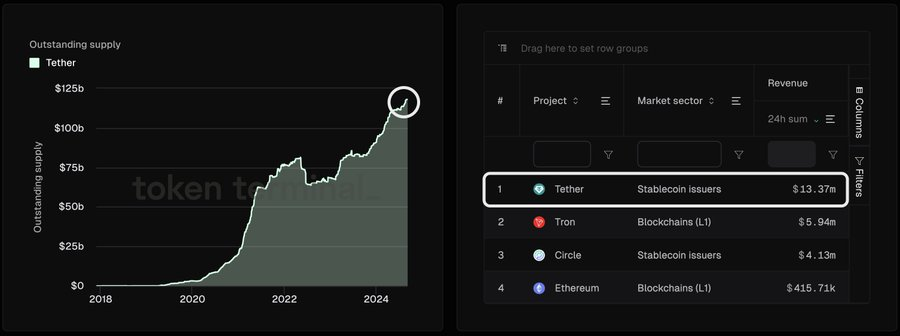
根据 Token Terminal 的数据,Tether 做出的投资策略获得了丰厚的收益,日收入超过了 1300 万美元。


Letture associate

The Revived Codex, Carrying OpenAI's Hopes for IPO

This article analyzes the intense recent development of OpenAI's Codex, positioning it as a crucial component for OpenAI's impending IPO. Over the past two months, Codex has seen a rapid series of major updates focused on integrating into real enterprise workflows. Key new features include enhanced context capture (Appshots, file previews, built-in browser), long-running task execution ("Goal Mode"), remote operation (phone control, lock-screen access), and enterprise management tools (plugin sharing, access tokens, automated risk review). These updates aim to make Codex a comprehensive AI workbench that can "see the scene, push tasks, and manage risks." The author argues that while ChatGPT proves OpenAI's massive user base and API provides foundational revenue, Codex represents OpenAI's clearest path to demonstrating tangible, high-value commercial viability. It targets developers and engineering teams—a segment already accustomed to paying for efficiency gains in costly software development cycles. This is critical because, despite higher overall revenue, OpenAI's adjusted operating margins remain deeply negative, highlighting the challenge of outrunning immense compute costs. The pressure is amplified by competitor Anthropic's success with Claude Code, which has shown that a focused approach on high-value enterprise and developer workflows can lead to a path toward profitability. Codex's aggressive evolution is thus seen as OpenAI's strategic move to capture a similar enterprise-ready, revenue-generating narrative essential for its market debut. In essence, "ChatGPT proved OpenAI has users. Codex needs to prove OpenAI is a business that can make money."

marsbit20 min fa

The Revived Codex, Carrying OpenAI's Hopes for IPO

marsbit20 min fa

a16z: 7 Charts to Understand How Tokenization Is Changing the Nature of Assets

a16z: 7 Charts on How Tokenization is Transforming the Nature of Assets Tokenized Assets, often referred to as "real-world assets" (RWA), are altering the form, flow, and structure of the financial system. The market recently surpassed $30 billion (excluding stablecoins), driven largely by tokenized U.S. Treasuries. These offer investors digital, yield-bearing assets with efficient settlement. Growth varies significantly by asset class. Asset-backed credit leads in speed, followed by niche financial assets, while venture capital and active strategies took longer to scale. U.S. Treasuries and commodities dominate, holding about two-thirds of the current market share. Within commodities, gold tokenization dominates entirely due to its standardization and historical appeal in crypto. The ecosystem is spread across multiple blockchains. Ethereum holds over half the market, with others like BNB Chain, Solana, and Stellar holding significant shares. However, a key insight is that most tokenized assets currently lack "composability." While the total market is large, only a small fraction (e.g., 5% of tokenized bonds) is used within DeFi protocols. Many tokens are simply digital records of off-chain assets, not natively programmable financial building blocks. In contrast, smaller categories like reinsurance tokens see very high on-chain usage. Looking ahead, forecasts for the tokenized asset market by 2030 range from $2 trillion to over $30 trillion, representing immense potential growth from today's ~$340 billion base. Yet, relative to global markets (e.g., $140T+ in bonds), tokenization's penetration remains minuscule (<0.02%). The current phase focuses on digitizing straightforward assets for efficiency. The next major challenge is bringing more complex financial instruments on-chain and integrating tokenized assets into truly composable, internet-native financial infrastructure.

marsbit50 min fa

a16z: 7 Charts to Understand How Tokenization Is Changing the Nature of Assets

marsbit50 min fa

Trading

Spot
Futures
活动图片