Coinbase:10张图表解析加密市场基本面和技术趋势

Odaily星球日报Publicado a 2024-06-19Actualizado a 2024-06-19

Resumen

加密市场总价值锁定增长速度超过总市值增长速度,以太坊 L2 的 TVL 同比增长了 2.4 倍。

原文作者:David Han, Institutional Research Analyst

原文编译:Kate, 火星财经

在我们的年中回顾中,我们展示了 10 个图表,涵盖了一些关键的加密市场基本面和技术趋势。

关键要点

  • 我们通过在顶层第 1 层 (L1) 和第 2 层 (L2) 网络上的原生 gas 代币的价格升值来标准化总价值锁定 (TVL) 的增长。

  • 我们隔离了 CME 期货基础交易对 ETF 流量的影响,显示自 4 月初以来,BTC ETF 的非对冲敞口的增长已大幅放缓。

在我们的年中回顾中,我们提供了 10 个图表,涵盖了一些关键的加密市场基本面和技术趋势。我们通过在顶层第 1 层 (L1) 和第 2 层 (L2) 网络上的原生 gas 代币的价格升值来标准化总价值锁定 (TVL) 的增长。我们还采取了一种相对的方法,通过总交易费用和活跃地址来衡量这些网络中链上活动的冲动,然后具体分解以太坊交易费用的最大驱动因素。之后,我们研究了链上供应动态、相关性以及加密现货和期货市场流动性的现状。

另外,加密货币领域一个更密切追踪的指标是美国比特币现货 ETF 的流入和流出,这通常被视为加密货币需求变化的一个指标。然而,迄今为止 CME 比特币期货未平仓合约 (OI,Open Interest) 的增长表明,自推出以来,ETF 的部分流入是由基差交易驱动的。我们隔离了 CME 期货基础交易的影响,显示自 4 月初以来,BTC ETF 的非对冲敞口的增长已大幅放缓。

基本面

TVL 的增长

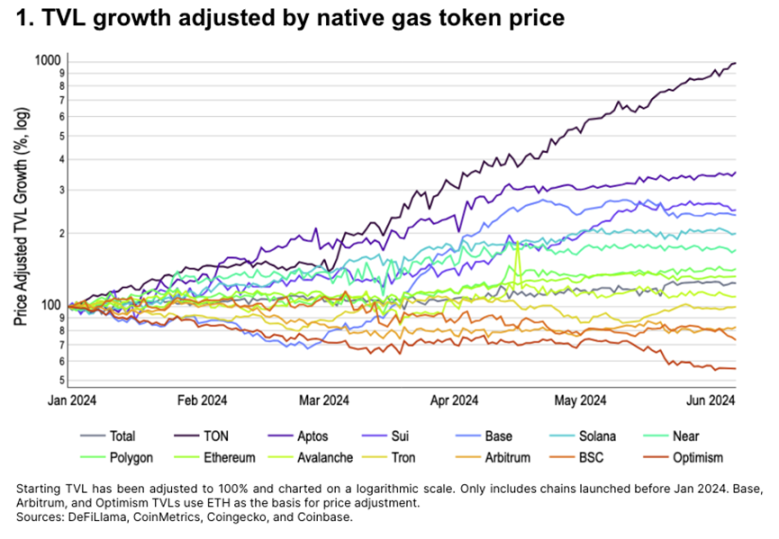
我们不是比较不同链的原始 TVL,而是通过其原生 gas 代币的价格升值来跟踪 TVL 的增长。通常,由于抵押品或流动性的使用,原生代币构成了生态系统中 TVL 的很大一部分。通过价格增长调整 TVL 增长有助于区分 TVL 增长有多少来自净新价值创造,而不是纯粹的价格升值。

总体而言,TVL 的增长速度超过了加密市场总市值的增长速度,同比增长 24% 。增长最快的链——TON、Aptos、Sui 和 Base 都可以被认为是相对新生的,并受益于快速增长阶段。
Coinbase:10张图表解析加密市场基本面和技术趋势

活动推动:费用和用户

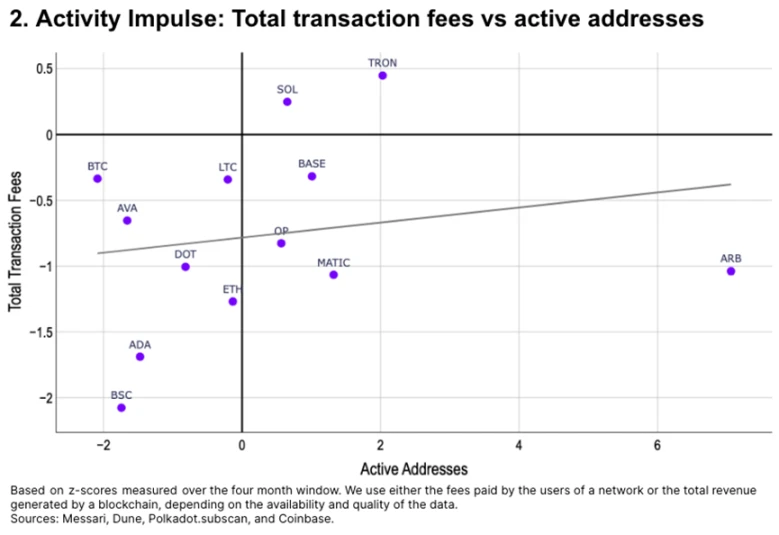
我们比较了每个网络 5 月份的 ( 1) 平均每日活跃地址数与同期的 ( 2) 平均每日费用或收入,两者都以与前四个月 ( 1 - 4 月 ) 相比的标准偏差来衡量。它显示:

  • 除了 Solana 和 Tron 外, 5 月份的链上费用普遍下降

  • 由于 EIP-4844 后费用下降,以太坊 L2( 特别是 Arbitrum) 上的活跃地址大幅增长

  • Cardano 和币安智能链的费用低于钱包活动的下降

Coinbase:10张图表解析加密市场基本面和技术趋势


交易费用驱动因素

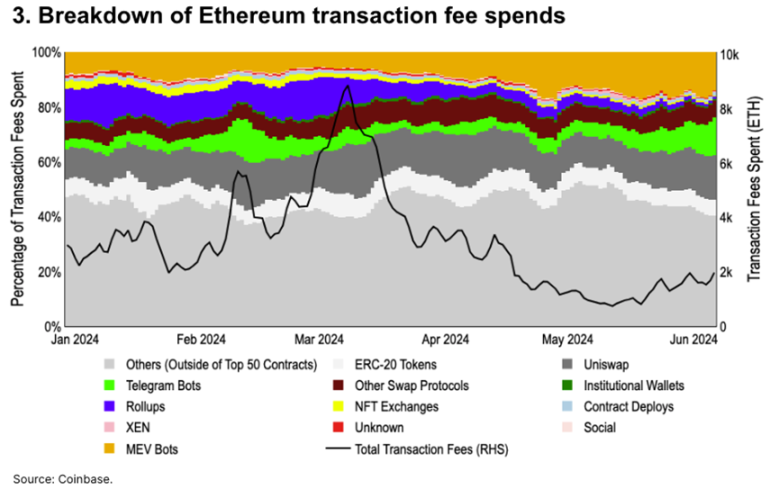
对以太坊前 50 个合约的费用明细进行分类。这些合约加起来占到年初至今总 gas 消耗的 55% 以上。

在 3 月份升级了 Dencun 之后,rollup 的支出从占主网费用的 12% 逐渐减少到不足 1% 。MEV( 最大可提取价值 ) 驱动的交易费用从 8% 上升到 14% ,直接交易费用从 20% 上升到 36% 。尽管 ETH 从 4 月中旬开始出现通胀,但我们认为市场波动的回归 ( 以及高价值的交易需求 ) 可能会抵消这一趋势。
Coinbase:10张图表解析加密市场基本面和技术趋势

以太坊 L2 增长

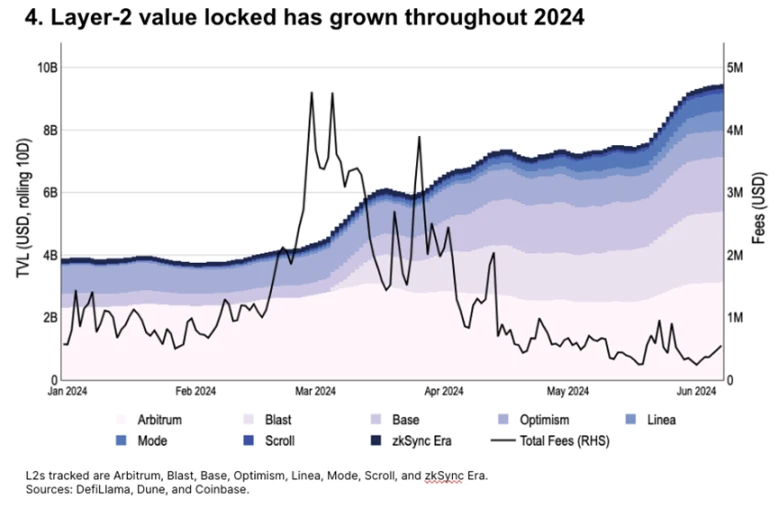
以太坊 L2 的 TVL 同比增长了 2.4 倍,截至 5 月底,L2 的总 TVL 为 94 亿美元。截至 6 月初,Base 目前占 L2 TVL 总量的 19% 左右,仅次于 Arbitrum( 33% ) 和 Blast( 24% )。

与此同时,在 3 月 13 日的 Dencun 升级中推出 blob 存储后,总交易费用大幅下降,尽管 TVL( 以及许多链上的交易计数 ) 处于历史最高水平。
Coinbase:10张图表解析加密市场基本面和技术趋势


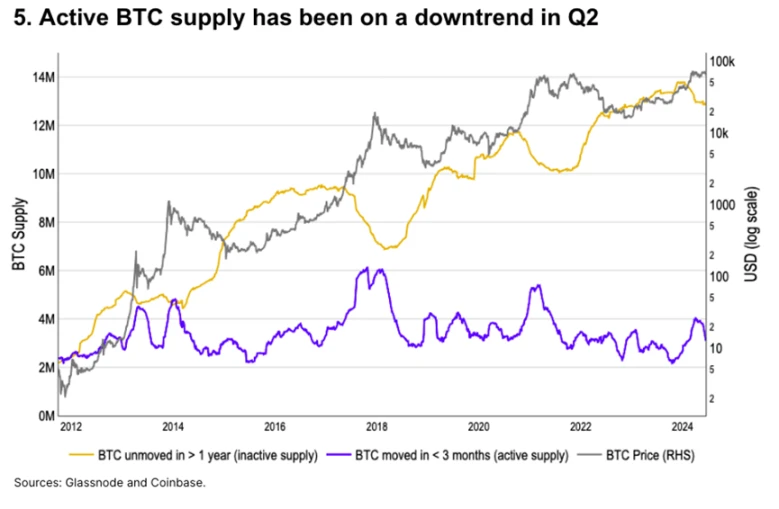
比特币活跃供应量变化

活跃比特币供应量的下降,我们将其定义为过去 3 个月移动的比特币,历史上一直落后于本地价格峰值,表明市场成交量放缓。活跃的比特币供应量在 4 月初达到了 400 万比特币的局部峰值,这是自 1 H 21 年以来的最高水平,然后在 6 月初降至 310 万比特币。

然而,与此同时,BTC 的非活跃供应,即超过 1 年未移动的 BTC,年初至今保持平稳。我们认为,这表明近期市场的乐观情绪已经减弱,尽管长期周期性投资者仍在关注。Coinbase:10张图表解析加密市场基本面和技术趋势


技术面

相关性

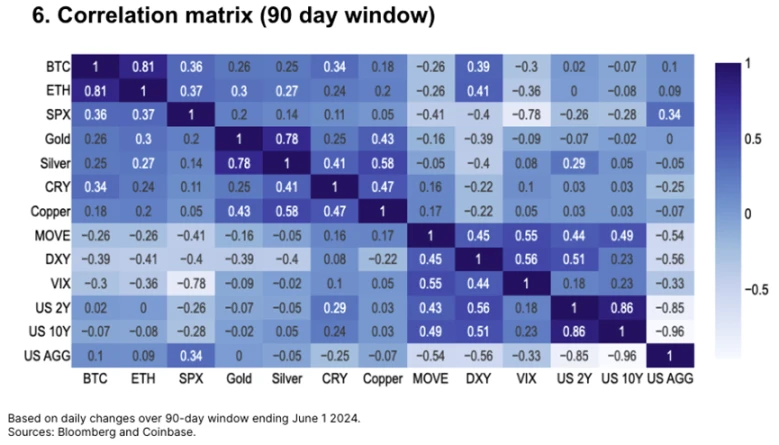
基于 90 天的窗口,比特币的回报似乎与一些关键宏观经济因素的每日变化适度相关。这包括美国股票、大宗商品和多边美元指数,尽管与黄金的正相关性仍然相对较弱。

与此同时,以太币与标准普尔 500 指数之间的相关性 ( 0.37) 与比特币与标准普尔 500 指数之间的相关性 ( 0.36) 几乎相同。与跨行业相比,加密货币对继续以高相关性进行交易,尽管 BTC/ETH 相关性从 3 月至 4 月的 0.85 峰值略有下降至 0.81 
Coinbase:10张图表解析加密市场基本面和技术趋势


增加市场流动性

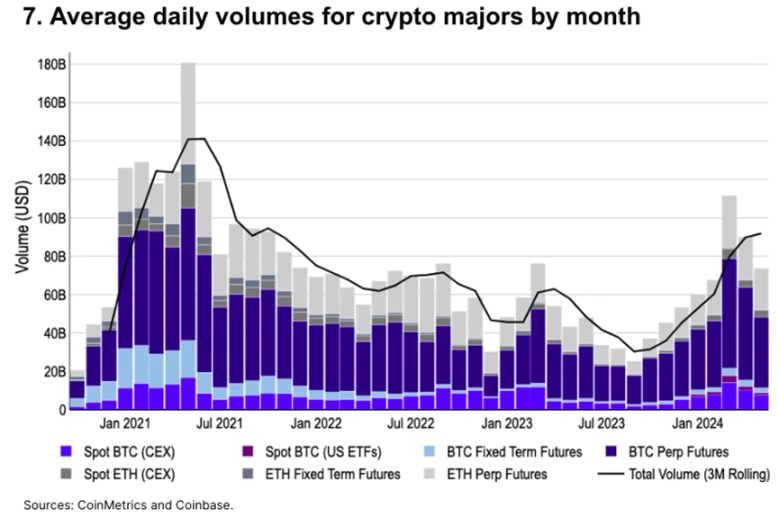
比特币和以太坊的日均现货和期货总交易量较 2024 年 3 月 1115 亿美元的峰值下降了 34% 。尽管如此, 5 月份的销售额 ( 746 亿美元 ) 仍然高于自 2022 年 9 月以来的任何一个月,除了 2023 年 3 月。

在 1 月份美国现货比特币 ETF 获得批准后,现货比特币交易量也大幅增加, 5 月份的现货中心化交易所 (CEX) 比特币交易量比 12 月份增加了 50% ( 76 亿美元对 51 亿美元 )。5 月份,现货比特币 ETF 交易量为 12 亿美元,占全球现货交易量的 14% 。
Coinbase:10张图表解析加密市场基本面和技术趋势

CME 比特币期货

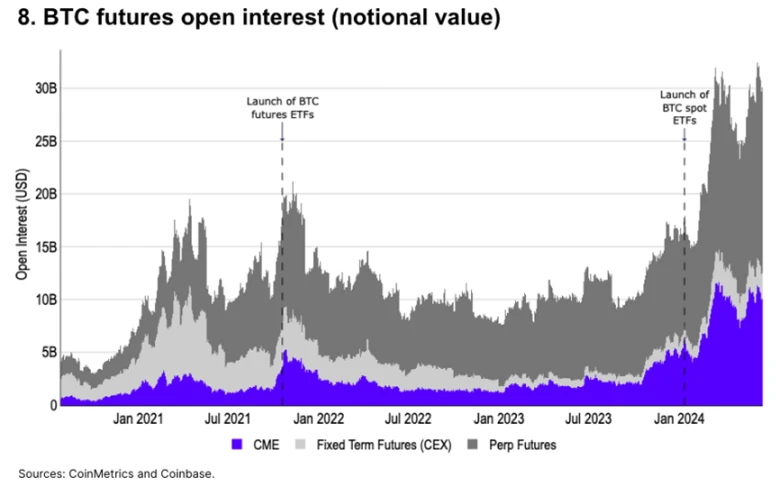
CME 未平仓合约自 2024 年初以来增长了 2.2 倍 ( 从 45 亿美元增长到 97 亿美元 ),自 2023 年初以来增长了 8.1 倍 ( 达到 12 亿美元 )。我们认为,年初至今的大部分新资金流动可归因于现货 ETF 获批后的基差交易。在它们推出后,比特币基差交易现在可以在美国完全通过传统证券经纪商完成。

永续未平仓合约也从 98 亿美元增加到 166 亿美元,全年 CME 未平仓合约的比例保持在 30% 左右 ( 29-32% )。话虽如此,CME 期货的市场份额已从 2023 年初的 16% 大幅增加,表明美国在岸机构的兴趣有所增加。
Coinbase:10张图表解析加密市场基本面和技术趋势


CME 以太坊期货

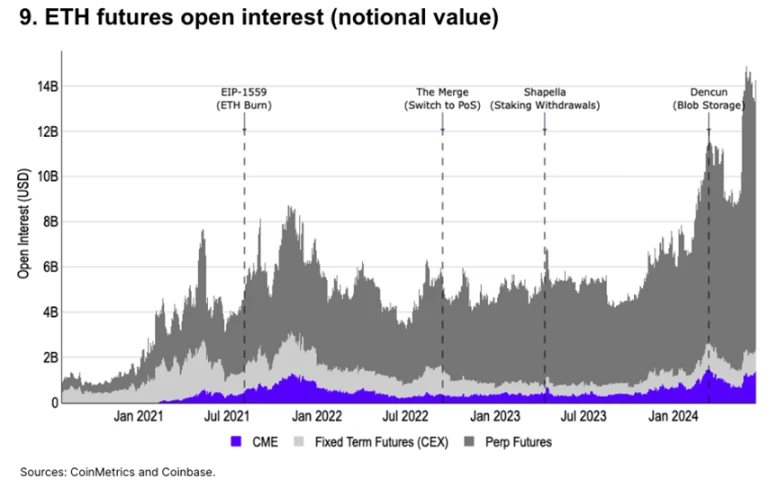
CME ETH 期货未平仓合约接近历史最高水平。然而,ETH 未平仓合约仍然以永续期货合约为主,这些合约仅在某些非美国司法管辖区可用。截至 6 月 1 日,未平仓合约交易总额的 85% ( 121 亿美元 ) 是期货交易,而 CME 期货交易仅占 8% ( 11 亿美元 )。

内源性 ETH 催化剂对未平仓合约的影响通常是可见的,在美国批准现货 ETH ETF ( 19 b-4 文件 ) 之后,未平仓合约的最后一次大幅飙升。在此之前, 3 月 13 日的 Dencun 升级令未平仓合约达到顶峰。

另外,中心化交易所的传统固定期限期货仍然很受欢迎,其未平仓合约金额与 CME 期货相当。
Coinbase:10张图表解析加密市场基本面和技术趋势


隔离 CME 比特币基差交易

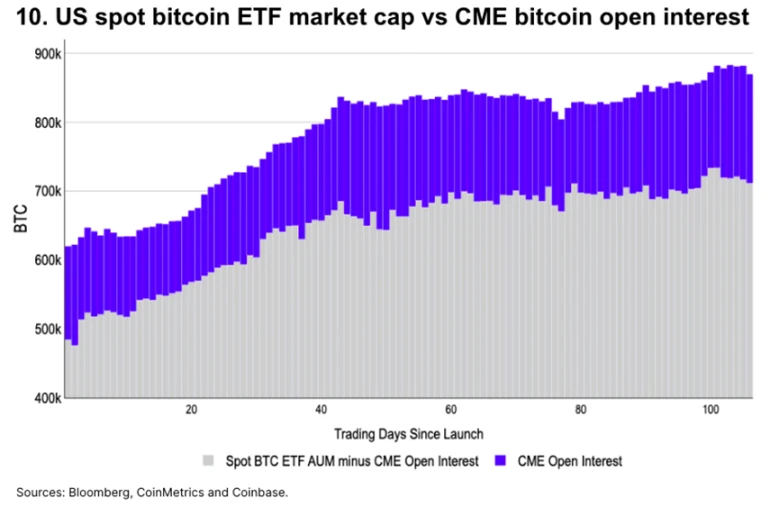
将现货 ETF 总市值与 CME 比特币未平仓合约的对比标准化表明,自 4 月初 ( 第 55 天 ) 以来,大部分现货 ETF 流动可归因于基差交易。

现货 ETF 获批后,截至 3 月 13 日 ( 第 43 天 ),ETF 托管的比特币增加了约 20 万比特币。这表明在这段时间内,比特币被定向买入,这在一定程度上解释了那段时间的价格上涨。从那以后,ETF 托管的比特币一直保持在 825-850 k 之间,直到 5 月底才强势突破这一区间。

Coinbase:10张图表解析加密市场基本面和技术趋势

Lecturas Relacionadas

Tidal Investment: We Remain Bullish on the AI Industry Chain, But for Different Reasons Now

Tidal Investments remains optimistic about the AI industry chain, but the rationale has shifted. The market is concerned about massive concurrent fundraising by tech giants like SpaceX, OpenAI, Alphabet, and Meta, fearing an AI peak. However, the authors argue this signals the next act of AI development, not its end. Capital expenditure (Capex) from major cloud providers (Alphabet, Amazon, Meta, Microsoft, Oracle) continues to surge aggressively into 2026. This investment cycle is more resilient than past hardware cycles due to its scale and complexity. Bottlenecks have shifted from chips to critical physical infrastructure like power grids, transformers, cooling, and data center construction—areas with long lead times and limited capacity for rapid expansion. Supply chain data (e.g., Eaton's orders) confirms substantial, tangible progress. Key market concerns are addressed: 1. **ROI vs. Capex Growth**: While Capex growth outpaces revenue, the authors note cloud giants have historically overcome similar phases through scale. The cycle will only be in danger if Capex guidance is cut, orders are canceled, or AI product demand falters—none of which are currently observed. 2. **Comparison to the 2000 Dot-com Bubble**: Unlike the telecom bubble, where cheap, oversupplied fiber crashed prices, AI infrastructure (especially power) is constrained, customized, and subject to lengthy approvals, making a similar supply glut and crash unlikely. In conclusion, the wave of fundraising reflects the immense, ongoing capital needs for AI's next phase, constrained by slow-moving physical bottlenecks. The AI cycle is not over; the script has simply changed.

链捕手Hace 4 min(s)

Tidal Investment: We Remain Bullish on the AI Industry Chain, But for Different Reasons Now

链捕手Hace 4 min(s)

Grayscale: These 15 Profitable Crypto Protocols Are Severely Undervalued

Grayscale Research identifies 15 top-revenue crypto protocols trading at significant valuation discounts, with many at single-digit or even 1x revenue multiples. Protocols like Pump.fun, PancakeSwap, and Meteora have market capitalizations roughly equal to their annual revenue. The report argues these financially-focused protocols (DEXs, lending, staking) are fundamentally undervalued and could benefit from the potential passage of the CLARITY Act, expected as soon as next month. This legislation aims to clarify digital asset regulation, potentially reducing institutional barriers and driving on-chain activity. The analysis breaks down the protocols into three groups: the "1x Club" (market cap ≈ revenue), mid-tier protocols with 3-9x multiples (e.g., Aave, Lido, Jupiter), and high-multiple protocols like Hyperliquid (15x) and Uniswap (37x), where valuation reflects future potential rather than current cash flows. Grayscale applies a traditional DCF model to Aave, suggesting a one-year price target of ~$175, representing ~130% upside from current levels. The report notes a risk-off macro environment since the Iran conflict has further compressed valuations, creating a potential entry window. The conclusion highlights that while the valuation data presents an intriguing opportunity, the investment thesis is contingent on the CLARITY Act's passage and subsequent institutional capital flows. Investors are cautioned to consider Grayscale's inherent conflict of interest as a crypto asset manager with products tied to these assets.

marsbitHace 32 min(s)

Grayscale: These 15 Profitable Crypto Protocols Are Severely Undervalued

marsbitHace 32 min(s)

Sam Altman's Personal Alchemy of Wealth: Investing in 400 Companies, Over 10 Deeply Tied to OpenAI

The article investigates Sam Altman's personal wealth strategy, centered around his investments in approximately 400 companies while serving as OpenAI's CEO. Despite not holding direct equity in OpenAI, Altman has built a vast portfolio, with at least 10 of his investments having commercial ties or ongoing negotiations with OpenAI. This creates a complex network of potential conflicts of interest, drawing scrutiny from U.S. congressional committees and state attorneys general. Key investments highlighted include the anti-aging startup Retro Biosciences (valued at $258 million for his stake as of late last year) and the chipmaker Cerebras, whose value soared following an OpenAI procurement deal. His most significant financial gain is linked to the nuclear fusion company Helion, where a recent funding round reportedly increased his stake's value to at least $4.1 billion. The article details a decade-long relationship between Altman, Helion, and OpenAI, including a controversial non-binding power purchase agreement and Altman's efforts to secure investments from OpenAI and its backer SoftBank for Helion. Other points include internal investigations at Tools for Humanity (developer of Worldcoin) and OpenAI's massive contracts with tech giants like Nvidia. According to Forbes, Altman's net worth is around $3.4 billion, ranking him 1251st globally—a rise of over 1400 places since 2024. OpenAI's board states that Altman's external dealings are transparent and potential conflicts are carefully managed.

Odaily星球日报Hace 53 min(s)

Sam Altman's Personal Alchemy of Wealth: Investing in 400 Companies, Over 10 Deeply Tied to OpenAI

Odaily星球日报Hace 53 min(s)

Former SpaceX Engineer Reconstructs Financial Execution System Using First Principles

Former SpaceX engineer Lex Li applies "First Principles Thinking" to financial infrastructure with Plan Execution Lab, recently raising angel funding at a $50M post-money valuation. The team argues that the core function of finance is capital allocation, and the critical gap is not in trading but in execution, which remains highly manual and fragmented. While assets, liquidity, and settlement have migrated on-chain, execution workflows (monitoring, risk management, liquidity coordination) are still human-native. In an era of accelerating AI agents, strategy decay is rapid, shifting the competitive edge from having the best strategy to having the most robust execution network. Plan Execution Lab introduces two core components: 1. **PlanX**: A Financial Execution Protocol designed as infrastructure for the migration from CEX to DEX, providing on-chain execution capabilities, liquidity access, risk management, and capital orchestration. 2. **Xgent**: An Autonomous Financial Runtime. Users define investment intents, risk preferences, and constraints; Xgent automatically constructs an execution graph, verifies it, and handles ongoing execution and optimization—streamlining the process from Intent to Autonomous Execution. The long-term vision is to create the "Bloomberg Terminal for Autonomous Finance"—a shared operating environment and execution network built collectively by participants like execution nodes, liquidity providers, and autonomous agents. The future of finance, they contend, belongs not to isolated algorithms but to open, collaborative execution networks.

marsbitHace 1 hora(s)

Former SpaceX Engineer Reconstructs Financial Execution System Using First Principles

marsbitHace 1 hora(s)

Trading

Spot
Futuros
活动图片