This Is the Most Crypto-Friendly Country in the World, According to Analysis Firm Coincub

Daily HodlPublicado em 2022-04-16Última atualização em 2022-04-16

Resumo

A new study from crypto insights firm Coincub is shedding light on the most accommodating...

A new study from crypto insights firm Coincub is shedding light on the most accommodating markets in the world for the digital asset industry.
Coincub’s latest report says that Germany has now replaced Singapore as the most crypto-friendly country on earth.
The analytics firm highlights a number of key developments over the past year that have helped Europe’s largest economy to overtake Singapore.
“Germany is already one of the world’s most crypto-friendly countries. The country also has the highest number of Bitcoin nodes besides the US, but with a smaller population and GDP demonstrating an even greater commitment to crypto. There have been several positive developments over the last few months.
The Federal Financial Supervisory Authority issued a crypto custody business license for Coinbase’s German arm earlier this year. German stock market operator Deutsche Boerse has also listed more than 20 crypto exchange-traded products on its digital exchange, Xetra. The Sparkasse savings bank looking into offering wallets to trade crypto is a huge step for institutional acceptance.”
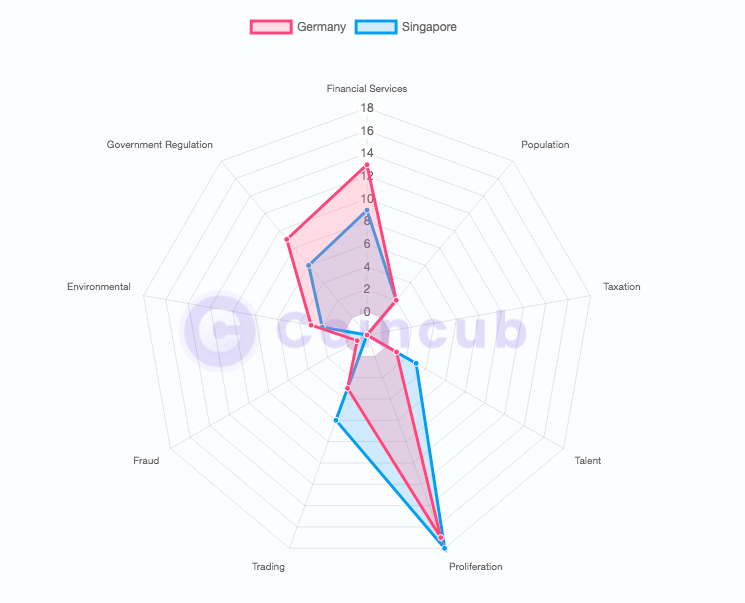
Source: Coincub With Singapore now ranked second, the United States now sits in third, followed by Australia, Switzerland and Hong Kong.
Coincub says that the United Arab Emirates (UAE) has become a new country on the list, appearing at number 22 after previously taking a hard stance against crypto with bans on trading and other activity. India has moved up to number 19, but as Coincub says, suffers from indecisive government policy.


Leituras Relacionadas

Bitcoin's 'Rally Ends,' Officially Entering the Later Stage of a Bear Market?

Bitcoin prices declined 13% this week, reversing the recent rebound and signaling a likely transition into the later stages of a bear market. Key on-chain metrics deteriorated, with the short-term holder cost basis falling below the Realized Price—a pattern last seen in early 2022, characteristic of bear market maturity. The rally to ~$82k proved to be a bear market bounce, as evidenced by the 90-day realized profit/loss ratio failing to sustain above the bullish threshold of 2. Daily realized losses surged to $1.35B, including significant selling from long-term holders who accumulated near cycle tops, indicating ongoing supply redistribution. Price was rejected almost precisely at the aggregate US spot ETF cost basis of ~$83k, turning that level into resistance and leaving the average ETF investor underwater again. Spot market selling pressure intensified, with the 7-day volume delta turning significantly negative to its weakest level since February. While a major long liquidation event cleared over $400M in leverage, spot demand has not yet stepped in to absorb the resulting supply. Options markets continue pricing in higher future volatility (elevated volatility risk premium) and maintain a skew toward put options, reflecting persistent demand for downside protection, though not yet panic. Overall, market structure remains fragile. Sustained recovery likely requires a reclaim of the ETF cost basis, a shift back to positive spot demand, and a slowdown in realized loss-taking. Until then, the market risks further downside or extended consolidation within the broader bear trend.

Foresight NewsHá 56m

Bitcoin's 'Rally Ends,' Officially Entering the Later Stage of a Bear Market?

Foresight NewsHá 56m

How Risky is the "Death Spiral" of MSTR and STRC?

Summary: This article explores the perceived "death spiral" risk between MicroStrategy (MSTR), its Bitcoin holdings, and its perpetual preferred stock (STRC), drawing comparisons to the LUNA-UST collapse. While both systems feature price anchors, high yields for holders, and potential feedback loops, their core mechanisms differ fundamentally. The MSTR-STRC structure relies on continuous financing to sustain its high dividend payouts, primarily through stock ATM offerings. A negative feedback cycle could occur: falling MSTR stock price makes raising equity capital harder, increasing pressure to sell Bitcoin, which undermines STRC confidence and further depresses MSTR. However, unlike LUNA-UST's automated, direct linkage, the MSTR-STRC loop is weaker and has brakes: STRC dividends can be deferred or rates lowered, and STRC holders have a $100/share liquidation preference in bankruptcy, providing a price floor. The company's sustainability hinges on its ability to continue financing. Its current ~$900 million USD reserves cover only about 6.3 months of its ~$1.71 billion annual interest/dividend burden. The next six months are critical, aligning with both the potential bottom in Bitcoin's four-year cycle and the depletion timeline of its reserves. While a LUNA-style catastrophic collapse is deemed highly unlikely due to structural differences, the key question is whether MicroStrategy can navigate this period through healthy deleveraging to restart its capital engine.

Foresight NewsHá 1h

How Risky is the "Death Spiral" of MSTR and STRC?

Foresight NewsHá 1h

Trading

Spot
Futuros
活动图片