[Featured Research]Why I Think Selling My #BLUR Airdrop Was a Mistake

MirrorPublished on 2023-02-21Last updated on 2023-02-21

Abstract

The key is product experience. Majority of their portcos prioritise this, Blur is no exception.

Over the weekend, I've been renewing my personal thesis for $BLUR, why I think selling my airdrop was a mistake, and why Blur Bidding is a game-changer for the NFT space.
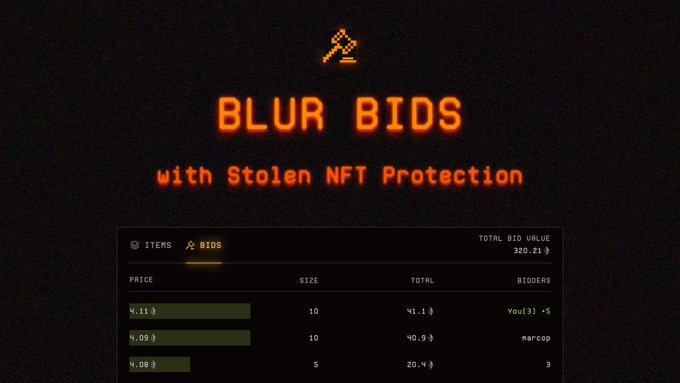
What is the most important aspect wrt product experience on NFT marketplaces? Ease of buying/selling NFTs.

ADVANTAGE OF BLUR

The majority of trading volume in the current state of the NFT market is from whales, and they want one thing: To be able to buy cheaper and sell quickly in SIZE

Compared to the DeFi space, the trading experience for NFTs is subpar. Before blur_io came along, the user experience was terrible and was not optimized for the professional, mass trading market.

NFT trading needs to (at least) attain the usability of fungible tokens in DeFi

Here comes the second (and likely the hardest) pain point: Liquidity.

While attempts have been made to solve this, including (but not limited to) NFT fragmentation, asset tokenization, and incentivization (via trading volume/listing rewards), liquidity is still extremely thin.

If I was looking to sell off 20 Doodles NFT today, it would've been impossible, likely taking days to weeks to unload fully, not to mention a downward spiraling floor price + me needing to actively re-adjust the floor price.

So what did @blur_io do? Introducing the Bid Points system.

Blur's bid mining model is essentially a liquidity pool transaction where users provide ETH (not WETH!) liquidity to a liquidity pool, a parallel comparison would be Uniswap's AMM innovation for the DeFi space.

On the other hand, opensea, LooksRare , and the_x2y2 models are pending order transactions, which makes them illiquid/inaccurate.

Blur's bidding system then incentivizes users who want the airdrop to provide liquidity and bear the risk of NFT prices once the bid is accepted.

In essence, what blur_io did right was find the right PMF (Pro NFT traders) and design a platform that focuses on the best-in-class product experience.

Users get deeper liquidity on Blur than OpenSea, allowing whales to buy/sell large amounts of NFTs frictionlessly.

GREAT AIRDROP

With $BLUR's release, the project imo is one of the most successful projects in transferring the power of protocol value distribution to the community.

The initial circulating supply of 360M tokens (12%) of supply) were distributed to the community, but what about the rest?
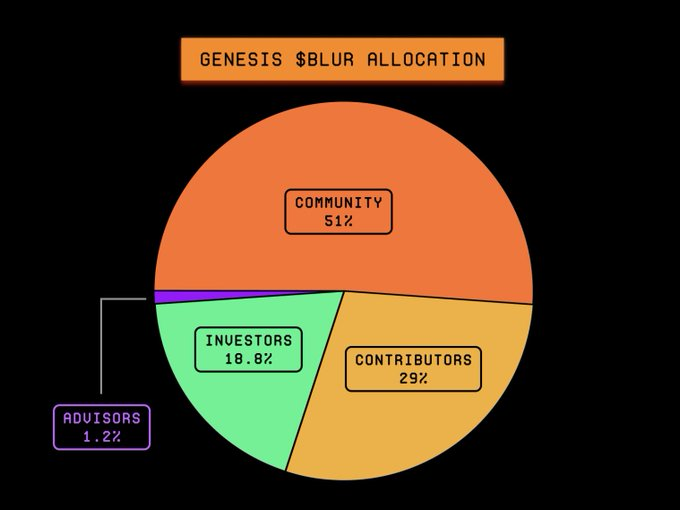
Majority of the airdrop in the first round has already been claimed, and over billions in $BLUR trading volume. Users who wanted to sell the airdrop would have already sold by now and the tokens are transferred to stronger hands.

The first year selling pressure is likely to be high, as circulating supply will increase by nearly 3x to 1 billion by the end of this year. Even so, the majority of the tokens are owned by the community. Investor/Team allocations are also subjected to a 4+ year vesting period

In my view, $BLUR is a proxy of the NFT market and a pure-play bet on the space since Blur benefits when NFT collections rise as a whole.

Assuming Blur becomes the market leader in the future, the current implied FDV of $2-3B is likely justified, given OS valuation of $13B

GREAT NEWS AHEAD

The largest exchange binance has yet to even list $BLUR, and once Blur's clear volume dominance is sustained and gains further traction, it will be inevitable.

Further, if that traction continues to gain steam, additional funding will come pouring in too.

ADVANTAGE COMPARE TO OTHER PLAYERS

Even if OS wanted to compete, they would have to reduce costs to traders and royalties (and they already did), but to really compete with Blur on liquidity, they likely have to switch to a similar model to Blur. (although that offers zero differentiation from Blur lol)

Further, building out a new product might potentially introduce bugs, which could completely destroy OS.

Wen $OS? Imo, highly unlikely, given the regulatory landscape and their desire to IPO. It also doesn't make sense from the business/investor POV; why would they give away their profits?

Also, PacmanBlur and the Blur team understand the NFT market deeply, perhaps better than OpenSea themselves. LooksRare and X2Y2 were focused on incentivizing trading volume instead of the most important thing: Liquidity.

The models used by Looksrare and X2Y2 incentivize wash trading, essentially fake volume that does nothing to improve the product experience. In other words, ponzinomics designed to attract retail who wants a dividend payout. Nothing wrong with that, btw. To each his own.

When the airdrop/token incentives end, how does Blur plan to sustain its liquidity depth? Good question, but this has been reiterated many times in multiple podcasts with @PacmanBlur, and the team is well aware of this and will be optimizing for growth long term.

Being a 2-sided marketplace, as long as user experience is top-notch and prioritized by the team, users will remain sticky to the platform. So product experience = #1

A case in point is OpenSea. Even without a token, users kept using it, of course, until Blur came along.

The Blur team is currently not making $$ themselves since marketplace fees are currently still 0%. And as everyone knows, they are @paradigm backed, but what does that even imply?

The key is product experience. Majority of their portcos prioritise this, Blur is no exception.

Related Reads

Podcast Notes: Hyperliquid Has Become the Top Interest Point for Traditional Hedge Funds

Empire Podcast hosts Jason Yanowitz and Santiago Santos discuss the surging institutional interest in Hyperliquid, a decentralized perpetual exchange, marking the highest level of engagement from traditional hedge fund managers since Paul Tudor Jones endorsed Bitcoin in 2020. The primary driver is the demand for weekend trading of commodities like oil, especially during geopolitical tensions such as the Iran conflict, as Hyperliquid provides the only active price discovery venue when traditional markets are closed. Trade XYZ, a front-end on Hyperliquid, has seen significant growth, with weekend oil price predictions having a median error of only 50 basis points. Santos predicts commodity trading volume on Hyperliquid will surpass Bitcoin within the year and that its market cap could rise from $25 billion to $100 billion. Other key points include Kraken raising $200 million at a reduced valuation of $13.3 billion, and the SEC clarifying that self-custodied DeFi frontends like MetaMask are not subject to broker-dealer rules, resolving a major regulatory uncertainty. The hosts also note the strong correlation between crypto and macro markets, with the S&P 500 posting one of its best 10-day rallies since 1950. They highlight MicroStrategy's continued Bitcoin acquisitions and the potential of real-world asset (RWA) tokenization as a key trend. The discussion concludes with skepticism towards many L2 projects, predicting a wave of protocols truly going to zero as capital concentrates in proven assets like Bitcoin and Hyperliquid.

marsbit34m ago

Podcast Notes: Hyperliquid Has Become the Top Interest Point for Traditional Hedge Funds

marsbit34m ago

a16z: The Next Frontier of AI, The Triple Flywheel of Robotics, Autonomous Science, and Brain-Computer Interfaces

a16z presents a comprehensive investment thesis for the next frontier of AI: Physical AI, centered on a synergistic flywheel of robotics, autonomous science, and novel human-computer interfaces (HCIs) like brain-computers. While the current AI paradigm scales on language and code, the most disruptive future capabilities will emerge from three adjacent fields leveraging five core technical primitives: 1) learned representations of physical dynamics (via models like VLA, WAM, and native embodied models), 2) embodied action architectures (e.g., dual-system designs, diffusion-based motion generation, and RL fine-tuning like RECAP), 3) simulation and synthetic data as scaling infrastructure, 4) expanded sensory channels (touch, neural signals, silent speech, olfaction), and 5) closed-loop agent systems for long-horizon tasks. These primitives converge to power three key domains: * **Robotics:** The literal embodiment of AI, requiring all primitives for real-world physical interaction and manipulation. * **Autonomous Science:** Self-driving labs that conduct hypothesis-experiment-analysis loops, generating structured, causally-grounded data to improve physical AI models. * **Novel HCIs:** Devices (AR glasses, EMG wearables, BCIs) that expand human-AI bandwidth and act as massive data-collection networks for real-world human experience. These domains form a mutually reinforcing flywheel: Robotics enable autonomous labs, which in turn generate valuable data for robotics and materials science. New interfaces provide rich human-physical interaction data to train better robots and scientists. Together, they represent a new scaling axis for AI, moving beyond the digital realm to interact with and learn from physical reality, promising significant emergent capabilities and value.

marsbit52m ago

a16z: The Next Frontier of AI, The Triple Flywheel of Robotics, Autonomous Science, and Brain-Computer Interfaces

marsbit52m ago

Conversation with Bitwise Advisor: From K-Shaped Economy to AI Taking Jobs, How Can Bitcoin Save the Younger Generation?

Jeff Park, a macro strategist and advisor at Bitwise, argues that the traditional financial system is broken, particularly for young generations. He describes a "K-shaped economy" where asset inflation enriches the wealthy while leaving others behind, with unaffordable housing as a key symptom. Park explains that real estate is often a depreciating asset due to maintenance costs and taxes, yet it remains unattainable for many young people due to distorted demand from global capital flows. He proposes Bitcoin as a superior store of value—scarce, portable, and free from maintenance costs or excessive taxation. By diverting capital away from real estate, Bitcoin could help lower housing prices and increase accessibility. Park also discusses the decline of traditional "smart investing" (e.g., value stocks) and the rise of "ideological investing" in non-correlated assets like crypto, luxury goods, and collectibles. On AI, Park warns it could trigger extreme social inequality by eliminating jobs while boosting corporate profits. He believes this will push younger generations toward Bitcoin, not only as a hedge but also as a symbol of decentralization and data sovereignty—offering an alternative to centralized AI systems that use personal data without fair compensation. He advises a diversified portfolio with Bitcoin as a core holding to hedge against currency devaluation and systemic risk.

marsbit2h ago

Conversation with Bitwise Advisor: From K-Shaped Economy to AI Taking Jobs, How Can Bitcoin Save the Younger Generation?

marsbit2h ago

Trading

Spot
Futures
活动图片