[Featured Research]What Has Changed In Crypto Market?

MirrorPublicado em 2023-02-17Última atualização em 2023-02-19

Resumo

What Others Should We Know About The Market?

How crypto market has changed in 2023-- 5 lessons from recent bull run:

A closer look at the January mini bull run and what you can learn from it as an investor/speculator—

1. Rotation no more

Liquidity rotation used to be structural feature of crypto mkt— at onset of a bull run, large caps (BTC, ETH) rose the most & once mkt participants made gains on those, liquidity shifted to smaller caps, prompting them to pump next.

The rotation game is so 2021.

Most recent (mini) bull run in Jan 2023 showed different mkt progression. Once up cycle started in early Jan, it took mere 2 wks for 80%+ of tokens among top 1000 mkt caps to rise above their 40-day moving average.
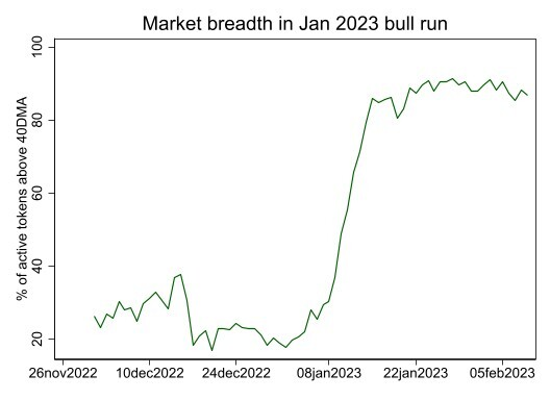
In contrast, back in 2019 (similar stage of cycle) it took the mkt 3 mos & multiple small hype cycles for 80% of top tokens to rise over 40dma.
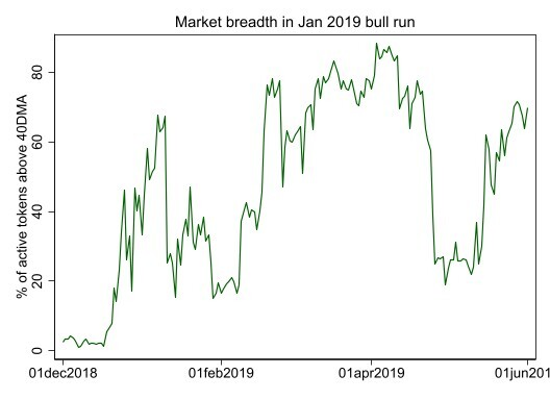
In other words, while there was distinctive liquidity rotation back in 2019, it doesn't work that way anymore. Once mkt up trend started everything that can go up goes up almost all at once.

Why the change?

Many reasons. For example—

Token listings on large exchanges have broadened. Mkt participant profiles have shifted & diversified. Rotation game has become public knowledge that everyone now wants to exploit & front run. Plus, a lot more liquidity on sideline now compared to a few yrs ago.

I'll talk abt what this means to you as individual investor in a min.

2. Underdogs lead recovery at market bottom

At mkt turning point coming out of long bear trend, downtrodden names that lead previous downturn also tend to lead subsequent recovery. This is a structural feature in other risk asset mkts as well not just crypto.

Chart below plots % gains in Jan 2023 against % gains in prior yr for mid-cap-and-above tokens (mkt cap > $250 mn). Study the chart & reach your own conclusion. Hopefully it's an obvious one.
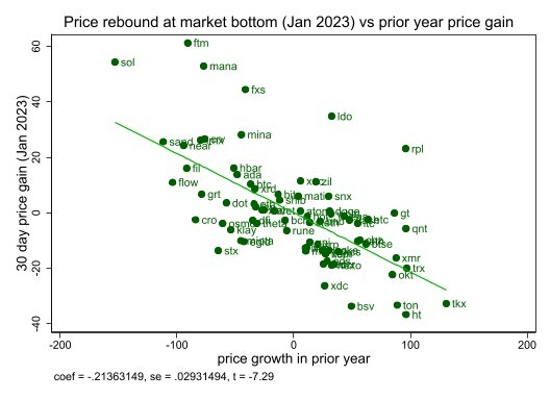
Does this relationship hold in other market conditions? No.

This underdog-to-growth-star phenom is unique feature for when mkt has strong reversal from deep bottom.

3. Market cap matters (sort of)

There's significant inverse correlation btw token mkt cap and price gain among smaller cap tokens (<$230 mn mkt cap) during recent up move, after controlling for prior year price gain & age of token.
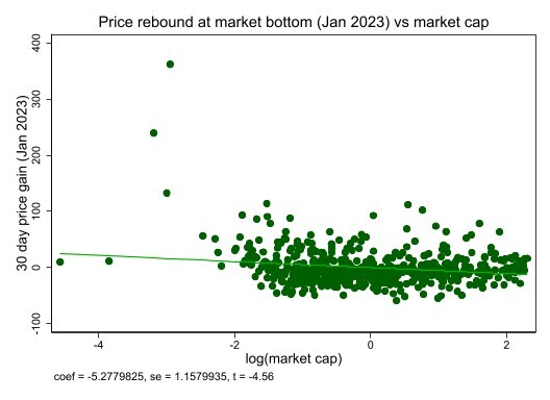
Among larger cap tokens this relationship does not exist esp in the $250 mn to $10 bn mkt cap range.

In other words conventional wisdom that smaller caps make bigger moves is true to some extent, but only if you're looking among small up-and-coming names, which is not practical for anyone w/ more than a few thousand $ to deploy since those are usually thinly traded.

4. Expect shorter cyclical moves in bear mkt

Bull runs in bear mks have shorter shelf life.

January mini bull run lasted in earnest for a month w/ majority of move done in 1st 2 wks of Jan. You can observe same pattern from previous run-up in July/August 2022.

These are distinctively shorter runs compared to up cycles in a bull mkt. The hostile macro environment means pumps are more fragile & prospect for continued buying demand after an up move is highly uncertain.

5. Rethink what the "fundamentals" mean

This is not a new pattern, but worth your attention b/c it'll persist.

Traditional metrics Wall St uses to evaluate company fundamentals—e.g. sales, earnings, margins— are mostly useless in crypto, at least at this stage.

I know it sounds politically incorrect but the biggest *fundamental* for any token is the amount of attention it can attract. Period.

What attracts attention?

For example:

· Over hyped themes— e.g. AI, zero knowledge, liquid staking.

· Big $ initiatives— e.g. $300 mn developer grants.

· Key personnel changes— e.g. famous so-and-so comes back as CTO.

Here's a list of top gaining tokens in Jan w/ $200 mn+ mkt cap (tokens w/ < 1 yr history excluded). Half have some attention driving narrative at play (aside from the fact, as discussed earlier, most of these are down horrendously bad, which is in itself an attention driver).
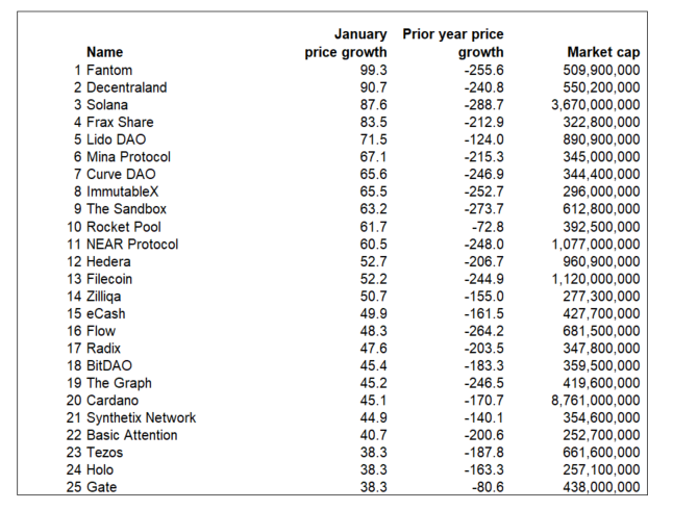
Do some research yourself. Can you identify what the driver is on each?

You may think a certain attention grabbing narrative is stupid or unjustified.

Well, first, tell that to the market & see if it cares.

Second, this is actually a rational behavior by the mkt despite appearing otherwise. Crypto projects at current stage are not steady money-making enterprises. They are experimental tech.

All that matters to the fate of experimental techs is whether they'll get mass-adopted. What would be a good predictor of that? The number of eyeballs they attract.

So the phenom of attention/narrative driving prices is really just mkt trying to deduce a project's growth prospect from however little information there is available. It's entirely rational if you ask me.

What all this means for you as an investor/speculator

What can you do to take advantage of evolving mkt features discussed above? A few ideas:

1. Be flexible & nimble when macro conditions are hostile. There'll be bull runs even in worst mkts but you need to act quickly & be vigilant on both entries & exists since these runs'll be more ephemeral than usual.

2. If you wait for rotation from large caps to the rest you'll be front run. There's hardly any rotation anymore. When mkt turns everything goes up together.

3. At mkt turning point out of major down trend, focus on beaten-down underdogs. If your capital size is small, focus on smaller caps as well.

4. Your time may be better spent researching the next attention-driving narratives & themes rather than studying technical analysis. Just sayin' ;)


Leituras Relacionadas

When Futu Turns into a Matchmaking Corner: Overseas Identity Becomes the Hard Currency for the Middle Class

When Futu Becomes a Matchmaking Corner: Overseas Status as the New Hard Currency for China's Middle Class Following a severe penalty announcement from Chinese regulators on May 22nd targeting offshore brokerages like Futu, its app community unexpectedly transformed into an impromptu matchmaking platform. Users posted相亲 (matchmaking) requests, explicitly seeking partners with overseas residency or citizenship, revealing a stark new reality: for China's middle class, an overseas identity has become a crucial asset. The regulatory crackdown, which restricts mainland Chinese residents from opening new accounts to buy overseas securities like US stocks, has sharply escalated the value of a foreign passport or permanent residency. This status now acts as a gateway to global asset allocation—including US equities, offshore property, and foreign currency deposits—effectively becoming a new form of "hard currency." Its scarcity, non-transferability (except through marriage, inheritance, etc.), and role as a hedge against domestic uncertainty have driven its premium. The article traces the evolution of how China's middle class views overseas resources: from an investment for opportunity (2000s), to risk diversification (2010s), and now to a mandatory "insurance policy" for financial access. With the regulatory window closing for many, the demand is shifting towards securing such status for the next generation through international education. The surreal scene of high-performing investors posting dating resumes underscores a 2026 where financial talent can be secondary to the right passport.

marsbitHá 26m

When Futu Turns into a Matchmaking Corner: Overseas Identity Becomes the Hard Currency for the Middle Class

marsbitHá 26m

Understanding Bound in One Article: The "Multi-signature + Timelock" Escape Mechanism and the Off-Chain Matching Black Box

**Title**: Understanding Bound: The Escape Mechanism of "Multi-Sig + Time Lock" and the Off-Chain Matching Black Box **Summary**: Bound Exchange, evolved from the earlier radFi platform, introduces a novel approach to Bitcoin trading by combining self-custody security with exchange-like speed. Its core mechanism relies on a 2-of-2 multi-signature (multi-sig) address for user deposits. One private key is held by the user via a passkey, and the other is held by Bound. This setup requires both keys to sign any transaction, preventing Bound from unilaterally accessing user funds (non-custodial). To address the risk of Bound becoming unavailable, a 3-month timelock is integrated into the Bitcoin script. After this period, users can withdraw their assets with just their single signature, ensuring an escape hatch. For trading, Bound operates a concentrated liquidity AMM. However, as Bitcoin L1 lacks smart contracts, the AMM curve, liquidity management, and trade price calculations occur off-chain in Bound's backend database. On-chain Bitcoin transactions serve only as final settlement receipts for pre-determined amounts. This creates a centralization point: the critical sequence of trade execution—which determines the exact price along the curve for each order—is managed off-chain by Bound in a non-transparent "black box." While the 2-of-2 setup protects user本金 (principal), the pricing and ordering of trades introduce potential operational MEV risks, as the order processing is invisible and unverifiable on-chain. In practice, users can also connect external wallets (like Unisat) for fully self-custodied trading, but this requires manually signing every transaction. The platform currently supports deposits of BTC and Runes only.

marsbitHá 30m

Understanding Bound in One Article: The "Multi-signature + Timelock" Escape Mechanism and the Off-Chain Matching Black Box

marsbitHá 30m

Technology Has No Barriers, 24/7 Trading is the Key to Hyperliquid's Success

The article argues that Hyperliquid's competitive edge lies not in technological superiority but in its 24/7 trading model, which fundamentally challenges traditional finance's fixed market hours. Based in Singapore with an 11-person team, Hyperliquid has generated significant revenue and trading volume. Its core advantage is the ability to facilitate trading continuously, including during weekends when major exchanges like the CME are closed. This was demonstrated when Hyperliquid listed a SpaceX pre-IPO perpetual contract on a Sunday, allowing the market to price the company hours before traditional institutions opened. This disruption has drawn regulatory scrutiny from traditional giants like CME and ICE, who cite risks like lack of KYC and market manipulation. However, the article suggests their concern stems from Hyperliquid eroding the "time monopoly" of established markets. The piece contrasts Hyperliquid's synthetic derivatives—pure price-betting contracts with no underlying asset or centralized issuer—with other models like PreStocks (dependent on real股权) and Ondo (licensed but targetable). Hyperliquid's code-based, decentralized structure makes it resilient to takedowns, even if founders face legal action. Ultimately, the author concludes that while it raises legitimate regulatory questions, Hyperliquid's "unforgeable" competitive barrier is the time advantage of non-stop trading, a feature legacy systems cannot replicate.

marsbitHá 36m

Technology Has No Barriers, 24/7 Trading is the Key to Hyperliquid's Success

marsbitHá 36m

New Information Laundering in Prediction Markets: How Secrets Blend into Investment Signals

"The New Information Laundering in Prediction Markets: How Secrets Infiltrate Investment Signals In late February 2026, nine linked anonymous wallets on Polymarket placed over 80 bets on specific details of a US-Iran war, winning over $2.4 million with a 98% win rate. This exemplifies 'information laundering'—a destructive flaw inherent to prediction markets. These markets function by aggregating trader supply and demand on an order book to set prices, which represent collective probability estimates. This makes them valuable real-time sentiment indicators for institutions. However, the system cannot distinguish between public information and stolen secrets. Confidential information enters one end, and 'clean' market prices—bearing no trace of their illicit origin—emerge from the other. For example, an insider knowing of an imminent strike can buy contracts at low odds, pushing the price up and disguising the secret as a savvy market signal, then profit massively when the event occurs. Analysts can sometimes uncover these schemes due to the blockchain's transparency, as seen with Bubblemaps. Paradoxically, this same transparency can inadvertently broadcast secrets to adversarial observers, providing them with low-cost intelligence. Current laws, like insider trading regulations focused on corporate information, fail to address this issue, especially concerning events like military actions with no 'issuer.' Jurisdictional challenges are amplified as platforms operate offshore, easily bypassing national bans with VPNs. Recent US congressional investigations and proposed bills aim to ban war betting and trading on non-public information by officials. The core issue is that information laundering is not a bug but a feature: a market that perfectly converts knowledge into price will inherently reward those with the best information, including those who obtained it illicitly. As prediction markets grow, potentially reaching hundreds of billions in volume, society must confront whether it can tolerate a machine that profitably transforms its most guarded secrets into public, tradable numbers."

链捕手Há 45m

New Information Laundering in Prediction Markets: How Secrets Blend into Investment Signals

链捕手Há 45m

Trading

Spot
Futuros
活动图片