The live price of Bitcoin (BTC) is $63,988.40 USD and its current market capitalization is $-- USD.
Get real-time BTC/USD updates on HTX. Stay informed with the latest data and market trends to make smart trading decisions. HTX, your trusted source for accurate cryptocurrency price information.
Bitcoin Key Stats
24h Volume (USD)
$--
Price Change Today
--
Circulating Supply (BTC)
20.06M
Sign up and trade to win rewards worth up to 1,500 USDT.Join Now
BTC Price Performance
Track Bitcoin price movements with chart views spanning 1 day, 30 days, 60 days, 90 days, 1 year, and the period since it was listed on HTX.View more data for the Bitcoin prices
Time
Change
Change%
Highest Price
Lowest Price
No data
BTC Market Information
Get the latest Bitcoin price details on HTX: 24-hour high and low, all-time high (ATH), and daily price change percentage.
24h Low
$0
24h High
$0
All-Time High
$0
Market Cap
$0.00
24h Volume (USD)
$--
Circulating Supply
--
What is BTC?
Bitcoin is a digital asset and a payment system invented by Satoshi Nakamoto who published a related paper in 2008 and released it as open-source software in 2009. The system featured as peer-to-peer; users can transact directly without an intermediary.
It's super easy to buy BTC on HTX. Simply click here to view a complete guide to buying Bitcoin with ease.
Real-Time BTC Markets
View real-time Bitcoin prices on HTX's spot markets. Switch between spot and futures markets to instantly compare live prices and 24-hour price changes.
Based on the historical performance of Bitcoin, our prediction tool estimates that the price of Bitcoin (BTC) could reach -- by --.
Predicted BTC Price in --
Our most recent forecast indicates the price of Bitcoin (BTC) will increase to -- by --, with a price change of --% and a cumulative ROI of approximately --%.
Buy your first BTC on HTXSign Up
BTC FAQs
QWhat is the Bitcoin (BTC) price today?
AThe current price of Bitcoin (BTC) is $63,988.40 USD.
QWhat is the Bitcoin (BTC) market cap?
AThe current market capitalization of Bitcoin (BTC) is $0.00 USD, calculated by multiplying its circulating supply by its current price.
QWhat is the Bitcoin (BTC) circulating supply?
AThe current circulating supply of Bitcoin (BTC) is -- BTC.
QWhat is the Bitcoin (BTC) all-time high?
AAs of 2026-08-11, the all-time high of Bitcoin (BTC) is $0 USD.
QWhat is the Bitcoin (BTC) 24h trading volume?
AThe 24-hour trading volume of Bitcoin (BTC) is -- USD on HTX.
QCan I buy Bitcoin (BTC) on HTX?
AYes, HTX offers industry-leading trading fees and deep liquidity, ensuring a smooth and secure Bitcoin (BTC) purchase experience.
American Bitcoin (NASDAQ: ABTC) shares surged after insider buying. Board member Justin Mateen, co-founder of Tinder, purchased approximately $1.93 million worth of shares over two days in early August. Following the purchases, ABTC stock rose about 10% in 24 hours to $7.11.
Mateen's buy is reportedly the largest insider purchase at the company in the past year. Insider ownership stands at about 7.1%. Analysts' ratings are mixed, with consensus being "Hold" and an average price target of $45.
Despite the recent uptick, ABTC shares remain down over 95% from their post-IPO high. The company recently executed a 1-for-15 reverse stock split to maintain its Nasdaq listing. It reported a Q2 2025 net loss of $57.2 million, an improvement from Q1, driven partly by an $71.1 million loss on its Bitcoin holdings despite mining a record 932 BTC. American Bitcoin now holds over 8,300 BTC, ranking 16th among public corporate holders.
Bitcoin, the leading cryptocurrency by market cap, peaked above $126,000 in early October before entering a prolonged decline. By August, it was mainly trading between $63,000 and $65,400, inflicting losses on late buyers but resulting in what is, historically for Bitcoin, an unusually shallow bear market—down about 49% from its peak, compared to typical 75-80% plunges.
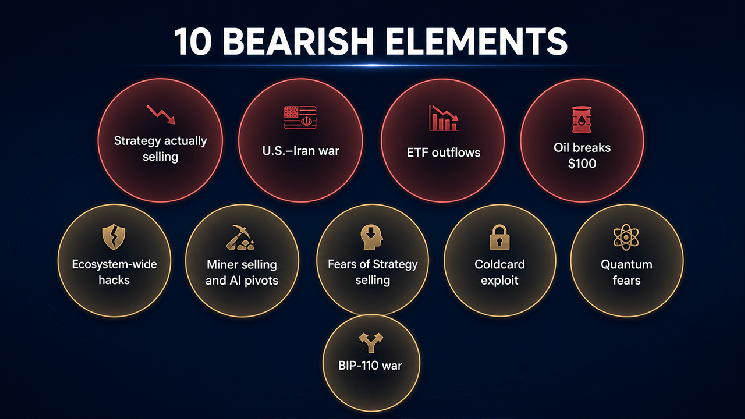
Throughout 2026, Bitcoin faced multiple headwinds yet demonstrated notable resilience. Geopolitical tensions in the Middle East and volatile oil prices revived inflation concerns but failed to trigger the panic-driven sell-offs seen in prior cycles. A significant psychological blow came from corporate seller MicroStrategy, a longtime accumulator, which began strategic sales to bolster its cash position, reducing its holdings. U.S. spot Bitcoin ETFs also faced sustained outflows, though a late-week inflow hinted at potential relief.
Pressure also came from within the ecosystem. A contentious blockchain proposal, BIP-110, failed after a minority chain stalled. Miners, facing tighter economics, sold reserves and pivoted infrastructure toward AI. A major security breach involving Coldcard hardware wallets saw an estimated 2,000 BTC stolen, shaking confidence in self-custody. Long-term threats like quantum computing resurfaced in discussions.
Despite this confluence of corporate selling, ETF outflows, miner capitulation, geopolitical shocks, internal conflict, and security issues—any one of which could historically cause sharp declines—Bitcoin stubbornly held above a key $60,000 support level. Deeper market liquidity, regulated products, and long-term holders appear to be absorbing selling pressure that once would have caused deeper crashes.
This resilience suggests a maturing market structure, though risks remain. Another shock could still push Bitcoin toward $50,000. For now, its 49% decline, severe for most assets, is relatively moderate by Bitcoin's own volatile standards. The remaining months of 2026 will test whether $60,000 is a durable floor or merely the next major line of defense.
AI startup Anthropic is aggressively expanding its computing power capacity. According to Bloomberg, Anthropic has signed a long-term cloud computing contract with Bitcoin mining company Riot Platforms worth $9.1 billion over 20 years. This is part of a recent series of massive compute procurement deals by Anthropic, totaling over $60 billion in recent months, including agreements with infrastructure startup Volta Infra Holdings ($10 billion) and Elon Musk's xAI (nearly $45 billion). The deals aim to address the severe compute shortage bottlenecking the growth of its Claude AI tools.
The agreement with Riot grants Anthropic access to 191 megawatts of computing power from Riot's data center campus in Texas. The contract includes options for two five-year extensions, potentially increasing its total value to $16.1 billion and extending it to 2048. Following the news, Riot's stock surged 25% in after-hours trading.
This deal marks a significant strategic shift for Riot Platforms, transitioning from Bitcoin mining to the AI data center market, leveraging its existing power infrastructure and large-scale data center operations. The long-term, high-value contract is seen as reshaping Riot's revenue model from volatile cryptocurrency mining towards more stable, contracted service income.
In a single week, three key players in the crypto world pulled back simultaneously, signaling a market-wide retreat. MicroStrategy sold 1,690 BTC at a loss to repurchase its discounted preferred shares. Trump Media reported a quarterly net loss of $238.1 million, largely due to a $190.4 million crypto asset impairment, and announced a scaling back of its crypto ambitions. Grayscale withdrew its filings for spot ETFs tied to Cardano (ADA), Polkadot (DOT), and Hedera (HBAR) within minutes.
Individually, these are company updates; together, they point to a sharp ebb tide in crypto. However, in this industry, such contractions are not an end but a prelude. Unlike traditional markets, crypto lacks institutional buffers. Its cleansing happens violently through price crashes and leverage implosions, which are painful but necessary to purge weak hands—speculators, over-leveraged entities, and undisciplined corporate buyers—and transfer their holdings to stronger ones.
Previous cycles washed out retail and projects, laying groundwork for DeFi and institutional products like spot Bitcoin ETFs. The current phase targets corporate and institutional excess. MicroStrategy's sale shows even "forever holders" face balance sheet realities. Trump Media's retreat highlights the perils of undisciplined corporate treasury management. Grayscale's product pruning reflects a cooling institutional appetite for altcoins beyond BTC and ETH.
This painful process creates a cleaner market structure. It shifts the focus from speculative narratives to fundamentals like cash flow and asset quality. As weak hands exit, selling pressure subsides, paving the way for sustainable growth. The last cycle built ETFs on FTX's ashes. This one may forge a more mature, resilient foundation from the lessons of the corporate "buy-the-dip" era. The path forward, while uncertain, holds promise for a healthier market.
Bitcoin developer Luke Dashjr has been removed as an editor of Bitcoin Improvement Proposals (BIPs). The removal followed a mailing list discussion and a pull request by developer Mark Erhardt, who alleged that Dashjr unfairly favored BIP 110, a proposal he was heavily involved in, by attempting to assign it a number prematurely and merging updates too quickly. Another developer, Jon Atack, confirmed Dashjr's privileges were revoked and finalized the removal. Dashjr condemned the action as an "abuse of power" by Bitcoin Core, asserting they lacked the authority. BIP 110 aimed to temporarily limit arbitrary data in transactions and previously caused a minor, short-lived chain split due to enforcement disagreements.
cointelegraph15分钟前
Threads
Welcome to the HTX Community. Here, you can stay informed about the latest platform developments and gain access to professional market insights. Users' opinions on the price of Bitcoin (BTC) are presented below.
Related Questions
Welcome to the Crypto FAQ. Users' questions and answers on Bitcoin (BTC) are presented below.