Crypto Winter is Near. Is Bitcoin Headed for a Deep Correction?

bitcoinistPublished on 2025-12-08Last updated on 2025-12-08

Abstract

The cryptocurrency market is experiencing heightened anxiety, with high volatility and talks of a "crypto winter" fueling fears of a deep Bitcoin correction. While some investors are moving to stablecoins, others are looking at infrastructure projects built on Bitcoin. Despite being the foundational asset, Bitcoin's limitations—slow transactions, high fees, and lack of flexible smart contracts—hinder its use in DeFi and mass applications. This has increased interest in Layer 2 solutions. Infrastructure altcoins that aim to transform Bitcoin into a base for financial applications are gaining attention. Projects focusing on modular blockchains, virtual machines, and liquidity bridges are being viewed as potential leaders in the next cycle. Among them is Bitcoin Hyper and its token $HYPER, which positions itself as the first Bitcoin Layer 2 integrating the Solana Virtual Machine (SVM). This project aims to combine Bitcoin's security with Solana's high throughput, offering low latency and minimal fees. Bitcoin Hyper's architecture uses Bitcoin for finality and an SVM layer for real-time transactions and smart contracts. It claims to exceed Solana's performance with sub-cent fees, enabling DeFi, NFT platforms, and gaming applications using wrapped Bitcoin. The project has raised $29 million in its early sale, with on-chain data showing significant "smart money" interest. The $HYPER token features staking with high APY and governance rights. Bitcoin Hyper's goal is to address Bit...

The market is nervous again: high volatility, aggressive selling of leveraged positions, and growing talk of a "crypto winter" are fueling fears of a deep Bitcoin correction. For many, this is a reason to freeze capital in stablecoins, but for some investors, such periods are a time to look for infrastructure stories.

Bitcoin has remained the market's base asset for over a decade, but its limitations haven't gone anywhere. Slow transactions, high fees during periods of network load, and an almost complete lack of flexible smart contracts make the network inconvenient for DeFi and mass applications. Hence the surge of interest in layer-2 solutions built on top of Bitcoin.

Against this backdrop, attention is growing towards infrastructure altcoins that aim to turn Bitcoin from "digital gold" into a full-fledged base for financial applications. Investors are increasingly looking not only at price but also at architecture: modular blockchains, virtual machines, liquidity bridges. In such reviews, the best altcoins for the next cycle are already consistently featured.

It is in this context that Bitcoin Hyper and its token $HYPER fit in—an infrastructure project that presents itself as the first Bitcoin Layer 2 with Solana Virtual Machine integration. In the face of a potential deep Bitcoin correction, this poses a simple question for the investor: to leave capital passive or use the downturn to invest in the infrastructure that could scale Bitcoin itself.

BUY BITCOIN HYPER

Why Bitcoin Needs a Second Layer

The main problem with Bitcoin is familiar to anyone who has ever made a transaction during peak demand. Confirmation can take tens of minutes, and fees can reach significant amounts even for a simple transfer. For the world of DeFi, gaming, and high-frequency payments, this is a critical limitation.
Therefore, over the past few years, a whole range of second-layer solutions has emerged. Some bet on payment channels, others on rollup architecture, and others experiment with separate virtual machines and sidechains. This reflects the growing competition for the role of key infrastructure on top of Bitcoin.

In parallel, the segment of high-performance chains like Solana is developing, offering thousands of transactions per second but lacking a direct "native" link to Bitcoin's security. As a result, the market is looking for a hybrid: infrastructure that offers Solana-level performance but is backed by the time-tested Bitcoin network. Bitcoin Hyper is trying to occupy this niche by offering a Layer 2 with SVM support.

Bitcoin Hyper: Betting on SVM and Speed Higher Than Solana

Bitcoin Hyper is building a modular architecture: the base Bitcoin layer handles final settlement, while a separate layer with the Solana Virtual Machine handles real-time transaction execution and smart contracts. This combination allows for ultra-low latency in processing operations while relying on the security of the main network.

The team claims that the performance of the L2 layer exceeds that of Solana itself, and fees are kept at fractions of a cent even under high load. For the user, this opens up the possibility to conduct transactions in wrapped Bitcoin, launch DeFi protocols, NFT platforms, and gaming applications on the familiar Rust stack, but with a link to Bitcoin capital, not just the Ethereum ecosystem.

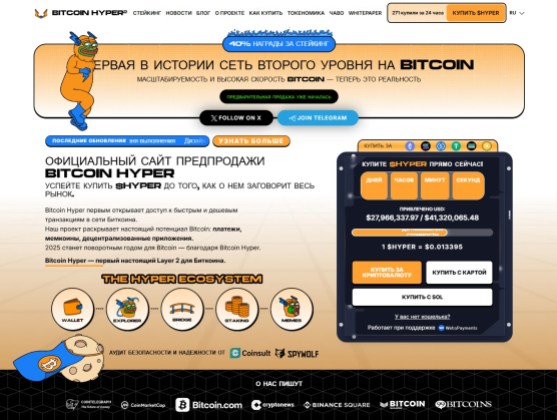
A separate element of the construction is a decentralized canonical bridge for moving Bitcoin to the second layer, as well as compatibility with SPL-format tokens adapted for this L2 environment. At the early placement stage, the project has already raised $29 million at a price of approximately $0.013395 per $HYPER token, demonstrating significant interest in the idea of an accelerated Bitcoin based on SVM. Furthermore, on-chain monitoring data shows that two large wallets have collectively purchased about $396,000, which is usually perceived as a signal of "smart money" attention.

The reward model for $HYPER holders is built around staking with increased APY and participation in network governance. After the token launch, early investors can almost immediately move their tokens to staking, and for pre-sale participants, a seven-day vesting period is provided. In the future, not only financial incentives but also voting rights in the development of the protocol will play a key role.

Bitcoin Hyper's task is simple and ambitious at the same time: to eliminate Bitcoin's three main limitations—slow transactions, high fees, and the lack of developed smart contracts. If the project manages to establish itself as a productive Layer 2 with SVM and a convenient toolkit for developers, $HYPER could become one of the few infrastructure bets that benefit from the next wave of interest in Bitcoin, rather than just following its price.

Related Questions

QWhat is the main concern of the cryptocurrency market according to the article?

AThe main concern is a potential sharp correction (deep drawdown) in Bitcoin's price, fueled by high volatility, aggressive leveraged position selling, and growing fears of a 'cryptowinter'.

QWhat are the three main limitations of the Bitcoin network mentioned in the text?

AThe three main limitations are slow transaction speeds, high fees during periods of network congestion, and the near-total lack of flexible smart contracts.

QWhat solution does the Bitcoin Hyper project propose to address Bitcoin's limitations?

ABitcoin Hyper proposes a Layer 2 solution that integrates the Solana Virtual Machine (SVM) to provide high-speed transactions, low fees, and smart contract functionality while leveraging the security of the Bitcoin base layer.

QWhat key advantage does Bitcoin Hyper claim to have over Solana itself?

ABitcoin Hyper claims that the performance of its L2 layer surpasses that of the original Solana network, offering ultra-low latency and transaction fees of a fraction of a cent even under high load.

QWhat was the result of Bitcoin Hyper's early funding round?

AThe project raised $29 million in its early funding round, with the $HYPER token priced at approximately $0.013395.

Related Reads

Crypto Market Prices the Verdict: $1.8 Billion Bet on Do Kwon's Sentencing Outcome

The cryptocurrency market is witnessing an extraordinary $1.8 billion in futures trading volume for LUNA and LUNA2 tokens, despite their lack of fundamental value. This surge in speculative activity is directly tied to the upcoming sentencing hearing of Terraform Labs co-founder Do Kwon in a New York federal court on December 11th. Prosecutors are seeking a 12-year prison sentence for Kwon’s role in the $40 billion Terra-LUNA collapse, while his defense team is arguing for a 5-year term. This 7-year discrepancy has created a high-stakes betting environment. The market is characterized by extreme divergence, with a high volume of short positions (indicated by negative funding rates) and a powerful counter-force of buyers attempting to squeeze those shorts. The article argues that the current LUNA traders are not the original victims of the crash but are now primarily event-driven speculators, quantitative funds, and opportunistic traders. For them, LUNA has been transformed from a failed project into a pure "legal derivative," a volatile instrument whose price is entirely driven by the legal outcome of Kwon's case, devoid of any fundamental anchor. The author concludes that regardless of the sentencing outcome—whether a harsh or light sentence—the event's conclusion will likely cause LUNA's price to collapse. A harsh sentence would reaffirm its zero fundamental value, while a light sentence would trigger a "sell the news" event. This situation exemplifies the crypto market's cold, hyper-efficient ability to price and monetize anything, including justice and a person's freedom, reducing moral judgment to mere noise against the pursuit of volatility and profit.

比推49분 전

Crypto Market Prices the Verdict: $1.8 Billion Bet on Do Kwon's Sentencing Outcome

比推49분 전

Trading

Spot
Futures
活动图片