Blockchain and no-code tools challenge AWS' dominance: Crypto exec

cointelegraphPublished on 2025-12-20Last updated on 2025-12-20

Abstract

The rise of AI-powered no-code tools and blockchain technology is challenging Amazon Web Services' dominance in cloud computing, according to Lomesh Dutta of the Dfinity Foundation. These tools democratize app creation and enable AI-driven, continuously updated user experiences without relying on centralized servers. Blockchain provides a secure, tamper-resistant infrastructure that operates without constant human intervention. Despite promoting decentralization, many crypto and Web3 projects still depend on AWS, as seen in multiple 2025 outages that disrupted major platforms like Binance, Coinbase, and MetaMask. Industry executives argue that true decentralization must extend beyond the ledger to infrastructure to avoid reliance on centralized providers.

The rise of AI-powered no-code tools that allow users to create applications through linguistic prompts rather than computer code, decentralized through blockchain technology, will challenge Amazon Web Services’ (AWS) dominance of the cloud computing market.

No-code tools will democratize access to app creation and custom-tailored user experiences that will require constant updates and maintenance from AI, Lomesh Dutta, vice president of growth at the Dfinity Foundation, a non-profit organization that guides development of the Internet Computer Protocol (ICP) ecosystem, told Cointelegraph.

This rise of user-created applications eliminates the need for centrally managed software solutions stored on centralized servers.
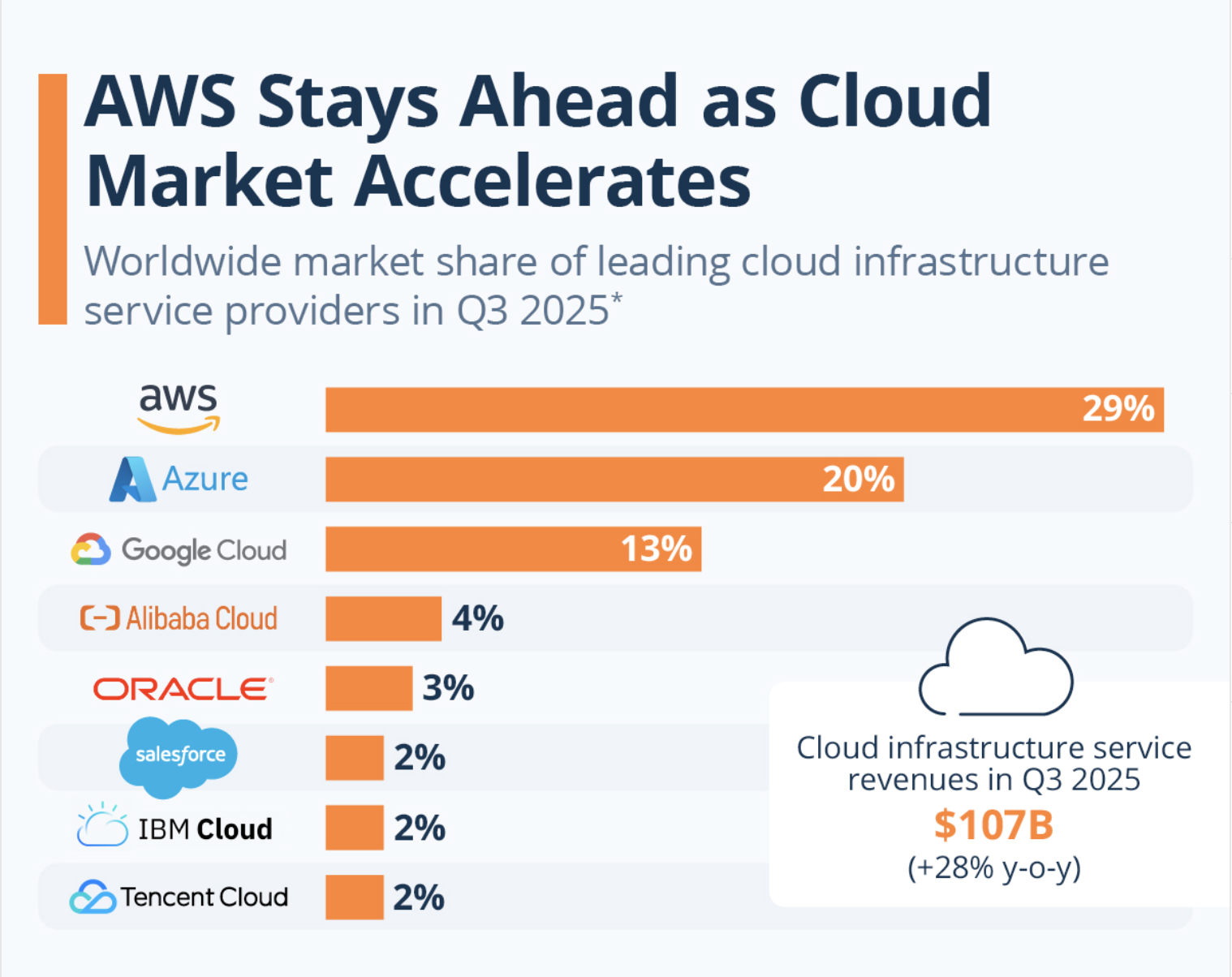
AWS continues to dominate the cloud-computing market in 2025. Source: Statista

“When applications are continuously generated and evolved by AI, you need infrastructure that is secure, tamper-resistant, and able to stay online without constant human intervention,” he said. Lomesh added:

“Decentralized blockchain networks introduced a revolutionary computing paradigm: by eliminating central points of control, they enable the creation of secure, reliable, and fault-tolerant software.”

A significant portion of crypto companies and Web3 projects rely on centralized AWS infrastructure to power their consumer-facing applications and websites, Internet Computer founder Dominic Williams told Cointelegraph.

Related: Cloudflare outage shows why crypto needs end-to-end decentralization

AWS outages rock the crypto industry in 2025

Several AWS outages occurred in 2025, impacting multiple crypto platforms and exchanges using AWS servers and data centers to host their applications.

The first outage occurred in April, causing disruptions to centralized crypto exchanges, including Binance, KuCoin and MEXC. At the time, Binance temporarily paused withdrawals until normal service was restored.

AWS experienced another outage in October, causing disruptions in crypto exchange Coinbase’s mobile application, with users reporting login problems, slowdowns and withdrawal issues.
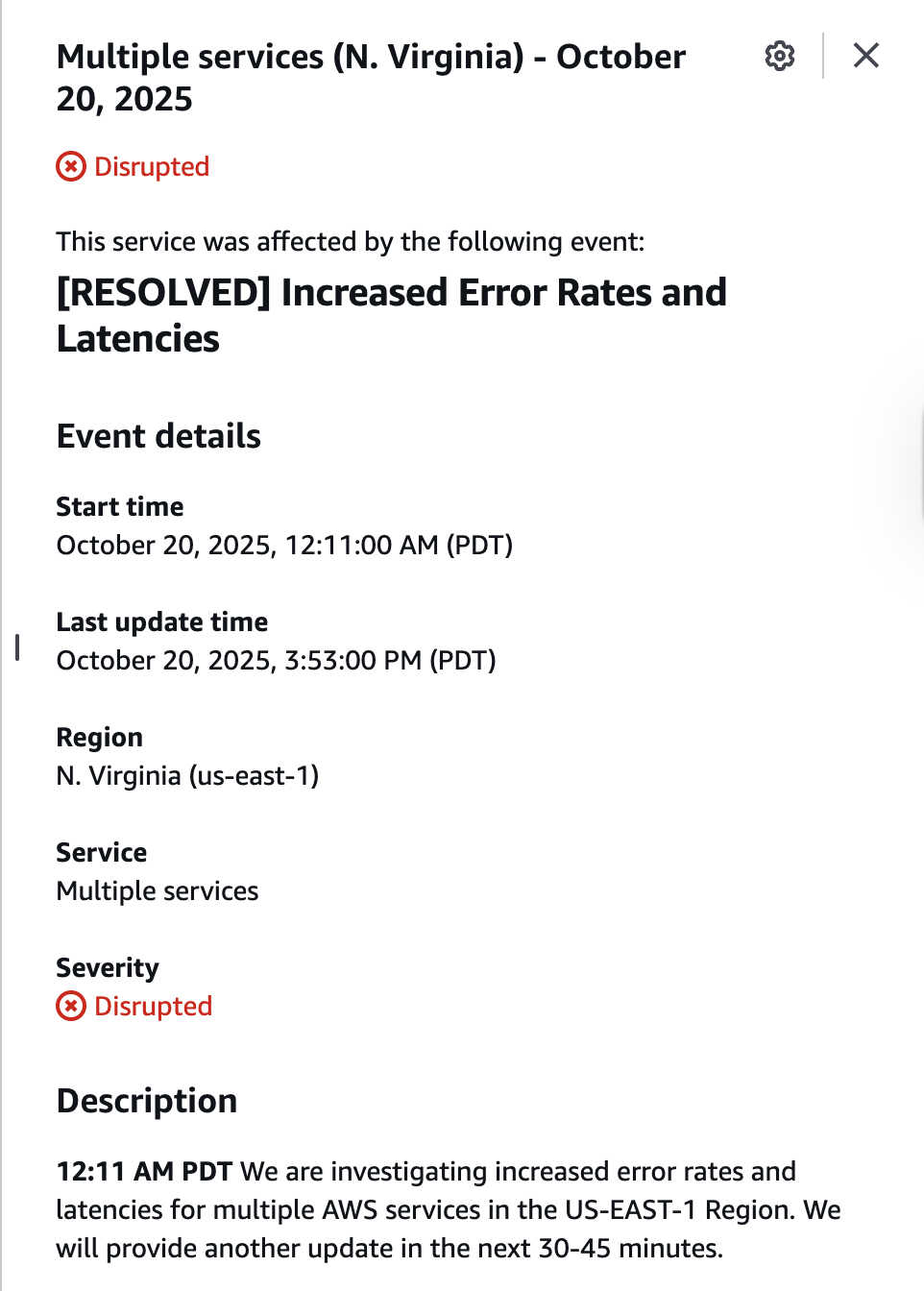
AWS reports an outage on October 20. Source: AWS Health Dashboard

Other financial applications were impacted by the outage, including the mixed-asset brokerage platform Robinhood and Web3 wallet MetaMask.

The October AWS outage lasted for about 15 hours and underscored the level of reliance crypto and Web3 projects, which market themselves as decentralized alternatives, have on centralized cloud infrastructure providers.

Crypto’s reliance on centralized infrastructure has drawn criticism from several crypto industry executives, including Jamie Elkaleh, chief marketing officer at crypto wallet company Bitget Wallet, and Carlos Lei, co-founder of decentralized physical infrastructure network (DePIN) marketplace Uplink.

“Decentralization has succeeded at the ledger layer but not yet at the infrastructure layer,” Elkaleh told Cointelegraph in October.

Magazine: Meet the onchain crypto detectives fighting crime better than the cops

Related Questions

QAccording to the article, how will no-code tools and blockchain technology challenge AWS' dominance in cloud computing?

ANo-code tools democratize app creation through AI-powered linguistic interfaces, while blockchain provides decentralized, secure, and tamper-resistant infrastructure that eliminates reliance on centralized servers and reduces need for constant human maintenance.

QWhat specific problems did AWS outages cause for crypto platforms in 2025 as mentioned in the article?

AAWS outages in April and October 2025 caused disruptions including Binance pausing withdrawals, Coinbase experiencing login problems and withdrawal issues, and affecting platforms like KuCoin, MEXC, Robinhood, and MetaMask.

QWhat criticism did crypto executives have regarding the industry's infrastructure according to the article?

AExecutives like Jamie Elkaleh criticized that 'decentralization has succeeded at the ledger layer but not yet at the infrastructure layer,' highlighting the contradiction between Web3's decentralized ideals and its reliance on centralized cloud providers like AWS.

QWhat advantages does Lomesh Dutta attribute to decentralized blockchain networks for AI-generated applications?

AHe stated decentralized blockchain networks provide 'a revolutionary computing paradigm' by eliminating central points of control, enabling the creation of secure, reliable, and fault-tolerant software that can stay online without constant human intervention.

QWhich major companies and projects were mentioned as being affected by the AWS outages in the article?

AThe affected entities included crypto exchanges Binance, KuCoin, MEXC, and Coinbase; mixed-asset brokerage Robinhood; and Web3 wallet MetaMask.

Related Reads

Understanding Tokenization: Distinguishing the DTCC Model from the Direct Ownership Model

The article clarifies the key differences between two distinct tokenization models in the securities market: the DTCC model and the direct ownership model. The DTCC model, recently approved by the SEC, involves tokenizing "security entitlements" within the existing, multi-layered intermediary system. It creates a digital twin of these rights on a blockchain to improve operational efficiency, enable 24/7 transfers between institutions, and reduce costs, all while preserving the core benefits of the current system, such as netting and centralized liquidity. Crucially, it does not tokenize the underlying shares themselves, and ownership remains indirect. In contrast, the direct ownership model tokenizes the shares themselves, recording ownership directly on the issuer's share registry. This approach enables self-custody, peer-to-peer transfers, and full composability with on-chain DeFi applications. While this model sacrifices the efficiency of netting and leads to fragmented liquidity, it offers unprecedented functionality and disintermediation. The article concludes that these are not competing visions but complementary paths serving different needs. The DTCC model modernizes the core of the public markets for institutional scale and stability, while the direct ownership model fosters innovation at the edge. The ultimate winner is investor choice, as both paths will coexist, offering a broader market interface with more options for all participants.

marsbit19분 전

Understanding Tokenization: Distinguishing the DTCC Model from the Direct Ownership Model

marsbit19분 전

Signs of an Imminen Breakout Emerge, BTC/ETH Bullish Trend Confirmed, SOL Shorting Window Opens, Comprehensive Analysis of Crypto Long-Short Opportunities

Current market conditions indicate a potential bullish breakout is imminent. Bitcoin (BTC) has been adjusting for a month, showing consolidation signals with a flattening EMA20 and higher lows on the daily chart. A decisive break above the $89,600 resistance could open further upward momentum. Ethereum (ETH) maintains a bullish outlook after breaking its descending channel. Despite minor pullbacks, the overall structure remains strong, with the next target around $3,170-$3,200. A dip to the $2,930-$2,900 area could present a buying opportunity. Solana (SOL) shows signs of a short-term rebound but is expected to decline afterward. Key shorting opportunities are near $134 and $131.5. AAVE presents a potential buying opportunity following a major sell-off, supported by the conclusion of a 4-year SEC investigation and positive long-term development plans. The current profitable sectors are alpha tokens and contract trading, while secondary and primary markets show weaker returns. Alpha tokens like $GUN, $LISA, and $RTX may continue rising, though high-volatility contract tokens like $LIGHT carry higher risks. A classification of Binance Alpha tokens is provided: 1) Strong consensus tokens (e.g., $RARE, $NIGHT) for long-term holds; 2) Low market cap tokens (e.g., $CYS, $ZKP) with short-term pumps; 3) Highly manipulated tokens (e.g., $PIPPIN, $LIGHT) for speculative trading; and 4) Low-quality projects to avoid. Focus on understandable opportunities and manage risks accordingly.

金色财经24분 전

Signs of an Imminen Breakout Emerge, BTC/ETH Bullish Trend Confirmed, SOL Shorting Window Opens, Comprehensive Analysis of Crypto Long-Short Opportunities

金色财经24분 전

December 22: BTC, ETH, SOL, LIGHT, MERL, PIPPIN Market Analysis

December 22: BTC, ETH, SOL, LIGHT, MERL, PIPPIN Market Analysis Bitcoin saw low liquidity and reduced volatility over the weekend but halted its downward trend, climbing back to around $90,000. The weekly chart shows signs of stabilization, with limited downside and potential upside in the coming month. Macro conditions currently don’t support further decline. BTC is trading at $89,240, still in a broad consolidation range. Key resistance is at 89.5K–90K; a break above could signal further gains. Key support lies at 87,900, with major resistance near 100,000 and strong support around 78,000–79,000. ETH has consolidated and reclaimed $3,000. Long positions can consider partial profit-taking or break-even stops. Next targets are $3,144 and $3,269. A pullback to $2,980–$2,950 may offer entry opportunities. SOL has shown weak momentum, with less than 3% gains over three days. It faces strong resistance near $134, making it a candidate for shorting. Further downside is expected after a potential brief rebound. LIGHT experienced a sharp drop with little buyer reaction. Such altcoins often have short cycles and high risk. Caution is advised—avoid FOMO. Better opportunities may lie in tokens like XPIN, NIGHT, and BEAT after clearer signals emerge. MERL has repeatedly failed to hold above $0.50 due to heavy selling pressure, especially with large unlocks in mid-December. A drop toward $0.30 is likely, making it a candidate for short positions with a stop above $0.52. PIPPIN has surged over 200% but shows signs of a double top formation on the daily chart, indicating a likely peak. The second peak was missed but confirms a probable reversal. Overall, the market remains cautious with selective opportunities. Major coins like BTC and ETH show resilience, while altcoins require careful timing and risk management.

金色财经25분 전

December 22: BTC, ETH, SOL, LIGHT, MERL, PIPPIN Market Analysis

金色财经25분 전

Trading

Spot
Futures
活动图片