Bitcoin miners could boost corporate adoption as crypto treasury buys slow

cointelegraphPublished on 2025-12-12Last updated on 2025-12-12

Abstract

According to BitcoinTreasuries.NET, Bitcoin miners are poised to become key drivers of corporate Bitcoin adoption as purchases by crypto treasury companies slow significantly. Corporate treasuries are projected to buy only 40,000 BTC in Q4, the lowest since Q3 2024. Miners, who can generate BTC at a discount through block production, now account for 5% of new additions and 12 of public company balances. They are already among the largest corporate holders, with MARA Holdings and Riot Platforms ranking second and seventh, respectively. A November price drop below $90,000 created a stress test, leaving roughly 65% of corporate buyers with unrealized losses. This has not caused widespread distress but has led companies to a slower, more selective purchasing cadence as they reassess risk. The report concludes that miners' ability to acquire BTC cheaply makes their balance sheets increasingly vital for supporting corporate adoption.

Bitcoin miners, which can acquire the cryptocurrency at below-market costs, could be in the best position to shape corporate adoption as accumulation by crypto treasury companies slows, says BitcoinTreasuries.NET.

Bitcoin (BTC) treasury companies are projected to buy 40,000 BTC in the fourth quarter, the lowest since Q3 2024, BitcoinTreasuries.NET President Pete Rizzo said in a corporate adoption report released on Thursday.

Despite the slowdown, Rizzo said Bitcoin mining companies continue to “anchor public‐market Bitcoin holdings” and accounted for 5% of new additions and 12% of aggregate public company balances in November.

“Because miners can acquire BTC at an effective discount to spot markets via block production, their balance sheets may become increasingly important in supporting corporate adoption, especially if other treasuries pause or slow purchases,” he said.

Miners already among top Bitcoin holders

On average, miners generate about 900 Bitcoin per day, according to Bitbo and MARA Holdings has the second largest Bitcoin stash among public companies, with a stash of 53,250 Bitcoin.
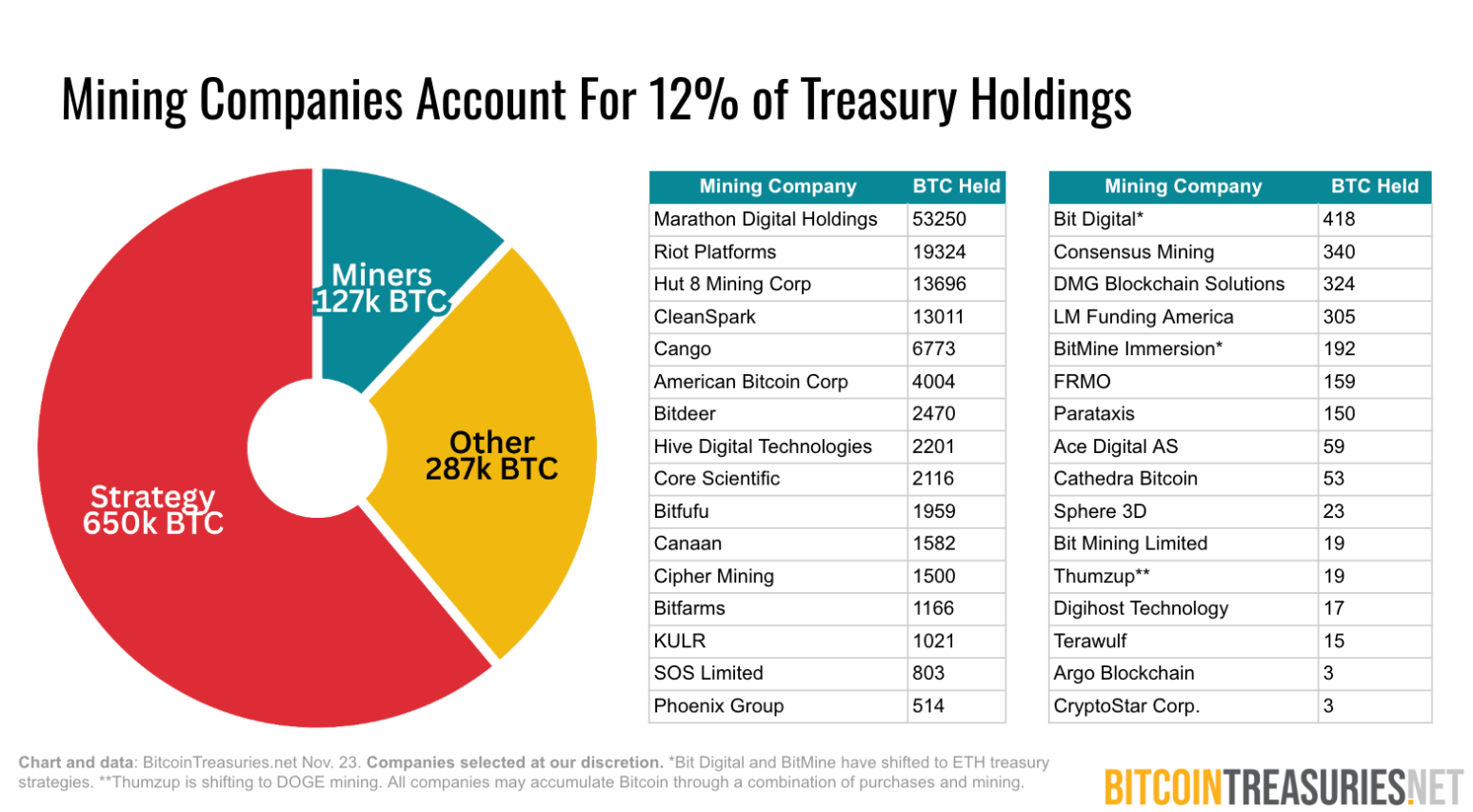
Source: BitcoinTreasuries.NET

Riot Platforms is the seventh largest public Bitcoin holder, with 19,324, while Hut 8 Mining is ninth with 13,696.

Rizzo said that the “summer buying frenzy” from crypto treasury companies has eased, but “demand has not vanished.”

“Public corporations appear to be normalizing to a slower, more selective cadence as they digest recent purchases and reassess risk,” he added.

November a stress test for treasury companies

In November, Bitcoin’s price sank below $90,000 for the first time since April, which created one of the first true stress tests for the Bitcoin capital markets era, Rizzo said.

Roughly 65% of buyers purchased Bitcoin above current market prices and now have unrealized losses.

Related: Businesses are absorbing Bitcoin 4x faster than it is mined: Report

“Bitcoin’s late‐November drawdown pushed spot prices toward $90,000, dragging many 2025 buyers into the red. For the 100 companies where cost basis could be measurable, about two‐thirds now sit on unrealized losses at current prices,” he said.

“This does not yet point to widespread distress, but it does force risk committees and boards to confront the downside of averaging into elevated prices and relying on long-term upside to validate treasury decisions.”

Magazine: Mysterious Mr Nakamoto author — Finding Satoshi would hurt Bitcoin

Related Reads

You Should Still Believe in Crypto

The article "You Should Still Believe in Crypto" addresses the growing sense of burnout and disillusionment within the cryptocurrency industry, sparked by a post from Aevo co-founder Ken Chan titled "I Wasted 8 Years of My Life in Crypto." It acknowledges the collective fatigue many feel due to the industry's fast-paced, often speculative nature, where narratives shift rapidly, and projects frequently fail or disappear. However, the piece argues that the core value of crypto remains vital. It references Nic Carter’s response, highlighting crypto’s potential to create a more robust monetary system, encode business logic via smart contracts, establish true digital property rights, improve capital market efficiency, and enhance global financial inclusion. The article revisits Bitcoin’s origin as a peer-to-peer electronic cash system born from the 2008 financial crisis, emphasizing its purpose as a trustless, decentralized alternative to traditional finance. It points to real-world adoption in high-inflation countries like Argentina and Turkey, where Bitcoin and stablecoins serve as essential financial tools, and notes increasing institutional embrace from firms like BlackRock and Fidelity. Finally, it draws a parallel to the early internet era, arguing that despite chaos, failed projects, and speculative excess, the crypto industry—like the internet—is laying foundational groundwork for future technological and financial evolution. The conclusion is a call to persevere, recognizing that the collective efforts of developers, researchers, and builders worldwide are contributing to a transformative global shift.

marsbit1시간 전

You Should Still Believe in Crypto

marsbit1시간 전

Trading

Spot
Futures
活动图片