Crypto, TradFi sentiment improves: Will Bitcoin traders clear shorts above $93K?

cointelegraphPublished on 2025-12-08Last updated on 2025-12-08

Abstract

Over the past two weeks, Bitcoin has repeatedly tested the $90,000 range amid improved retail and institutional sentiment. Analysts from Bernstein and BlackRock's Larry Fink suggest the Bitcoin cycle is elongating, with sovereign wealth funds and institutions accumulating at lower prices. Strategy's recent $962.7 million BTC purchase—its largest since July 2025—supports this outlook. Despite the positive sentiment, Bitcoin faces resistance between $90,000 and $93,000, with order book data showing significant sell pressure starting at $90,000. However, a cluster of short liquidations between $94,000 and $95,300 could provide fuel for a potential push toward $100,000 if bullish catalysts emerge.

Over the past two weeks, Bitcoin price repeatedly revisited the $90,000 range as retail investor sentiment improved, fund managers restated their bullish expectations for a potential end-of-year rally, and Strategy announced a sizable BTC purchase.

According to VanEck head of digital asset research, Matthew Sigel, Bernstein wrote that “the Bitcoin cycle has broken the 4-year pattern (cycle peaking every 4 years) and is now in an elongated bull-cycle with more sticky institutional buying offsetting any retail panic selling.”

Bernstein’s comments follow BlackRock chair and CEO Larry Fink mentioning that sovereign wealth funds are “incrementally” buying Bitcoin as it “has fallen from its $126,000 peak.”

Fink said,

“I know they bought more in the 80s. And they’re establishing a longer position. And you own it over years. This is not a trade. You won if for a purpose, but the market is skewed, it is heavily leveraged and that’s why you’re going to have more volatility.”

Mirroring Fink’s and Bernstein’s view, on Monday Strategy announced a fresh 10,624 ($962.7 million) purchase of Bitcoin at an average $90,615 per coin. Bitwise European head of research Andre Dragosch noted that Strategy’s purchase “was the biggest amount since July 2025.”
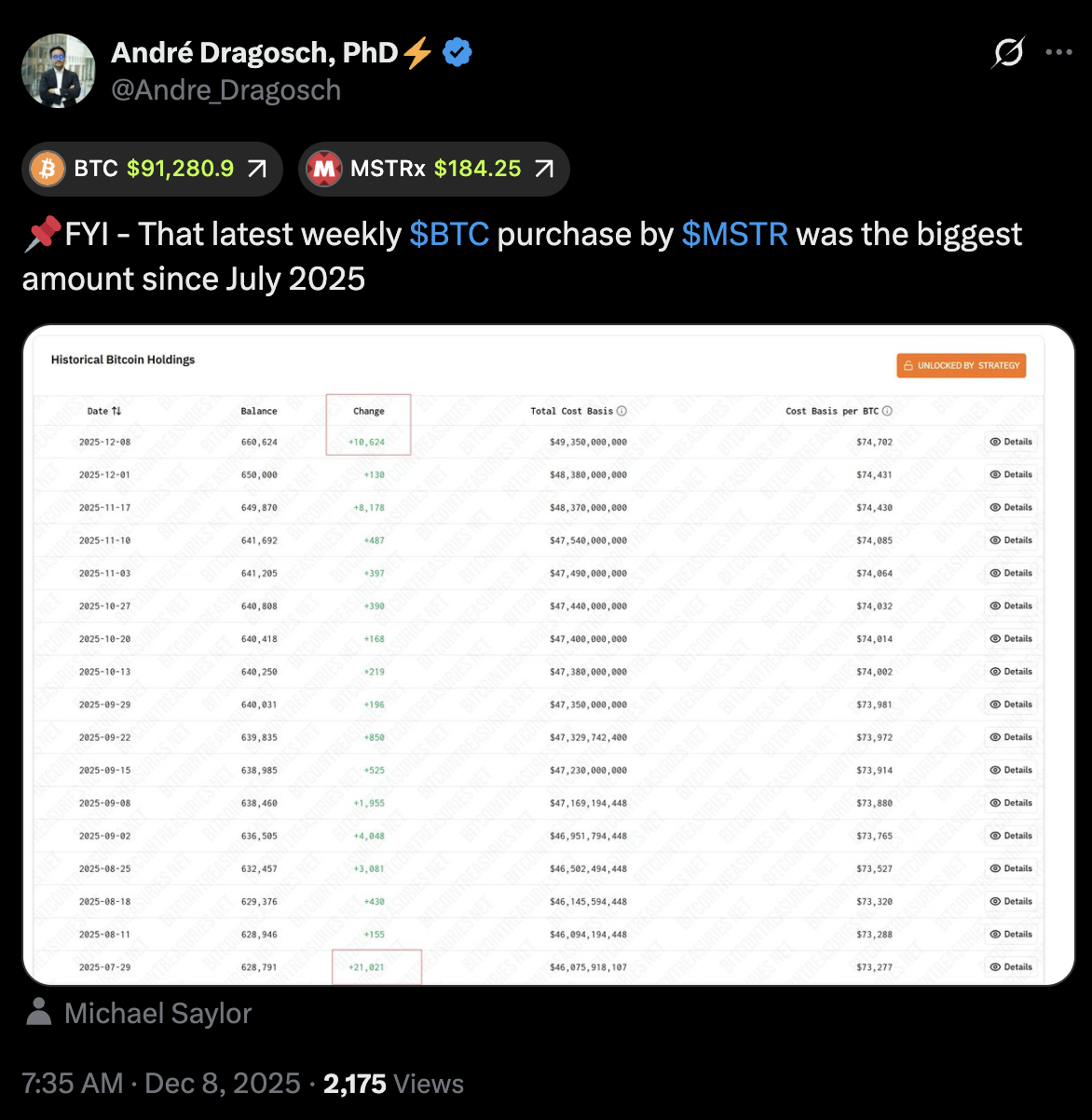
Strategy makes is biggest BTC purchase since July. X / Andre Dragosch

While Bitcoin’s recovery from its Nov. 21 low of $80,612 has followed the improvement in investor sentiment, the price is still capped in the $90,000 to $93,000 range. On Saturday, chartered market technician Aksel Kibar said,

“This is part of the choppy price action where BTC/USD is possibly trying to find a bottom. Technical support is lower between $73.7K and $76.5K. It took few months in March-May period to form that short-term double bottom.”

Related: Did BTC's Santa rally start at $89K? 5 things to know in Bitcoin this week

Cumulative volume data from Hyblock provides a more nuanced view, highlighting rising participation from investors in the 0 to 100 BTC trade cohort, which some analysts label as retail. Larger trade-size cohorts in the 1,000 to 100,000 and 100,000 to 1 million (cumulative volume delta) appear to be selling on rallies in the $90,000 to $93,000 price range.
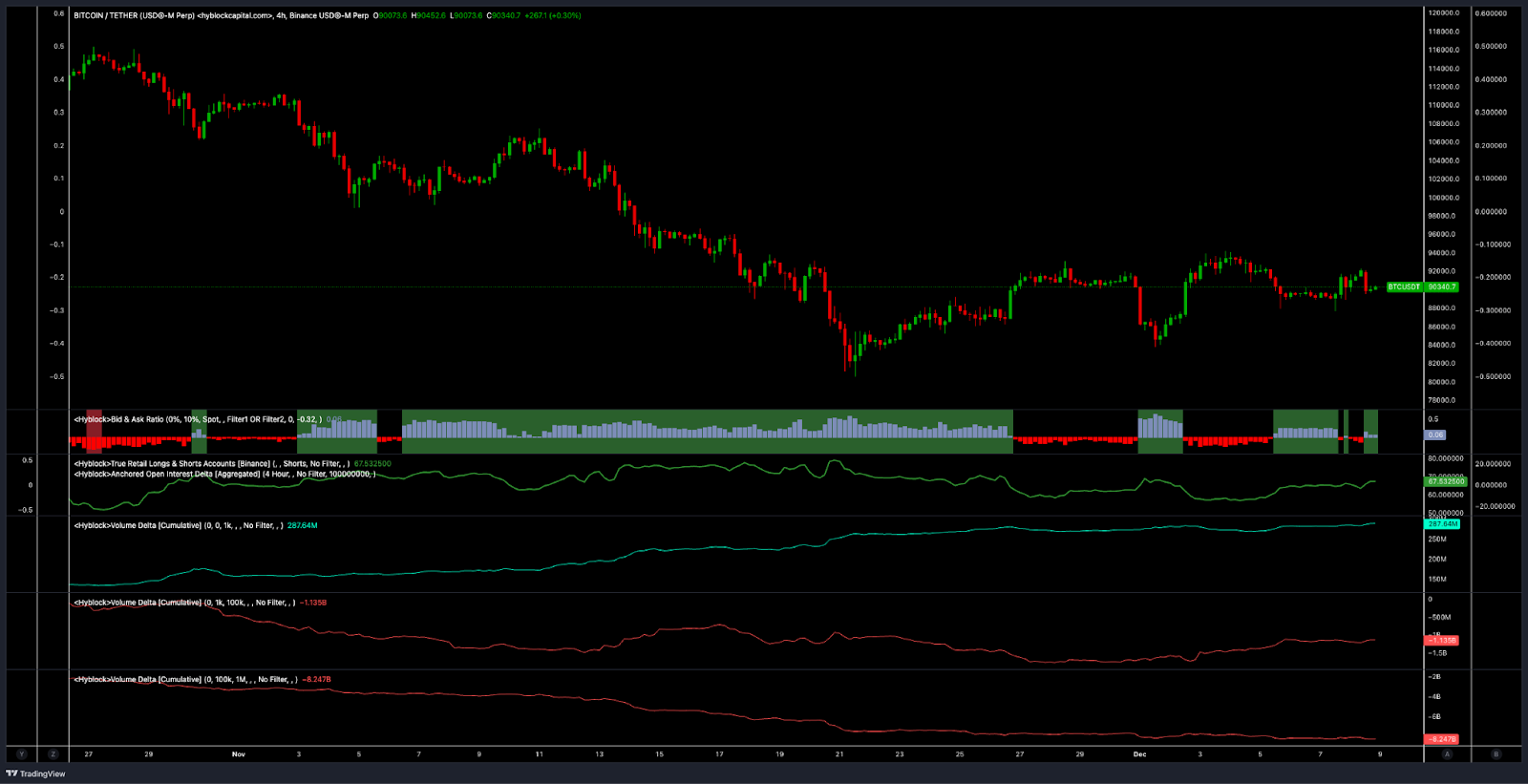
BTC/USDT Binance, cumulative volume deltas. Source: Hyblock

Similarly, order book data for BTC/USDT (perpetual contracts at Binance) shows a wall of asks starting at $90,000 and thickening from $94,000 to $95,000.
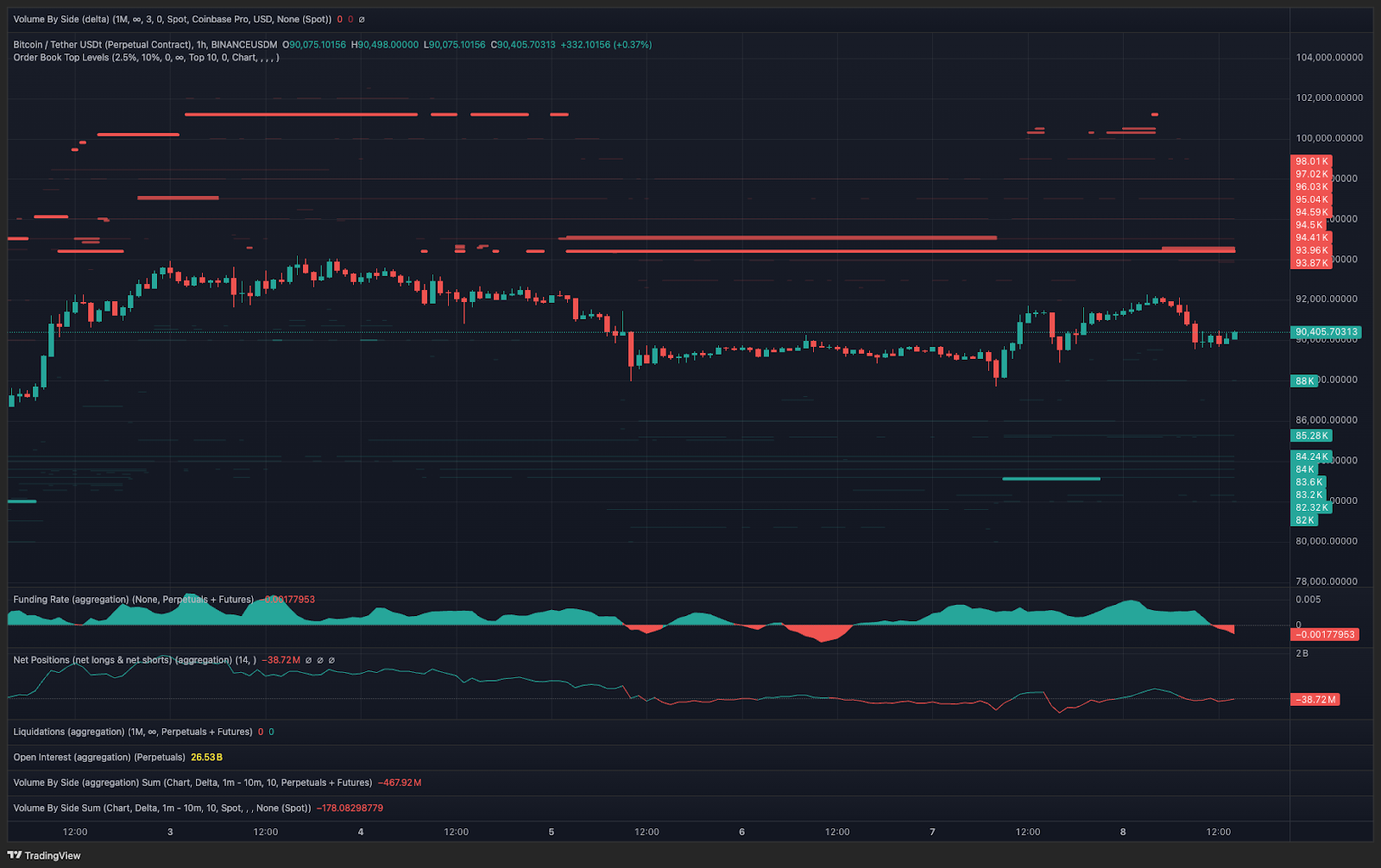
BTC/USDT (Binance), orderbook asks at 5%-10% depth. Source: TRDR.io

Liquidation heatmap data, on the other hand, shows short liquidity at $94,000 to $95,300, which could serve as fuel for bulls to attempt a run on $100,000 if the market provides sufficient catalyst to induce an uptick in either spot or futures buying.
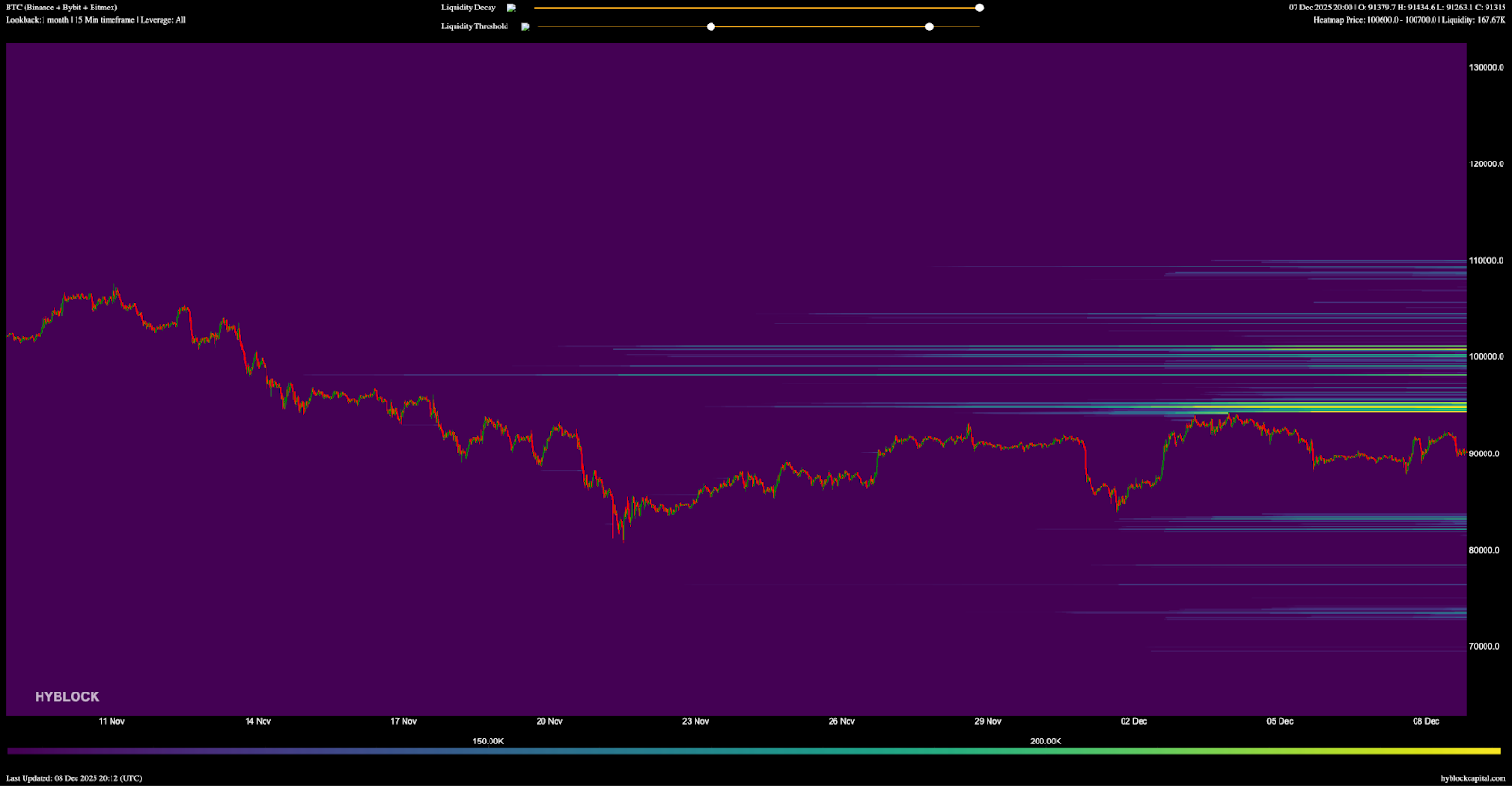
BTC/USDT liquidation heatmap, 1-month lookback. Source: Hyblock

This article does not contain investment advice or recommendations. Every investment and trading move involves risk, and readers should conduct their own research when making a decision.


Related Reads

Why is Crypto the Key Infrastructure for the Large-Scale Adoption of AI Agents?

Why Crypto is Key Infrastructure for AI Agent Mass Adoption For AI Agents to become widely deployable autonomous software, they require two core capabilities: composability and verifiability. These are inherently lacking in traditional Web2 systems but are natively provided by cryptocurrency networks. AI's future lies not in isolated models but in agents that automatically call services, compose with other agents, write code, test, and execute decisions involving financial actions. This agent composability depends on verifiability—knowing another agent executed as promised. Web2 infrastructure (APIs and SaaS) fails here due to black-box operations, mutable data, unprovable results, centralized audits, and manual settlements. Cryptocurrency provides the missing verified base layer through: 1. Verifiable Execution: Smart contracts and ZK proofs enable transparent, provable on/off-chain actions. 2. Verifiable Identity: DIDs and signed agent code ensure trust and integrity. 3. Verifiable Value Transfer: Automated payments, revenue sharing, collateralization, and penalties enable direct fund management without intermediaries. As AI evolves from code generation to full-cycle automation (writing, testing, running, fixing), especially with real-world financial impact, crypto becomes essential. It enables automatic penalties for failures, rewards for contributions, multi-agent settlements, and trustless coordination—making AI economically viable beyond demos. In short: AI enables autonomy; crypto makes autonomy trustworthy. Without crypto's verifiability, AI agents cannot operate reliably at scale in the real economy.

深潮5 分前

Why is Crypto the Key Infrastructure for the Large-Scale Adoption of AI Agents?

深潮5 分前

Ripple's Bullish Sentiment Grows: What Will Trigger XRP's Breakthrough to $2.65?

Ripple (XRP) is experiencing a surge in bullish sentiment, with analysts predicting a potential breakout to $2.65. Over the past 24 hours, XRP’s price increased by 3%, climbing 15.5% from its November 21 low to reach $2.10. Several factors are driving this optimism, including growing institutional demand, shifting trader sentiment, and a bullish technical pattern. Institutional interest is rising, with XRP exchange-traded products (ETPs) attracting $245 million in inflows in the week ending December 5. According to CoinShares, year-to-date inflows have reached $3.1 billion, far surpassing 2024’s total of $608 million. Spot XRP ETFs in the U.S. have also seen consistent inflows, recording $10.23 million on Friday and extending a 15-day streak of net inflows. Cumulative inflows are nearing $900 million, with assets under management (AUM) hitting $861.3 million. Crypto investor Giannis Andreou noted that this accumulation often precedes a market shift. Trader sentiment is increasingly bullish. XRP’s daily funding rate turned positive at 0.0189%, indicating that most traders are opening long positions. On Binance, the long/short ratio shows 72% of accounts are bullish, though this introduces liquidation risks. Similarly, on Hyperliquid, 72% of XRP exposure is long, totaling $94.5 million, compared to $37.6 million in short positions. Technically, XRP has broken out of a symmetrical triangle pattern on the four-hour chart. A sustained close above the $2.15 trendline could trigger a 27% rally to $2.65. Analysts note that a daily close above $2.30 would confirm the breakout, potentially pushing prices toward $2.58, provided the $2.00 support level holds.

cointelegraph_中文7 分前

Ripple's Bullish Sentiment Grows: What Will Trigger XRP's Breakthrough to $2.65?

cointelegraph_中文7 分前

After a Valuation of $1 Billion and Five Years of Exploration, Why Did It 'Admit Defeat'?

After five years of development and raising $180 million at a near $1 billion valuation, Farcaster has officially conceded that its Web3 social strategy did not succeed. The platform, initially designed as a decentralized alternative to Twitter, aimed to address issues like platform monopoly, user data ownership, and creator monetization through an on-chain, protocol-based approach. Despite a brief surge in early 2024—when monthly active users (MAU) peaked at around 80,000—growth quickly stalled. MAU has since declined to under 20,000 by late 2025. Farcaster’s user base remained heavily concentrated within the crypto-native community, failing to attract mainstream users due to high barriers to entry, niche content, and inferior user experience compared to established platforms like X or Instagram. Co-founder Dan Romero announced a strategic pivot from social-first to a wallet-focused product, acknowledging that social alone wasn’t driving sustainable growth. Internal data showed that wallet features—used for transactions, trading, and interacting with dApps—consistently outperformed social modules in user retention and frequency. The shift reflects a broader realization: It’s easier to add social features to a wallet than to build a social product around crypto. While the move has sparked some community discontent, Farcaster is betting that deeper integration with on-chain utilities represents a more viable path to product-market fit.

深潮12 分前

After a Valuation of $1 Billion and Five Years of Exploration, Why Did It 'Admit Defeat'?

深潮12 分前

Interpreting the True Turning Point of Crypto Regulation: BTC, ETH, and USDC Gain Access to the U.S. Derivatives Market

The U.S. Commodity Futures Trading Commission (CFTC), under Acting Chair Caroline D. Pham, has launched a Digital Asset Collateral Pilot Program. This initiative allows regulated derivatives market participants to use Bitcoin (BTC), Ethereum (ETH), and the stablecoin USDC as compliant margin. The program is a significant regulatory shift, marking the first time digital assets are formally recognized as collateral in mainstream U.S. finance. Key details of the pilot include: - **Participants:** Licensed Futures Commission Merchants (FCMs) are the eligible entities. - **Assets:** Initially limited to BTC, ETH, and USDC for a three-month period, with strict weekly reporting requirements to the CFTC. - **Safeguards:** Stringent rules are in place, including holding assets in segregated accounts, conservative haircuts to mitigate volatility risk, and immediate reporting of any issues. - **Framework:** The CFTC also issued new guidance for tokenized collateral and provided "No-Action Relief" to give institutions regulatory clarity for operating within the rules. Industry leaders from Coinbase, Crypto.com, Circle, and Ripple hailed the move. They see it as a milestone that unlocks capital efficiency, reduces settlement risk, legitimizes stablecoins for payments, and paves the way for 24/7 trading, ultimately signaling deeper integration between crypto and traditional finance. While the pilot's immediate impact on retail investors is limited, it is a major long-term signal of institutional adoption. It represents a structural shift in U.S. regulatory approach—from restriction to institutionalization—and is a crucial step toward a future where tokenized assets are fundamental to the financial system.

Odaily星球日报19 分前

Interpreting the True Turning Point of Crypto Regulation: BTC, ETH, and USDC Gain Access to the U.S. Derivatives Market

Odaily星球日报19 分前

Trading

Spot
Futures
活动图片