Summer.fi shuts down after exploit – Lazy Summer DAO to resume withdrawals

ambcryptoPublicado em 2026-07-16Última atualização em 2026-07-16

Resumo

DeFi platform Summer.fi is shutting down after seven years due to a $6 million exploit on July 6th that drained critical liquidity and the team's capital, leaving no financial runway for recovery. Despite rapid initial growth reaching $200 million in TVL, the security failure in its Lazy Summer Protocol caused a collapse in user confidence and activity. The platform will remain available until August 31st. While the Lazy Summer DAO is working to restore user withdrawals, the incident underscores that in DeFi, lasting success requires robust security and maintaining trust, not just attracting capital.

DeFi management platform Summer.fi announced plans to wind down operations after seven years. The platform concluded that the damage caused by the 6th of July Lazy Summer Protocol exploit left the team without the runway required to rebuild.

Previously, the protocol expanded rapidly and accumulated $200 million in total value locked [TVL] within its first nine months. This reflected strong user confidence in the protocol.

However, DeFi conditions weakened after the Stream Finance fallout in October 2025, reducing momentum before the exploit occurred.
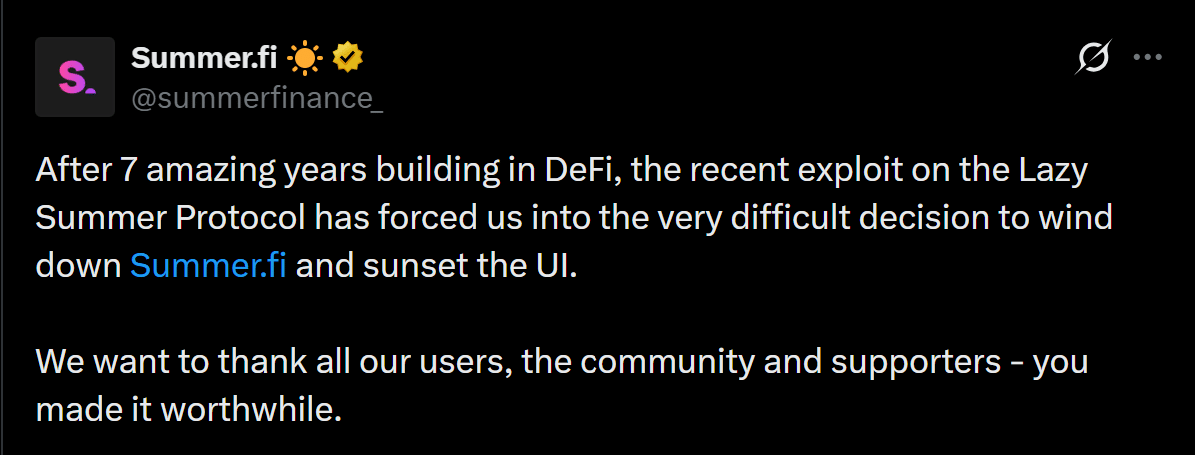
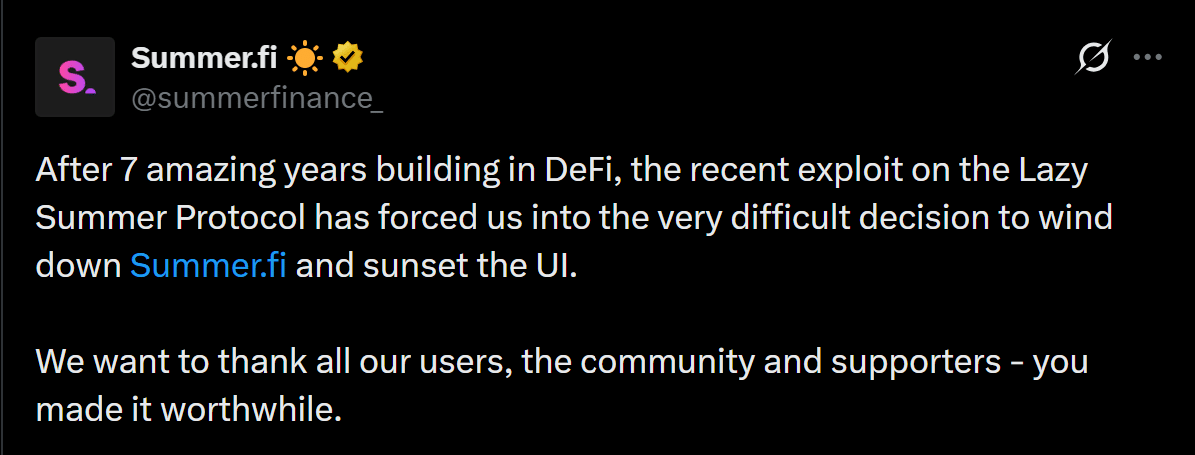
Summer.fi on X

Then, the 6th of July exploit removed critical liquidity and depleted part of the team’s own capital, eliminating its recovery runway. Consequently, users faced uncertainty, while confidence across DeFi weakened further.

The exploit highlights how security failures can rapidly erase years of ecosystem growth.

Therefore, the closure reinforces growing security concerns, encourages investors to reassess protocol risk, and may slow capital inflows into similar platforms.

Why growth isn’t enough

Following the shutdown announcement, attention has shifted from the exploit itself to its lasting effects on users and protocol activity. More importantly, the Summer.fi app will remain available until the 31st of August.

SummerFi’s journey shows that rapid growth alone cannot guarantee long-term success in DeFi. Before the 6th of July exploit, the Lazy Summer Protocol attracted strong user interest, with total value locked holding between $22 million and $25 million.

However, a weakness in the protocol’s system allowed attackers to exploit it and steal around $6 million. As a result, the team paused vaults, users rushed to withdraw funds, and new deposits quickly slowed.
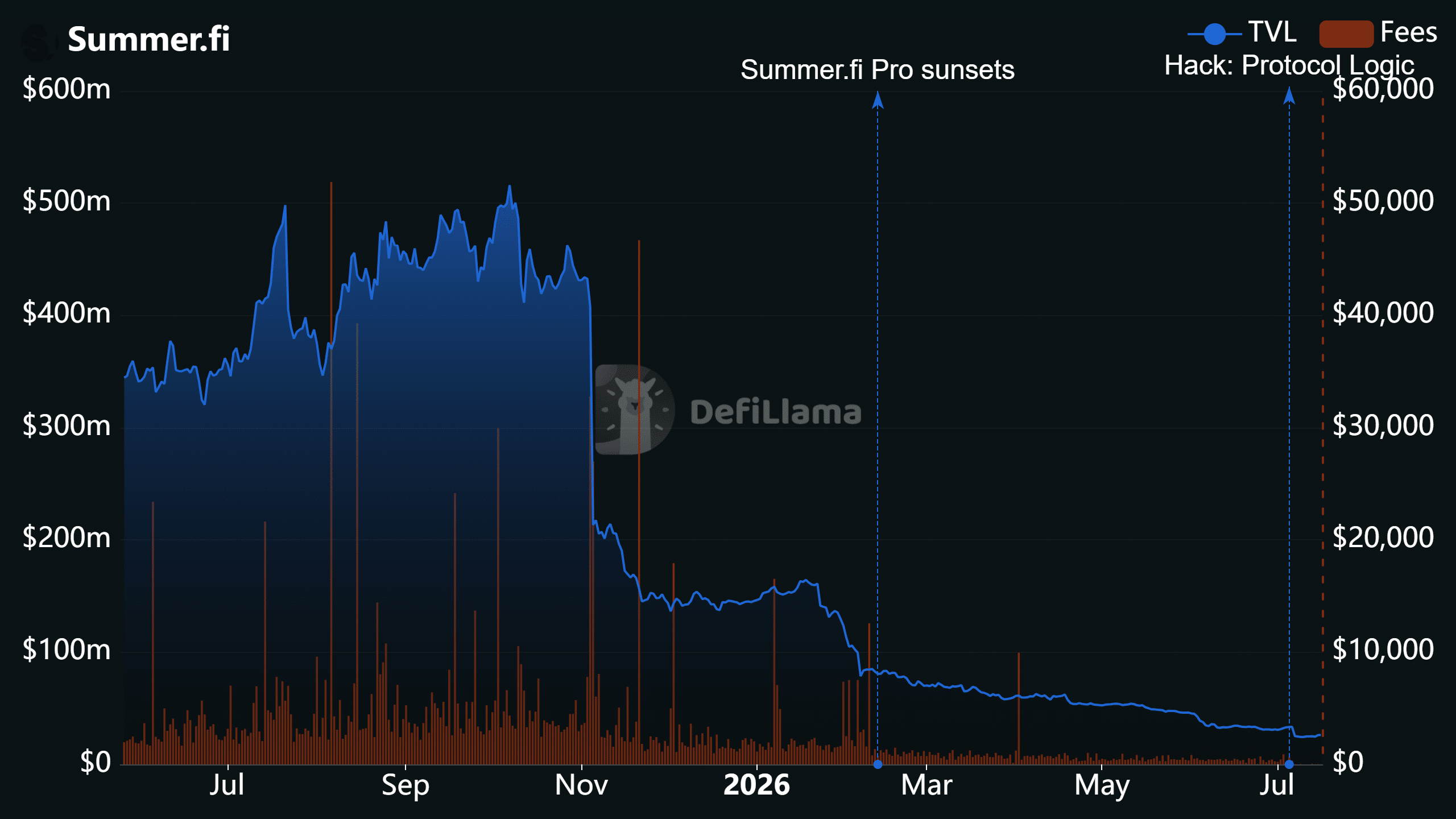
Source: DeFiLlama

Activity across the platform also declined as confidence weakened. This sequence shows that strong growth can disappear quickly when security fails.

More importantly, the sharp drop in user participation suggests trust is much harder to rebuild than liquidity.

Meanwhile, the Lazy Summer DAO is working to restore withdrawals and redemptions, offering affected users a potential path to recover funds. Even so, rebuilding confidence may prove far more difficult than restoring functionality.

Ultimately, SummerFi’s closure highlights that lasting success in DeFi depends not only on attracting capital but also on protecting users and maintaining confidence through strong security.


Final Summary

  • Summer.fi is winding down after a $6.04 million exploit erased the financial runway required to rebuild.
  • The DAO is working to restore withdrawals, although full recovery of the stolen funds has not been guaranteed.

Criptomoedas em alta

Perguntas relacionadas

QWhat was the main reason for Summer.fi's decision to wind down operations?

AThe main reason was the Lazy Summer Protocol exploit on July 6th, which caused significant damage, depleted the team's capital, and eliminated the financial runway required to rebuild the platform.

QHow much value was stolen during the exploit?

AApproximately $6 million (specifically $6.04 million) was stolen during the exploit.

QWhat is the Lazy Summer DAO doing in response to the situation?

AThe Lazy Summer DAO is working to restore withdrawals and redemptions, offering affected users a potential path to recover their funds, although a full recovery of the stolen amount has not been guaranteed.

QWhat does the Summer.fi case suggest about the importance of security in DeFi?

AIt highlights that strong growth and user confidence can be quickly erased by security failures. Lasting success in DeFi depends not only on attracting capital but also on protecting users and maintaining trust through robust security measures.

QUntil when will the Summer.fi app remain available?

AThe Summer.fi app will remain available until August 31st.

Leituras Relacionadas

Re-evaluating Founder-Market Fit Amidst the Crypto Bear Market

In the current crypto bear market, the concept of founder-market fit emerges as the most enduring investment signal. While markets, regulations, and products constantly change, the alignment between a specific founder and a specific market remains the constant, compounding factor, especially when prices stall. The blockchain space is now attracting a higher caliber of founders than ever before. Talent has converged on solving serious problems in two key verticals: AI and fintech. The most compelling challenge has become building institutional-grade financial infrastructure, drawing serious operators from firms like Citadel, Stripe, Block, Nvidia, and Goldman Sachs. This shift is supported by maturing on-chain data: stablecoin settlement now surpasses Visa and Mastercard combined, institutional adoption is rising, and tokenized real-world assets are growing rapidly. When evaluating founders, four key traits are sought: deep domain expertise, high agency, an unfair advantage in networks, and obsession. Examples like Offchain Labs (Arbitrum), Ondo Finance, Morpho, Circle (USDC), and Alchemy demonstrate that projects possessing all four traits can define categories and endure through cycles. For founders already building, bear markets strip away momentum and reveal true conviction. This period offers the quiet, uncrowded space to build foundational products that will define the next cycle when capital returns. Capital is still available, and lower valuations present an opportunity. The advice is to extend runway, focus on genuine product-market fit, and recruit strategically. For talented individuals still within traditional finance giants, the moment to act is now. The hard problems in crypto now align with their skills in institutional infrastructure—settlement, credit, custody, compliance. The bear market is not a risk but a testing ground, clearing out noise and creating the ideal conditions for builders with the right fit to establish themselves. The defining founders of the next cycle are not waiting; they are building in the quiet of the winter, anchored by a deep belief in their market that price action cannot shake. The ultimate question is not if the market will return, but who will be standing, stronger, in the market they were inherently meant to win.

Foresight NewsHá 1m

Re-evaluating Founder-Market Fit Amidst the Crypto Bear Market

Foresight NewsHá 1m

SEC Pushes for All-Day Trading in US Stocks, Will RWA's Biggest Advantage Disappear?

**Summary: SEC Advances Towards 24-Hour U.S. Stock Trading, Impact on Crypto RWA Tokens** The U.S. Securities and Exchange Commission (SEC) has announced a public roundtable for September 17th to discuss preparations for moving the U.S. equity markets towards 24-hour trading. This signals a potential substantive shift from the traditional 9:30 AM to 4:00 PM ET trading day to a near 24/5 model (23 hours a day, 5 days a week) by late 2026 or early 2027, pending regulatory approval and infrastructure alignment. Key exchanges like NYSE Arca and Nasdaq are planning extended hours, and critical clearing infrastructure from DTCC already supports 24/5 operations. For the crypto industry, particularly the Real World Asset (RWA) tokenization sector, this development directly challenges a core narrative: that tokenized assets offer superior, round-the-clock trading access compared to traditional markets. As U.S. stocks become tradable for most of the global day, the simple advantage of "24/7 availability" for tokenized equities diminishes. This may pressure RWA platforms that relied heavily on this differentiation. However, the shift also presents opportunities for deeper integration. True 7x24 trading including weekends, near-instant atomic settlement on-chain, and programmable features like automated dividends remain inherent blockchain advantages. The regulatory environment is evolving in parallel, with the SEC including tokenized securities in its agenda, potentially creating clearer pathways for compliant RWA markets. Platforms are already innovating, such as Backpack offering 24/7 access to real stocks for international users and Ondo's tokenized products linked to traditional liquidity. Ultimately, the competitive edge for RWA is shifting from trading hours to other value propositions: settlement finality, global accessibility, DeFi composability, and interoperability with traditional finance. Tokenization of private credit, real estate, and other alternative assets may benefit from increased acceptance of the model. The key challenge will be managing risks like low overnight liquidity and navigating an evolving regulatory landscape that may favor compliant, asset-backed tokens over synthetic derivatives.

Foresight NewsHá 6m

SEC Pushes for All-Day Trading in US Stocks, Will RWA's Biggest Advantage Disappear?

Foresight NewsHá 6m

Tokenized Stocks Are Gaining Momentum, But Traditional Market Infrastructure Faces Severe Challenges

Tokenized stocks are rapidly moving from pilot tests to live trading, but the core infrastructure underpinning traditional equity markets—corporate action processing, entitlement distribution, reference data maintenance, and settlement mechanisms—is not prepared for these new assets designed for multi-venue, continuous trading. While platforms like Nasdaq and NYSE have received SEC approval to list tokenized versions of major stocks and ETFs, and the DTCC has launched a pilot, significant challenges remain. Regulatory paths diverge: one ties tokenized shares directly to the underlying traditional shares (using the same CUSIP, following T+1 settlement), while a potential "innovative exemption" could allow crypto-native platforms to list price-tracking tokens without issuer consent. This raises critical questions about whether such tokens truly replicate all shareholder rights, such as dividends, voting, and corporate actions. The real complexity lies in replicating a stock's full attributes—far beyond price feeds—across potentially dozens of blockchains operating 24/7. This strains systems built for centralized, fixed-hour trading. Fragmentation is a key systemic risk: without unified standards, multiple unconnected platforms issuing tokens for the same stock could lead to fractured price discovery, information asymmetry, and liquidity splits. Ultimately, tokenized stocks represent a broader infrastructure transformation. The next phase will be led by those who can integrate disparate tokenized venues into a coherent market system, ensuring consistent investor rights, reliable corporate action handling, and trustworthy settlement—regardless of the settlement "rail." Success requires close collaboration between tech providers, traditional players, and regulators to harness blockchain's efficiency while upholding investor protection.

Foresight NewsHá 11m

Tokenized Stocks Are Gaining Momentum, But Traditional Market Infrastructure Faces Severe Challenges

Foresight NewsHá 11m

Trading

Spot

Artigos em Destaque

Como comprar DAO

Bem-vindo à HTX.com!Tornámos a compra de DAO Maker (DAO) simples e conveniente.Segue o nosso guia passo a passo para iniciar a tua jornada no mundo das criptos.Passo 1: cria a tua conta HTXUtiliza o teu e-mail ou número de telefone para te inscreveres numa conta gratuita na HTX.Desfruta de um processo de inscrição sem complicações e desbloqueia todas as funcionalidades.Obter a minha contaPasso 2: vai para Comprar Cripto e escolhe o teu método de pagamentoCartão de crédito/débito: usa o teu visa ou mastercard para comprar DAO Maker (DAO) instantaneamente.Saldo: usa os fundos da tua conta HTX para transacionar sem problemas.Terceiros: adicionamos métodos de pagamento populares, como Google Pay e Apple Pay, para aumentar a conveniência.P2P: transaciona diretamente com outros utilizadores na HTX.Mercado de balcão (OTC): oferecemos serviços personalizados e taxas de câmbio competitivas para os traders.Passo 3: armazena teu DAO Maker (DAO)Depois de comprar o teu DAO Maker (DAO), armazena-o na tua conta HTX.Alternativamente, podes enviá-lo para outro lugar através de transferência blockchain ou usá-lo para transacionar outras criptomoedas.Passo 4: transaciona DAO Maker (DAO)Transaciona facilmente DAO Maker (DAO) no mercado à vista da HTX.Acede simplesmente à tua conta, seleciona o teu par de trading, executa as tuas transações e monitoriza em tempo real.Oferecemos uma experiência de fácil utilização tanto para principiantes como para traders experientes.

226 Visualizações TotaisPublicado em {updateTime}Atualizado em 2026.06.02

Como comprar DAO

Discussões

Bem-vindo à Comunidade HTX. Aqui, pode manter-se informado sobre os mais recentes desenvolvimentos da plataforma e obter acesso a análises profissionais de mercado. As opiniões dos utilizadores sobre o preço de DAO (DAO) são apresentadas abaixo.

活动图片