A Zhejiang University professor has joined the robotics IPO queue.
Leifeng.com learned that recently, Zhejiang JIAZHI Technology Co., Ltd. (JIAZHI) once again submitted an application to list on the main board of the Hong Kong Stock Exchange, aiming to list under Chapter 18C.
Behind it is its leader, Xiong Rong, a professor at the College of Control Science and Engineering, Zhejiang University, and one of the earliest pioneers in the Chinese robotics competition scene.
Xiong Rong's story carries the imprint of her times. In 2001, she and her Zhejiang University students created the university's first-generation soccer robots, leading the team to multiple championship wins in the following decades. In March this year, the International Federation of Robotics unveiled the list of "11 Women Shaping the Future of Robotics in 2026," with Xiong Rong being the only Chinese face on the list.
In 2016, Xiong Rong and several lab students founded JIAZHI Technology in Hangzhou. Over a decade, the company has attracted a long list of investors behind it. Currently, the robotics corps is rushing intensively towards IPOs, and JIAZHI Technology now stands at the doorstep of the Hong Kong Stock Exchange.

Xiong Rong (Zhejiang University official website)
Zhejiang University's Female Professor, Starting a Business with Students
About to Go Public in Hong Kong
The story begins in Taicang, Suzhou.
In middle school, Xiong Rong passed by a county-run computer training class and impulsively signed up. By the end of the summer, she was not only proficient in BASIC but also witnessed for the first time a computer playing chess against a human. In the 1990 college entrance exam, she applied to the Computer Science Department of Zhejiang University.
Seven years later, after graduating with a master's degree from Zhejiang University's Computer Science Department, she stayed at the university and joined the State Key Laboratory of Industrial Control Technology as a lab technician. Her daily work involved managing the lab's email and servers, designing web pages, and occasionally participating in basic software development.
The turning point came in 2000. The then-director of the laboratory, Chu Jian, heard about the rise of soccer robotics research abroad and asked Xiong Rong if she was willing to give it a try. Coming from a computer science background, she was not proficient in mechanical and electrical control and didn't even have a clear concept of "robotics." However, she felt there was a tangible project she could dive into and agreed.
With no ready-made team, she posted a recruitment notice on the Zhejiang University BBS. Eventually, she and three recruited students started from scratch, forming Zhejiang University's robotics "startup team."
China's robotics industry was in its infancy at that time, with very few robotics books available on the market. She spent all her free time in the library, scouring all available materials, literature, and professional papers she could find, and took her students on numerous research trips.
Hearing that Northeastern University had developed its own soccer robotics system, she made a special trip to learn from them. But when she saw the system they had worked on for two years, which could barely walk in a straight line without wobbling, she couldn't help feeling disappointed: When will we be able to build our own robots?
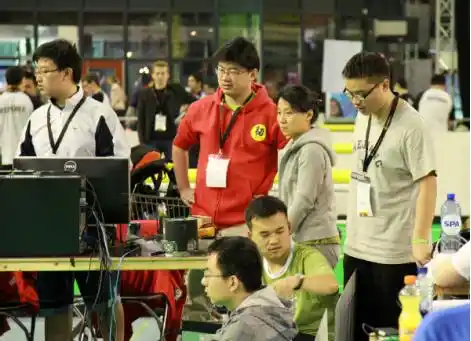
Xiong Rong instructing students in competitions (Zhejiang University official website)
A year later, Xiong Rong and her students developed Zhejiang University's first-generation FIRA soccer robots, beginning their journey in domestic and international robotics competitions. The Zhejiang University team she led has won the Small Size Robot Soccer World Cup four times, including a 1:0 victory over Germany's ER-Force team in the 2019 final.
In March this year, the International Federation of Robotics unveiled the list of "11 Women Shaping the Future of Robotics in 2026," with Xiong Rong being the only Chinese face on the list.
Xiong Rong's story with robotics has always been accompanied by a group of students.
The lab at that time resembled a small startup company, with little prior experience. Students remember the room often filled with the burnt smell of soldering circuit boards. In 2015, the team developed China's first trackless autonomous navigation AMR intelligent handling robot. Around 2016, the practical application demand for industrial mobile robots gradually emerged, attracting attention from the market and capital. They felt they could no longer keep their achievements locked in the lab.
Thus, in July 2016, Xiong Rong, along with several students, founded JIAZHI Technology in Hangzhou. At its establishment, the company had a registered capital of 5 million yuan, with Xiong Rong holding 49% and Chen Shouxian, who later became CEO, holding 2.4% at the time.
Chen Shouxian had participated in robotics competitions with Xiong Rong as early as his student days, winning a world championship with the team. The core team of JIAZHI Technology also largely came from the Robotics Laboratory of Zhejiang University's Institute of Intelligent Control. The teacher and students who once debugged robots and stayed up late for competitions together thus became partners in entrepreneurship.
The initial direction of the startup was not clear. Chen Shouxian once recalled that around 2017, the team explored scenarios for service robots in hotels and shopping malls, at times acting like someone with a hammer looking for a nail. After comparisons, they realized that industrial sites' requirements for positioning accuracy, reliability, and environmental adaptability were more suitable for the mobile robot technology the team had accumulated over the years. Xiong Rong believed the team also had the capability to develop autonomous driving systems and service robots, but they ultimately chose to focus on industrial intelligent logistics, valuing its contribution to manufacturing upgrade.
To introduce AMRs for a leading domestic panel manufacturer, JIAZHI Technology dispatched a team to the factory. They spent two to three months analyzing dozens of processes at the module production end, then repeatedly collaborated with the customer to finally customize a dedicated robot, deploying about 200 units at once.
JIAZHI Technology's products were thus honed bit by bit on the factory floor. In 2018, its first AMR product, EMMA V1, achieved commercialization. In 2020, the company launched the outdoor mobile robot LUNA 2; in 2021, it commercialized the omnidirectional heavy-duty OMNI and pallet-handling FOLA series; in 2022, it entered the mobile manipulator field; and in 2025, it launched the embodied intelligent mobile chassis NERA-P.
Funding also continuously flowed in. Just half a year after its establishment, JIAZHI Technology received angel investment from Ginkgo Valley Capital. Subsequently, it introduced investors such as Paladin, Ankong Technology, Yunyi Investment, Huiyou Investment, and Hongrong Capital. In 2021, ByteDance-affiliated Quantum Jump and Lenovo Capital invested, followed by a B+ round led by Xianghe Capital with participation from Shenzhen Capital Group and others. After that, companies like Supcon, Fangguang Capital, and several Zhejiang local state-owned assets successively injected funds. In early 2026, the company completed a C++ round of financing, with a post-investment valuation reaching 2.13 billion yuan.
A decade of entrepreneurship has finally been written into the prospectus.
From 2023 to 2025, JIAZHI Technology's revenue was 74.95 million yuan, 110 million yuan, and 260 million yuan, respectively. In the first half of 2026, the company's revenue was 169 million yuan, a year-on-year increase of 25%, with 891 robots shipped and pending contract value of approximately 500 million yuan at the end of the period.
Among these, it was still the industrial AMRs chosen at the startup phase that truly supported the revenue. In the first half of 2026, robot solutions contributed 147 million yuan, accounting for 87.3% of total revenue.
Robotics Companies Queueing for IPO
The gong for robotics company listings is ringing more frequently.
Huayan Robot, Estun, LeDong Robot, Siantec, and LUXROBO have successively completed listings on the Hong Kong Stock Exchange. On August 19th, Unitree landed on the STAR Market. In early September, Mech-Mind listed on the Hong Kong Stock Exchange, and UDI Robot has also completed its IPO.
The queue is still growing. According to incomplete statistics from Leifeng.com, there are over 50 robotics-related companies queuing at the Hong Kong Stock Exchange alone: companies like Zhiyuan Robotics, LeapingGo, and RoboPeak have entered the IPO process; companies like LimX Dynamics, Kuawei Intelligence, Zhipingfang, and Zibianliang have also successively signaled their listing intentions. Meanwhile, companies like Xinghaitong, Zhongqing Robot, Songyan Power, Xingdong Jiyuan, Xingchen Intelligent, and Fourier Intelligent have completed share reform and entered the IPO preparation stage.
To some extent, this is the collective "ten-year covenant" for China's first generation of robotics startups.
Around 2015, the AI and smart manufacturing sectors heated up, leading to the migration of a large number of research achievements from university laboratories to the industry, with companies like JIAZHI Technology emerging. A decade later, the VCs, industrial capital, and local state-owned assets that placed bets along the way are finally seeing the moment for exit returns.
A Chinese robotics corps is flocking to the capital market in groups, striving to knock on the door of the public market before the financing window narrows.
Capital is accelerating towards a few leading players. Since 2026, industry leaders have secured tens of billions of yuan in large-scale financing within just a few months, while the financing pace for mid-tier and lower companies has noticeably slowed.
Robotics is, after all, a long and capital-intensive business. From technology R&D and prototype testing to supply chain setup, on-site debugging, and after-sales maintenance, each step forward requires funding.
For companies still in continuous investment without stable profitability, an IPO is a crucial step to access public market financing and M&A tools, creating exit conditions for early shareholders. Companies remaining outside the door will continue to face pressure from subsequent financing, valuation, and cash burn.
The system provides a new financing entry for these long-term R&D-investing companies. The Hong Kong Stock Exchange's Chapter 18C is designed for Specialist Technology Companies that cannot meet the Main Board Chapter 8 financial eligibility tests, offering them a path to IPO financing for product commercialization and business expansion, while setting corresponding eligibility, disclosure, and investor protection requirements.
But listing does not equal reaching safe harbor.
In March this year, Huayan Robot's public offering received over 5,000 times subscription, yet its stock price fell below the issue price on the first day of trading. Two months later, Yifei Technology, which did not introduce cornerstone investors or set up a green shoe mechanism, saw its stock price surge 80% on the first day, with a market cap exceeding 13 billion HKD. As more robotics IPOs emerge, the secondary market's responses vary.
The primary market looks at technology roadmap, team background, and growth potential, while the secondary market also questions gross margin, customer concentration, collection cycle, and cash flow.
Zhou Zhifeng, Managing Partner of Qiming Venture Partners, once summarized to Leifeng.com the three hurdles for robotics and embodied AI companies entering the public market: the ability for large-scale commercial deployment, whether the technology roadmap can converge, and whether hardware costs, gross margins, and supply chain management capabilities can break through. In his view, 2027 will become an important validation window for robotics and embodied AI companies.
The real test has only just begun.
This article is from the WeChat public account "天天IPO," author: Chen Jia