On October 12, the Chinese PCB sector continued its decline. Jinan Gintek Material fell by the daily limit for two consecutive trading sessions, Hongchang Electronic hit the limit down, and Huazheng New Material saw intraday losses exceeding 9%. The market concerns were triggered by a U.S. defense procurement restriction set to take effect on January 1, 2027.
However, a closer look at the timeline reveals that the statement from the American Printed Circuit Board Association (PCBAA) urging the exclusion of Chinese PCBs was actually issued on September 11. Within the United States, the debate over whether to implement the exclusion of Chinese PCBs three months from now is still ongoing.
The Information Technology Industry Council (ITI), representing tech companies, submitted formal rulemaking comments to the Department of Defense, requesting a 36-month transition period for relevant commercial products after the final rule is issued. The PCBAA, on the other hand, issued a statement urging the Department of Defense to proceed with excluding Chinese PCBs as planned, without further delays or relaxations. On October 12, a Citi research report pointed out that the global aerospace and defense PCB market is only about $1.4 billion. Considering the massive scale of China's PCB industry, the direct impact of the U.S. defense ban on Chinese PCB demand is estimated to be less than 1% of the total.
One side pleads for leniency, another pushes for the ban, while a third argues the ban is inconsequential. Behind these divergences lie American PCB manufacturers anticipating new orders and downstream companies foreseeing higher costs. The weight of China's supply chain is reflected in these conflicting demands: the U.S. can find alternative suppliers, but maintaining previous prices, volumes, and delivery schedules will not be easy.
Scope of Restrictions and Industry Background
This restriction has been in the making for five years. The FY2021 National Defense Authorization Act (NDAA) first proposed the PCB procurement ban, and the FY2022 NDAA postponed the implementation date to January 1, 2027.

On January 1, 2021, the U.S. Senate voted 81-13 to override President Trump's veto of the FY2021 NDAA, formally enacting the bill into law.
The ban primarily targets U.S. Department of Defense procurement, covering specific PCBs from China, Russia, Iran, and North Korea, including bare boards and assembled boards used in mission-critical systems, weapons, and command and control systems. Common electronics like mobile phones, automobiles, and commercial AI servers are not entirely prohibited from using Chinese PCBs. The law also includes commercial product exceptions and waiver mechanisms, with the specific scope of enforcement awaiting final rule clarification.
For American companies, however, this regulation means not only establishing separate production lines for defense orders but also undertaking specialized supply chain tracing. If procurement requirements are tightened immediately in 2027, companies will not only need to find new suppliers but may also face additional costs for certification, traceability, and production. These costs must be borne solely by the companies, which is the fundamental reason behind ITI's request for a delay.
PCBAA holds the opposite stance. For domestic U.S. PCB manufacturers, the procurement restrictions represent a batch of defense orders that would otherwise likely go overseas. Continued delays would give customers insufficient incentive to switch to U.S. suppliers, and new factories would struggle to secure stable order expectations.
The current U.S. administration clearly hopes to enhance the competitiveness of domestic PCB manufacturers. While the U.S. boasts leading chip design companies and tech brands, much of the supporting manufacturing for large-scale electronics production has shifted overseas. The consequence of this is dependence on foreign sources for even the most basic components.
Sun Xi, director of the Case Center at Capital University of Economics and Business, in his analysis "'Counter-current' Grand Alliance—Analyzing the Banner and Essence of 'Science: The New Golden Age'," summarized this shift as "rebuilding the industrial commons": the state no longer entirely delegates key manufacturing capabilities to global division of labor but redefines strategic needs and organizes domestic supply through defense orders, fiscal subsidies, and tax incentives. The procurement restriction is not a direct product of "Science: The New Golden Age," but both share the same policy shift: the U.S. is turning its previously "done but not said" developmentalism and protectionism into explicit industrial rules.
According to data released by PCBAA in May of this year, the U.S. share of the global PCB supply has dropped from about 30% to 4% over the past 30 years. In 2000, the U.S. had over 2,000 PCB enterprises; today, there are fewer than 145 manufacturing entities.
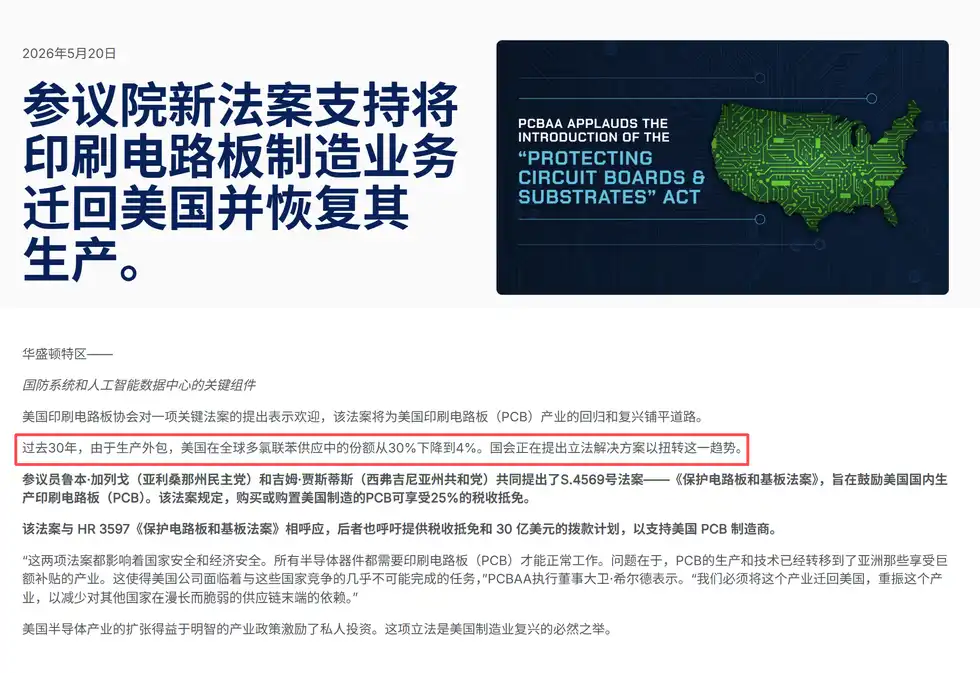
Over the past 30 years, the U.S. share of global PCB supply has fallen from about 30% to 4%.
AI is further amplifying this gap. Higher chip performance demands higher requirements for circuit boards. High-speed signal transmission necessitates low-loss materials, finer circuit lines, and more complex interlayer connections. PCBs are no longer just foundational components connecting electronic elements; they are also beginning to directly impact the signal quality and system performance of AI servers.
Prismark statistics show that the global PCB market reached approximately $85.8 billion in 2025, a year-on-year increase of 16.7%. U.S. leader TTM reported a 91% year-on-year increase in its Data Center & Network business revenue for Q2 this year, now accounting for 40% of the company's total revenue.
The rapidly growing AI hardware market is providing new orders for high-end PCBs. But for the U.S., the problem is that demand is returning, but a sufficiently complete domestic manufacturing ecosystem is not.
In May this year, a new bill supported by PCBAA proposed a 25% tax credit for purchasing U.S.-made PCBs and package substrates, with a House version also including a $3 billion support plan.
This, together with the 2027 procurement restriction, forms a coherent industrial policy approach: using defense procurement to provide a market for domestic PCB makers, and then leveraging tax credits and subsidies to steer more commercial orders toward U.S. factories.
What the U.S. hopes to restore is not just the supply capability for military circuit boards, but to make advanced electronics manufacturing a part of the domestic industry once again.
As Sun Xi put it when interpreting the new science report, defense procurement here serves the function of "pre-guaranteeing market demand" for specific capabilities. However, the PCB case also serves as a reminder that while the state can provide initial orders, it cannot absorb all commercial costs for enterprises. The law can set a ban date, but industrial capability requires equipment ramp-up, yield validation, supplier certification, and order allocation. The disputes between board manufacturers and tech companies are precisely the sound of these policies landing on the cost sheet.
Four Years of U.S. Factory Building, While Existing Capacity Still Expands in China
Expecting to redirect orders back to the U.S. by excluding Chinese suppliers is likely harder to achieve. The real challenge for the U.S. is bridging the gaps in capacity, supporting industries, and commercial competitiveness left by industrial hollowing-out.
In June this year, an American PCB manufacturer officially opened a new plant. The $130 million project, which includes $30 million from the U.S. defense sector, primarily serves military projects like radar and missile defense, producing ultra-high-density interconnect circuit boards.
TTM announced its investment plans as early as 2023. According to the company's progress update in August, the new factory only began a gradual ramp-up in Q3 of this year, with full production capacity expected by 2028. The timeline from investment announcement to full capacity spans over 4 years, and this is for an established U.S. PCB leader with existing technology, production experience, and defense clients. It's even more challenging for companies lacking these foundations to build equivalent capabilities.
Beyond factory buildings, the U.S. also faces gaps in materials, equipment, and certification systems. Last year, PCBAA's Executive Director testified before Congress that after U.S. PCB manufacturing relocated overseas, the supply of related materials and equipment followed, with many specialized machines needing procurement from Europe or Asia, and the U.S. having only one remaining source for copper foil production at the time.
Even after building a factory, new suppliers must meet defense procurement requirements. The U.S. Department of Defense estimated in a pre-rule notification issued in July this year that IPC-1791 certification typically takes 8 to 16 months, while the other two supply chain security and traceability standards require 3 to 11 months.
More importantly, the U.S. needs to address capacity utilization. PCBAA previously estimated that the defense sector accounts for about 40% of domestic U.S. PCB demand. Military projects can sustain high-specification, low-volume production but are insufficient to provide economies of scale for all new capacity.
Once a high-end PCB production line is operational, it incurs ongoing costs for equipment depreciation, materials, labor, and maintenance. Relying solely on subsidies and military procurement, without sufficiently large commercial orders, makes it difficult to develop a cost structure competitive with Asian supply chains.
Thus, the U.S. PCB industry association hopes for prompt implementation of restrictions to lock some orders domestically, while downstream tech companies worry that procurement rules will change faster than supplier capacity can be built to replace it.
ITI clearly stated in its August comments that commercial manufacturers typically do not build separate production lines for government clients. If requiring entire commercial lines to meet additional defense standards, the costs of certification, traceability, and vetting would spread to commercial business. Building a dedicated defense supply chain would increase investment and operational expenses.
ITI also opposes changing the commercial product exception that meets standards into a waiver requiring case-by-case application. This would subject existing commercial products to renewed review and waiting when entering the defense procurement system.
Even with new regulations and subsidies from the government, domestic enterprises have not contracted their overseas footprint. TTM, a major U.S. defense contractor, shared in its August earnings call that a China expansion area which was an empty building in March had drilling equipment installed by May, and the board subsequently approved additional investment.
The same U.S. company is leveraging government support to bolster domestic defense manufacturing while utilizing China's established industrial ecosystem to meet growing market demand. This unintended consequence illustrates the U.S. manufacturing dilemma. Policies can set restriction lists, but they cannot prevent companies from gravitating towards industrial clusters with lower costs, more mature supporting industries, and higher delivery efficiency.
China's PCB Advantage Extends from Capacity to High-End Manufacturing
According to Prismark statistics, among the global top 100 PCB enterprises in 2025, 43 are headquartered in China, contributing about 36% of the global PCB output value. The manufacturing capability the U.S. hopes to restore is precisely the advantage China's PCB industry has accumulated over many years.
A more noteworthy change is that China's PCB sector is moving from scale advantage to a combination of technology and scale. Chinese companies are no longer just securing orders through mass production of standard circuit boards but are increasing product value-added in high-end segments like AI servers, high-speed switches, and advanced packaging.
In the first half of this year, Shanghai Shennan Circuit Co. (SCC) reported revenue of 13.689 billion yuan, a year-on-year increase of 61.17%; net profit attributable to shareholders was 2.923 billion yuan, up 73.72%, with a PCB business gross margin of 40.52%. Profit growth outpacing revenue growth indicates SCC is benefiting from high-end product demand and business structure upgrades.
Similarly targeting the AI computing market, Victory Giant Technology has achieved mass production of 6-step 24-layer HDI and possesses the capability for mass production of 8-step 28-layer HDI. Its 2026 interim report shows the company has overcome core manufacturing processes for 10-step 30-layer and 14-step 36-layer HDI and achieved mass production of some PCB products in the custom computing chip (ASIC) field.
This type of high-end PCB requires finer circuit lines and multiple sequential build-up layers for high-density interconnection within limited space. The technical challenge lies not only in producing samples but also in controlling yield, maintaining consistency, and meeting customers' continuously evolving product requirements. Once integrated into a customer's product on a large scale, replacement becomes very difficult.
Breakthroughs in high-end PCBs are also extending upstream to materials. Global CCL leader Shengyi Technology disclosed in August that its extremely low-loss materials have passed certification by multiple domestic and international end customers, with some products starting batch supply. These materials are primarily used in AI servers and high-speed switches to reduce loss during high-speed signal transmission. In the first half of this year, Shengyi Tech's revenue grew 50.05% year-on-year, with net profit up 130.42%, driven in part by an increased proportion of high-end products.
Moving closer to chips, Shennan Circuits is expanding its IC substrate business. In the first half, IC substrate revenue was 3.667 billion yuan, a year-on-year surge of 110.76%, with high-end FC-BGA substrates achieving volume production for multiple customers.
Material companies develop lower-loss base materials, board manufacturers convert new materials into stable, deliverable processes, and mass orders from end customers provide the capital for further investment in equipment and R&D. Viewed this way, the confidence of China's PCB industry stems not just from the number of companies or output share, but from the "industrial commons" formed jointly by materials, board makers, end customers, and engineering validation. It is not a supplier list that can be quickly replicated by a restrictive order, but an organizational capability formed through long-term orders, collaborative development, and mass production iteration.
One core reason for the difficulty in reviving the U.S. PCB industry is that, after a large portion of commercial electronics manufacturing moved overseas, U.S. military PCB manufacturers lost the opportunity to directly leverage commercial mass-production experience for process upgrades. This, precisely, is the significant advantage China's PCB industry currently holds: vast markets for communications, consumer electronics, and computing equipment provide manufacturing enterprises with continuous opportunities for new product development, validation, and mass production. The growth in AI demand is now pushing this accumulated expertise toward even higher-end applications.
In the past, the U.S. held chip design, end brands, and high-value orders, while China and Asia's manufacturing systems provided scaled supporting capabilities. Now, AI is altering this division of labor. Leading Chinese PCB manufacturers are not only capable of undertaking high-end product manufacturing but are also entering more profitable segments of the global electronics industry, leveraging their materials, processes, and mass production capabilities.
For Chinese board manufacturers, U.S. supply chain restrictions may increase costs for overseas factory building and compliance, and potentially alter the flow of some orders. But what the U.S. finds truly difficult to replicate is not any single Chinese factory, but the industrial ecosystem formed by material supply, process accumulation, customer validation, and large-scale production.
The U.S. can use law to decide who gets defense orders, but it cannot use law to decide who is more capable of production. As Chinese PCB enterprises have moved from competing on scale to high-end manufacturing, what the U.S. seeks to regain is no longer just the capacity it lost in the past, but the new competitive advantages Chinese companies are now establishing.
This article is from WeChat Official Account: Ke Gong Li Liang (Science & Industry Power), Author: Wang Runlian