Original | Odaily Planet Daily
Author|Azuma
Earlier this month, Trade.xyz officially completed the deployment of its prediction market product on the Hyperliquid mainnet, becoming the third HIP-4 prediction market project in the Hyperliquid ecosystem, following Outcome.xyz and Skew Markets.
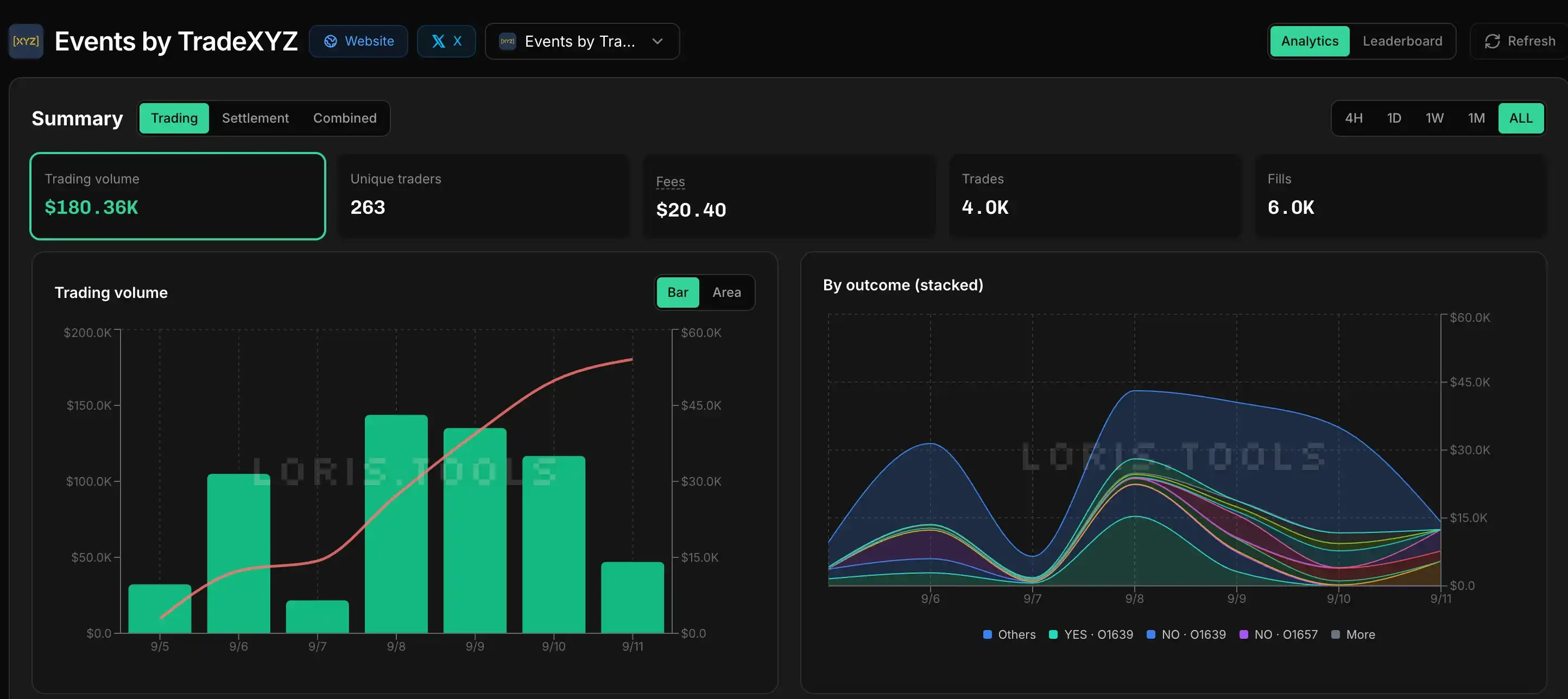
In its first few days of operation, Trade.xyz quietly launched 34 prediction events through the "Predict" subpage on its official website, covering Finance, Sports, and Others. However, perhaps due to the lack of a formal announcement, the cumulative trading volume and number of users were not high — only $180,000 in total trading volume and 263 users in the first week.
This morning, Trade.xyz began officially promoting the product through official channels for the first time.
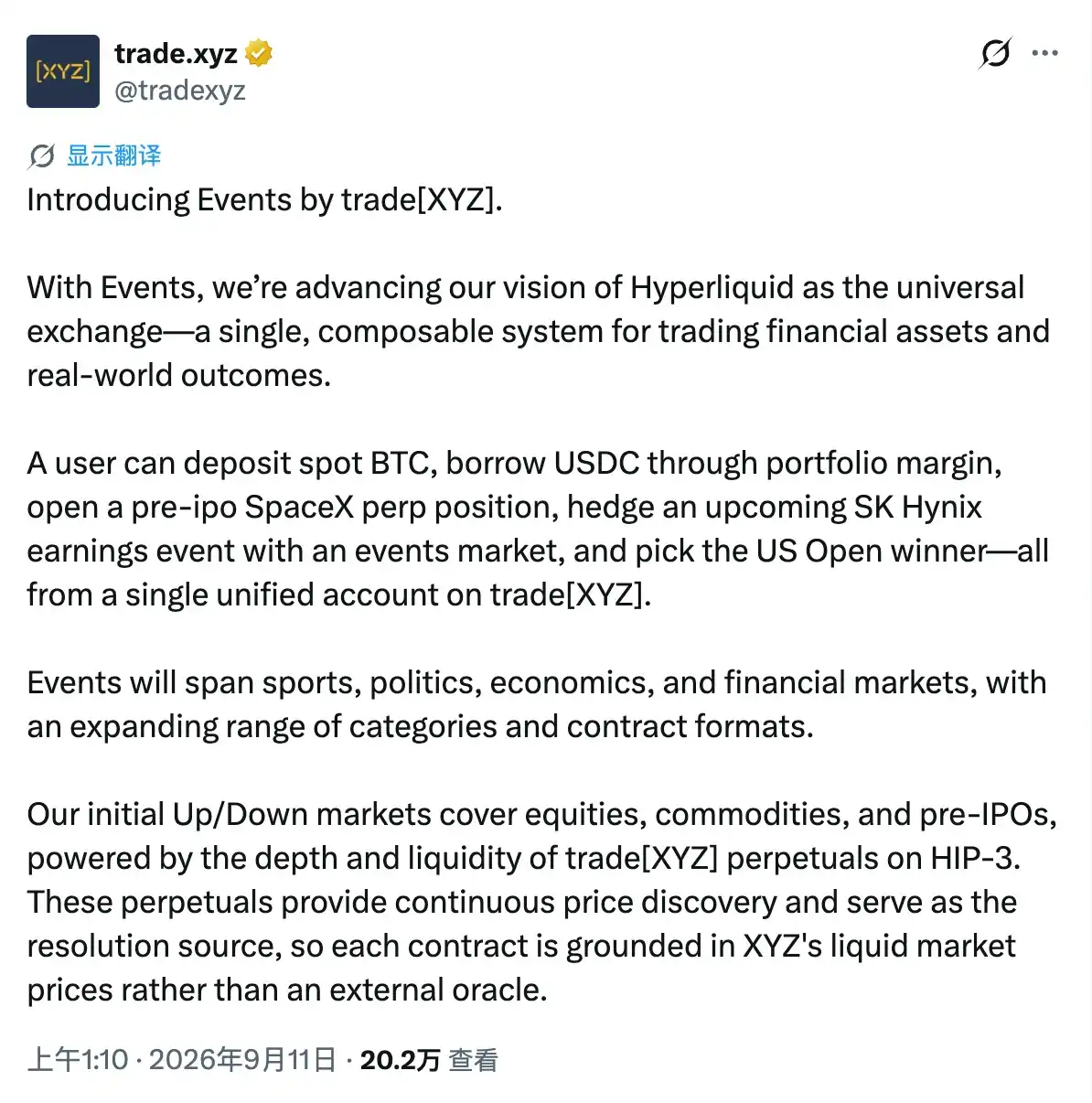
According to the latest announcement, Trade.xyz has named the product "Events." Events will cover sports, politics, economics, and financial markets, and will continue to expand into more categories and contract forms in the future. The initial batch of events related to stocks, commodities, and Pre-IPO assets will leverage the depth and liquidity of Trade.xyz's perpetual contracts on HIP-3, ensuring that each contract is based on the real price from Trade.xyz's highly liquid markets, rather than relying on external oracles.
Through Events, Trade.xyz hopes to further advance its vision of establishing Hyperliquid as a "universal exchange" — building a unified and composable system for trading financial assets and real-world event outcomes.
Additionally, and more importantly, Trade.xyz has formally added the design details of Events to its product documentation, especially clarifying the fee-related standards. Through these standards, we can objectively compare the fee structures of Trade.xyz and Polymarket to see which one is truly cheaper.
Fee Comparison: Trade.xyz vs Polymarket
Let's first look at the fee logic of both platforms.
Trade.xyz's Events directly adopts Hyperliquid's Outcome Trading fee system. Currently, it does not charge additional project fees in its initial configuration; users only need to pay fees according to Hyperliquid's spot fee rates.
The base rates are Taker (0.07%) and Maker (0.04%). These rates are tiered based on the user's weighted trading volume over the past 14 days, with the highest tier offering rates as low as Taker 0.025% and Maker 0%. Furthermore, staking HYPE can provide up to a 40% fee discount. It's worth noting that fees for Events are not charged when opening a position, but rather when closing the position or during final settlement. Also, Makers do not receive additional rebates.
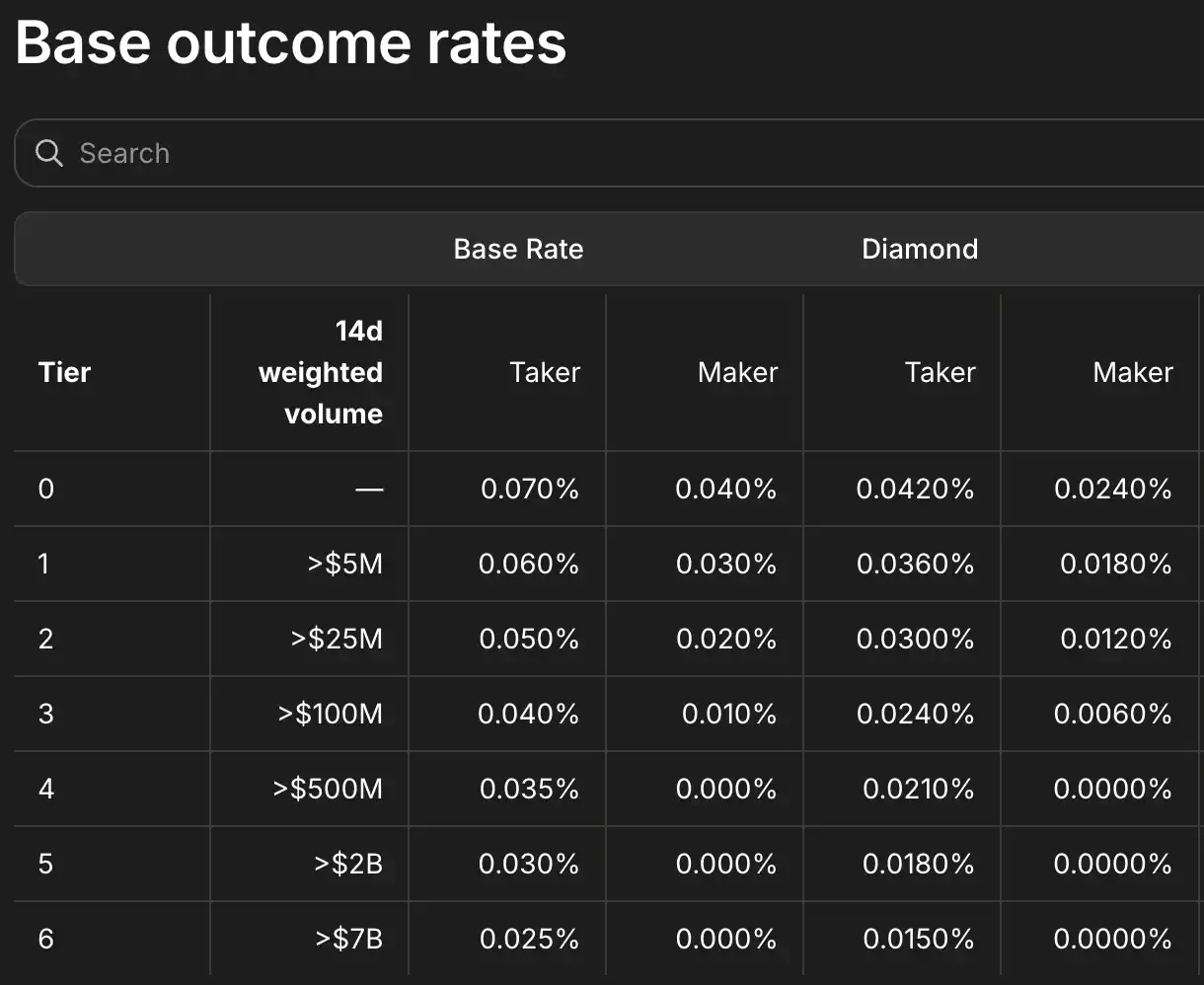
Odaily Note: Base tiered rates for Events, and tiered rates after staking discount (illustrated using the highest Diamond tier only).
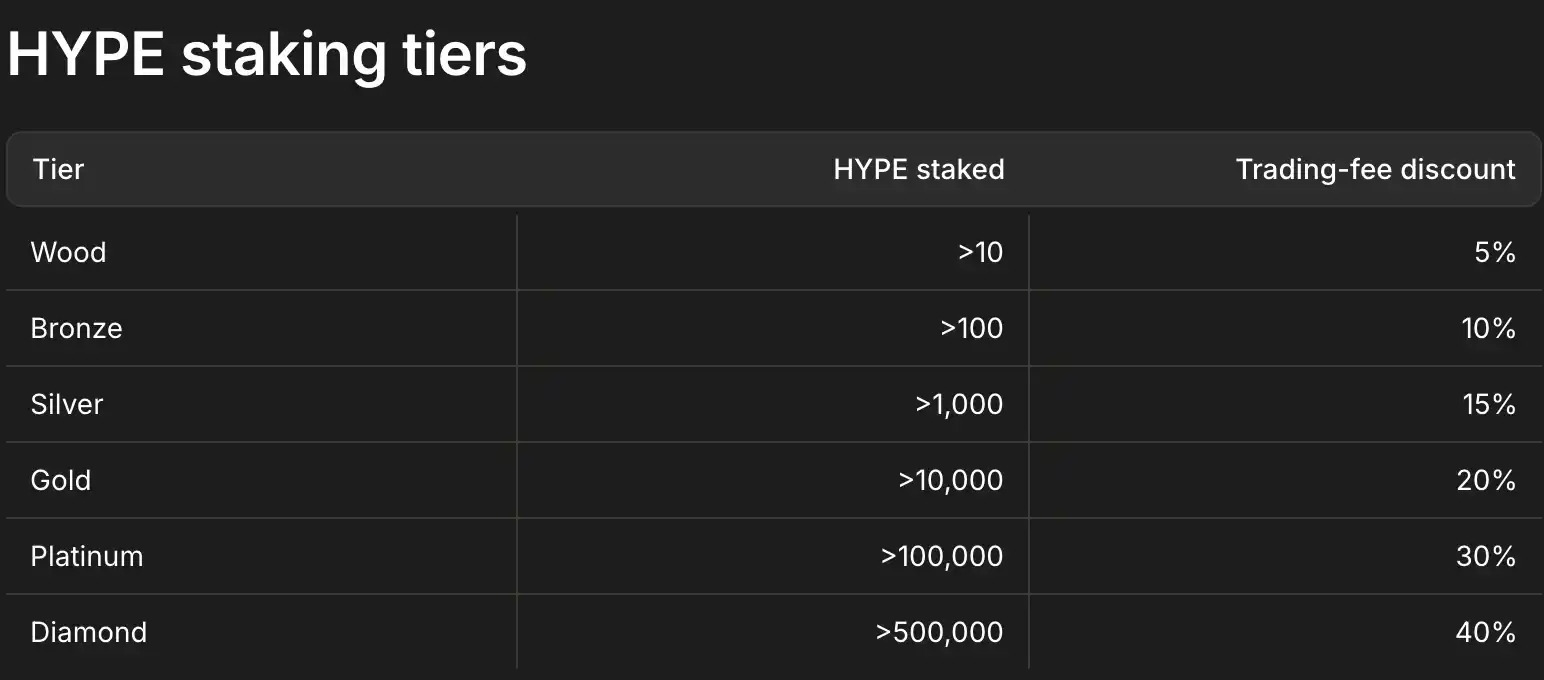
Odaily Note: The staking fee discount for Events.
Polymarket's logic is distinctly different. Makers enjoy zero fees and receive rebates ranging from 15% to 25%. Taker fees are dynamically calculated based on the market category and the probability price at the time of order execution.
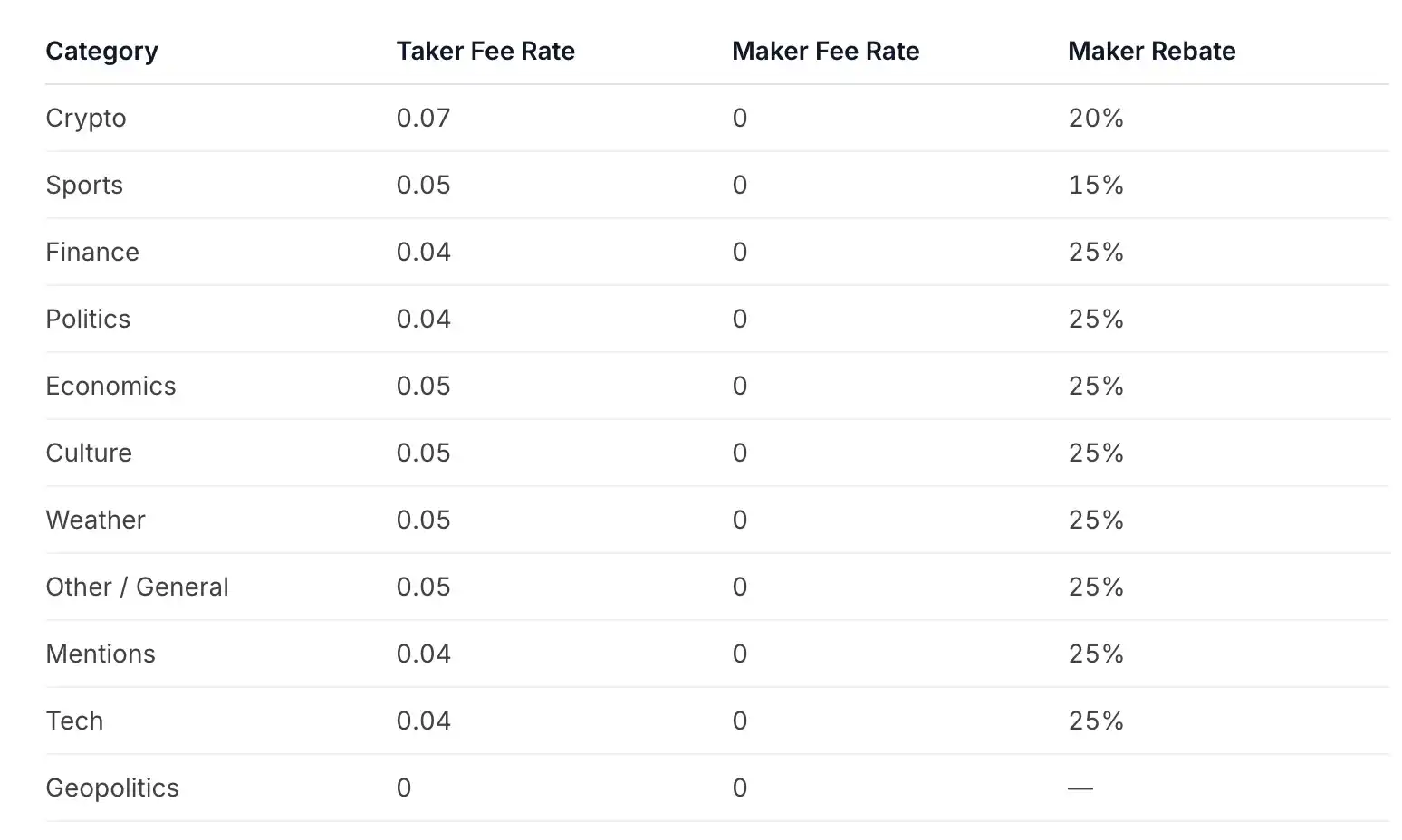
Odaily Note: Fee parameters for different markets on Polymarket.
Currently, the fee parameter for Crypto markets on Polymarket is 0.07%; Sports, Economics, Culture, Weather, and Other categories are 0.05%; Finance, Politics, Mentions, and Tech are 0.04%; while Geopolitics is completely free. Specific fees are calculated as C × feeRate × p × (1-p). Therefore, even with the same 0.04% fee parameter, the actual fee paid will vary with price changes.
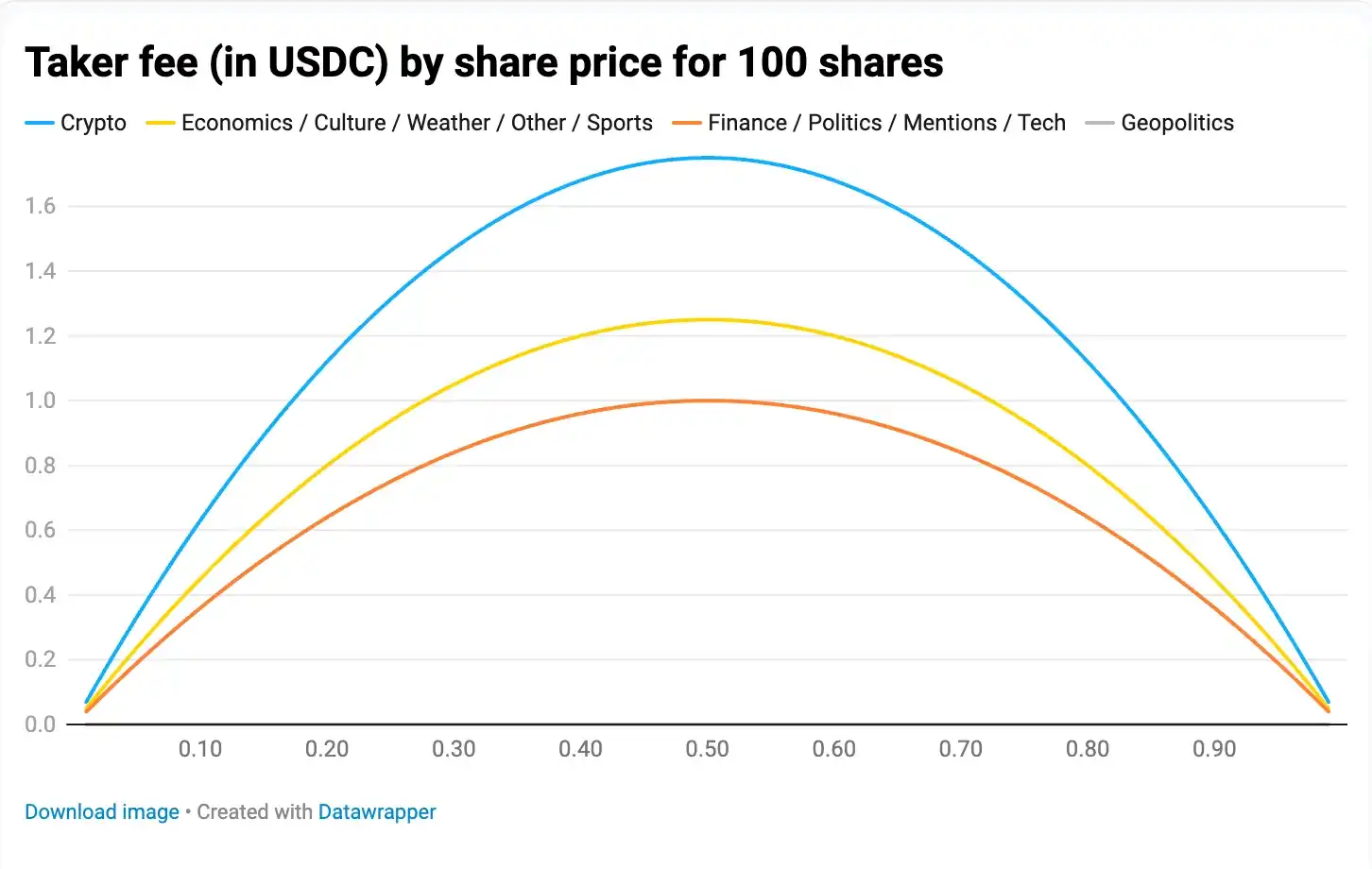
Odaily Note: Changes in Polymarket's fee curve at different probabilities.
Precisely because of this, the actual fee difference between Trade.xyz and Polymarket can vary significantly under different circumstances.
First, consider a straightforward example. Assuming a user acts as a Taker for a $100 event with a 50% probability, Trade.xyz charges approximately $0.07 based on its base Taker rate of 0.07%. On Polymarket, for categories like Finance or Politics with a fee parameter of 0.04, calculated as C × feeRate × p × (1-p), the fee would be about $1. For Sports and other categories with a parameter of 0.05, it's about $1.25, and for Crypto markets, it reaches $1.75. In other words, during the phase where probabilities are closest to 50/50 and trading is most contested, Polymarket's actual fees can be 14 to 25 times higher than Trade.xyz's.
However, as an event's outcome becomes clearer, the gap between the two platforms shrinks rapidly. This is because Polymarket's fees are not simply a percentage of the transaction value but are tied to the p × (1-p) factor in the formula — the closer the probability is to 50%, the higher the fee; the closer it is to 0% or 100%, the lower the fee.
For instance, for the same $100 Taker trade in Finance or Politics, if the event probability increases from 50% to 90%, Polymarket's fee would drop from about $1 to $0.36. At a 95% probability, the fee would be about $0.19, and at 99%, it would be only about $0.04. This means that for events already close to a "deterministic outcome," Polymarket's dynamic fee mechanism can significantly reduce transaction costs, potentially even lower than Trade.xyz's base Taker rate.
However, there is another important variable: Maker trades. Trade.xyz's base Maker fee is 0.04%, while Polymarket charges zero trading fees for Makers and even provides rebates. For users who habitually place limit orders and wait for the market to fill them, Polymarket's cost advantage becomes significantly more pronounced. Conversely, for Taker users who need fast execution and directly take liquidity from the order book, Trade.xyz still holds a considerable fee advantage in most mid-probability ranges.
Additionally, the fee performance varies across different event categories. For example, Geopolitics markets on Polymarket are completely free, with no trading fees. Therefore, one cannot simply judge whether Polymarket is cheaper using a fixed fee rate; the actual cost also depends on "what event is being traded" and "what the current probability of the event is."
In summary, if users primarily engage in trades during the early stages of an event, when probabilities are near 50/50 and require frequent active taking of liquidity, Trade.xyz's low, fixed-rate advantage is very prominent. If they primarily trade geopolitical events and other highly skewed tail events, or are accustomed to executing via Maker limit orders, Polymarket may offer lower, sometimes near-zero, actual transaction costs.
In other words, Trade.xyz's strength lies in simple, stable, and low Taker costs, while Polymarket ties its fees to market probability, creating a more complex dynamic fee system that can be cheaper in specific trading scenarios.
The Scale Gap Remains Vast, but the Cross-Border Leader Should Not Be Overlooked
That said, judging by current data, Trade.xyz is clearly not yet in a position to compete head-on with Polymarket. A first-week trading volume of only $180,000 and 263 users pale in comparison to the liquidity, user base, and market coverage Polymarket has established — a difference of several orders of magnitude. At least at this stage, Trade.xyz resembles a newcomer challenger more than a direct competitor to Polymarket.
However, if we slightly broaden our perspective beyond the prediction market itself, Trade.xyz does not lack opportunities. Over the past year or more, Trade.xyz has already demonstrated its capabilities in market creation, liquidity organization, and long-tail asset trading on HIP-3 within the Hyperliquid ecosystem. Events can precisely extend these accumulated strengths further into the prediction market.
Especially regarding fees, liquidity, and integration with Hyperliquid's perpetual markets, Trade.xyz is not simply replicating Polymarket. Instead, it aims to incorporate prediction markets into Hyperliquid's unified trading system. If it can successfully migrate the trading capabilities already built on HIP-3 to Events in the future and leverage Hyperliquid's user base and liquidity for a cold start, then Trade.xyz could potentially become a disruptor in the prediction market arena.
Of course, all of this remains potential for now. For prediction markets, low fees are just one competitive factor. What truly determines market structure is still liquidity, user scale, event coverage, and market-making capability. Whether Trade.xyz can replicate its advantages from HIP-3 onto Events is perhaps the most critical aspect to observe moving forward.