The Great Migration of Mining Companies: Some Already Hold $12.8 Billion in AI Orders

marsbitPublished on 2026-03-06Last updated on 2026-03-06

Abstract

Bitcoin mining companies are undergoing a massive structural shift toward AI and high-performance computing (HPC), driven by compressed mining profits and the lure of massive AI infrastructure contracts. With Bitcoin’s mining difficulty rising and profitability declining, miners are leveraging their existing assets—power contracts, land, cooling systems, and data centers—to pivot into AI compute provisioning. Key players like TeraWulf have secured over $12.8 billion in HPC contracts, while IrisEnergy holds a $9.7 billion deal with Microsoft. Other firms, including Hut8, CipherDigital, and CoreScientific, have also announced multi-billion dollar AI agreements. Some, like BitDigital, are exiting Bitcoin mining entirely to focus on AI and Ethereum infrastructure. Financial reports show a clear trend: AI/HPC revenue is becoming a major income source, sometimes surpassing mining. Capital markets are selective, favoring companies with strong execution, resource advantages, and strategic positioning within the AI supply chain. The migration is accelerating—miners must adapt to the new reality or risk obsolescence.

Original|Odaily Planet Daily (@OdailyChina)

Author|Wenser(@wenser 2010)

Over the past decade, Bitcoin mining companies were once the most stable foundation of PoW networks and the cost anchor of the BTC "Tier 0 market." But now, these industry cornerstones are collectively pivoting, either actively or passively, towards AI.

On the surface, the direct incentive for mining companies to transform is the continuous increase in mining difficulty and the compression of profit margins by a sluggish market; but the deeper driving force is the extreme pursuit of the AI narrative by capital markets—and mining companies happen to possess the most easily convertible real-world assets: electricity, land, cooling systems, data centers, and ready-made data infrastructure, which can be exchanged for AI computing power contracts worth tens of billions of dollars.

Amid the clamor of multi-model competition, mining companies standing at the intersection of energy, electricity, computing power, and crypto assets are undergoing an unprecedented yet almost inevitable industry migration.

Some are steady and watchful, some are forced to turn and go all-in, but one thing is certain: the wind has risen—this is a structural shift blowing from the crypto market towards the AI world.

A Hard Battle That Must Be Fought, and a Cake Too Tempting to Refuse

Entering 2026, for mining companies, the real pressure has never come solely from price fluctuations, but from structural squeeze: difficulty continues to rise, unit revenue continues to fall, and operating costs continue to increase.

In the Winter: Selling Coins to Survive and Bankruptcy Liquidation

On February 20, Bitcoin mining difficulty once increased by 15% to 144.4T, the largest increase since 2021. During the same period, the network hash rate recovered from 826 EH/s to 1 ZH/s, but the hashprice fell to a multi-year low of only about $23.9/PH/s. With the profit compression brought by the 2024 halving continuing, mining companies were forced into a cash flow defense mode.

The most symbolic event came from Bitdeer. On February 20, it disclosed that its own BTC holdings had dropped to 0, with production and sales exactly equal that week. Although founder Jihan Wu later explained that "being 0 now does not mean being 0 in the future," the market still saw it as a microcosm of the pressure on mining companies.

The困境 is not limited to one company. In early February, NFN8 Group filed for Chapter 11 bankruptcy protection in Texas, USA, planning to sell all its assets. Documents showed that a core mine fire, the burden of leases from sale-leaseback models, and the cliff-like drop in hashprice after the halving directly crushed its cash flow. Despite owning multiple mining facilities, NFN8's own assets of 5000 mining rigs were valued at less than $50,000, while liabilities reached the million-dollar range.

As the environment continued to deteriorate, mining companies' reaction was unusually consistent—marching towards AI.

Second Spring: Astonishing Profits Behind AI/HPC Mega Orders

For AI giants, computing power data centers are always scarce: traditional construction cycles take 3-5 years, with high costs for land, electricity, and cooling. Mining companies already have power contracts, infrastructure, and operational experience, making them the most realistic承接方 in the AI expansion cycle.

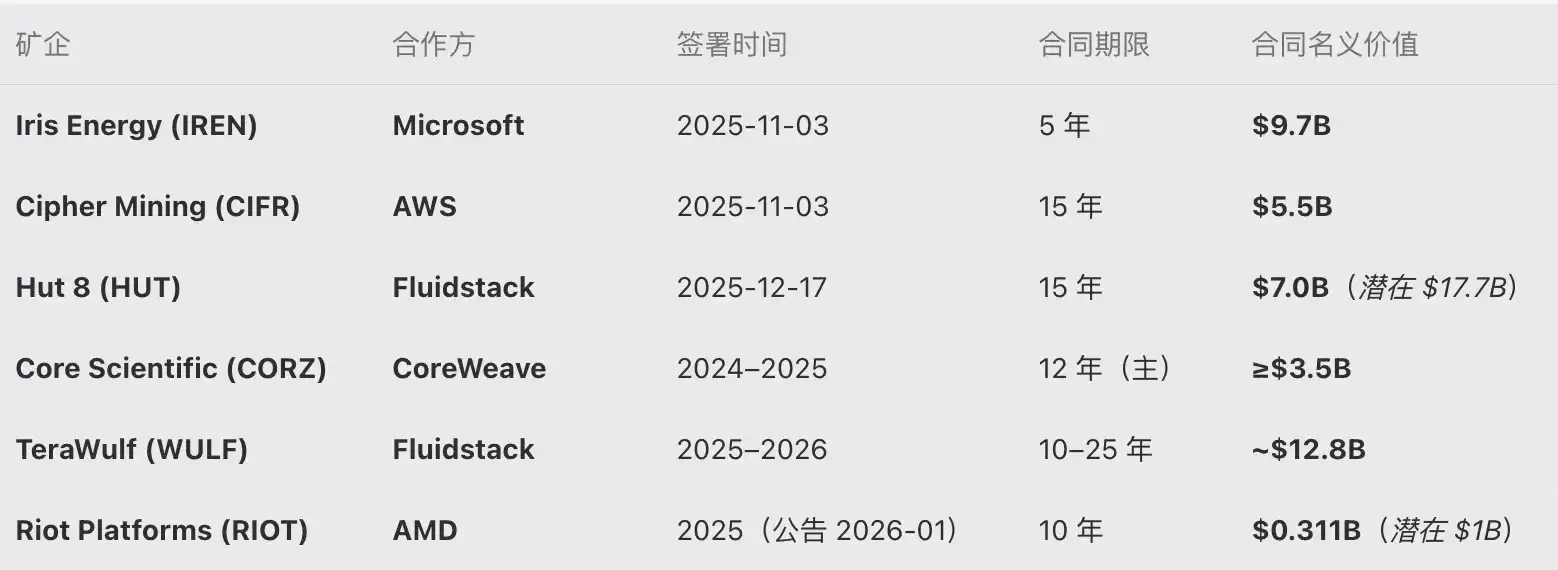
Since last year, mining companies have seen a集中爆发 of orders. According to public data statistics, as of the time of writing, 6 mining companies including IREN, CIFR, HUT have accumulated AI/HPC orders worth approximately $38.5 billion. Among them, TeraWulf's $12.8 billion order contract with Fluidstack and IREN's 5-year $9.7 billion contract with Microsoft are惊人数据, and have also become important supports for their stock prices. From financial reports, the proportion of AI/HPC revenue for many mining companies has increased from less than 15% to 40%-60%.

If mining is a cyclical business, AI is like a long-term cash flow pipeline.
Earnings Consensus: AI Becomes the Keyword

The Q1 2026 earnings season almost gave a unanimous signal: mining companies are systematically transforming.

"HPC Contract Giant" WULF: Holds Over $12.8 Billion in Contracts

Mining company TeraWulf's full-year 2025 revenue reached $168.5 million, a year-on-year increase of 20.3%, of which $16.9 million came from the newly launched high-performance computing (HPC) leasing business.

TeraWulf currently holds over $12.8 billion in HPC contracts, with 522MW of capacity already signed, and has obtained $6.5 billion in financing to support data center expansion.

"AI Mining Giant in the Making" IREN: Holds Microsoft's $9.7 Billion Order

Thanks to previous huge orders and rapid transformation, IREN has隐隐 become a new generation of "AI mining giant in the making".

According to the financial report of mining company Iris Energy (IREN), as of January 31, 2026, it held $2.8 billion in cash and cash equivalents. So far this fiscal year, it has obtained over $9.2 billion in funds through customer prepayments, convertible bonds, GPU leasing, and GPU financing. Subsequent plans include adding 140,000 GPUs, expecting to achieve $3.4 billion in annual recurring revenue by the end of 2026.

"Trump's" HUT: Holds $7 Billion in Orders

Mining company Hut8's 2025 fiscal year generated $9.6 million in revenue from hosting services, holding approximately $1.4 billion in cash and Bitcoin reserves.

In addition, Hut8's spun-off mining subsidiary American Bitcoin (ABTC) achieved full-year 2025 revenue of $185.2 million, deployed approximately 25 EH/s of computing power and owns about 78,000 ASIC miners. Furthermore, its BTC reserves have exceeded 6,000 coins.

The company is also a major crypto mining company supported by the Trump family, thus receiving high market attention.

"Brand Transformation Completed" CIFR: Holds $5.5 Billion in Orders

Mining company Cipher Digital disclosed in its 2025 fiscal year performance report that it officially changed its name from "Cipher Mining" to "Cipher Digital" to complete its brand transformation.

Last November, CIFR reached a leasing agreement with Amazon Web Services worth up to $5.5 billion; additionally, it exchanged 5.4% equity for Google's agreement to provide a guarantee for the $1.4 billion contract signed with Fluidstack.

"Selling Coins to Buy Land and Build Data Centers" RIOT: Reaches Leasing Cooperation with AMD

Mining company Riot Platforms announced its full-year 2025 performance, with annual revenue reaching $647.4 million, a significant increase from $376.7 million in 2024; its Bitcoin holdings exceed 18,000 coins.

In January of this year, RIOT sold 1080 Bitcoins and used the proceeds (approximately $96 million) to purchase the Rockdale plot to develop a data center project. Additionally, the company signed a data center leasing and service agreement with AMD, which will deploy 25 megawatts of critical IT load capacity at the Rockdale campus. The aggressive investment firm Starboard Value stated that Riot's potential valuation from transitioning towards AI and HPC could be as high as $21 billion.
"BTC Stalwart" MARA: Partners with Capital Institutions to Layout AI Data Centers

MARA's financial report data shows that affected by the average Bitcoin mining price dropping about 14%, MARA's Q4 2025 revenue was $202.3 million, a year-on-year decrease of about 6%. At the end of February, MARA announced a cooperation with investment institution Starwood Capital Group to build large-scale data centers for artificial intelligence and cloud computing customers on the basis of existing mines in the United States. After the news was announced, its stock price rose about 17% in after-hours trading.

It is worth mentioning that unlike other mining companies firmly transitioning to the AI field, MARA's management emphasized that although short-term price trends are uncertain, its long-term confidence in the Bitcoin asset class has not changed, Bitcoin will still be the long-term strategic core.

"Data Center Revenue Soars" CORZ: Holds CoreWeave's Over $10 Billion Order

Core Scientific (CORZ) announced its Q4 2025 financial report. Total revenue for Q4 2025 was $79.8 million, down from $94.9 million in the same period last year. Among them, Bitcoin mining revenue dropped to $42.2 million; data center hosting service revenue大幅增长 to $31.3 million, higher than $8.5 million in 2024. Q4 gross profit rose to $20.8 million, higher than $4.8 million in the same period in 2024.

Core Scientific CEO Adam Sullivan said that the company's existing construction projects are more than half completed and are expanding the hosting platform to a 1.5 gigawatt leasable capacity pipeline. Last October, AI company CoreWeave planned to acquire CoreScientific for about $9 billion, but ultimately failed due to lack of shareholder approval; in January this year, CoreScientific sold 1900 BTC (approximately $175 million) for business transformation.

The company estimates that AI business will drive revenue compound growth of 60.9% from 2026 to 2028, reaching $1.5 billion by 2028.

Other Mining Company Representatives: Bitfarms Renames, BitDigital Switches to ETH Camp

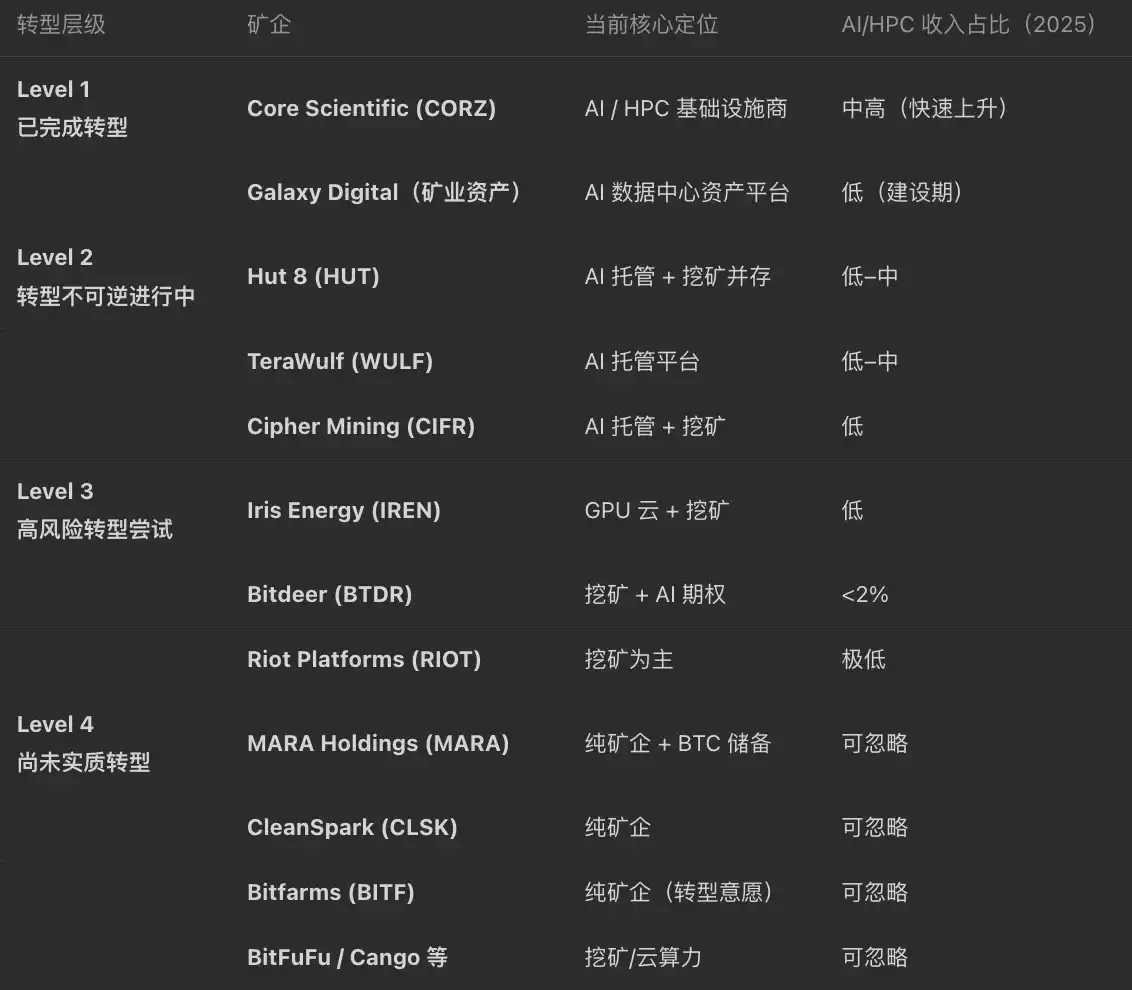
In February, Bitfarms (BITF) announced that it would move its headquarters from Canada to the United States and plans to change its name to Keel Infrastructure (pending shareholder, exchange, and court approval), accelerating its transformation into infrastructure. Previously, the company had converted $300 million in debt financing into project financing in October last year for the construction of a data center in Pennsylvania, and sold the Paso mine for $30 million in January this year, officially exiting the Latin American market.

On the other hand, BitDigital's turn was more thorough. As early as last July when the DAT (Odaily Note: Digital Asset Treasury company)热潮兴起, it率先 announced switching from BTC to ETH treasury listed companies; in January this year, it further clarified that it would completely stop Bitcoin mining and instead increase its focus on Ethereum infrastructure, staking, and HPC/AI strategy, marking the official completion of the阵营切换 for this mining company that has been deeply involved in mining for five years. Currently, its AI subsidiary WhiteFiber has completed an IPO, and BitDigital holds approximately 27 million shares, worth over $457 million at the current market value.

In addition to the above two, Galaxy, Bitdeer, Cleanspark, Cango Cango, etc. are still in the stage of promoting AI transformation, and the proportion of revenue contribution remains to be increased. Among them, Cango Cango completed a $10.5 million equity financing in February this year and received an additional $65 million investment commitment, which may accelerate the layout of AI/HPC data center business.

The following is a brief comparison based on public information for reference.
Capital Attitude: Choosing Winners, Not Narratives

The market does not fully accept the "AI transformation," but is quickly differentiating.

In early February, JPMorgan pointed out in a report that Bitcoin mining companies performed strongly at the beginning of the year, mainly driven by the phased缓解 of network competition and the升温 of the HPC narrative. At that time, the total market value of the 14 US-listed mining companies and data center operators it tracked rose to about $60 billion at the end of January, a month-on-month increase of 23%, far exceeding the S&P 500's同期约 1% gain.

But soon, with the密集发布 of a new round of AI models and the impact of OpenClaw on the valuation system of software stocks, market sentiment quickly turned. Capital began to worry about the structural disruption brought by AI, and the stock prices of mining companies related to AI infrastructure随之回调, with CIFR, IREN, and Hut8's intraday declines once exceeding 10%.

On February 10, Morgan Stanley released a research report, giving CIFR and WULF an overweight rating, while downgrading MARA to underweight.

By the end of February, with order fulfillment and stock price recovery, the market wind reversed again. Some analysts believe that against the background of high short-selling ratios by hedge funds, coupled with mining companies locking in long-term low-cost power contracts, their strategic value is no longer limited to traditional mining, but is closer to that of AI infrastructure suppliers.

With order fulfillment and stock price recovery, the market logic has gradually become clear: capital only bets on structural winners.

Therefore, the future of mining companies largely depends on three things:

Execution: Whether the migration of computing power form can be completed quickly;

Resource Endowment: Whether electricity and land have scale advantages;

Narrative Ability: Whether it can be embedded in the upstream supply chain of AI.

In fact, the company's transformation decision is not important; what is more important is capital screening.

The tide has come. Mining companies only have two choices: either migrate with the trend or become history.
Trending Cryptos

Related Questions

QWhat is the main reason for Bitcoin mining companies to collectively shift towards AI, according to the article?

AThe direct incentive is the rising mining difficulty and compressed profit margins in a bear market, but the deeper driving force is the extreme pursuit of the AI narrative by capital markets. Mining companies possess easily convertible real assets like electricity, land, cooling systems, and data center infrastructure, which can be exchanged for AI computing power orders worth tens of billions of dollars.

QWhich mining firm has secured the largest AI/HPC order mentioned in the article, and what is its value?

ATeraWulf (WULF) has secured the largest HPC order mentioned, valued at over $12.8 billion.

QName two mining companies that have received significant financial analyst downgrades or faced market skepticism regarding their AI transition.

AAccording to the article, Morgan Stanley downgraded Marathon Digital (MARA) to underweight. Additionally, market sentiment turned skeptical causing stocks like CIFR, IREN, and Hut8 to fall over 10% in a day due to concerns about AI's structural disruption.

QApart from securing AI contracts, what other strategic shift did BitDigital make?

ABitDigital made a more thorough shift by first announcing a move from BTC to ETH treasury, then further clarifying it would completely cease Bitcoin mining to instead focus on Ethereum infrastructure, staking, and HPC/AI strategy.

QWhat are the three key factors that will determine the future of mining companies in their AI transition, as outlined in the article?

AThe three key factors are: 1. Execution capability: The ability to quickly complete the migration of computing power forms. 2. Resource endowment: Whether their electricity and land provide a scale advantage. 3. Narrative ability: The ability to embed themselves into the upstream AI supply chain.

Related Reads

Coinone warns of phishing, identity theft after customer data breach

South Korean crypto exchange Coinone warned customers about potential phishing scams and identity theft after an attacker breached its outsourced customer support provider, MetaM, exposing information shared during customer service interactions. Coinone said the attacker accessed MetaM servers on Thursday and viewed or extracted customer support records, learning of the breach the same day. Potentially exposed data includes names, phone numbers, email addresses, dates of birth, bank account numbers, passwords, national identification numbers, home and wallet addresses, and transaction IDs, varying by customer; those who never contacted the support center were unaffected, and Coinone did not disclose how many customers were impacted. The exchange urged customers who shared passwords during support interactions to change them and warned that fraudsters could impersonate Coinone using details from previous conversations. Coinone said its account, trading, and wallet infrastructure operates separately from MetaM's servers, with no evidence of direct compromise, and it has reported the incident to South Korean authorities. The disclosure comes as South Korea strengthens financial-sector cybersecurity; in October the Financial Services Commission identified security deficiencies at 130 of 555 financial firms reviewed, and on Thursday the regulator said it would allow crypto exchanges to suspend withdrawals when hacking is suspected, alongside calls for round-the-clock monitoring.

cointelegraph1h ago

Coinone warns of phishing, identity theft after customer data breach

cointelegraph1h ago

Is There a Hidden Hand Behind Jensen Huang's Departure? Secretary of State Rubio or Anthropic?

The article alleges that Nvidia founder Jensen Huang's departure was the result of a coordinated "hunt" involving two forces: Secretary of State Marco Rubio and AI rival Anthropic. On the policy front, the dispute centers on AI chip export controls—Huang was the most prominent corporate voice opposing built-in tracking and remote kill-switch functions in chips, while three bipartisan chip bills (covering congressional review of export licenses, anti-smuggling measures, and pressure on allies to halt equipment sales) have been folded into the Senate's annual defense authorization bill. The storm began with a highly classified memo leaked to The New York Times; according to The Washington Post, the memo originated with Rubio, who reportedly rewrote a CIA report whose analysts were unconvinced by the underlying intelligence, using "his own more aggressive wording," then sent it to senior officials and briefed the president. David Sacks called the leak a crime and asked why someone would risk prison to bring Huang down. Separately, NYT reporter Tripp Mickle said a mysterious industry contact told him to "drop everything" and investigate Megaspeed, a Singapore-based Nvidia compute rental firm; suspicion points to Anthropic CEO Dario Amodei and a co-founder as the leaker. Anthropic reportedly donated $40 million to Public First Action, which pushes AI safety rules and chip export controls—positions opposite Huang's defense of open-source AI and opposition to backdoors. Nvidia shares fell on the news, and tech leaders including Musk, Garry Tan, and Tim Sweeney are petitioning for Huang's reinstatement, with Sweeney comparing his ouster to Apple firing Steve Jobs.

marsbit3h ago

Is There a Hidden Hand Behind Jensen Huang's Departure? Secretary of State Rubio or Anthropic?

marsbit3h ago

Global Chip Stocks Retreat Nearly 40% from Peak: Has the AI Bubble Burst?

Nvidia is set to report its fiscal Q3 2027 earnings after market close on November 17, but the call will be led by interim CEO and CFO Colette Kress, not Jensen Huang, who resigned as president, CEO, and board member effective November 12 following an apology letter to employees admitting infidelity and a board investigation into reports that he was a target of foreign intelligence activity. The report comes as investors question whether massive AI capital expenditures will pay off. On November 5, the Philadelphia Semiconductor Index plunged 12.25%, its worst single-day drop since March 2020, with Nvidia falling 9.3% and losing about $447 billion in market value; Seoul's KOSPI triggered a circuit breaker the next day. Over the past month, Nvidia has shed nearly $1.4 trillion in market value from its early-October peak, the semiconductor index has pulled back nearly 40% from its June 22 peak of 14,634, Oracle is down over 30% year-to-date, and CoreWeave has retreated about 70% from its June 2025 high. Yet the broader market looks calm: the Nasdaq is only about 12% off its high, and the equal-weighted S&P 500 hit a record during the selloff week—the crash is concentrated in AI. The timeline shows early warnings in Korea in June, with memory stocks falling first; Goldman's AI memory basket is down 51% from its June peak, the largest drawdown since ChatGPT launched. The selloff layered by proximity to end cash flow: memory worst, then leveraged neoclouds like CoreWeave, then power, chips, and optics, while cash-rich cloud giants held up, with the seven giants still up about 9.6% year-to-date before the crash. Nvidia's roughly 14x P/E isn't necessarily cheap—its revenue is others' capex, low multiples on cyclicals often mark peak profits, and chip index declines historically lead semiconductor sales drops by 6-9 months, suggesting real estimate cuts may not appear until Q1 2027. Meanwhile, orders are full but stocks still fall: Lumentum says data center optics are sold out for years, SanDisk beat for six straight quarters yet is down over 60% from its high, and CoreWeave's Q3 beat and $132.5 billion backlog didn't stop a 32% year-to-date decline. Hyperscaler capex guidance for 2026 totals $720-745 billion, up nearly 80% from 2025, but the market's reaction has turned cold—Google fell 12.6% on October 29, its worst day ever. Free cash flow is turning negative: the five biggest players spent $556.9 billion in the first nine months versus $542.9 billion in operating cash flow, with four of the seven giants seeing negative FCF for the first time in a decade, funded by debt—US cloud companies issued about $225 billion in bonds in the first nine months, up 973.7% year-over-year. Oracle's CDS spread widened from about 58 basis points a year ago to 295, and CoreWeave's exceeded 1,000, with bond yields near 15%. The bond market is already pricing default risk while stocks debate bubbles. Politics adds a second layer: Democrats won both chambers in the November 3 midterms, and of 41 local data center ballot measures in 10 states, 40 went against data center construction. Texas, which holds 27% of planned US capacity, elected a governor promising a moratorium. Goldman estimates 45% of planned US data center capacity faces short-term pause risk. Buffers exist—the new Congress seats in January 2027, any restrictions face a presidential veto, and UBS estimates only about 30% of planned 2028 capacity would be affected. Demand hasn't broken; what broke is the belief that spending alone lifts stocks—AI is moving from storytelling to audit. Whether the pullback becomes a collapse depends on three readings: whether cloud giants' free cash flow turns positive, whether Oracle and CoreWeave credit spreads keep widening, and whether state-level data center restrictions take effect.

marsbit4h ago

Global Chip Stocks Retreat Nearly 40% from Peak: Has the AI Bubble Burst?

marsbit4h ago

Successfully Recovering Starship Upper Stage, SpaceX Debuts 'Chopsticks Catching the Ship,' Analyst: The Most Critical Step Supporting a Trillion-Dollar Valuation

SpaceX achieved a historic first on November 15, successfully catching the Starship upper stage in mid-air using the launch tower's giant "Mechazilla" robotic arms after the spacecraft completed 14 orbits and re-entered the atmosphere. More than 5 million viewers watched the live broadcast. It marks the first time since NASA's Space Shuttle in 2011 that a spacecraft returning from orbit has been recovered, and the first-ever capture of an orbital spacecraft by a tower. However, the mission was only half successful: the Super Heavy booster aborted its recovery attempt after an early engine shutdown during descent, splashing down in the Gulf of Mexico and exploding. SpaceX engineers are investigating the cause. This was the 15th test flight and the most ambitious, marking the first simultaneous recovery attempt of both stages. Analysts stress the cost implications. Bernstein called full reusability "the most important step" supporting SpaceX's multi-trillion-dollar valuation, key to high launch frequency and lower orbital costs. Citi called fully reusable rockets the industry's "holy grail." Morgan Stanley argued markets underestimate the significance, noting the ship's capture is harder than the booster's because it endures extreme re-entry stress. Success would reduce execution risk across commercialization, Starlink deployment, and future space-based AI computing. The Starship released 26 Starlink V3 satellites during the flight, re-entering at over 26,000 km/h with temperatures reaching 7,000°F. NASA Administrator Jared Isaacman congratulated SpaceX, and Musk shared video of the recovered ship. NASA's Artemis lunar program and Musk's Mars ambitions both depend on Starship. SpaceX stock (SPCX) dipped 2% after the booster failure, trading just 3% above its $135 IPO price and 38% below its June high of $225.64. Bernstein noted SpaceX remains roughly a decade ahead of competitors in reusability. Starlink, SpaceX's profit center, serves over 13 million users in 170+ countries with over 11,000 satellites, posting about $3.5 billion in Q3 EBITDA. Starship can carry up to 60 Starlink V3 satellites—each nearly four times the volume and ten times the data capacity of V2. Musk hopes to build space-based AI data centers, possibly starting in late 2027, with reusability being the prerequisite for lowering per-unit orbital costs.

marsbit6h ago

Successfully Recovering Starship Upper Stage, SpaceX Debuts 'Chopsticks Catching the Ship,' Analyst: The Most Critical Step Supporting a Trillion-Dollar Valuation

marsbit6h ago

Trading

Spot

Hot Articles

Discussions

Welcome to the HTX Community. Here, you can stay informed about the latest platform developments and gain access to professional market insights. Users' opinions on the price of AI (AI) are presented below.

活动图片