Written by: Zhang Yaqi, Wall Street Insights
Energy prices are once again driving the inflation trend, but the pressure from core inflation is easing marginally, providing support for the Fed to hold rates steady.
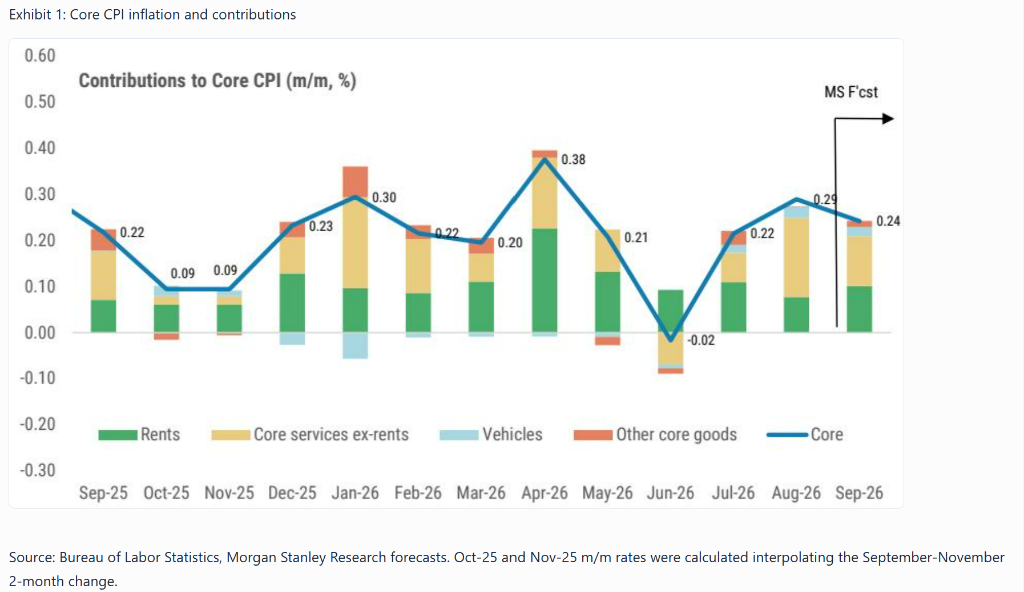
The U.S. Bureau of Labor Statistics will release the September CPI data on October 14 (next Wednesday). According to market news, Barclays and Morgan Stanley predict that the headline CPI in September will accelerate due to a significant increase in gasoline prices. However, the month-over-month increase in core CPI is expected to be slightly smaller than August's figure, primarily due to a partial pullback in wireless communication service price increases. Both institutions forecast a month-over-month core CPI increase of 0.24%, lower than August's 0.29%.
This data will directly influence the Fed's decision at its October meeting. Barclays research believes that, although recent inflation risks remain skewed to the upside, Fed officials are likely to keep interest rates unchanged in October, continuing to observe subsequent data and pushing a potential 25-basis-point hike to December.
The Fed's recently released September meeting minutes showed that "most" officials expect one more rate hike this year but hinted there's no rush in October. Fed Governor Waller stated that rate hikes need not occur at consecutive policy meetings, and officials can be flexible with timing based on economic data. The market has already postponed rate hike expectations from October to December. Goldman Sachs believes a December hike is more likely, but the probability that the FOMC ultimately judges further tightening unnecessary is also quite substantial.
Energy Drives Headline Inflation, Top-Line Data Jumps
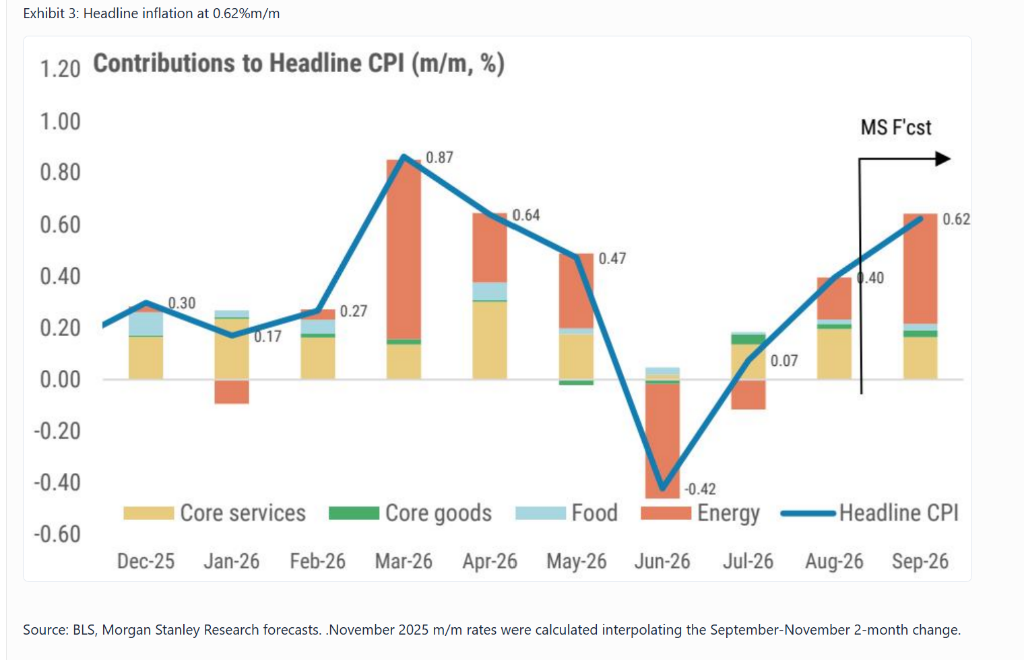
Barclays forecasts that the headline CPI in September will rise 0.58% month-over-month (seasonally adjusted), with the year-over-year rate climbing to 3.7%, up about 0.3 percentage points from August's 3.4%, though still below the recent peak of 4.2% seen in May. Morgan Stanley's forecast is slightly higher, with a year-over-year increase of 3.69% and a month-over-month increase of 0.62%.
Energy is the core driver of this headline inflation jump. According to Barclays' forecast, the energy component's month-over-month increase is as high as 5.05%, with gasoline prices surging 9.23% month-over-month, representing a 34.8% year-over-year increase; heating oil is even higher at 38.8% year-over-year.
Morgan Stanley notes that the ongoing tensions in the Middle East are an important factor pushing up oil prices and will further transmit to airfares and transportation costs. Barclays' research team also warned in a previous report that rising diesel prices are gradually being passed through to U.S. consumers.
Core Inflation Slows Slightly, Wireless Communication Pullback is Main Reason
While headline inflation rises, core CPI pressure has eased slightly. Barclays forecasts a 0.24% month-over-month increase in core CPI for September, year-over-year at 2.5%; Morgan Stanley's forecast is consistent, also at 0.24%, both down 5 basis points from August's 0.29%.
The primary force behind the core inflation slowdown comes from the "Education and Communication" component. In August, wireless communication service prices jumped unusually, contributing about 0.1 percentage points to core CPI that month. Barclays expects that Verizon's latest price increase, combined with AT&T's planned price hike being more moderate, will still exert upward pressure on inflation from this component in September, but the force will be significantly less than last month.
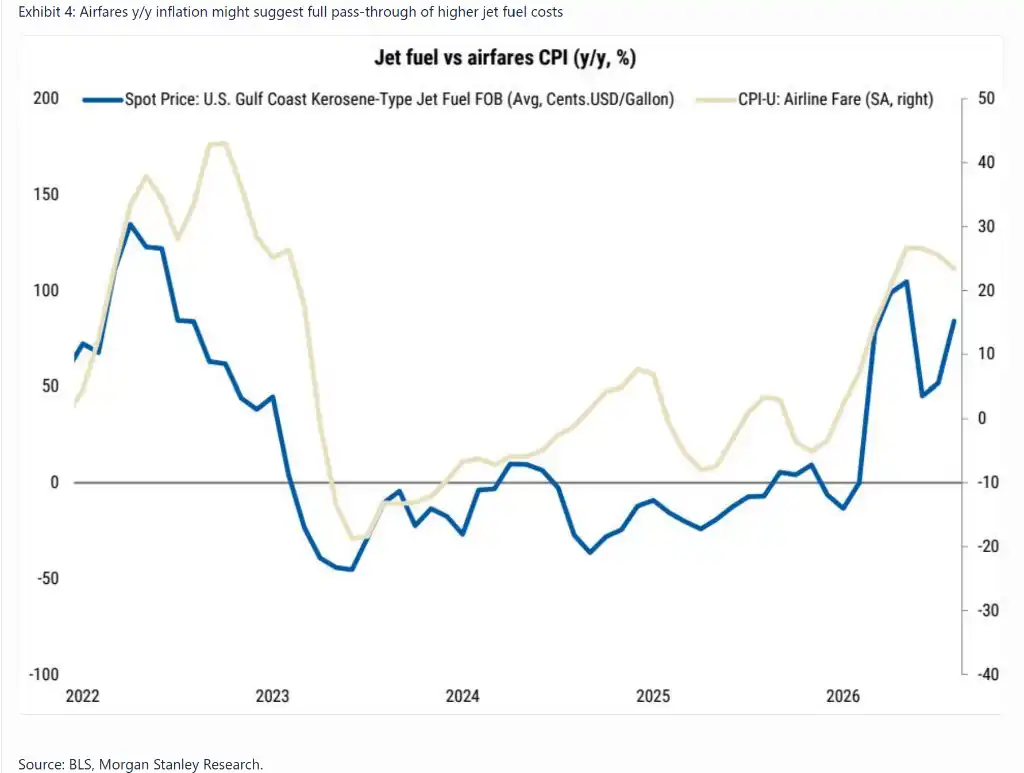
Meanwhile, airfares and medical service prices remain supporting factors for core inflation. Morgan Stanley points out that airfares already rose 23% year-over-year in August and are still forecast to increase 1.8% month-over-month in September; Barclays predicts a 2.6% month-over-month increase in airfares. Morgan Stanley adds that jet fuel prices are up nearly 90% year-over-year, and fuel accounts for about 20% to 30% of airline operating costs. By this measure, airlines' pass-through of fuel cost increases to prices may be nearing completion. Additionally, after weakening in August, Morgan Stanley forecasts medical services will rebound 0.55% month-over-month in September.
Regarding core goods, Barclays and Morgan Stanley forecast month-over-month increases in the range of 0.13% to 0.14%, essentially flat with August, with new and used car prices strengthening slightly.
Shelter Inflation Stabilizes, Insurance Drag Persists
The shelter component continues its steady trend. Barclays forecasts that Owners' Equivalent Rent (OER) will rise 0.24% month-over-month in September, and primary residence rent will increase 0.23%; Morgan Stanley predicts OER and primary residence rent at 0.25% and 0.20%, respectively. Morgan Stanley notes that since May this year, shelter inflation has averaged about 0.24% per month, slightly below the long-term pre-pandemic trend of 0.26%, and expects it to fluctuate near this level in the near term.
Auto insurance continues to be a drag on core inflation. Morgan Stanley forecasts that auto insurance premiums will decline 0.20% month-over-month in September and expects the negative growth trend to continue into 2027, mainly because improved profitability for insurers is prompting them to compete for market share through price reductions.
Regarding hotel prices, which rebounded strongly in August after two consecutive months of unusual weakness, Morgan Stanley predicts they will return to flat (0% month-over-month) in September.
PCE Inflation Forecast: Expected to Remain Near 3%
The CPI data also provides guidance for the Fed's preferred PCE inflation measure. Barclays forecasts core PCE inflation for September at 0.22% month-over-month, year-over-year around 3.0%; Morgan Stanley's forecast is slightly higher at 0.23% month-over-month.
Barclays researchers Pooja Sriram, Marc Giannoni, Jonathan Millar, and Colin Johanson point out there is some uncertainty in the PCE price for financial services, especially with the Bureau of Economic Analysis (BEA) adopting a new method to estimate the price of portfolio management services. Required data on nominal expenditures and hours worked may not be available timely, adding to forecasting difficulty. The team stated they will further revise their forecast after next week's CPI and PPI data release.
Fed Path: Hold Steady in October, 25 bps Hike in December
Regarding the policy path, Barclays maintains its baseline forecast: the Fed will hike rates by 25 basis points in December. The institution notes that due to base effect drag, the six-month and twelve-month medium-to-long-term inflation measures favored by Chair Warsh are unlikely to improve significantly within this year, but the outlook for 2027 will markedly improve.
Recent remarks from Fed officials show that uncertainty around the distribution of inflation outcomes may support further tightening from a risk management perspective, but Barclays expects policymakers to choose to wait and watch in October, awaiting more data for verification.
It is worth noting that Morgan Stanley reminds us that several key variables in this report need close tracking: First, Apple increased prices for some older iPhone models by 10% to 14% when releasing new iPhones on September 9. However, as smartphones account for only about 0.2% of the CPI basket, and sampling in some areas is bi-monthly, the direct impact is expected to be no more than 1 to 1.4 basis points. Second, whether there is further room for airfare increases is nearing its ceiling. Third, whether shelter inflation can maintain its current stable pace.