Stablecoins Are Quietly Becoming Business Infrastructure, NOWPayments Data Shows

TheNewsCryptoPublished on 2026-10-08Last updated on 2026-10-08

Abstract

NOWPayments data reveals stablecoins are increasingly adopted as operational business infrastructure, moving beyond trading. Between Jan-July 2025 and 2026, the combined share of SaaS/eCommerce partners grew from 48.26% to 55.54%, while Trading's share slightly declined. The shift highlights that different business models require distinct stablecoin workflows—SaaS focuses on billing and reconciliation, marketplaces on checkout and payouts, and trading on liquidity and network coverage. Data also shows significant industry variation in network preference; for example, USDT on TRON dominated eCommerce but was far less common in SaaS/Trading. The key takeaway is that businesses should first define their specific payment, settlement, and reconciliation needs before selecting stablecoin assets and networks.

Tallinn, Estonia, October 8th, 2026, Chainwire

SaaS and eCommerce increased their combined share from 48.26% to 55.54%, while Trading moved from 14.07% to 13.15%.

Businesses can build stablecoin infrastructure around the wrong problem.

The mistake is treating stablecoins primarily as a coin-and-network decision. For a digital business, they may need to support a much broader set of operating workflows, including billing, checkout, settlement, payouts, and reconciliation.

Which of those workflows matters most depends on the business model.

New aggregated data from NOWPayments shows the industry mix shifting toward businesses that use payments as part of their day-to-day operations. Between January 16 and July 16, 2026, SaaS and web services accounted for 27.78% of classified partners. eCommerce Marketplaces followed at 27.76%. Together, the two sectors represented 55.54% of the sample. During the same period in 2025, their combined share was 48.26%. The increase of 7.28 percentage points represents a 15.08% year-over-year rise in their combined share.

Trading remained an important part of the sample, but its share moved in the opposite direction. It declined from 14.07% in 2025 to 13.15% in 2026, leaving trading in third place behind SaaS and eCommerce.

The clearest upward shift came from SaaS. Its share increased from 15.58% to 27.78% in one year, closing a gap of 17.10 percentage points with eCommerce. The emerging picture is not stablecoins replacing trading. It is stablecoin adoption expanding into the operating infrastructure of digital businesses.

Unless otherwise stated, industry-distribution figures compare January 16 to July 16, 2025, with January 16 to July 16, 2026.

The Partner Mix Is Shifting Toward Operational Use Cases

In 2025, eCommerce marketplaces led the dataset at 32.68%. SaaS and Web Services followed at 15.58%, with Trading close behind at 14.07%.

One year later, SaaS had increased its share by 12.20 percentage points to 27.78%. eCommerce stood at 27.76%, leaving only 0.02 percentage points between the two sectors. Their combined share rose from 48.26% to 55.54%. More than half of the classified partners in the 2026 sample therefore came from two sectors built around digital transactions, recurring services, and online customer relationships.

The rest of the partner mix changed more gradually.

Financial Services moved from 9.00% to 6.35%. Gambling and iGaming increased from 6.20% to 6.87%, and adult platforms rose from 4.99% to 5.89%. Charity declined from 2.27% to 1.40%, while TGE/Presale moved from 2.12% to 1.35%.

These figures measure changes in each industry’s share of the sample. They do not measure absolute partner growth. A category may lose share because another category expanded faster.
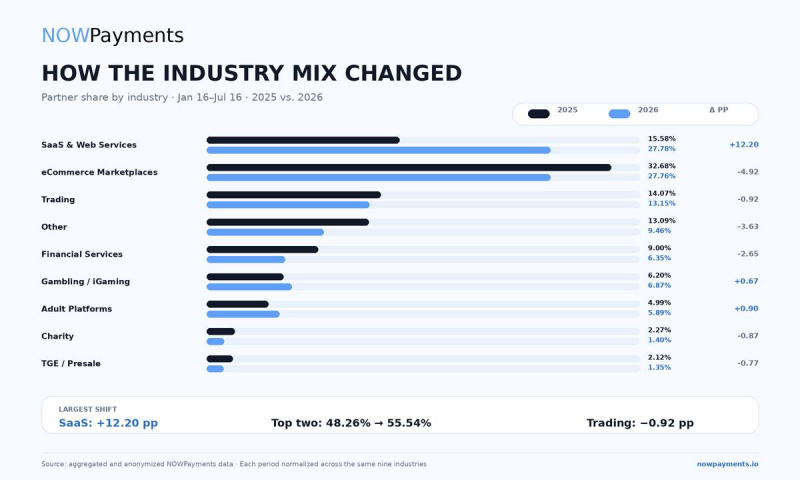
Methodology: Each percentage represents an industry’s share of the full aggregated partner sample classified across the same nine categories. The comparison covers January 16 to July 16 in both 2025 and 2026. Each period was normalized independently. Absolute partner counts are not disclosed, and percentages are rounded to two decimal places. The findings describe partner distribution within the NOWPayments dataset, not payment volume, transaction value, or market-wide industry share.

Different Business Models Need Different Stablecoin Workflows

The industry data becomes useful when it is translated into the operating questions each business model may need to solve.

For a SaaS company, stablecoin payments may need to connect with recurring billing, invoice matching, account activation, renewals, settlement, and financial reconciliation.

A marketplace may need stablecoins to work across a longer flow. The payment can begin at checkout and continue through refunds, seller settlement, affiliate commissions, and other payouts.

Trading platforms face a different set of requirements. Their priorities may include asset and network coverage, confirmation policies, liquidity, and treasury controls.

These are potential workflow drivers, not a universal description of every company in each category. The point is that the same stablecoin can serve all three sectors while performing a different operational job in each one.

This is why a business should define the workflow before choosing the asset and network.

The Network Mix Also Changes by Industry

The successful-payment data shows that industry differences extend to network usage.

USDT on TRON accounted for 54.58% of the measured successful-payment sample within eCommerce marketplaces. Its share was 12.04% in trading and 9.60% in SaaS and web services.

Within this dataset, USDT TRC20 was about 4.5 times as prominent in eCommerce as in Trading and 5.7 times as prominent as in SaaS.

The corresponding shares were 4.76% in Gambling and iGaming, 1.85% in Financial Services, 1.49% in Other, and 0.60% in Charity. Adult Platforms and TGE/Presale each recorded a 0% share in the analyzed sample.

The difference supports the same conclusion as the industry data. A stablecoin setup that fits one business model may not fit another.

For an eCommerce business, USDT on TRON may play a visible role in checkout activity. A SaaS company may see a different asset and network mix. Trading platforms may need broader coverage across both.

Businesses should validate these decisions against their own successful-payment data instead of importing the preferences of another industry.
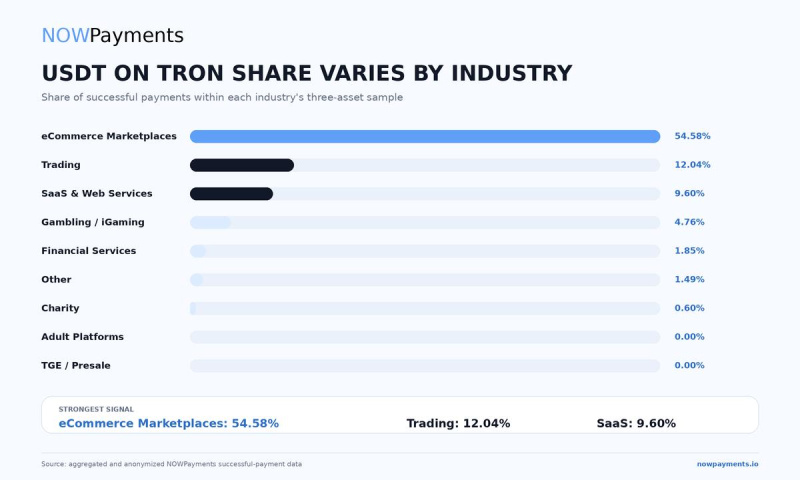
Methodology: Each percentage represents USDT TRC20’s share of the aggregated successful-payment sample within the corresponding industry. Absolute transaction counts are not disclosed. Failed, expired, refunded, and test transactions are excluded. The figures describe activity within the NOWPayments ecosystem and should not be interpreted as market-wide currency shares. A 0% result means that no successful USDT TRC20 payments were recorded in the analyzed sample for that category.

Build the Workflow Before Choosing the Rails

The five operating areas introduced at the beginning provide a practical framework for evaluating stablecoin infrastructure.

  • Billing: Does the payment need to connect with invoices, subscriptions, renewals, or account access?
  • Checkout: Which assets and networks produce completed payments for the company’s actual customers?
  • Settlement: Which asset should the business receive, and when should funds become available?
  • Payouts: Will funds need to move to sellers, affiliates, contractors, or customers?
  • Reconciliation: How will the finance team match transactions with invoices, orders, and internal reporting?

Not every business needs all five. A SaaS platform may focus on billing and reconciliation. A marketplace may need checkout, settlement, and payouts. A trading platform may prioritize network coverage, liquidity, and treasury controls.

The company should first identify which workflows apply. Asset and network selection comes after that.

“The mistake is asking which stablecoin is best. The better question is: best for what?” said Kate Lifshits, Commercial Director at NOWPayments. “Businesses should define the billing, checkout, settlement, payout, and reconciliation flow first. The coin and network should serve that workflow – not the other way around.”

Lifshits explores the commercial side of crypto payments in her Cryptopolitan series, Crypto That Works for Business. The first column, The 22% Sales Boost Hiding in Your Crypto Checkout, examined how payment infrastructure can affect checkout performance. Future installments will continue looking at where crypto payments can increase revenue, lower costs, and remove operational friction.

Stablecoin strategy starts with the job the money needs to do. The coin and network come next.

About NOWPayments

NOWPayments is a crypto business ecosystem designed to help companies accept payments, automate mass payouts, manage stablecoin treasury, and scale global digital asset operations through a single infrastructure. The platform supports more than 350 cryptocurrencies, over 30 stablecoins, flexible settlement options, and enterprise-grade APIs.

Contacts

PR Manager
Angelina T
NOWPayments
angelina.tmk@nowpayments.io
Commercial Director
Kate L
NOWPayments
kate.l@nowpayments.io

[googlesitekit-end-of-content]

Trending Cryptos

Related Questions

QAccording to the NOWPayments data, what are the two leading sectors by partner share in 2026, and what is their combined percentage?

AAccording to the NOWPayments data, the two leading sectors by partner share in 2026 are SaaS & Web Services (27.78%) and eCommerce Marketplaces (27.76%). Their combined share is 55.54% of the classified partner sample.

QWhat is the key mistake businesses make when building stablecoin infrastructure, according to the article?

AThe key mistake is treating stablecoins primarily as a coin-and-network decision. Instead, businesses should first define the operational workflows they need to support, such as billing, checkout, settlement, payouts, and reconciliation.

QHow does the usage of USDT on the TRON network differ between the eCommerce and SaaS sectors based on the successful-payment data?

ABased on the successful-payment data, USDT on TRON (TRC20) accounted for 54.58% of payments in the eCommerce sector, but only 9.60% in the SaaS & Web Services sector. This shows it is about 5.7 times more prominent in eCommerce than in SaaS.

QWhat are the five operating areas or workflows mentioned as a framework for evaluating stablecoin infrastructure?

AThe five operating areas or workflows are: Billing, Checkout, Settlement, Payouts, and Reconciliation.

QWhat was the year-over-year change in the combined share of SaaS and eCommerce partners from 2025 to 2026?

AThe combined share of SaaS and eCommerce partners increased from 48.26% in 2025 to 55.54% in 2026. This represents an increase of 7.28 percentage points, which is a 15.08% year-over-year rise in their combined share.

Related Reads

Mercado Bitcoin begins post-hack reopening without a timeline for withdrawals

Mercado Bitcoin, one of Brazil's largest crypto exchanges, began restoring read-only access to customer accounts in phases on Monday, a week after attackers drained an estimated $49 million from the platform. Access started at 19:00 UTC, with all accounts expected to be viewable by 21:00 UTC, showing holdings as they stood on Nov. 2, the day of the hack. The exchange has yet to say when customers will be able to withdraw funds. Fabricio Tota, vice president of new business, said the exchange hoped read-only access would reassure customers that their assets were still recorded on the platform. He explained that the company opted for "a more conservative approach" to reactivating accounts "to ensure our return happens with the utmost security." The caution follows concerns from blockchain security analysts that attackers were able to access addresses, draining funds through standard transfers rather than a smart contract exploit. Blockchain analysts traced some of the stolen funds to customer deposit addresses, but Mercado Bitcoin says customers won't bear the losses. Tota said the vast majority of assets were never even touched by anyone and were not involved in the incident. On Nov. 4, Mercado Bitcoin pledged to cover all losses with company funds, bolstered by a $20 million investment from stablecoin issuer Tether in July. Tota highlighted that a portion of the stolen funds were also frozen in the hours after the company announced the attack. The next phase of recovery will require users to confirm their registration details before they can move funds. The exchange plans to restore withdrawals via Pix, Brazil's instant payment system, initially allowing customers to withdraw only to accounts in their own name. Tota gave no date for either step. Mercado Bitcoin has yet to explain how the attackers gained access to its wallets. Blockchain data company Bitquery found that as of Nov. 4, wallets linked to the attacker held most of the stolen funds that had escaped freezes, including 106.07 BTC.

cointelegraph6h ago

Mercado Bitcoin begins post-hack reopening without a timeline for withdrawals

cointelegraph6h ago

Avalanche’s AVAX leads crypto gains following NYSE tokenization deal

Avalanche's AVAX token rose as much as 10% on Monday, becoming the top gainer among the 100 largest cryptocurrencies, after the New York Stock Exchange announced plans to use Avalanche's blockchain to settle trades on a new platform for trading tokenized stocks around the clock. AVAX later eased to $8.86, still up over 8% on the day, with a market cap of around $3.95 billion and $439.7 million traded in the past 24 hours. Avalanche's total value locked stands at $633 million, up 4% over the past day. NYSE's head of digital issuance, Dennis Lee, said the exchange is examining how blockchain technology can expand its equities offerings and is picking the right technology for each job. The deal underscores Wall Street's growing effort to use blockchain to make stock trading faster and enable trading outside regular market hours; traditional US markets are open 9:30 am to 4:00 pm EST on weekdays, with trades often taking at least one business day to settle. The NYSE first announced plans for the platform in January, and Ava Labs revealed in September that the exchange had spent about a year testing Avalanche, though the final selection was not confirmed until Monday. Avalanche will record stock trades and help complete transactions on the platform, which will let investors buy and sell digital versions of stocks across different blockchains. Lee said the settlement ledger needs to be fast, reliable, permissioned, cost-predictable, and backed by a large developer community—all of which Avalanche meets. The platform could launch before the end of 2026 pending regulatory approval. Ava Labs chief business officer John Nahas said first conversations with the NYSE began nearly a year ago and called it an important step toward blockchain becoming foundational financial infrastructure. The news comes as other major firms invest in blockchain for faster, round-the-clock trading: Nasdaq plans to invest $100 million in Kraken's parent Payward to launch tokenized stocks by Q2 2027, and the DTCC launched a service in October allowing firms to turn traditional securities into digital tokens. The NYSE deal follows other efforts to bring traditional assets onto Avalanche, including Progmat moving over 452 billion yen in digital securities onto a dedicated Avalanche blockchain in July and Aave Labs' plans for a lending service using tokenized assets as collateral.

cointelegraph6h ago

Avalanche’s AVAX leads crypto gains following NYSE tokenization deal

cointelegraph6h ago

Trading

Spot

Hot Articles

How to Buy DATA

Welcome to HTX.com! We've made purchasing DATA Network (DATA) simple and convenient. Follow our step-by-step guide to embark on your crypto journey.Step 1: Create Your HTX AccountUse your email or phone number to sign up for a free account on HTX. Experience a hassle-free registration journey and unlock all features.Get My AccountStep 2: Go to Buy Crypto and Choose Your Payment MethodCredit/Debit Card: Use your Visa or Mastercard to buy DATA Network (DATA) instantly.Balance: Use funds from your HTX account balance to trade seamlessly.Third Parties: We've added popular payment methods such as Google Pay and Apple Pay to enhance convenience.P2P: Trade directly with other users on HTX.Over-the-Counter (OTC): We offer tailor-made services and competitive exchange rates for traders.Step 3: Store Your DATA Network (DATA)After purchasing your DATA Network (DATA), store it in your HTX account. Alternatively, you can send it elsewhere via blockchain transfer or use it to trade other cryptocurrencies.Step 4: Trade DATA Network (DATA)Easily trade DATA Network (DATA) on HTX's spot market. Simply access your account, select your trading pair, execute your trades, and monitor in real-time. We offer a user-friendly experience for both beginners and seasoned traders.

3.7k Total ViewsPublished 2026.07.01Updated 2026.07.01

How to Buy DATA

Discussions

Welcome to the HTX Community. Here, you can stay informed about the latest platform developments and gain access to professional market insights. Users' opinions on the price of DATA (DATA) are presented below.

活动图片