Solving a 20-Year Math Problem, Microsoft Open-Sources Argus, Using Evidence-Driven Automatic Research for 1,548 Hours

marsbitPublished on 2026-09-07Last updated on 2026-09-07

Abstract

Microsoft, in collaboration with institutions like Shanghai Jiao Tong University, has open-sourced Argus, a general-purpose Agent reasoning runtime designed for long-term research tasks. The system addresses a key bottleneck in current AI agents: while they can execute actions (through "Harness"), they lack autonomous, long-term decision-making ("Driving") for projects spanning days. Argus introduces an "Evidence-Driven" approach, where the agent's next steps are determined by accumulated evidence rather than a rigid initial goal. This enables sustained, multi-day operation with minimal human intervention, averaging one human request per 40.7 hours over 1,548 hours of wall-clock time tested. The runtime architecture organizes work into Campaigns and Missions, employing a multi-agent loop with Manager, Planner, Engineer, and Reviewer roles. This separation of planning, execution, and validation improves efficiency and prevents local optimization. Argus is designed with a decoupled core and vertical components, allowing domain experts to customize workflows for fields like mathematics, GPU optimization, and chip design. In less than a month, Argus has delivered concrete research outcomes across AI4AI, GPU kernels, AI4Science, chip design, AI4Math, and AI4System tasks. These results demonstrate its ability to autonomously drive projects from execution to exploration of open-ended research questions, effectively transitioning the human role from a constant driver to a superviso...

From 'Capable of Execution' to 'Capable of Steerage': What Do Long-Horizon Agents Still Lack?

In the rapidly evolving field of Agents, Harness technology has already enabled large language models to interact with the real world, allowing them to call tools, modify code, and run experiments. However, when tasks extend from tens of minutes to several days, systems still require a human to remain at the screen long-term, judging where to go next.

The key bottleneck is not merely insufficient model capabilities, but that most existing Agents have automated "execution" but not truly automated the "steering" above execution. Harness grants the model the ability to act, while humans grant the model decision-making. Once the human leaves, the project stops. Moreover, without dense reward feedback, the Agent's execution and reactions can appear slow and clumsy.

To address this issue, Microsoft, Shanghai Jiao Tong University, and other institutions have open-sourced Argus, a general Agent reasoning runtime for long-horizon research tasks, and released a technical report. Through designs such as evidence-driven operation, self-evolution, multi-agent collaboration, and decoupling of core and vertical domains, the system enables Agents to extend research over multiple domains for days, even without dense standard feedback.

The report covers 27 Campaigns and 1,548 hours of wall-clock time. On average, it requested human intervention once every 40.7 hours; the working duty cycle was 95.1% to 98.7%. What Argus delivers is not just high benchmark scores, but a complete production-grade portfolio of results. The team presents achievements across a wide range of tasks including AI4AI, GPU Kernel, model training, AI4Science, chip design, AI4math, and AI4System, demonstrating Argus's generality and real research-grade intelligence.
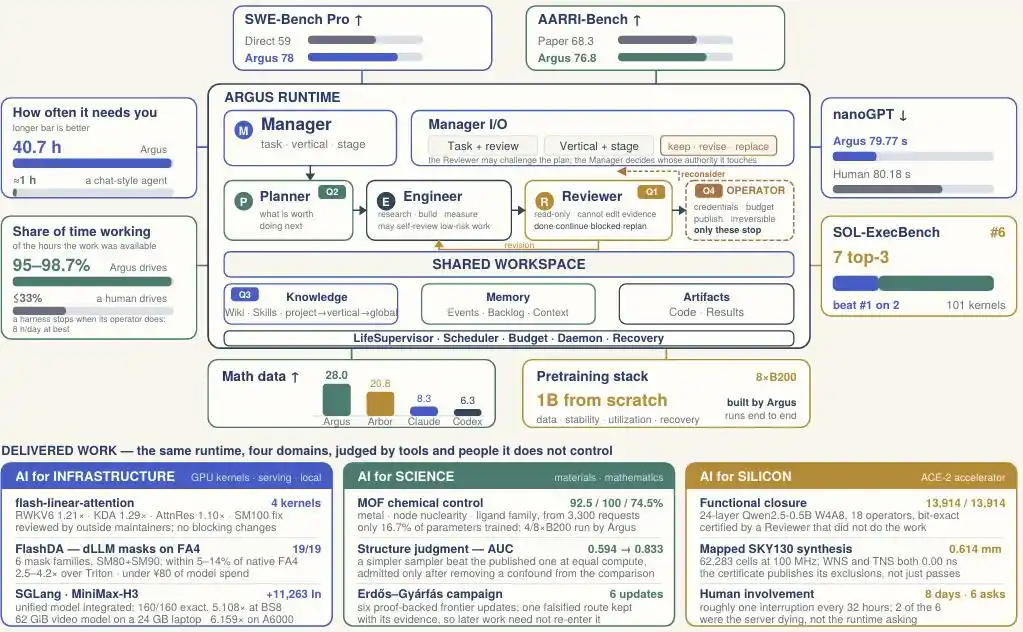
Figure 1: Overview of Argus runtime, capability benchmarks, and delivered results.
  • Paper Title: Argus: Who Drives the Harness for Days?
  • Paper: https://arxiv.org/abs/2608.05144
  • Code: https://github.com/lbx154/Argus
  • Project Homepage: https://argusbot.cn/
  • Project Results Repository: https://github.com/Argus-AiTeam
  • Project Math Problem Solving Live Stream: https://open.argusbot.cn/#counterexample-live

01

Shifting from Goal-Driven to Evidence-Driven:

Who Decides the Agent's Next Step?

Over the past two years, major progress in Agent engineering has centered on Harness: using the analogy of self-driving FSD, the model is like the engine, Harness is like the drivetrain, but the one truly deciding where the vehicle goes is still the person sitting at the screen. For short tasks, like standard automated parking, the task itself can still provide clear feedback; once tasks extend over days, research problems often lack both stable rewards and clearly defined goals from the start. Existing Agents thus reveal the true bottleneck: they can execute, but they still cannot make continuous judgments under uncertainty.
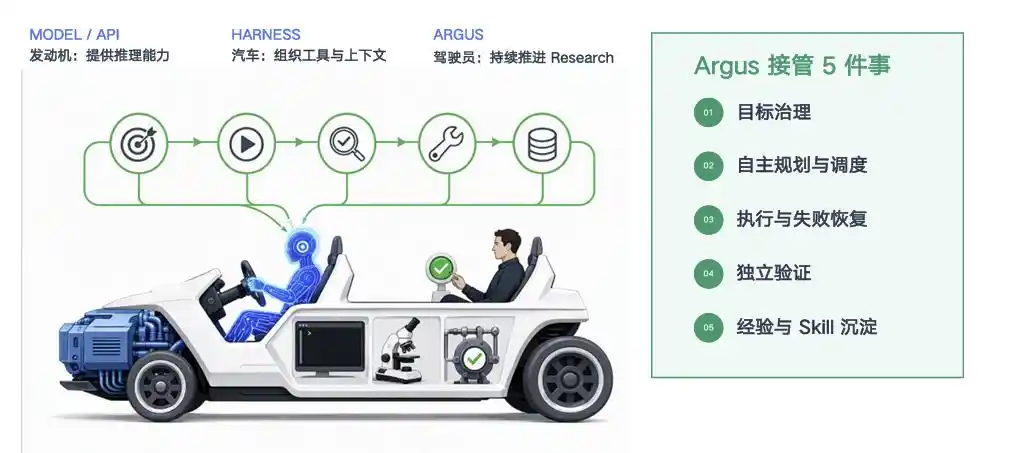
Figure 2: Argus transforms the human role from the ongoing driver's seat to a co-pilot by achieving auto-research for autonomous scientific inquiry.

Argus refers to the previously unautomated position above Harness as the Driver. Its job is to keep steering based on evidence even when plans conflict with reality. The goal written at the start of research is merely the initial hypothesis at the information-poorest stage; if the Agent can only chase preset endpoints in a Goal-Driven manner, or even repeatedly waste tokens on impossible goals, it leads to goal fixation. Evidence-Driven, however, inverts the control logic: the next step is determined by existing evidence, not by the initial hypothesis of the plan. All results during operation are valid evidence that can change the route; the system is precisely driven by evidence. Specifically, the Driver needs to repeatedly answer the following four questions based on current evidence:

1. Is this work already complete, and is the quality sufficient?

2. Based on current evidence, what is the most worthwhile thing to do next?

3. How should the experience gained in this round alter the system's subsequent behavior?

4. Does the remaining problem involve decisions that only humans can make?

02

Building a General, Customizable Long-Horizon Runtime

Argus organizes long-term projects into persistent Campaigns, which are then broken down into a series of well-bounded Missions. Its fundamental loop is: Manager → Planner → Engineer ⇄ Reviewer → Manager:

Using OpenAI Codex's /goal mode as a reference helps clarify Argus's design orientation. /goal extends a single agent's single-turn loop into a persistent loop with a goal state; Argus organizes research projects as a multi-role, multi-harness, knowledge-persisting long-horizon runtime. The former answers "how to keep the agent from stopping," the latter answers "once the agent doesn't stop, how to work effectively." This is precisely the structural difference at the runtime level corresponding to the shift from Goal-Driven to Evidence-Driven.

1. Manager controls phase transitions, process approvals, and global strategy;

2. Planner formulates specific tasks based on current evidence;

3. Engineer enters real codebases, experiments, and executes;

4. Reviewer independently audits artifacts, evaluates novelty and effectiveness, reports to the Manager, or sends tasks back to the Engineer.

The key here is not multi-role itself, but splitting the context—multiple roles collaborate to prevent the agent from becoming a simple local hill climber. Each role has its own unique context but shares a workspace, avoiding entrusting planning, execution, and validation entirely to a single agent, improving token efficiency. This also allows Argus to simultaneously enable different harnesses like Pi, Codex, Claude Code, DeepSeek Harness etc., within a single task, ensuring high customizability.

The system saves a complete set of artifacts; only experiences that pass the evidence threshold enter the Wiki and Skill, and are reused in subsequent tasks within Project, Vertical, or Global scopes.

Simultaneously, Core and Vertical remain decoupled: Core is responsible for role permissions, evidence submission, and human boundaries. Vertical, defined by domain experts, determines what constitutes valid evidence in tasks like mathematics, GPU, materials, etc., along with related human skills and knowledge. Vertical can significantly improve the delivery quality of research tasks and also provides an interface for human experts and agents to co-evolve and customize workflows.
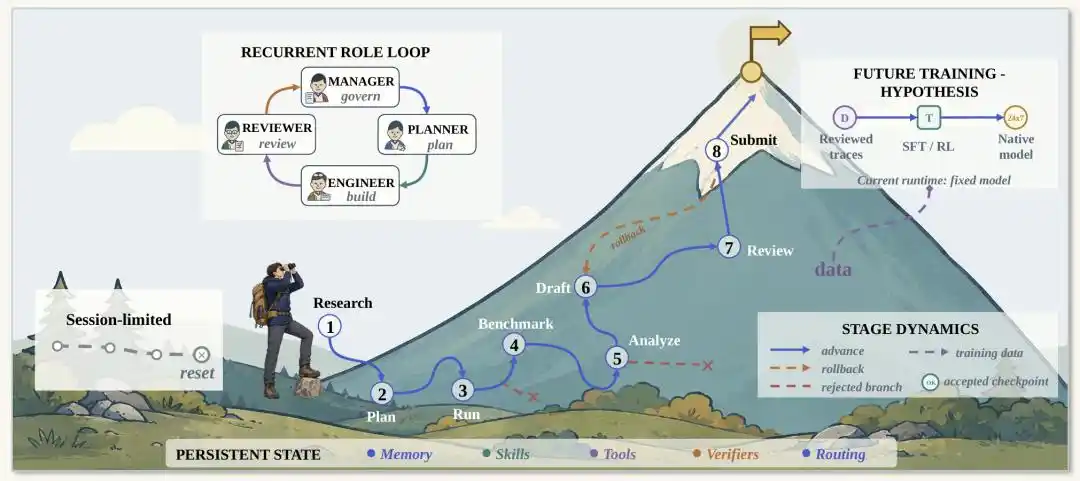
Figure 3: Argus's long-horizon runtime mechanism. Four role types cycle around persistent state; Campaigns can advance or roll back between eight research phases.

03

After 1,548 Hours, What Has Argus Left Behind?

What truly determines the validity of a long-horizon Agent is whether time can be translated into genuine research outcomes. Within less than a month of its open-source release, Argus has already made outstanding contributions in infrastructure, materials, chips, mathematics, and AI system research. The team is also the first to publish complete end-to-end logs for solving mathematical conjecture screening, opening all running trajectory sessions, etc. The following is a summary of Argus's achievements since its open-source release:
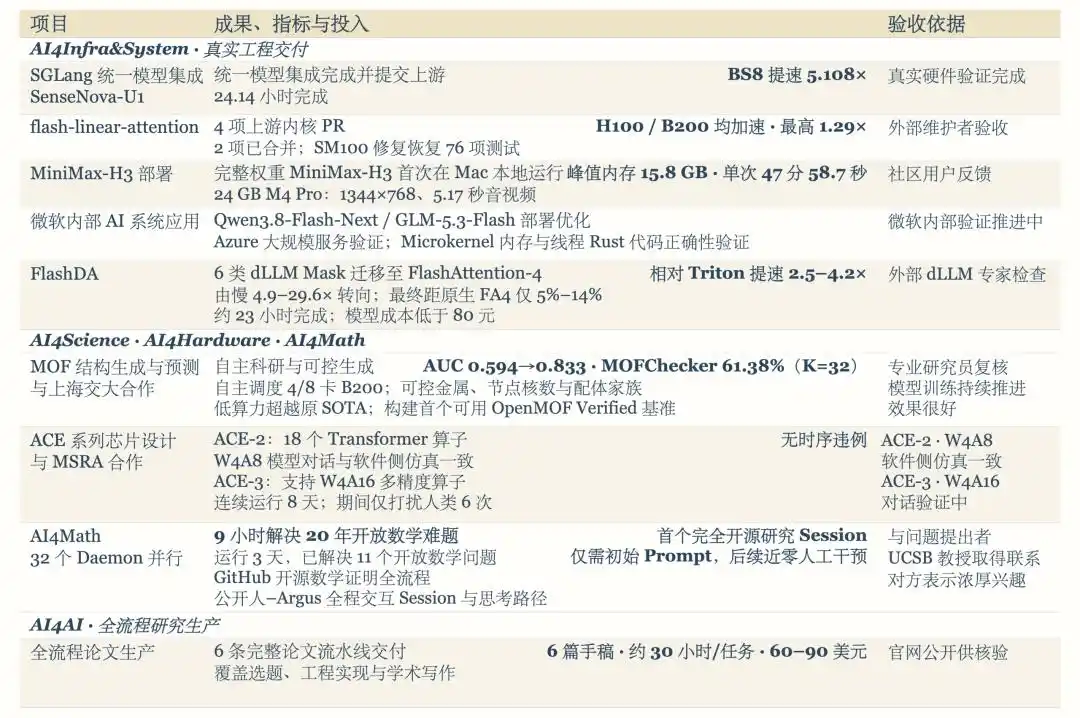
Figure 4: Argus's representative research results, key metrics, and acceptance criteria.

As shown in the table above, Argus first translated continuous operation into verifiable real-world deliverables in AI4System & Infra, achieving the first step from automated execution to autonomous research with clear engineering outcomes. Subsequently, tasks expanded from AI infrastructure to AI4Science, AI4Hardware, and AI4Math, and the evaluation criteria shifted accordingly from "whether the assigned task is completed" to "whether unresolved real-world research problems can be explored." Auto-research thus progressed further from automated delivery to automated exploration. Building on this, Argus extended from point achievements to complete research workflows in the AI4AI direction, continuously driving task progression with evidence without requiring humans to remain at the screen, forming a progressive path from real-world delivery, cross-domain exploration, to full-process autonomous research.
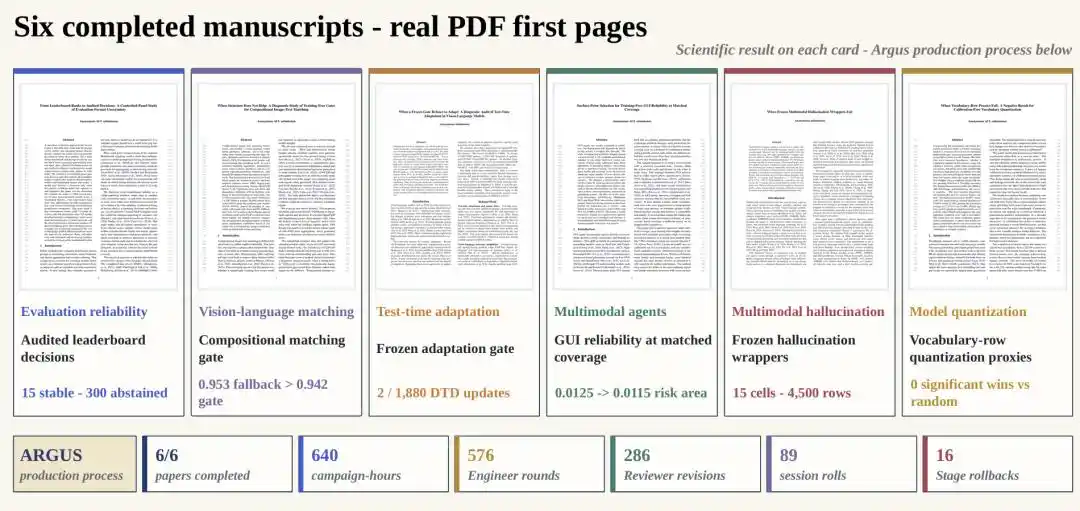
Figure 5: Argus's delivery results in the full-process paper production.

All the above results were achieved within 1 month. Stringing these outcomes together, Argus represents a gradually deepening value chain: the object of automation expands from a single execution to evidence-driven research progression, greatly accelerating research progress. This is the most direct answer to "who steers the Agent after the human leaves the screen."

Conclusion

After the Screen Goes Dark, the Project Doesn't Reset to Zero

Long-horizon intelligence is about transforming tokens into intelligence, then using that intelligence to continuously advance a research project, generating real value. Argus organizes previously disjointed model calls into a continuously operating research system, letting Evidence-Driven control the direction, and then solidifying experience into capability through self-evolution.

Argus demonstrates not just a longer-running Agent, but a new way of organizing research: Harness addresses how the model acts, the Driver determines how the system continuously moves forward, and research speed is no longer constrained by human work and leisure hours. This may signal the arrival of an era of accelerated research. The screen can go dark, but the research continues.

About the Authors

Argus was led by researchers from Microsoft and Shanghai Jiao Tong University, with contributions from researchers at multiple universities.

This article is from the WeChat public account "机器之心" (Almost Human)

Related Questions

QWhat is the core problem that the Argus system aims to solve in long-term AI agent research?

AArgus aims to solve the problem that most existing AI agents automate 'execution' but not the higher-level 'driving' or decision-making required for long-term research tasks. These tasks often lack dense, immediate feedback, causing progress to stall without constant human supervision.

QWhat is the key design shift in Argus's approach compared to traditional agent systems?

AArgus shifts from a 'Goal-Driven' approach to an 'Evidence-Driven' approach. Instead of rigidly following an initial goal, Argus uses evidence gathered during execution to continuously decide the next steps, adapting its course based on real-time results.

QWhat are the four main roles within the Argus runtime's basic operational loop?

AThe four main roles are: Manager (handles phase transitions and global strategy), Planner (creates specific tasks based on current evidence), Engineer (executes tasks in codebases and experiments), and Reviewer (independently reviews work products for validity and innovation).

QAccording to the article, what is a significant outcome demonstrated by Argus in its testing?

AIn testing across 27 campaigns and 1,548 hours of wall-clock time, Argus demonstrated high autonomy with an average of only one human intervention request every 40.7 hours and a work duty cycle of 95.1% to 98.7%, while delivering tangible research results across multiple fields.

QHow does the Argus system architecture separate general and domain-specific functionalities?

AArgus's architecture keeps the Core (handling role permissions, evidence submission, and human boundaries) decoupled from Verticals. Verticals are defined by domain experts to specify what constitutes valid evidence and relevant skills/knowledge for fields like mathematics, GPU programming, or materials science.

Related Reads

4.8 Billion Dollars: Tether's Hand Has Reached Into 13 U.S. Public Companies

Tether, the world's largest stablecoin issuer, holds roughly $4.8 billion in public-market exposure across 13 U.S.-listed companies, according to a Protos review of regulatory filings. Its holdings span a controversial video platform, gold royalty companies, a satellite firm, bitcoin miners, and a bitcoin treasury project. Key positions include a 50.3% stake (including warrants) in Rumble (RUM), though voting power is capped below 9.9%; Rumble has also acquired Tether's Northern Data and counts Tether as its most important advertising client, committed to $50 million annually for two years. Tether and Bitfinex are controlling shareholders of Twenty One Capital (XXI), with rights to nominate four of seven directors, including Tether CEO Paolo Ardoino; the company trades at about 60% of its bitcoin value. In gold, Tether holds about 27% of Elemental Royalty (ELE), 12.6% of Gold.com (GOLD), 12.6% of Versamet Royalties (VMET), 14.6% of Metalla (MTA), 14.4% of Gold Royalty (GROY), 12% of Aurelion (AURE), and about 8% of Antalpha (ANTA). It also holds 19.7% of Bitdeer (BTDR) and a stake in Adecoagro (AGRO), plus shares in Satellogic (SATL), 9.9% of SDEV (down about 99%), and a stake in VCI Global (VCIG) via Oobit. Powerlaw Corp (PWRL) claims roughly $20 million in Tether equity. The exposure is concentrated in a few large holdings—Twenty One, Rumble, and Adecoagro—showing Tether's growing role as a multi-sector financial institution that also places executives in key positions.

marsbit3m ago

4.8 Billion Dollars: Tether's Hand Has Reached Into 13 U.S. Public Companies

marsbit3m ago

Tesla and SpaceX Merger Accelerates: A $3.47 Trillion Giant, Deal Could Be Announced as Early as December

Tesla and SpaceX are reportedly advancing merger talks, with a deal potentially announced as early as December, though complex corporate structure and regulatory issues could delay it to early 2027. Based on recent market values—SpaceX at about $1.90 trillion and Tesla at about $1.57 trillion—the combined entity would be worth roughly $3.47 trillion, making it one of the largest corporate integrations in history and bringing rocket launch, satellite internet, EVs, energy storage, AI, and robotics under one roof. In October, Musk called a merger "a good idea" and confirmed both companies had formed independent director special committees. The strategic logic centers on AI infrastructure—chips, compute, and energy—with the Terafab chip manufacturing joint venture as a concrete example, expected to produce first test chips in mid-2027 and reach mass production in Q3 2028. Shareholder impact is significant: Musk holds about 40-45% economic interest in SpaceX with over 80% voting power via dual-class shares, versus nearly 20% of Tesla with equal voting rights, raising questions about control and whether Tesla shareholders would accept a new structure. Regulatory hurdles may be the hardest obstacle, given SpaceX's sensitive U.S. defense contracts and Tesla's major China operations, implicating CFIUS and Chinese regulators. The merger reflects Musk's ambition to unify his business empire around a shared technology base spanning Earth and space.

marsbit38m ago

Tesla and SpaceX Merger Accelerates: A $3.47 Trillion Giant, Deal Could Be Announced as Early as December

marsbit38m ago

10-Second 4K Image Generation: MiniMax Once Again Delivers Open-Source SOTA

MiniMax has released MiniMax H3 Image, an open-source image generation model that has quickly claimed state-of-the-art status among open-weight models. It natively outputs 4K images (around 16 million pixels) in roughly 10 seconds with the fast version, supports up to 16 reference images, and ranks first among open-weight models on Artificial Analysis for both text-to-image and image editing. The model is available via web, API, and local deployment on GitHub and HuggingFace. In hands-on tests, H3 Image produced highly realistic WeChat chat screenshots with accurate iPhone status bar details, rendered complex graffiti-style text ("MiniMax H3 Image") with 3D lettering and spray-paint effects, and generated convincing Victoria's Secret backstage photos, cinematic street portraits, and Y2K-style retro portraits. It also handled image-to-image tasks well: turning a photo into a hand-drawn sticker, adding CCTV-style face bounding boxes and zoom-ins, and converting realistic images into anime collage styles. The model further demonstrated understanding of physical structure by generating a labeled exploded-view diagram of a 35mm camera, producing accurate outfit try-on images, e-commerce product posters, and typography-heavy Eastern botanical posters, and following complex multi-reference editing instructions. Architecturally, H3 Image derives from MiniMax's full-modal video model H3, retaining its backbone and text encoder (a 32-billion-parameter multimodal language model) while dropping the audio branch. Its core is a 33.1-billion-parameter diffusion Transformer using 3D multimodal rotary position encoding, with text and reference-image tokens processed in a single stream and decoded by a VAE. Native generation avoids external super-resolution. The video-first lineage is credited with giving the model strong visual world knowledge, including viewpoint, material, lighting, and motion understanding. The release has energized the global AI community: derivatives such as Pruna's P-H3-Image, Nvidia's Sol-H3, and Pika H3 Flex have appeared, with roughly 220 H3-based entries on Hugging Face. Chinese open-source technology is increasingly the foundation for overseas teams, and MiniMax is building a commercial loop around free weights plus paid hosted APIs and subscriptions. The article argues competition is shifting from raw model capability to ecosystem strength.

marsbit1h ago

10-Second 4K Image Generation: MiniMax Once Again Delivers Open-Source SOTA

marsbit1h ago

Jensen Huang Resigns, CFO Becomes NVIDIA Interim CEO, Who Is Kress?

NVIDIA announced on November 12 that co-founder Jensen Huang has resigned as president, CEO, and board member, effective immediately, after scandals involving extramarital affairs. The board accepted his resignation on November 11, and Huang, who led the company for 33 years and holds about 3.6% of shares, also left the board entirely. CFO Colette Kress has been appointed interim CEO while continuing as EVP and CFO; she becomes the first female leader in NVIDIA's history. Former Synopsys CEO Harvey C. Jones, a director since 1993, becomes the company's first independent board chair. The board will search for a permanent CEO internally and externally. Kress, 59, holds a finance degree from the University of Arizona and an MBA from SMU Cox, and previously worked at Texas Instruments, Microsoft, and Cisco before joining NVIDIA in 2013 at Huang's invitation. During her 13 years as CFO, NVIDIA's revenue grew from $4.13 billion in FY2014 to $215.9 billion in FY2026, roughly 52-fold, and she became a billionaire in July 2025 with a net worth of about $1–1.2 billion. The resignation followed reports of Huang's infidelity, including a New York Times report of a romantic relationship with NVIDIA healthcare VP Kimberly Powell. NVIDIA shares fell sharply, hitting a five-month low below $150 before recovering to about $160. The board expressed confidence that operations, customer commitments, and product roadmaps will not be disrupted.

marsbit1h ago

Jensen Huang Resigns, CFO Becomes NVIDIA Interim CEO, Who Is Kress?

marsbit1h ago

Trading

Spot
活动图片