Russia Introduces Protocol for Seizing Crypto Assets, Already Applied in Practice

cryptonews.ruPublished on 2026-10-12Last updated on 2026-10-12

Abstract

Russian authorities have reportedly used a new protocol for seizing crypto assets in a practical case. According to a published investigative action protocol (from October 10, 2026), an investigator in the Republic of Tatarstan seized $6,328 in digital currency. The funds were transferred from a trading account on the RoboForex platform, converting them to USDT and sending them to a specified TRON network address. The procedure was conducted with the participation of the account owner, a defense lawyer, and a specialist, following a court order to seize property. This case aligns with new Russian legislation effective from March and July 2026, which regulates the seizure and storage of digital assets as property in criminal proceedings. The rules establish a framework for transferring seized crypto to special state-controlled addresses. It is noted that the action described constitutes an arrest to secure the assets, not a final confiscation, which would require a separate court ruling. The authenticity of the specific protocol could not be independently verified.

  • An investigator from the Main Investigative Department of the Russian MVD in the Republic of Tatarstan seized digital currency amounting to $6328.
  • From a previously confiscated laptop, he initiated a withdrawal from a RoboForex trading account, choosing to receive the funds in $USDT via the TRON network.

A purported protocol of the investigative action has been published online, showing how the new Russian mechanism for seizing and storing digital assets can work in practice.

According to the document dated October 10, 2026, an investigator from the Main Investigative Department of the Russian MVD in the Republic of Tatarstan

The Happy Coin News editorial team was unable to confirm the authenticity of the published protocol; however, the procedure described in it aligns with the rules for handling seized digital currency that came into force this year.
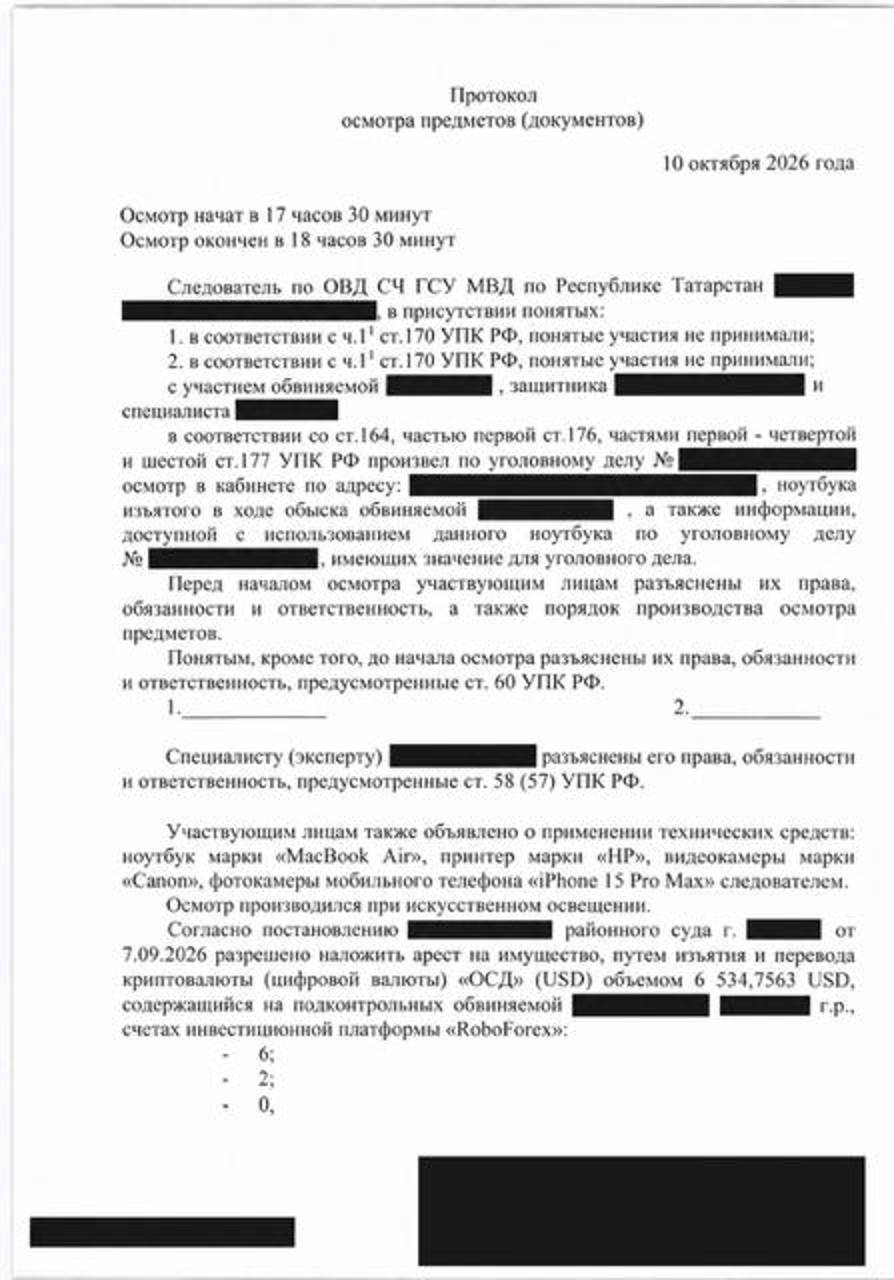
A fragment of the published protocol

How the Investigator Withdrew Funds via RoboForex

It follows from the document that the object of inspection was an HP Pavilion x360 Convertible laptop, previously seized during a search. The basis for the actions was a ruling by a district court in Kazan dated September 7 to seize property.

The accused provided access to the laptop and phone and, according to the protocol, voluntarily confirmed consent to the transfer of funds as part of cooperation with the investigation. Thus, the document does not describe account hacking or bypassing security; the investigative action was conducted with the participation of the owner of the credentials, a defense lawyer, and a specialist.

After logging into RoboForex, the account displayed a balance of $6641.84. The investigator opened the withdrawal section and specified an amount of $6328.

The subsequent operation went through the Difinex payment service. According to the data recorded in the protocol, the interface showed the receipt of approximately 6331.33 $USDT, a commission of 3 $USDT, and the option to choose a blockchain. The investigator specified TRON and entered the recipient address provided to him.

The official RoboForex instructions confirm the general procedure for such operations: the user selects a trading account and payment system, enters a password and amount, after which the selected service may require additional data or confirmation.
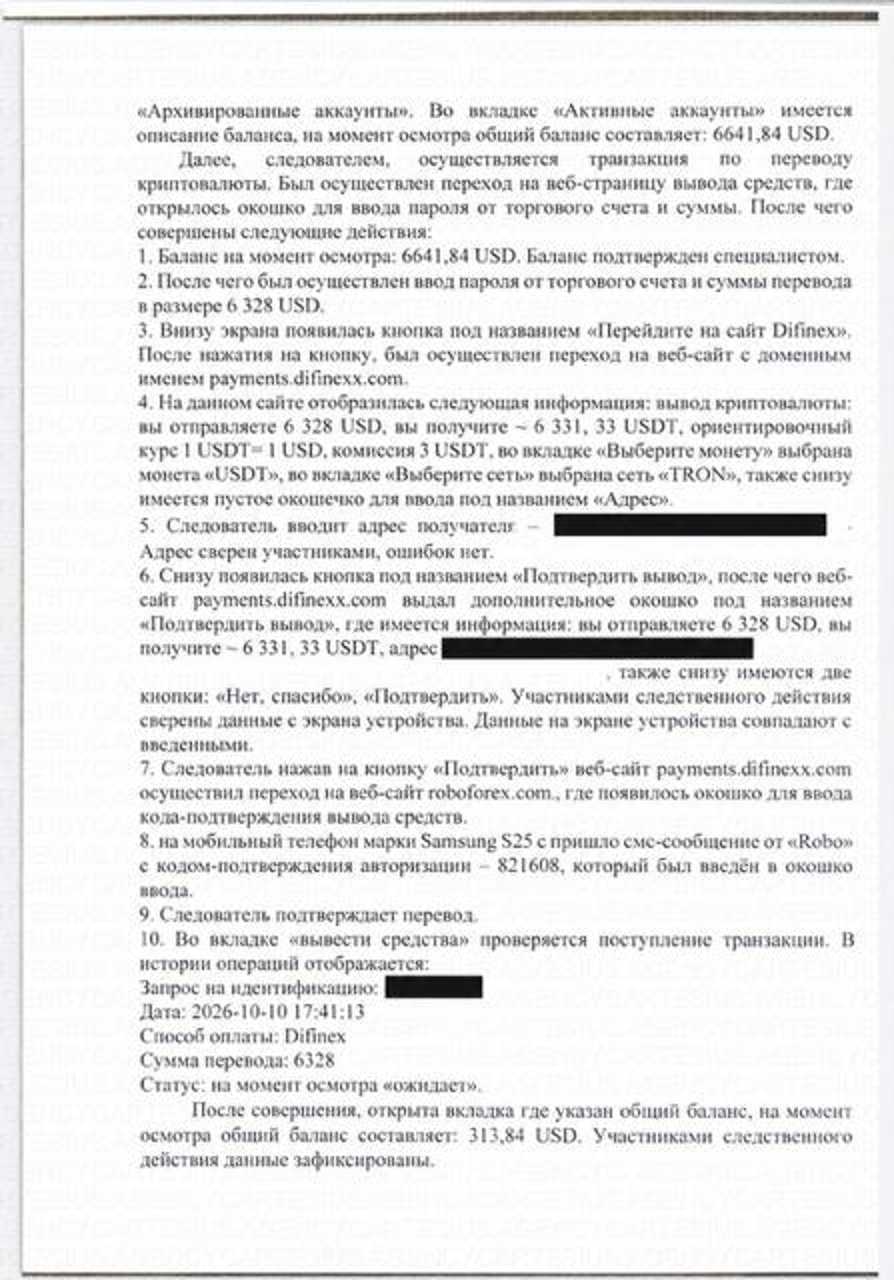
The investigator initiated a withdrawal of $6328 from RoboForex, receiving $USDT via the TRON network. At the time the inspection ended, the transaction was pending

After additional SMS confirmation, the request appeared in the RoboForex transaction history, and the account balance decreased to $313.84.

However, there is a crucial detail here: at the time the inspection was completed, the transfer had not yet been confirmed as received at the final address. Its status in the protocol is designated as "currently pending," with a processing time from five seconds to three days.

New Rules Only Came into Effect This Summer

The practical significance of the document is linked to changes in Russian legislation. Since March 3, 2026, Article 164.2 of the Criminal Procedure Code separately regulates the seizure of digital currency. Investigative actions must be conducted with the participation of a specialist, and to preserve the assets, they are allowed to be transferred to a special identifier address when technically possible. The protocol must record the type and quantity of digital currency, the sender and recipient addresses, and data allowing identification of the transaction.

Since July 3, government-approved Rules for the Storage, Transfer, and Accounting of Digital Currency in Criminal Proceedings have been in effect. They provide for an infrastructure in which a state agent bank, together with an authorized organization, provides identifier addresses for the MVD, FSB, Investigative Committee, Prosecutor's Office, FSSP, Federal Customs Service, and other agencies.

The published protocol fits well into this scheme: the investigator received an address for storing the asset, the participants verified it, after which it was used as the destination address for withdrawing $USDT.

However, it is impossible to determine the owner of the specific TRON address from the document—it is obscured in the published image.

This is Seizure for Now, Not Confiscation

Another important distinction concerns the legal status of the funds. Since March 2026, digital currency has been recognized as property for the purposes of criminal legislation, so it can be seized, including to secure a civil claim, a fine, or possible subsequent confiscation.

But seizure is not the same as confiscation. The latter implies the forced transfer of property into state ownership based on a corresponding court decision. The presented protocol records an investigative action to ensure the preservation of assets, not their final transfer to the state.

Risk Warning:

The information on the site is for informational and educational purposes only and is not investment advice or financial guidance. Cryptocurrencies and digital assets involve a high level of risk, including potential loss of capital. The editorial team is not responsible for decisions made based on published materials. It is recommended to conduct your own research (DYOR) before making investment decisions. Review the editorial policy at https://happycoin.news/about/


Related Questions

QWhat is the main topic and practical significance of the Russian protocol discussed in the article?

AThe article discusses the practical application of a new Russian protocol for seizing and storing cryptocurrency assets. Its significance lies in showcasing the operational mechanics of Russia's recently implemented legal framework, which allows law enforcement to officially arrest and transfer seized digital assets to government-controlled crypto addresses during criminal investigations.

QBased on the protocol, how did the investigator from Tatarstan transfer the cryptocurrency?

AThe investigator accessed a previously seized laptop and, with the owner's cooperation, logged into a RoboForex trading account. From there, he initiated a withdrawal of $6,328. Using the Difinex payment service, he chose to receive the funds in USDT via the TRON blockchain and sent them to a specific recipient address that was provided to him, likely a government-held 'identifier address' as per new regulations.

QWhat are the key differences between 'arrest' and 'confiscation' of cryptocurrency under the new Russian laws mentioned in the article?

AAccording to the article, 'arrest' is a provisional measure to secure and preserve assets during an investigation, ensuring they are available to satisfy potential future civil claims, fines, or confiscation orders. It does not transfer ownership. 'Confiscation' is a final court-ordered penalty where the property is forcibly transferred to state ownership. The described protocol documents an arrest, not a confiscation.

QWhich two key legal changes in 2026 established the framework for the procedure described in the protocol?

A1. Effective March 3, 2026: Amendments to Article 164.2 of the Russian Criminal Procedure Code (УПК РФ) officially recognized cryptocurrency as property for criminal law purposes and established procedures for its seizure, requiring specialist participation and allowing transfer to special storage addresses. 2. Effective July 3, 2026: Government-approved 'Rules for the storage, transfer, and accounting of digital currency in criminal proceedings' created the infrastructure, involving a state agent bank and an authorized organization to provide 'identifier addresses' for law enforcement agencies to hold seized assets.

QWhat crucial detail about the transaction's status was noted at the end of the on-site inspection in the protocol?

AAt the conclusion of the on-site inspection documented in the protocol, the USDT transfer from RoboForex was still pending final confirmation on the blockchain. Its status was recorded as 'currently awaiting' processing, with an estimated completion time ranging from five seconds to three days. The funds had left the trading account but had not yet been confirmed as received at the destination wallet.

Related Reads

Strategy stock sheds 5% amid MSCI index removal, Bitcoin sell-off

Strategy (Michael Saylor's Bitcoin treasury company) fell 6.49% on Thursday to close at $114.41, after MSCI confirmed the company's removal from its global equity indexes, compounded by a broader crypto market sell-off. The removal takes effect after the Nov. 30 market close and could trigger selling by index-tracking funds; JPMorgan previously estimated roughly $2.8 billion in potential selling pressure. Ryan Kirkley, CEO of Global Settlement Network, said the decision could distinguish Bitcoin treasury companies from traditional operating businesses and limit indirect crypto exposure for passive investors, noting that index inclusion had given ordinary passive investors leveraged Bitcoin exposure they never chose. He added it raises questions about whether such companies should be classified alongside traditional operating businesses, arguing that buying and holding an asset isn't an operating business but rather a fund that doesn't follow fund rules. In its Aug. 31 response to MSCI's proposed rules, Strategy called the changes a pretext for targeting digital asset treasury companies and downplayed the impact, saying MSCI-linked funds held about 13 million of its shares, just 3.1% of basic shares outstanding. The decline coincided with a broader crypto sell-off, with Bitcoin near $71,340, down 4.3% in 24 hours, and total crypto market capitalization down 3% to about $2.49 trillion.

cointelegraph1h ago

Strategy stock sheds 5% amid MSCI index removal, Bitcoin sell-off

cointelegraph1h ago

US Justice Department, business groups and DeFi firms challenge Illinois crypto tax

The US Department of Justice, business and financial industry groups, and a coalition of DeFi firms have backed a legal challenge to Illinois' 0.2% digital asset tax, arguing it unfairly targets crypto transactions and could impose taxes even without profit. The Justice Department filed a statement of interest, while the US Chamber of Commerce and SIFMA submitted an amicus filing. A coalition including Andreessen Horowitz, Paradigm, Uniswap and Aave Labs also filed a brief. The law, enacted in June, taxes the value of digital assets exchanged, transferred or stored regardless of profit. The Digital Chamber sued Illinois officials in July, followed by a separate challenge from the Blockchain Association and Crypto Council for Innovation in August. Originally set for Jan. 1, 2027, the tax was delayed to July 1, 2027. Illinois projected $60 million in fiscal year 2027 revenue. SIFMA and the Chamber warned the tax would affect banks, broker-dealers, custodians and asset managers nationwide, exposing them to compliance costs and burdening customers—someone who loses money owes the same tax as someone who profits, and moving assets between accounts could trigger tax without a sale or gain. They argued it discriminates against digital assets and may violate federal internet tax protections and constitutional interstate commerce requirements. The DOJ said the tax undermines federal efforts to promote crypto innovation, citing the Strategic Bitcoin Reserve and GENIUS Act. The DeFi coalition warned the rules could impose obligations on software developers and blockchain participants lacking customer information or control over funds.

cointelegraph2h ago

US Justice Department, business groups and DeFi firms challenge Illinois crypto tax

cointelegraph2h ago

DTCC Plans Solana Expansion as Wallet Rules Limit Access

DTCC plans to connect its tokenization service to Solana in the second half of 2027, allowing certain securities held by its DTC subsidiary to be converted into digital tokens on the network. Analysts say the move could attract more traditional financial institutions to Solana, which is known for fast transactions and low fees and had about $4.94 billion in total value locked as of Nov. 12. However, the impact may be limited by US regulatory rules. Alex Lin of Reforge noted that Solana's experience handling memecoin trading served as a public stress test, giving the network credibility to handle retail-scale volume reliably. Still, under a December 2025 SEC no-action letter, DTC participants must register wallets to hold tokenized securities, and tokens can only be transferred between registered wallets. Lin said the near-term impact is overstated because the tokens remain in a walled garden, inaccessible to permissionless retail and DeFi liquidity until regulators allow these assets to function as true onchain collateral. DTCC launched its tokenization service on the Canton Network and its private Besu network on Oct. 28, with 20 DTC participants signed on, though it has not said whether any plan to use Solana. Kha Nguyen of Birdeye said Solana has already seen growing demand for tokenized stocks, with trading volume reaching around $4.9 billion in H1 2026 and over 1 million accounts holding tokenized stocks by late September. However, broader Solana activity has slowed, with transactions down nearly 40%, DEX volume down 34.4%, and fees down 39%, while tokenized RWA value rose almost 7% to $4.76 billion. Nguyen said DTCC's integration would need banks, brokers, and issuers to actively issue, trade, and settle on Solana, with enough liquidity for large trades. He stressed that assets must be active rather than idle—traded around the clock, used as collateral, and earning yield. Lin agreed that long-term impact depends on where assets are used for secondary trading and collateral activity, not where they are issued.

cointelegraph3h ago

DTCC Plans Solana Expansion as Wallet Rules Limit Access

cointelegraph3h ago

Trading

Spot
活动图片