Original | Odaily Planet Daily (@OdailyChina)
Author | Wenser(@wenser 2010)

In October, the Ripple ecosystem reached another new milestone—Evernorth, the largest DAT treasury company, completed its merger and listing, officially debuting on Nasdaq.
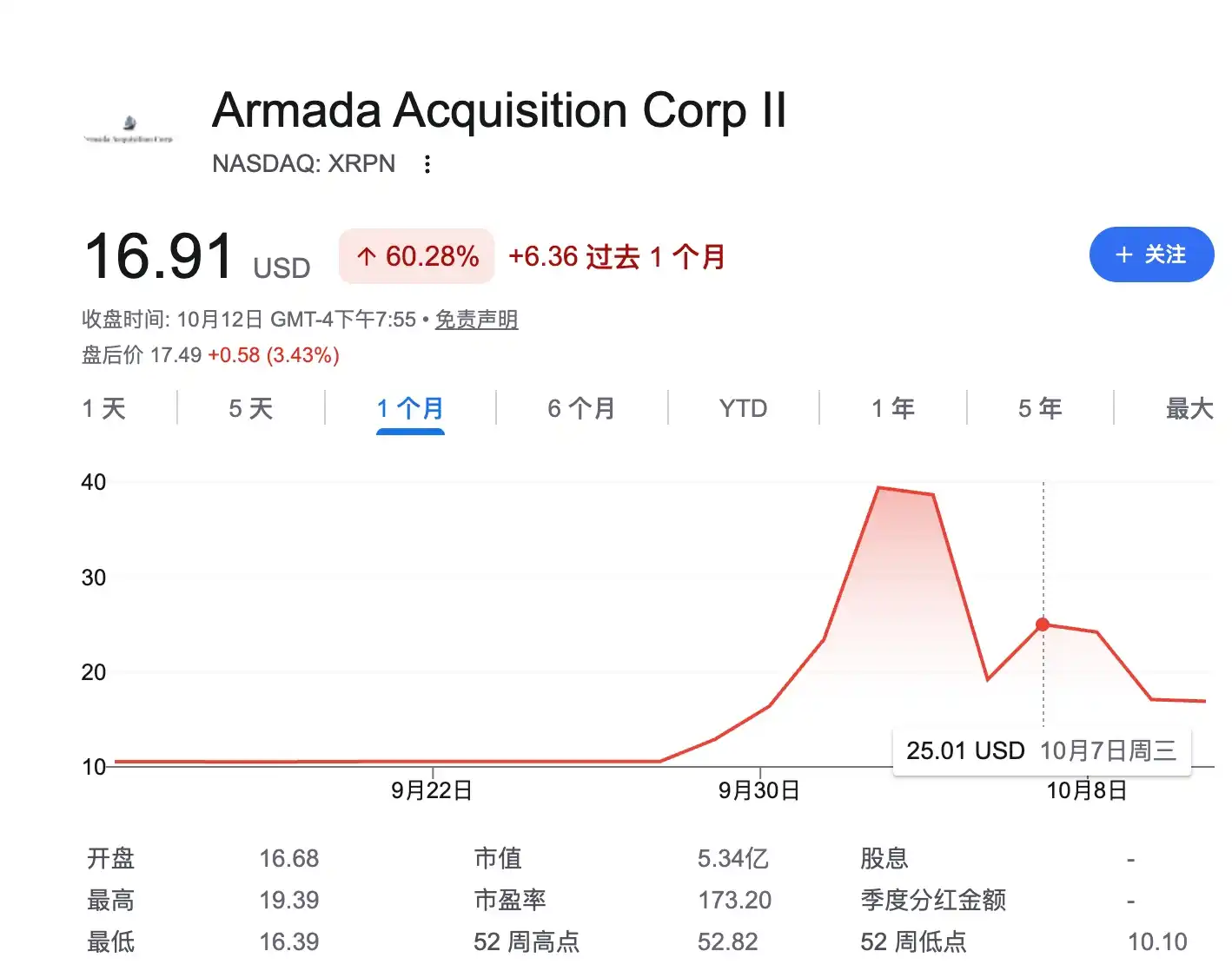
On October 9th, Evernorth completed its business combination with SPAC company Armada Acquisition Corp. II, bringing approximately 473 million XRP and $300 million in total cash proceeds into the public market. On October 12th, Evernorth began trading on Nasdaq under the ticker XRPN, opening with a surge of over 15% before retracing to close at $16.9. Over the past month, Evernorth's stock price once rose to $53, achieving a near 4x increase at its peak.
As an important channel connecting to traditional capital markets, can XRPN transform the XRP treasury narrative into a long-term gateway for institutional capital? The real test is just beginning.
XRPN Aims for Wall Street Liquidity, Aspiring to Be the Next "MSTR"
As the main driver of this nearly $10 billion merger, Evernorth is led by former Ripple executive Asheesh Birla as Founder and CEO. Its investors include Ripple, SBI Group, Arrington Capital, Pantera, Kraken, GSR, and others.
Among them, SBI Group and Arrington Capital control significant voting rights, especially the former, which has been an active long-term supporter of the XRP ecosystem in the crypto market. Furthermore, the Japanese crypto market's support for XRP is evident, with XRP's trading volume and ecosystem activity in the region often ranking just behind BTC and ETH. Now, let's discuss the "long birth story" of XRPN, which has taken over a year.
Formation Stage: $10 Billion Fundraising, Listing via SPAC
In October of last year, the Ripple-backed crypto company Evernorth high-profile announced its intention to list on Nasdaq by merging with Armada Acquisition Corp II (AACI.O), aiming to raise over $10 billion. This included a $200 million investment from SBI, as well as co-investments from leading digital asset and fintech institutions and investors like Ripple, Rippleworks, Pantera Capital, Kraken, GSR. Ripple co-founder Chris Larsen also participated in the investment.
The company planned to become the largest XRP treasury and the publicly listed company holding the most XRP. The transaction was expected to be completed in Q1 2026.
Following the "DAT frenzy" in the crypto market since June last year, the officially-backed XRP treasury company Evernorth had its "roadmap" and entry point into traditional finance figured out from the start. However, after the crypto market experienced the "October 11th Epic Crash," the DAT model also faced intense scrutiny. The merger originally planned for Q1 2026 was repeatedly delayed over time.
It's worth noting that even at that time, Evernorth's XRP holdings had grown to 389 million tokens. Valued at a coin price of $2.6, this was worth over $1 billion, with unrealized gains exceeding $50 million.
Growing Pains Stage: Holdings Surpass 470 Million, Asset Impairment Reaches $233 Million
Unfortunately, as the overall crypto market declined, XRP couldn't remain immune, and the treasury company became part of the falling dominoes.
In March of this year, Evernorth Holdings disclosed in an S-4 filing related to its SPAC listing that its digital assets experienced approximately $233.7 million in impairment in 2025, primarily due to the difference between purchase cost and the market price during the reporting period.
The filing showed that as of the end of 2025, Evernorth and Pathfinder Digital Assets (a wholly-owned subsidiary of Ripple Labs, Inc. and the core operator of Evernorth) held approximately 473.1 million XRP. Of this, the company acquired about 84.4 million XRP for approximately $214.1 million, with an average cost of around $2.54 per token. At that time, the XRP price had fallen to about $1.45, representing a roughly 35% decline from the cost.
Evernorth stated plans to introduce the RLUSD stablecoin to participate in XRP ecosystem decentralized finance (DeFi) transactions, including building RLUSD/XRP liquidity pools. Simultaneously, it aims to enhance asset returns through methods like lending XRP, providing AMM liquidity, and employing options strategies (such as covered calls, cash-secured puts). It's clear that the operational approach of the XRP treasury company differed from the passive income-focused DAT companies like Strategy and Bitmine from the outset.
Final Chapter: Holding 470 Million XRP, $300 Million in Cash
Moving to September this year, according to an 8-K filing disclosed by the U.S. SEC, the XRP treasury company Evernorth Holdings signed a bond purchase agreement with NH Investment & Securities. It plans to issue convertible preferred notes to an investment trust represented by NH to raise $30 million. These notes will have interest paid-in-kind (PIK), which can be added to the principal. The raised funds are intended for general corporate purposes, including purchasing XRP and conducting XRP ecosystem-related business. This bond issuance is conditional upon Evernorth completing its business combination with the special purpose acquisition company Armada Acquisition Corp. II, expected to finalize alongside the merger transaction in Q4 2026.
After nearly a year of waiting, now with relatively sufficient liquidity and a large-scale XRP holding, the merger between Evernorth and Armada Acquisition Corp II finally reached its conclusion. Following the official completion of the merger on October 9th, XRPN officially launched and began trading on Nasdaq on October 12th (U.S. Eastern Time).
The merged company retains the name Evernorth Holdings Inc., positioning itself as an "actively managed treasury." It plans to enhance "XRP per share" value through methods like lending, liquidity provision, DeFi strategies, and investment in XRPL infrastructure, drawing a parallel with BTC DAT company Strategy.
As of writing, XRPN's after-hours price is temporarily reported at $16.9, having declined by 56.65% over the past 5 days. To some extent, the DNA of a DAT treasury determines that XRPN still cannot escape the market rule of dramatic price swings.
Using a Capital Story to Knock on the Door of Traditional Finance, Recreating RWA Assets and Ecosystem Channels
The clues have been laid out far in advance; the birth of XRPN cannot be viewed merely as an independent DAT company. What it embodies is perhaps the ambition of the XRP ecosystem, Ripple, and even broader players to create the next "Strategy-like miracle."
Looking at XRP Trends from ETF Data: Ripple Not Satisfied with a Single Capital Channel Entry
According to SoSoValue data, during the last trading week (U.S. Eastern Time, October 5th to October 9th), XRP spot ETFs saw a net inflow of $11.3068 million. Among them: the XRP spot ETF with the highest weekly net inflow was the Bitwise ETF XRP, with a weekly net inflow of $10.5514 million. Its historical total net inflow for XRP has now reached $688 million. Next was the Franklin Templeton ETF XRPZ, with a weekly net inflow of $4.0962 million. Its historical total net inflow for XRPZ has reached $509 million.
The XRP spot ETF with the most weekly net outflow was the Canary ETF XRPC, with a weekly net outflow of $3.3407 million. Its historical total net inflow for XRPC has reached $487 million.
As of writing, the total asset net value of XRP spot ETFs is $1.57 billion. The ETF net asset ratio (market cap as a percentage of XRP's total market cap) is 1.80%, and the historical cumulative net inflow has reached $1.8 billion.
Although the figures appear impressive, a weekly inflow just over $10 million and a total asset size under $2 billion are merely a drop in the ocean compared to the traditional financial market, which handles hundreds of billions or trillions of dollars. If aiming to attract broader liquidity participation and attention from the traditional financial industry, the subsequent development of XRPN is indispensable.
The Long-Tail Value of XRPN: New Exposure, New Integration, New Model
After the company merger and listing, XRPN's main value will be reflected in the following aspects:
First, it provides institutional investors such as pension funds, RIAs, and corporate treasuries—which cannot directly hold crypto assets—with equity-form exposure to XRP assets.
Second, the company will further promote the deep integration of crypto assets with TradFi markets. XRPN can serve as a capital bridge, supporting tokenized securities, on-chain credit, etc., complementing trends like stablecoins and RWA. This is also a potential benefit of XRPN choosing an "active management model" to create ecosystem value.
Finally, as mentioned officially by XRPN, the company is committed to enhancing "XRP per share" value. Similar to Strategy's focus on enhancing "BTC per share" value, this will subsequently propel XRP's evolution from its previous roles as a payment tool or single cryptocurrency towards a broader institutional financial infrastructure. Just as Strategy has widely evangelized and continuously promoted BTC, XRPN will further expand XRP's global influence and capital reach.
Of course, the birth of XRPN is primarily driven by Ripple-affiliated executives and related institutions. Moreover, the actively managed DAT company operational model does not guarantee that an increase in XRP holdings will necessarily drive up the XRP token price or trigger explosive growth in various markets and applications within the XRP ecosystem. Additionally, XRPN's related holdings mainly stem from "contributions" by Ripple official and related partners—put bluntly, it's a transfer from one hand to another. While it appears to create a new asset class, increasing asset liquidity and transparency, it also amplifies the volatility and risks of the stock market. It might be worth speculative participation in the short term, but in the medium to long term, it remains highly dependent on the actual operational efficiency and returns performance of XRPN.
The stock market can sometimes be a mirror—whether it's a god or a monster, time will tell.