Raydium Price Forecast for October 2026: RAY Holds 144% September Gain as Volumes Outpace Pump.fun

cryptonews.ruPublished on 2026-10-08Last updated on 2026-10-08

Abstract

Raydium (RAY) Price Forecast for October 2026 remains bullish above $2, a key level to maintain its September breakout. Trading around $2.41, RAY has gained roughly 105% in a month. Key resistance levels are $2.56, $2.80, and $3, while support lies at $2.19, $2, and $1.58. The token has closed October higher in three of the past five years. Fundamental catalysts include a surge in Raydium's monthly revenue from ~$1.4M in August to over $7M in September, largely driven by Stonk Fun migrating its token launches to the platform. Raydium also briefly surpassed Pump.fun in 24-hour DEX volume, reaching $192.2M. However, analysts caution that revenue growth is heavily reliant on a single client (Stonk Fun) and may be cyclical. Daily fees have already declined from their September peak. The bullish target for October is $2.80, contingent on holding above $2.19 and closing above $2.56. The bearish risk is a drop to the 20-day EMA at $2, which could open a path down to $1.58. Reaching $5 or $10 in October is considered highly unlikely based on historical performance.

The Raydium price forecast for October will remain bullish above $2 — a level that $RAY must hold to maintain September's breakout.

Raydium Price Analysis: Can $RAY Reach $2.80 After Doubling in a Month?
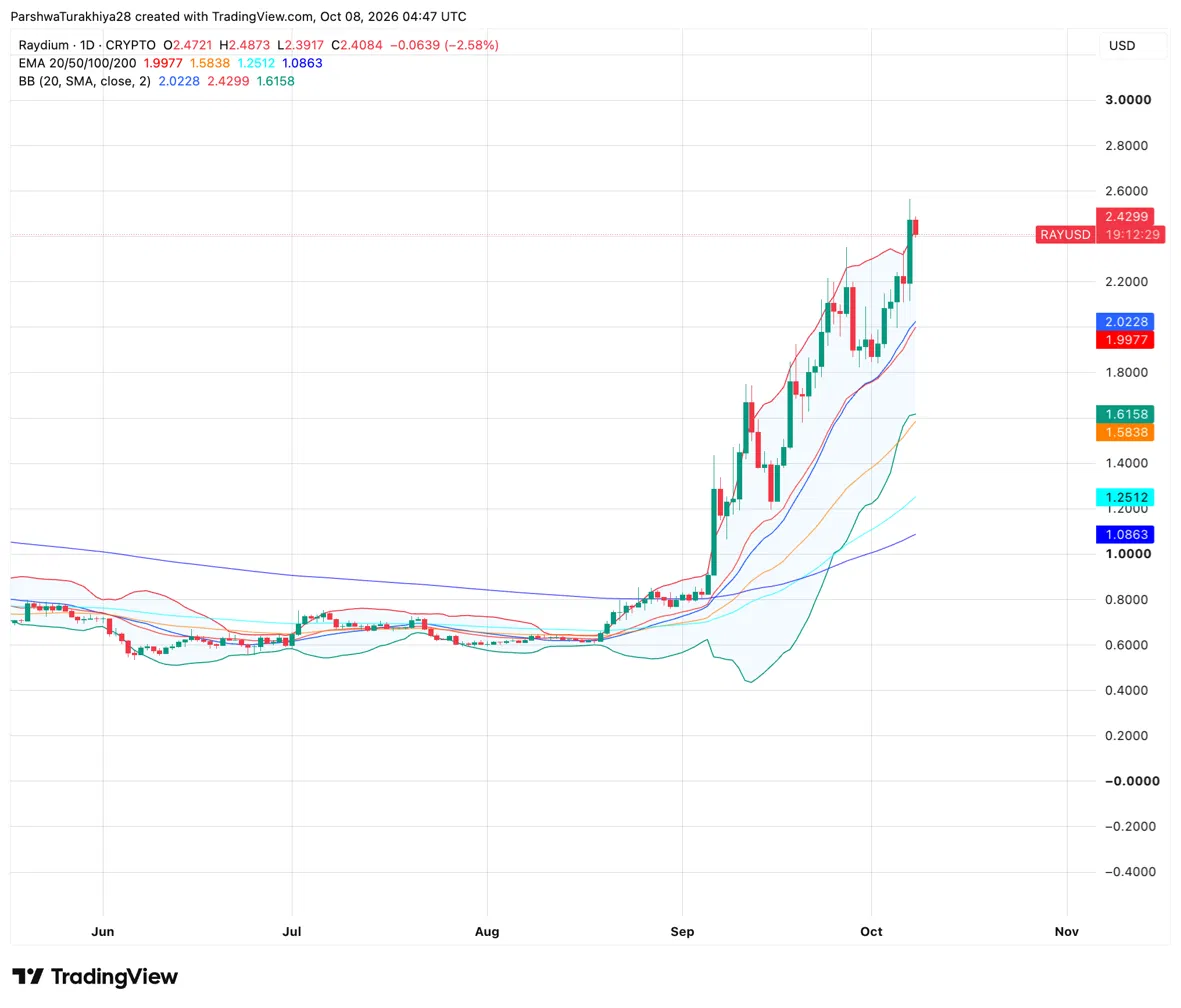
Raydium Price Analysis (Source: TradingView)

$RAY is trading around $2.41, down 2.58% today, after gaining approximately 105% over the month. It could continue rising if it surpasses Wednesday's high around $2.56, which would open the path to $2.80, and then $3. Despite this growth, $RAY remains about 15% below its price from a year ago, so the rally is a recovery that hasn't yet reached new territory.

The moving averages show how stretched the price has become. $RAY is about 21% above its 20-day EMA at $2, while the 50-day at $1.58 and the 100-day at $1.25 are significantly lower. A pullback to $2 would be a normal recharge, while a daily close below it would target $1.58.

Related: Meteora Price Forecast: MET Up 43% After DLMM Pro Launch Sparks Market Interest

$RAY Support and Resistance Levels for October 2026

Price Level
Resistance $2.56
Resistance $2.80
Resistance $3
Support $2.19
Support $2
Support $1.58

How Has Raydium Performed in October? $RAY Posted Gains in Three of Five Years

$RAY has closed October with gains in three of the five completed years since 2021, with an average gain of 12.1% and a median of 9.99%. A 75% gain in 2024 lifts the average, while a 38% decline in 2025 is the worst performance, making the median a better benchmark.

This October, it's already up 24.1%, more than the median, so $RAY is trading above its typical October performance. The 144.1% gain in September compares to a median September loss of 5.57% and follows a 32.3% gain in August.

Year October Performance
2026 (month-to-date) +24.1%
2025 -38%
2024 +75%
2023 +22.5%
2022 -8.92%
2021 +9.99%
Average (2021–2025) +12.1%
Median (2021–2025) +9.99%

$RAY News: Raydium Revenue Soared From $1.4 Million to Over $7 Million in a Month

The Bitcoin Strategy YouTube channel reported that Raydium's revenue increased from approximately $1.4 million in August to over $7 million in September — its best month since the summer of last year. The surge began when Stonk Fun, a platform for tokenized stocks priced new token launches, moved all its launches to Raydium in early September. The host reports that Stonk Fun now accounts for over a quarter of Raydium's revenue.

Metric Figure
Monthly Revenue $1.4M in Aug, over $7M in Sept
Daily Trading Fees Below $500K to ~$2.5M over 24h
Solana DEX Trading Share ~6% to ~12%
Liquidity Pool Deposits ~$1.3B, up ~20% over 30 days
Token Buybacks ~3M $RAY bought in Sept, ~20x new supply

Why Did Raydium Outpace Pump.fun? $RAY Won the Day with $192.2M Volume

Raydium just toppled PumpFun… @Raydium has overtaken @Pumpfun in 24-hour decentralized trading volume.

The protocol recorded $192.2M in total volume, compared to PumpFun's $185.0M.

This increased trading volume helped Raydium move up to eighth place globally in… pic.twitter.com/MVHYIc22IN

— BSCN (@BSCNews) October 7, 2026

BSCN reported on X that Raydium surpassed Pump.fun in 24-hour decentralized exchange volume — $192.2 million versus $185.0 million — moving it up to eighth place among the world's decentralized exchanges from ninth the previous day.

This metric covers a single day, so it shows where trading was concentrated that day, not long-term leadership. Bitcoin Strategy described a similar crossover on September 30th, when it stated Raydium had passed PumpSwap.

Will Raydium's Revenue Hold? Bitcoin Strategy Notes Single-Client Risk

Bitcoin Strategy argues that the revenue surge is heavily dependent on a single client and expects September's level to decline. Its main points:

  • Fees Peaked and Dropped: Daily fees peaked in the third week of September and fell by more than half by the last weekend of the month, two days before $RAY's September high. They remain more than triple the pre-Stonk Fun level.
  • Single Client: The Stonk Fun team is anonymous, and he says it raised roughly four times more than Raydium in a month, so Raydium may need the launchpad more than the reverse.
  • Low Leverage: The open interest on futures, the total value of open bets, is about $16 million, roughly 3% of market cap, and the funding rate is slightly negative, so he doesn't believe the surge is driven by borrowed money.

Raydium Price Forecast for October 2026: Where Could $RAY Trade Each Week?

Expected Range Key Levels
Oct 8 - 12 $2.19 to $2.60 $2.19 must hold on dips, with Wednesday's high at $2.56 as the upside cap.
Oct 13 - 19 $2 to $2.80 A close above $2.56 puts $2.80 in range, while a loss of $2.19 targets the 20-day EMA at $2.
Oct 20 - 26 $2 to $3 $2.80 is the next barrier, with $3 beyond it and $2 as the floor.
Oct 27 - 31 $1.58 to $3 The Fed decision on Oct 28 sets the tone: $3 as resistance, the 50-day EMA at $1.58 as the floor if $2 fails.

Raydium Price Forecast for October: Can $RAY Reach $2.80 or Fall to $2?

Bullish Case, Target: $2.80

$RAY holds $2.19 and the 20-day EMA at $2, then closes a day above Wednesday's $2.56 high. This opens the path to $2.80, with $3 beyond it. Maintaining revenue significantly above August levels would support this rise.

Bearish Risk, Risk Level: $2 (20-day EMA)

$RAY loses $2.19 and then the 20-day EMA at $2, ending September's uptrend. A daily close below this level would target the 50-day EMA at $1.58, and another drop in launchpad fees would fit this path.

FAQ: $RAY Forecast for October 2026

What is the Raydium price forecast for October 2026?

$RAY could rise to $2.56 and then $2.80 in October if it holds above $2 and closes above $2.56. A daily close below $2 would put the 50-day EMA at $1.58 in play.

Will Raydium reach $5 or $10 in October?

This is unlikely. $5 would require a gain of about 108% from $2.41, which is larger than any completed October on CryptoRank's data, where the best was 75% in 2024 at the monthly close. $10 would require about 315%.

Can Raydium fall below $2 in October?

Yes, if it loses $2.19 and the 20-day EMA at $2. This drop of about 17% would be exceeded only by October 2025's 38% decline over the five completed years.

Why is Raydium rising?

Analysts link the rise to revenue growing from ~$1.4M in August to over $7M in September after the Stonk Fun launchpad moved its launches to Raydium. BSCN also reports Raydium surpassed Pump.fun in 24-hour volume. The same channel warns that launchpad revenues are cyclical and may decline.

Trending Cryptos

Related Questions

QWhat is the price forecast for Raydium (RAY) in October 2026 according to the article?

AThe article forecasts that RAY's price may remain bullish above $2. It could increase to $2.56, then $2.80 if it holds above $2 and closes above $2.56. However, a daily close below $2 could target the 50-day EMA at $1.58.

QWhat key factor is cited as driving Raydium's recent revenue growth in September?

AThe recent revenue growth is attributed to Stonk Fun, a platform for new tokens, moving all its launches to Raydium in early September. This helped boost Raydium's revenue from about $1.4 million in August to over $7 million in September, with Stonk Fun reportedly accounting for over a quarter of Raydium's revenue.

QWhat historical performance data for Raydium in October is provided in the article?

AFor the five completed years from 2021 to 2025, RAY closed October with gains in three of those years. The average gain was 12.1%, with a median gain of 9.99%. The best October was 2024 with a 75% gain, and the worst was 2025 with a 38% decline. As of the article's writing, RAY was already up 24.1% in October 2026.

QWhat potential risk to Raydium's sustained growth does the Bitcoin Strategy channel highlight?

ABitcoin Strategy highlights the risk that the revenue surge is heavily dependent on a single client (Stonk Fun). It notes that daily fees peaked in the third week of September and more than halved by the month's end. The channel expects September's revenue level to decline and warns that the anonymous Stonk Fun team may be more important to Raydium than vice versa.

QAccording to the article, what trading volume milestone did Raydium achieve compared to Pump.fun?

AAccording to a report by BSCN cited in the article, Raydium surpassed Pump.fun in 24-hour decentralized trading volume, recording $192.2 million compared to Pump.fun's $185.0 million. This moved Raydium up to eighth place globally among decentralized exchanges.

Related Reads

Arthur Hayes ‘flattered’ as Coinbase backs US stock perps

Arthur Hayes, co-founder of BitMEX, said he was "flattered" by Coinbase's support for the CFTC in a US legal dispute over stock perpetual futures. Hayes noted that when BitMEX launched the perpetual swap in 2016, Washington's reaction was "less than warm," and remarked that "imitation is the sincerest form of regulation." Coinbase and five other companies submitted a brief opposing the Capital Markets Alliance Association's (CMAA) request to block trading in perpetual futures tied to individual stocks. The CMAA argues these contracts should be treated as security-based swaps, which face tighter retail trading restrictions. The SEC reportedly submitted a proposed brief opposing the alliance's request to temporarily halt trading, saying it is reviewing the exchanges' rules for listing the contracts. The CMAA said the CFTC approved the contracts without adequately explaining its decision or addressing unresolved regulatory questions, citing about $375 million in reported 24-hour notional trading volume for Kalshi's stock perpetuals shortly after launch. US District Judge Valerie Caproni denied the group's request for a temporary restraining order, finding the alliance was likely to succeed on its claim that the CFTC exceeded its authority. Stock perpetuals let traders speculate on share prices without owning the underlying stocks and have no fixed expiration date. Wojciech Kaszycki, strategy adviser to BTCS SA, said the lack of a fixed expiration or delivery date could complicate treating perpetual contracts as futures, but warned that a ruling against the CFTC could push trading toward offshore and decentralized platforms: "The product doesn't die; it just changes address."

cointelegraph1h ago

Arthur Hayes ‘flattered’ as Coinbase backs US stock perps

cointelegraph1h ago

TechFlow Intelligence: Jensen Huang Resigns as Nvidia CEO Amid Multiple Extramarital Affair Scandals; Microsoft Global Outage Still Unresolved After 12 Hours

TechFlow Intelligence Brief: Nvidia CEO Jensen Huang has resigned amid multiple extramarital affair scandals (one individual suspected of being a Chinese spy); CFO Colette Kress takes over as interim CEO, with shares falling to $156 and nearly $500 billion in market value wiped out. Anthropic launched its IPO page, claiming it has reached the threshold of "AI accelerating AI research," drawing intense Hacker News discussion. Google released Gemini 4 Hydrogen on its Antigravity platform, praised for multimodal and code-generation capabilities. Claude suffered major outages affecting claude.ai and Claude Code, sparking developer complaints about AI tool reliability. Claude also added Google Meet integration for automatic meeting notes. Crypto/Web3: Bitcoin fell below $70,000, dropping from $73,866 to $68,943 (6.11% in 24 hours), with $622 million liquidated in 4 hours, mostly longs. Spot Bitcoin ETFs saw five consecutive days of outflows totaling about $1.44 billion, turning yearly flows negative. DTCC plans to bring tokenized securities to Solana. Frax launched its Burn Engine to buy back and burn FRAX using protocol revenue. Chips/Hardware: Nvidia employees petitioned for Huang's return. Reuters reported a second employee relationship involving Huang. TSMC confirmed a cyberattack in an SEC filing. AMD detailed its Zen 6 architecture in a deep interview. Tech Companies: Microsoft suffered a global outage lasting over 12 hours, crippling Outlook and Teams. Microsoft researchers demonstrated implanting backdoors in AI agents by editing fewer than 10 neurons without retraining. Nebius announced a $40 billion neocloud spending plan. Markets/Finance: Former US AI czar David Sacks said there is no evidence that Alice Huang is a Chinese spy. Cerebras posted record Q3 revenue and raised guidance. Applied Materials issued strong Q1 guidance on AI demand. NY Fed's Williams warned inflation remains too high, with markets pricing consecutive rate hikes. New Products/Trends: The first NS2 emulator reportedly runs exclusive games on PC. AI tool Fable 5.2 produced an FPS game, "Saltline," for just $550. The takeaway: Huang's resignation, Bitcoin's plunge, Microsoft's outage, and Strait of Hormuz tensions all point to 2026 markets being exposed to both key-person risk and critical-infrastructure risk. As AI and crypto are priced as risk assets, their ties to geopolitics, corporate governance, and even CEO personal lives will only deepen.

marsbit2h ago

TechFlow Intelligence: Jensen Huang Resigns as Nvidia CEO Amid Multiple Extramarital Affair Scandals; Microsoft Global Outage Still Unresolved After 12 Hours

marsbit2h ago

Racing to Secure Seats Before the Senate Flips: Trump Nominates Four SEC and CFTC Commissioners, Ushering in a New Era for Crypto Regulation

On November 12, Trump submitted four nominations for SEC and CFTC commissioner positions—one Republican and one Democrat for each agency—as time runs short before Republicans lose their Senate majority in January. The seats have been vacant for months: SEC has only Chair Paul Atkins and Commissioner Mark Uyeda since Hester Peirce departed in October, while CFTC has only Chair Michael Selig. Even if all four are confirmed, SEC would have four commissioners and CFTC three—still short of full five-member slates—so the significance lies in adding voting participants rather than announcing new policy. Both CFTC nominees, Nathan Anonick and Matthew Rowland, worked on the CLARITY Act, which would authorize CFTC oversight of digital commodity spot intermediaries, platform registration, customer fund segregation and conflict-of-interest rules; it failed a procedural Senate vote in September. If confirmed, they would join Selig in voting on rules such as the event-contract draft proposed in June. SEC nominee Kristin Johnson, a former CFTC commissioner and law professor, publicly supported CFTC enforcement against three DeFi operators in 2023, arguing regulators should examine whether platforms concentrating clearing or settlement off-chain effectively act as intermediaries. The other SEC nominee, Levine, served as deputy chief of staff to acting Chair Uyeda during the agency's early crypto framework overhaul and would fill Peirce's seat. The bipartisan list responds to calls for restoring two-party representation and seeks broader support for confirmation. Senate hearings will be the first key window into the nominees' regulatory intentions.

marsbit3h ago

Racing to Secure Seats Before the Senate Flips: Trump Nominates Four SEC and CFTC Commissioners, Ushering in a New Era for Crypto Regulation

marsbit3h ago

Revenue Becomes This Year's Hardest Crypto Narrative

The article argues that "revenue" is becoming crypto's most durable narrative in 2026, as the industry matures and institutional allocators shift from speculation toward sustainable business models. Crypto protocols generated $11.68B year-to-date, on pace for ~$13.9B by year-end—only slightly below 2025 despite a much weaker market. The author contends the real opportunity lies not just in profitable protocols but in those with mechanisms converting business success into tokenholder value, primarily token buybacks backed by real revenue. Four criteria define a "good" buyback: revenue-funded, established product-market fit, transparent execution, and sustainable capital allocation. Context matters: Jupiter's $70M+ buyback failed amid a Solana-wide downturn, and buybacks can be swamped by new token emissions. Still, 2026 data is compelling—among the 16 top-revenue protocols with tradeable tokens, the 12 with active buybacks averaged +62.2% YTD (median +32.6%) versus −31.6% for those without, a 93.8-point gap, achieved despite crypto's total market cap falling ~19%. Buyback tokens also outperformed direct revenue-distribution tokens (190% vs 29% market-cap-weighted). The author highlights opportunities in stablecoins/RWA lending, World Liberty Financial's USD1 buyback linking stablecoin economics to WLFI, Venice's AI platform ($100M+ annualized revenue, VVV up 1,200%), Bittensor subnets using revenue for alpha-token buybacks, and Robinhood Chain's LONG 500 model combining buybacks with tokenized stock accumulation. The piece concludes the revenue narrative is still early, and in a true bull market, revenue-funded buybacks could act as accelerant rather than life raft.

marsbit3h ago

Revenue Becomes This Year's Hardest Crypto Narrative

marsbit3h ago

Trading

Spot

Hot Articles

How to Buy GAIN

Welcome to HTX.com! We've made purchasing GriffinAI (GAIN) simple and convenient. Follow our step-by-step guide to embark on your crypto journey.Step 1: Create Your HTX AccountUse your email or phone number to sign up for a free account on HTX. Experience a hassle-free registration journey and unlock all features.Get My AccountStep 2: Go to Buy Crypto and Choose Your Payment MethodCredit/Debit Card: Use your Visa or Mastercard to buy GriffinAI (GAIN) instantly.Balance: Use funds from your HTX account balance to trade seamlessly.Third Parties: We've added popular payment methods such as Google Pay and Apple Pay to enhance convenience.P2P: Trade directly with other users on HTX.Over-the-Counter (OTC): We offer tailor-made services and competitive exchange rates for traders.Step 3: Store Your GriffinAI (GAIN)After purchasing your GriffinAI (GAIN), store it in your HTX account. Alternatively, you can send it elsewhere via blockchain transfer or use it to trade other cryptocurrencies.Step 4: Trade GriffinAI (GAIN)Easily trade GriffinAI (GAIN) on HTX's spot market. Simply access your account, select your trading pair, execute your trades, and monitor in real-time. We offer a user-friendly experience for both beginners and seasoned traders.

8.3k Total ViewsPublished 2025.09.24Updated 2026.06.02

How to Buy GAIN

Discussions

Welcome to the HTX Community. Here, you can stay informed about the latest platform developments and gain access to professional market insights. Users' opinions on the price of GAIN (GAIN) are presented below.

活动图片