QuFi Launches Post-Quantum Verification Platform with Proof on Bitcoin Testnet

cryptonews.ruPubblicato 2026-09-04Pubblicato ultima volta 2026-09-04

Introduzione

QuFi Network, a post-quantum infrastructure company, has launched a verification platform designed to protect digital assets from future quantum computing threats without modifying existing blockchain networks. The platform separates verification from settlement, using a decentralized node network and post-quantum cryptography to validate transactions before they are processed on established blockchains. As a proof of concept, QuFi introduced uBTC, which applies this system to Bitcoin and operates on Bitcoin's Testnet4. It verifies BTC collateral and generates cryptographic proofs for value transfers, with final settlement occurring as standard Bitcoin transactions. The platform utilizes three post-quantum cryptographic standards—ML-DSA-65, SLH-DSA, and ML-KEM-1024—for digital signatures and key exchange. The external verification layer aims to avoid the increased storage, bandwidth, and computational demands that could come from directly integrating larger post-quantum signatures into individual blockchains. This launch aligns with growing industry efforts to enhance quantum resistance, including recent initiatives from StarkWare, a European pilot project testing similar standards, and ongoing protocol-level research by Bitcoin developers exploring options like the SHRINCS signature scheme.

Post-quantum infrastructure company QuFi Network has launched a verification platform designed to protect digital assets from future quantum computing threats without the need to modify existing blockchain settlement networks.

The platform separates verification from settlement, using a decentralized node network to verify transactions with post-quantum cryptography before they are executed on existing blockchain networks.

QuFi also launched uBTC—a proof-of-concept applying the verification system to Bitcoin ($BTC) and operating on Bitcoin Testnet4. The uBTC system verifies collateral in $BTC and generates cryptographic proofs governing the movement of value between settlement environments, while final redemption is executed as a standard Bitcoin transaction.

The platform utilizes three post-quantum cryptographic standards—ML-DSA-65, SLH-DSA, and ML-KEM-1024—for digital signatures and secure key exchange.

QuFi stated that the external verification layer aims to avoid the additional storage, bandwidth, and computational resource requirements that could arise from directly integrating larger post-quantum signatures into individual blockchains.

Related: The First Quantum Attack on Crypto Will Look Like an Unexplained Security Breach: Quantus Founder

Crypto Industry Ramps Up Quantum Defense

The platform launch comes amid a series of recent initiatives preparing blockchain networks for potential threats from quantum computing.

In August, StarkWare tested a quantum-resistant Bitcoin transaction on the mainnet without requiring a fork. However, the computation took several hours and cost roughly $150–$200, and the non-standard transaction format required direct submission to a miner.
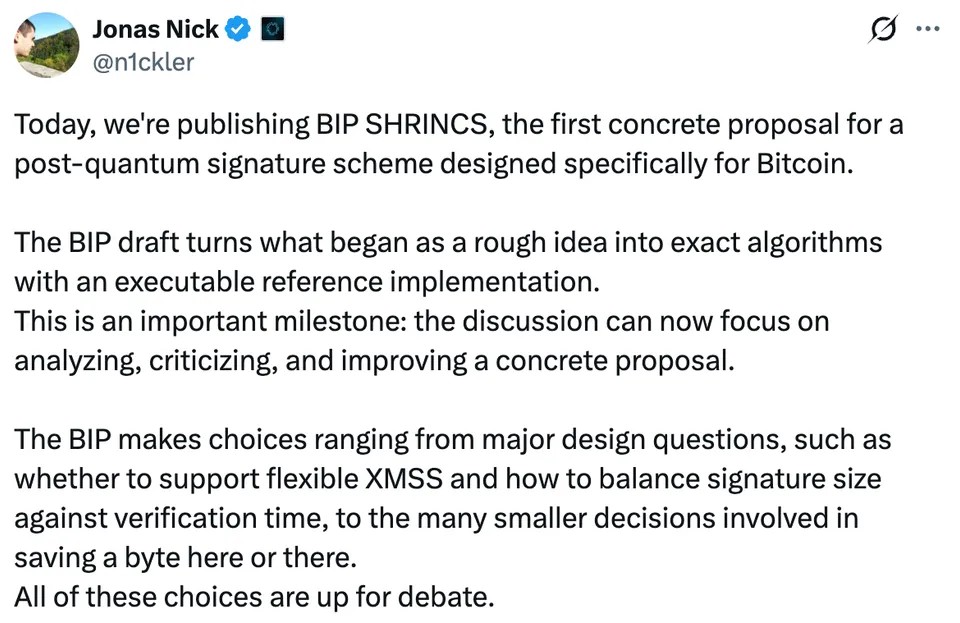
Jonas Nick presenting the BIP SHRINCS proposal on August 26. Source: Jonas Nick

That same month, banks and regulators across Europe, the Middle East, and Asia joined a pilot project testing post-quantum wallets and on-chain transfers using ML-DSA-65—one of the same cryptographic standards included in QuFi's platform. Meanwhile, the Ethereum Foundation removed the Poseidon hash function from its planned post-quantum architecture in favor of proven alternatives like SHA or BLAKE.

Bitcoin developers are also exploring protocol-level defenses. In August, Blockstream researchers published a Bitcoin Improvement Proposal for SHRINCS—an experimental post-quantum signature scheme designed to reduce the size and computational costs associated with quantum-resistant signatures.

This approach has trade-offs. SHRINCS uses stateful signatures to reduce their size, requiring wallets to track previously used signing keys. The scheme remains early-stage, lacking a complete security proof, and its design increases system complexity and creates additional potential user error scenarios.

Magazine: Bitcoin's New Quantum Defense, 18.9M SOL Destroyed: Hodler's Digest

end-content

Domande pertinenti

QWhat is the core function of the verification platform launched by QuFi Network?

AIts core function is to separate verification from settlement, using a decentralized network of nodes to verify transactions with post-quantum cryptography before they are executed on existing blockchain networks.

QWhat is uBTC and what network does it currently operate on?

AuBTC is a proof-of-concept from QuFi that applies its verification system to Bitcoin. It currently operates on the Bitcoin Testnet4 network.

QWhich three post-quantum cryptographic standards does the QuFi platform utilize?

AThe QuFi platform utilizes the ML-DSA-65, SLH-DSA, and ML-KEM-1024 standards for digital signatures and secure key exchange.

QWhat is one main advantage claimed by QuFi for its external verification layer?

AIt aims to avoid the increased data storage, bandwidth, and computational resource requirements that could arise from directly implementing larger post-quantum signatures into individual blockchains.

QAccording to the article, what are some potential drawbacks or trade-offs of the SHRINCS post-quantum signature scheme being researched for Bitcoin?

ASHRINCS uses stateful signatures, requiring wallets to track previously used signing keys. It is still at an early stage without a completed security proof, and its design adds system complexity and creates additional potential for user error scenarios.

Letture associate

The Life and Death of an Ordinary Meme Coin

The Life and Death of a Meme Coin Despite their association with retail speculation, meme coins effectively attract attention and liquidity to new ecosystems. However, their viral nature and low creation barriers mean they typically have extremely short lifecycles. An analysis of 150 meme coins using survival analysis techniques reveals a harsh reality. The median meme coin reaches its all-time high (ATH) just 17.2 days after its first trade, with a quarter peaking within 1.6 days. The journey from ATH to a 95% crash takes a median of 370 days. Price performance is overwhelmingly negative: over half of the coins trade more than 95% below their ATH. Only 5 out of 151 sampled coins (3.3%) have ever reclaimed their ATH after a 90% drop. By 300 days post-launch, most coins retain only 10% of their initial value. The analysis of local peaks versus the ultimate ATH shows that two-thirds of Solana-era meme coins experienced only one significant price surge, peaking within days and never recovering. Chain activity, measured by addresses with a balance over $1, mirrors this pattern, with current activity for major meme coins below 7% of its peak. While the data paints a bleak picture for long-term holding, meme coin speculation is deeply embedded in market culture and continues to migrate to new platforms. The pursuit of asymmetric returns persists, driven by gambling dynamics rather than rational investment, suggesting this trend will continue evolving alongside on-chain financialization.

marsbit27 min fa

The Life and Death of an Ordinary Meme Coin

marsbit27 min fa

The Nightmare of Timers: Missing the Best 15 Days of Performance Over the Past 3 Years, Bitcoin Returns Would Underperform Cash

**Title: The Market Timer's Nightmare: Missing Bitcoin's Top 15 Days Leads to Underperformance vs. Cash** A Grayscale report highlights a critical risk for Bitcoin investors: the immense opportunity cost of being absent from the market during its brief, explosive rallies. Over the past three years, Bitcoin delivered a cumulative return of approximately 225%. However, its gains are hyper-concentrated. If an investor missed just the 5 best trading days, the return collapses to 95%. Missing the top 10 days slashes it to 27%. If the top 15 days (less than 1.4% of the period) are missed, the return turns negative at -11%, underperforming cash. In stark contrast, the Nasdaq 100 would still retain a 21% gain after removing its own best 15 days. These crucial surge days typically occur under conditions of peak pessimism—following panic sell-offs, regulatory clarity, or short squeezes—when holding cash feels safest. The repricing is also extremely rapid, often happening within hours before a clear "right-side" trend is apparent. Therefore, the greatest investment risk for assets like Bitcoin is not volatility or drawdowns, but the high probability of missing the few days that generate virtually all excess returns. The report concludes that time in the market is superior to timing the market, emphasizing strategies like dollar-cost averaging to ensure participation during these decisive moments.

marsbit30 min fa

The Nightmare of Timers: Missing the Best 15 Days of Performance Over the Past 3 Years, Bitcoin Returns Would Underperform Cash

marsbit30 min fa

Trading

Spot
活动图片