Ledger implant tests Bitcoin ETFs as safer custodial solutions than hardware wallets

cointelegraphPublished on 2026-10-12Last updated on 2026-10-12

Abstract

A newly discovered hardware implant exploit affecting Ledger wallets has sparked debate about the safety of self-custody via hardware wallets compared to holding Bitcoin through ETFs. Analyst PlanB stated he had "zero regrets" about moving his BTC to ETFs in 2025, citing recent exploits as validation. Industry figures note a long-standing trend of large holders shifting to ETFs for "enhanced security," a phenomenon now entering public discourse following the Ledger incident, which may have caused over $86 million in losses. While experts like Blockstream's Adam Back assert hardware wallets can remain secure with improved threat modeling, others highlight the risks of user error. 21Shares co-founder Ophelia Snyder argued that without proper technical setup, self-custody is less secure than relying on specialized custodial firms. Bitcoin researcher Jameson Lopp cautioned against a panicked mass migration to ETFs, warning it could create new central points of failure. The discussion underscores a tension between the ideals of self-custody and the practical security offered by institutional solutions like Bitcoin ETFs.

The newly discovered Ledger exploit has stirred broad industry debate over the safety of hardware wallets compared to effectively custodying Bitcoin holdings through exchange-traded funds (ETFs).

Bitcoin analyst Plan B said his then-controversial decision to move his Bitcoin (BTC) holdings to ETFs in 2025 was the right call in light of the recent Coldcard and Ledger exploits. “Zero regrets” about my ETF decision, wrote the analyst in a Monday X post.

Large holders have been converting self-custodied assets to ETFs for “enhanced security” for years, which is one of the main “selling points” for ETFs, 21Shares co-founder Ophelia Snyder told Cointelegraph in an email on Monday, adding that the recent exploits made this phenomenon part of the “public discourse.”

The remarks follow the discovery of a compromised Ledger wallet that contained an unauthorized hardware implant. Some blockchain investigators estimated that losses from these implants could top $86 million, raising questions about the security of self-custodial cold wallets.

Related: Standard Chartered plans institutional crypto custody in Singapore

Hardware wallets are still safe, but providers need better threat modelling: Adam Back

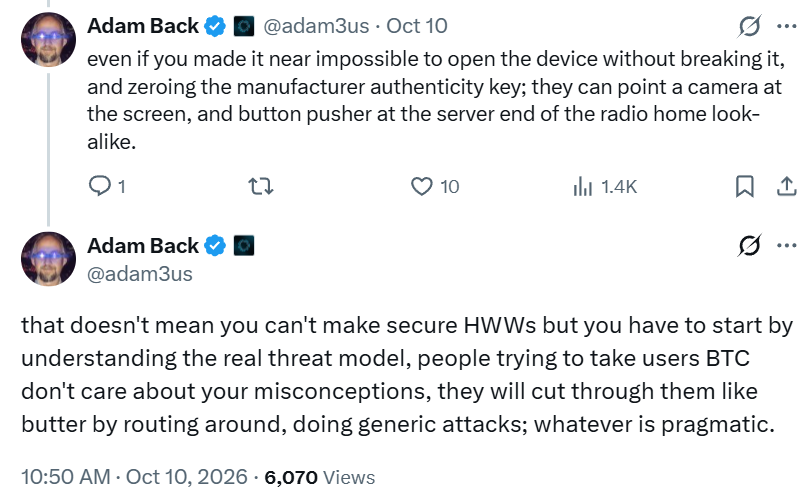
To be sure, hardware wallets can still be secure custodial options, but providers need a better understanding of the emerging threat landscape, according to Blockstream CEO and Hashcash inventor Adam Back.

“Surprisingly few manufacturers understood the generic attacks, or so it seemed from their marketing and design choices, for the last decade. Time to catch up with threat-modelling,” wrote Back in a Saturday X post.
Source: Adam Back

However, Snyder said the main issue with self-custodial wallets is that their security depends on investors’ technical expertise and individual setup. She said:

“Without taking the time and rigor to set up properly, self-custody will always be less secure than handing over the assets to a specialist firm whose job it is to manage those protocols for you.”

Bitcoin security researcher and cypherpunk Jameson Lopp also said that self-custodial wallets can be a robust option, but urged investors to avoid mass migration to create new central points of failure during rushed transactions.

Magazine: Bitcoiners turn to dice throws as self-custody setups are re-evaluated

Related Questions

QAccording to the article, why did analyst Plan B say he had 'zero regrets' about his decision to move Bitcoin to ETFs in 2025?

AAnalyst Plan B said he had 'zero regrets' because he believed his decision was the right call in light of the recent Coldcard and Ledger hardware wallet exploits, implying ETFs offered a safer custodial solution compared to those compromised self-custody options.

QWhat is one of the main selling points for Bitcoin ETFs mentioned by 21Shares co-founder Ophelia Snyder?

AOphelia Snyder stated that one of the main selling points for Bitcoin ETFs is 'enhanced security,' as large holders have been converting self-custodied assets to ETFs for this reason for years.

QWhat recent security incident raised questions about the safety of self-custodial cold wallets?

AThe discovery of a compromised Ledger wallet containing an unauthorized hardware implant raised these questions. Some investigators estimated losses from such implants could exceed $86 million.

QAccording to Blockstream CEO Adam Back, what do hardware wallet providers need to improve regarding security?

AAdam Back stated that hardware wallet providers need a better understanding of the emerging threat landscape and need to 'catch up with threat-modelling,' as surprisingly few manufacturers seemed to understand generic attacks based on their marketing and design choices in the past decade.

QWhat key vulnerability of self-custodial wallets does Ophelia Snyder highlight?

AOphelia Snyder highlights that the security of self-custodial wallets depends heavily on the investor's technical expertise and individual setup. Without proper time and rigor in setup, self-custody can be less secure than using a specialist firm.

Related Reads

Mercado Bitcoin begins post-hack reopening without a timeline for withdrawals

Mercado Bitcoin, one of Brazil's largest crypto exchanges, began restoring read-only access to customer accounts in phases on Monday, a week after attackers drained an estimated $49 million from the platform. Access started at 19:00 UTC, with all accounts expected to be viewable by 21:00 UTC, showing holdings as they stood on Nov. 2, the day of the hack. The exchange has yet to say when customers will be able to withdraw funds. Fabricio Tota, vice president of new business, said the exchange hoped read-only access would reassure customers that their assets were still recorded on the platform. He explained that the company opted for "a more conservative approach" to reactivating accounts "to ensure our return happens with the utmost security." The caution follows concerns from blockchain security analysts that attackers were able to access addresses, draining funds through standard transfers rather than a smart contract exploit. Blockchain analysts traced some of the stolen funds to customer deposit addresses, but Mercado Bitcoin says customers won't bear the losses. Tota said the vast majority of assets were never even touched by anyone and were not involved in the incident. On Nov. 4, Mercado Bitcoin pledged to cover all losses with company funds, bolstered by a $20 million investment from stablecoin issuer Tether in July. Tota highlighted that a portion of the stolen funds were also frozen in the hours after the company announced the attack. The next phase of recovery will require users to confirm their registration details before they can move funds. The exchange plans to restore withdrawals via Pix, Brazil's instant payment system, initially allowing customers to withdraw only to accounts in their own name. Tota gave no date for either step. Mercado Bitcoin has yet to explain how the attackers gained access to its wallets. Blockchain data company Bitquery found that as of Nov. 4, wallets linked to the attacker held most of the stolen funds that had escaped freezes, including 106.07 BTC.

cointelegraph2h ago

Mercado Bitcoin begins post-hack reopening without a timeline for withdrawals

cointelegraph2h ago

Avalanche’s AVAX leads crypto gains following NYSE tokenization deal

Avalanche's AVAX token rose as much as 10% on Monday, becoming the top gainer among the 100 largest cryptocurrencies, after the New York Stock Exchange announced plans to use Avalanche's blockchain to settle trades on a new platform for trading tokenized stocks around the clock. AVAX later eased to $8.86, still up over 8% on the day, with a market cap of around $3.95 billion and $439.7 million traded in the past 24 hours. Avalanche's total value locked stands at $633 million, up 4% over the past day. NYSE's head of digital issuance, Dennis Lee, said the exchange is examining how blockchain technology can expand its equities offerings and is picking the right technology for each job. The deal underscores Wall Street's growing effort to use blockchain to make stock trading faster and enable trading outside regular market hours; traditional US markets are open 9:30 am to 4:00 pm EST on weekdays, with trades often taking at least one business day to settle. The NYSE first announced plans for the platform in January, and Ava Labs revealed in September that the exchange had spent about a year testing Avalanche, though the final selection was not confirmed until Monday. Avalanche will record stock trades and help complete transactions on the platform, which will let investors buy and sell digital versions of stocks across different blockchains. Lee said the settlement ledger needs to be fast, reliable, permissioned, cost-predictable, and backed by a large developer community—all of which Avalanche meets. The platform could launch before the end of 2026 pending regulatory approval. Ava Labs chief business officer John Nahas said first conversations with the NYSE began nearly a year ago and called it an important step toward blockchain becoming foundational financial infrastructure. The news comes as other major firms invest in blockchain for faster, round-the-clock trading: Nasdaq plans to invest $100 million in Kraken's parent Payward to launch tokenized stocks by Q2 2027, and the DTCC launched a service in October allowing firms to turn traditional securities into digital tokens. The NYSE deal follows other efforts to bring traditional assets onto Avalanche, including Progmat moving over 452 billion yen in digital securities onto a dedicated Avalanche blockchain in July and Aave Labs' plans for a lending service using tokenized assets as collateral.

cointelegraph3h ago

Avalanche’s AVAX leads crypto gains following NYSE tokenization deal

cointelegraph3h ago

Trading

Spot
活动图片