Latest Research Report from the Publisher of "AI Doomsday Report": Agents and RWA Reshape the Crypto Industry

marsbitPublished on 2026-10-11Last updated on 2026-10-11

Abstract

The report "AI & Asset Tokenization" by Citrini Research argues that the rise of AI Agents and the tokenization of real-world assets (RWA) are converging to provide a crucial use case for blockchain technology. It posits that traditional financial systems, designed for human interaction, are ill-suited for a future where AI Agents will autonomously manage finances, seek optimal yields, and execute transactions 24/7. Blockchains, with their programmable, always-on infrastructure, are presented as the natural solution. The report highlights that while crypto initially lacked mainstream assets, this is changing rapidly with the tokenization of stocks, Treasuries, and other RWAs onto blockchains. Key recent developments include the off-platform circulation of stock tokens (e.g., via Robinhood), surging on-chain DEX activity, and evolving U.S. regulatory stances that are bringing these assets into regulated markets. The core thesis is that AI Agents need programmable finance, and tokenization brings desired assets on-chain, finally giving blockchain a clear utility. The focus for investors should shift from questioning tokenization's viability to identifying which platforms and applications will capture the revenue and profits from this growing fusion of traditional finance and crypto.

Author: Citrini Research

Compiled by: Jiahuan, ChainCatcher

AI and Asset Tokenization

Imagine your personal AI having access to all your financial information. It could easily put idle funds to work, make investment decisions for you, and secure the most favorable mortgage terms on your behalf.

"Claude, help me find the lowest-cost $500,000 loan to refinance my current one."

Pushing this scenario further, the outlook starts to become unsettling. What happens when millions of AI Agents—autonomous AI programs that can execute tasks—continuously shift deposits to institutions offering the highest interest rates? Could banks lose the low-cost funding they rely on? Could an AI Agent-induced bank run be on the horizon?

As consumer-facing Agents become more widespread, a scenario that sounded like a Hollywood sci-fi premise just a few years ago is no longer so distant.

The existing financial system wasn't designed for such a future. It's slow, operates in silos, and access to financial services is restricted by intermediaries, regulatory requirements, and customer identity verification. This system was built by and for humans.

These limitations were originally intended to protect the financial system from risks posed by human behavior, but they also objectively block Agent intervention. As we noted in *Agentic Reality*, in some respects, consumer-facing software is easier for Agents to disrupt first. Agents can already operate websites and apps; with authorization, they can operate our phones and other devices. Software that previously required humans to search, compare, click, and trade can now be entrusted to Agents.

The old financial world is different, and understandably so. But we are already beginning to see cracks in the wall.

We are rapidly moving towards a world where information and resources are increasingly machine-readable, programmatically controlled, and transferable across systems. This trend isn't limited to consumer data; it applies to funds, bandwidth, computing power, and will ultimately extend to financial assets themselves.

It follows logically that money and financial assets will ultimately gain the same capability to operate programmatically across applications 24/7, just as AI Agents can.

Broadly speaking, there are only two paths to achieving this. Either existing consumer-facing financial institutions rebuild themselves according to more open, programmable standards, or they are ultimately replaced by a new system that adopts these standards.

This brings us back to an industry that, for most of the past decade, seemed to have developed the technology first and then looked for problems to solve: the crypto industry.

The blockchain industry spent fifteen years building something unexpectedly practical for the Agent era: a 24/7, programmable financial infrastructure capable of holding assets, recording ownership, and settling transactions within the same system.

Until recently, this technology had limited utility. There were no Agents back then; humans had to struggle with seed phrases, wallet permissions, cross-chain bridges, and gas fees, all for the opportunity to buy the latest Shiba Inu-themed meme coin. Meanwhile, stocks, treasury bonds, credit, commodities, and other financial assets people actually wanted to hold remained within the traditional financial system.

Now, both things are changing.

Financial assets are entering blockchains in tokenized form, merging traditional finance with the crypto world. At the same time, Agents have become a new user class that doesn't care about the poor user experience of blockchain explorers.

Blockchain has finally found its purpose.

At the risk of sounding cliché, I must say: we've seen this story before. Do you know what HTTPS, TCP, and IP are? Maybe. How do they work? Probably not. Unless you're a tech enthusiast, you shouldn't need to know. The internet reached billions not because people learned network protocols, but because browsers ultimately hid the underlying technology in the background, so people no longer had to think about it.

Isn't it ironic that an industry that has burned vast amounts of capital and is considered by most mainstream investors as having no prospects ultimately gave birth to a truly important technology? And as these assets collectively emerge from the cyclical trough, does this also signal an attractive entry point for investors?

This led me to think: if our judgment is correct, the question investors truly need to ask isn't just whether more assets will be tokenized, but rather, who will ultimately capture the revenues and profits generated by related businesses.

Instead of guessing, we decided to investigate firsthand. Whenever a major investment theme emerges, thematic investors can't help but want to explore. So, I downloaded Coinbase Wallet, deposited $1,000, and entered a place few investors have managed to leave profitably: the live battlefield of on-chain trading.

I was prepared for scams, but the reality surprised me.

I discovered that while most investors, including us at Citrini Research, were still busy debating GPU and memory bottlenecks, an ecosystem of financial applications had quietly taken shape, resembling the existing traditional finance in many ways.

It's far more than the usual "get rich quick" schemes: from tokenized treasury bonds, stocks, and options, to debt products governed by smart contracts, lending, payments, yield-generating DeFi protocols, and various financial applications that didn't exist just a few years ago.

This experience changed our perspective on the crypto industry and led us to reconsider the investment opportunities within it.

The Long-Awaited Moment for the Crypto Industry

Over the past decade, it hasn't been difficult to view crypto as a technology that consistently failed to deliver on its promises. To be more direct, you could even cite failures like FTX as evidence that it has caused many losses.

The problem has always been that DeFi and Wall Street existed in separate worlds, each with its own assets, basic financial modules, and infrastructure. DeFi technology was interesting, but what was the point if it could only be used to bet on meme coins and transfer dollars?
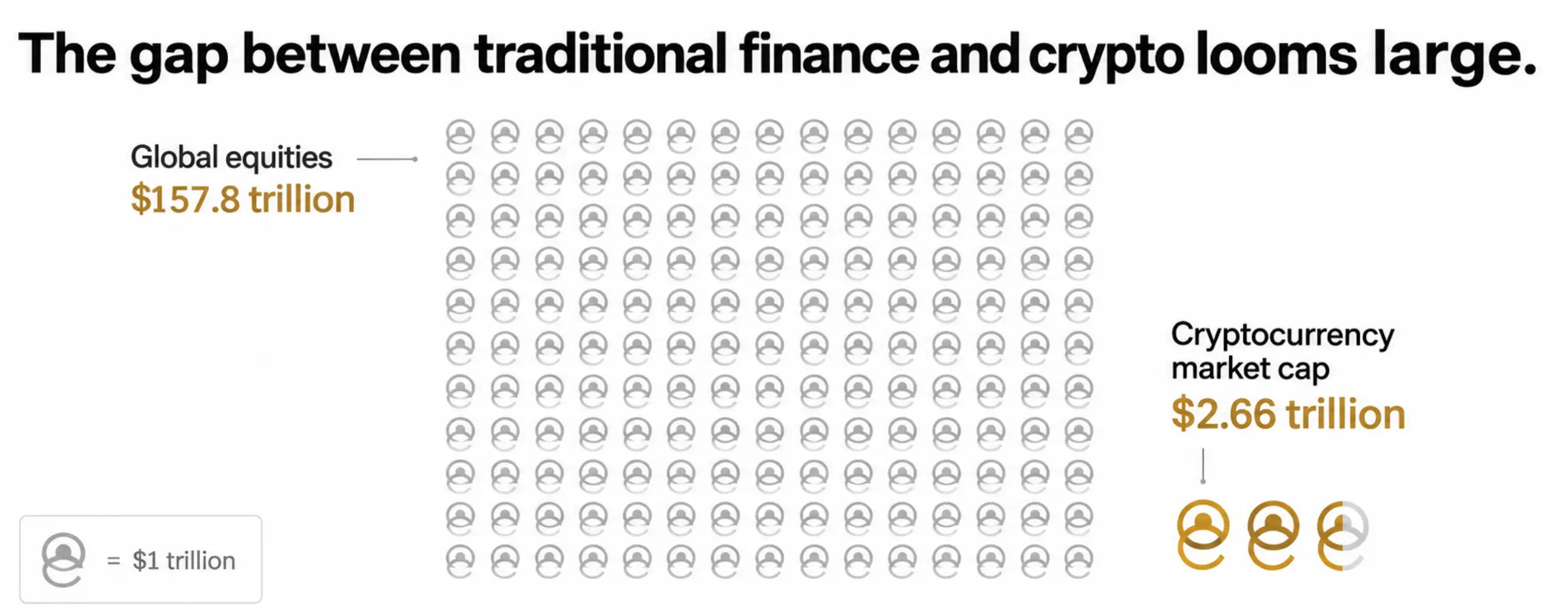
Real-World Asset (RWA) tokenization involves issuing on-chain tokens representing assets like gold, NVIDIA stock, U.S. Treasury bonds, or debt. The envisioned future is that any asset can be tokenized, circulating globally 24/7, with price discovery occurring outside the traditional financial system.

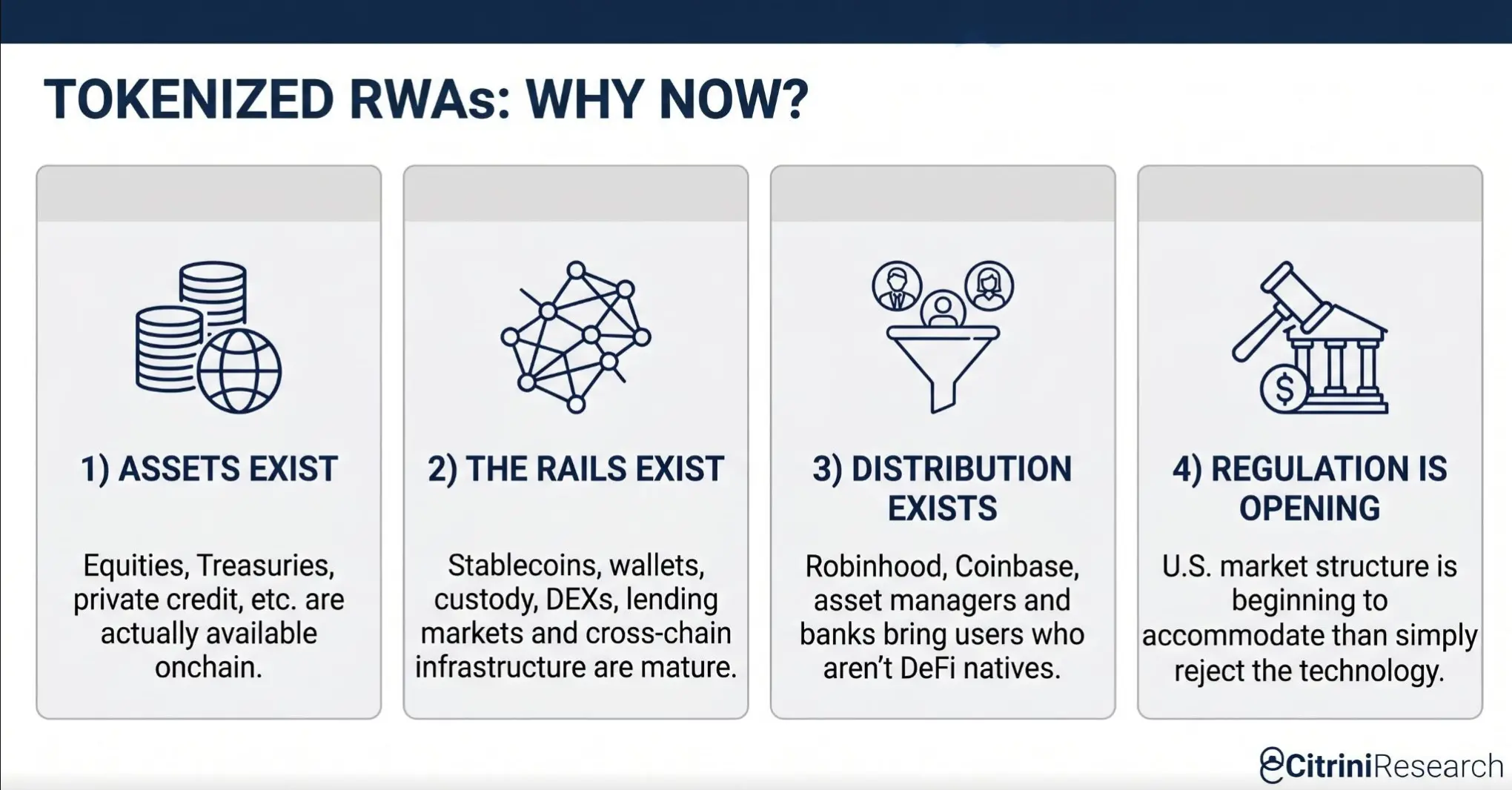
This may not have made headlines, but for years, technological progress has been gradually accumulating, and regulatory attitudes have quietly shifted towards acceptance.

However, what first made many truly realize the utility of on-chain markets was a weekend in March. As tensions with Iran escalated, Hyperliquid became one of the few markets with sufficient liquidity for traders to price crude oil.

Since then, RWA adoption has clearly accelerated. Over the past month, we've seen a series of major developments across the crypto industry, seemingly reaching an inflection point.

So, what exactly happened?
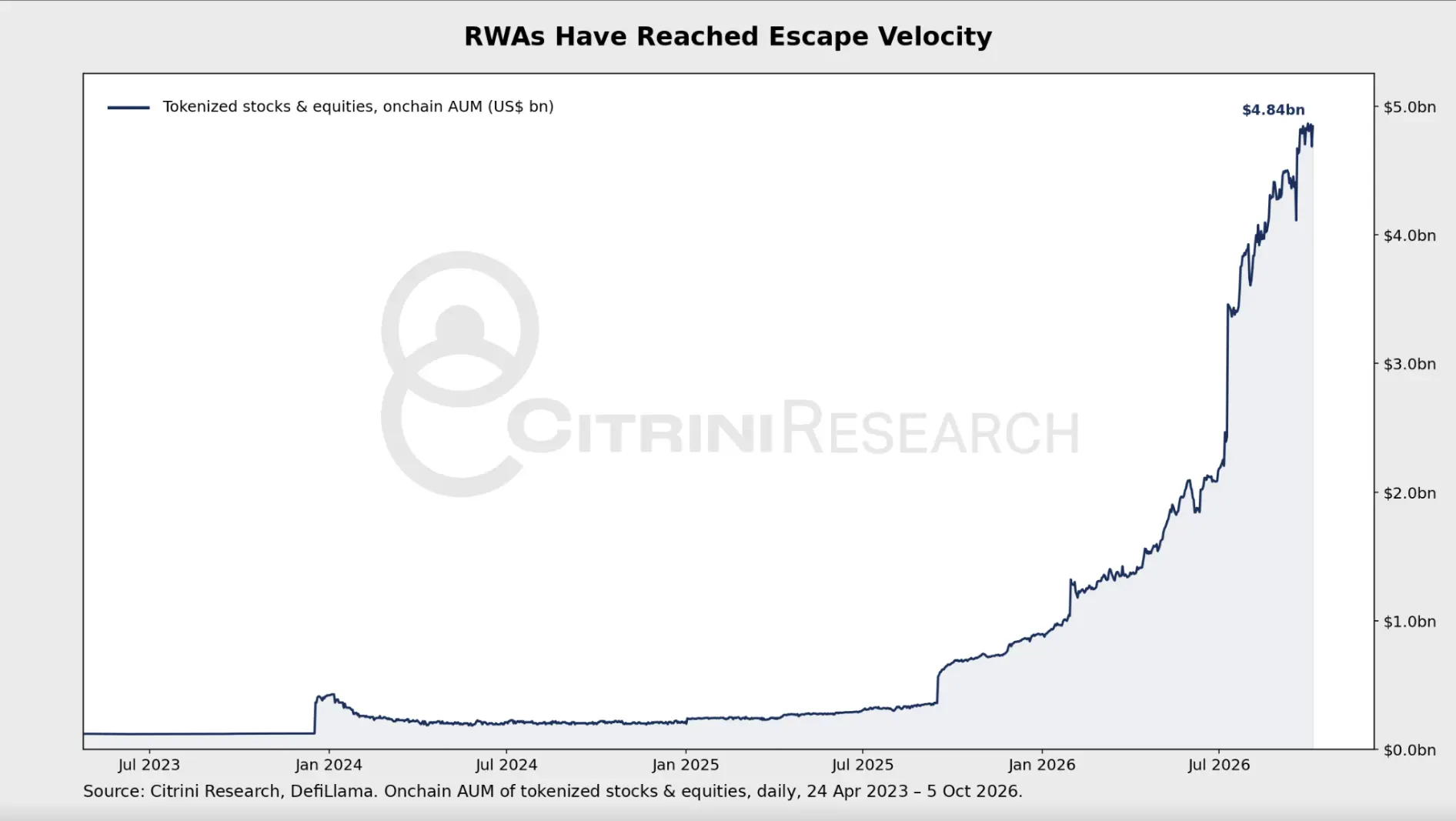
First, stock tokens can now circulate beyond their issuer's platform and be used by other on-chain applications. This means that, unlike the situation on Hyperliquid, these assets can be transferred across different applications and financial infrastructures that previously could only handle stablecoins and native crypto assets. Robinhood Chain (HOOD US) led the way with "stock tokens." Since then, this trend has snowballed onto more blockchains, driving significant growth in on-chain activity.
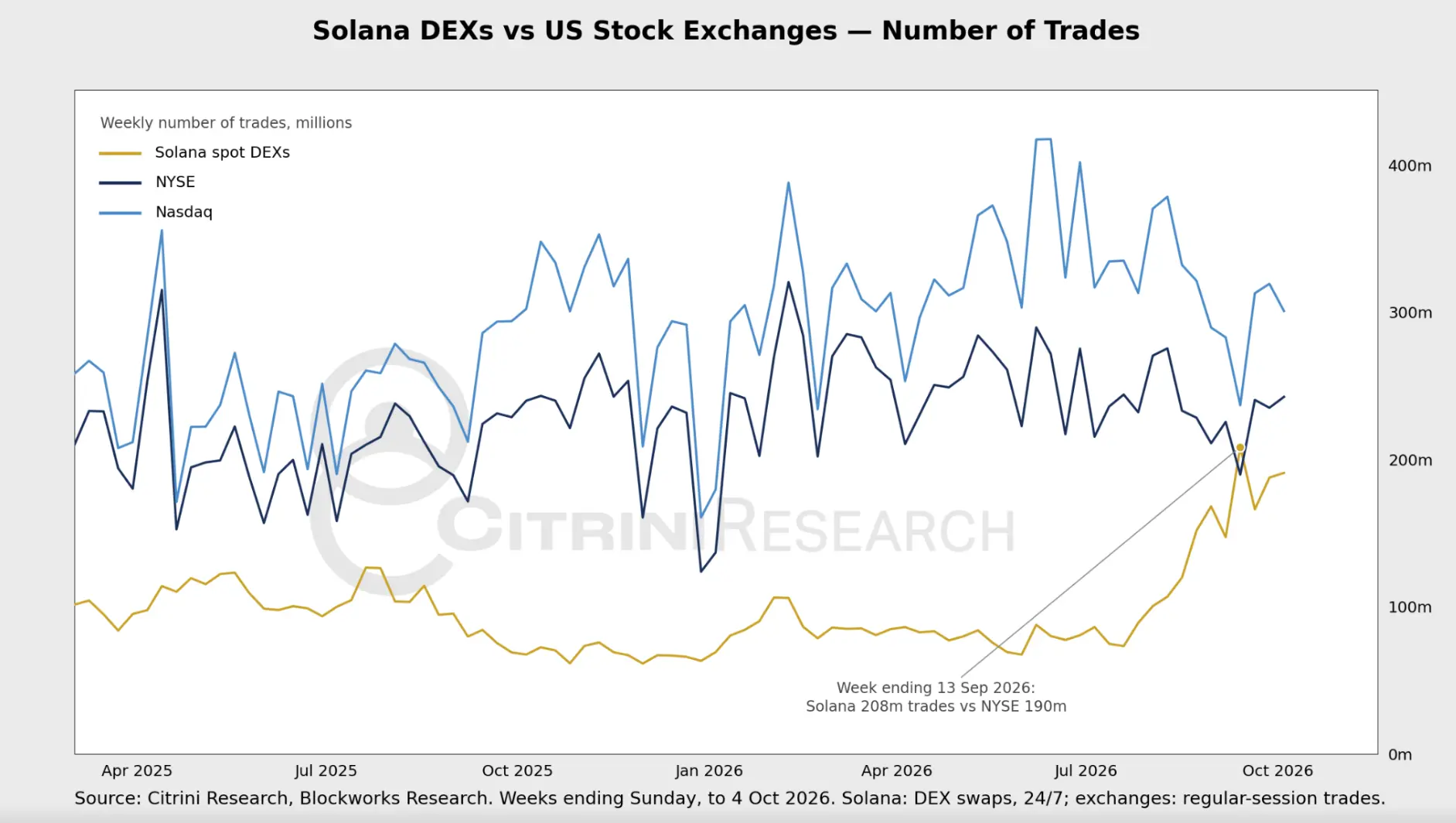
Some data highlights the scale: in September, the number of trades on Solana's spot decentralized exchanges (DEXs) briefly surpassed those on the New York Stock Exchange. While undoubtedly a large portion of this activity came from bots, meme coin pairs, and other less meaningful trades, it still demonstrates that on-chain trading is becoming more active.
Second, regulators are pushing tokenized assets from offshore experimentation into U.S.-regulated financial markets. Two days after the CLARITY Act failed in the Senate, the U.S. Securities and Exchange Commission (SEC) introduced an innovation exemption for trading tokenized stocks, providing regulatory relief under specific conditions.

Simultaneously, the next direction is U.S. equity perpetual contracts—contracts that track the price of U.S. stocks without a fixed expiry. Coinbase's proposed related product is now listed as "pending approval" by the U.S. Commodity Futures Trading Commission (CFTC).

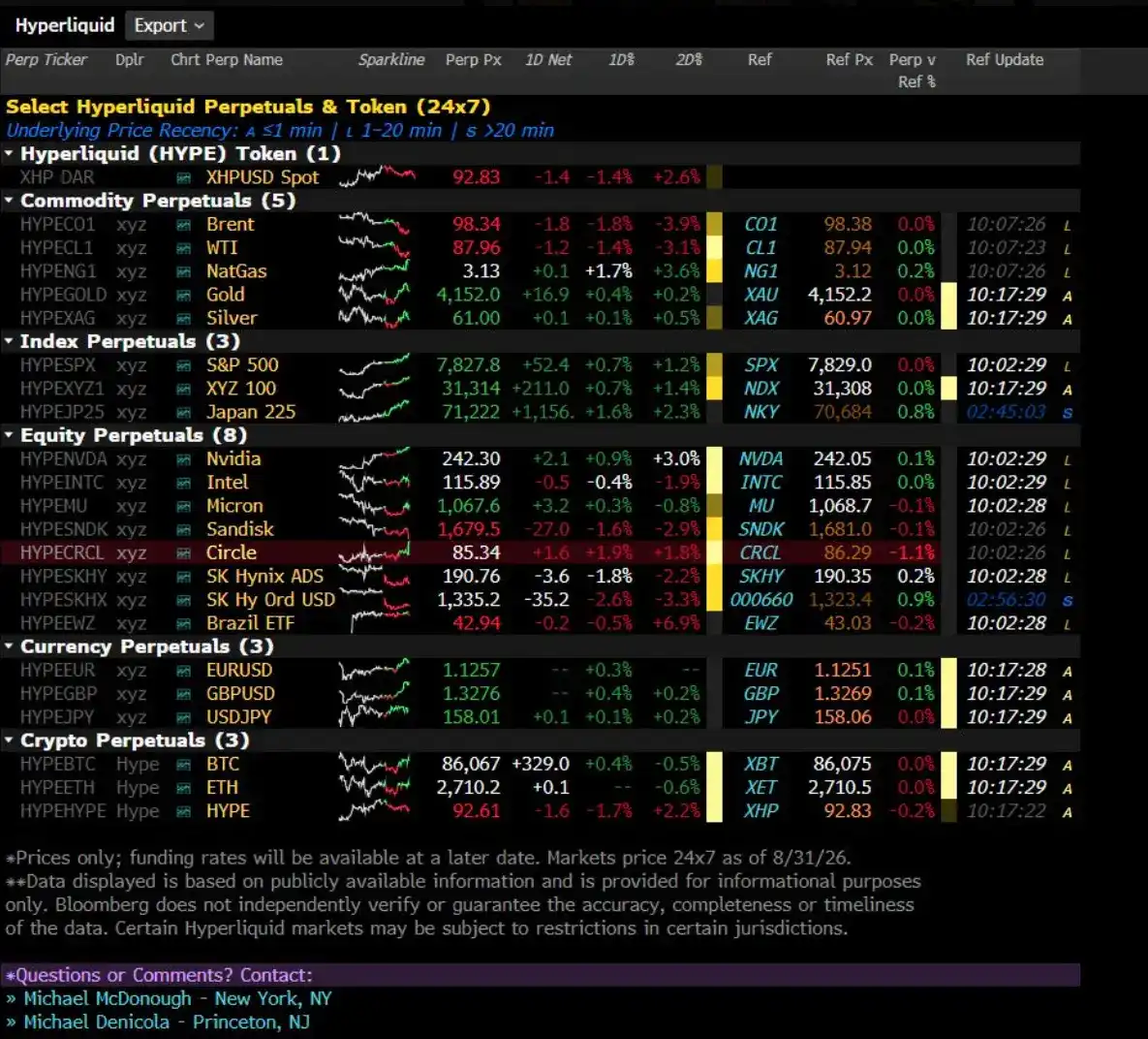
Even Bloomberg Terminal, a bastion of traditional finance, has started displaying Hyperliquid's perpetual contracts and token data. The direction is clear.
For the first time, we see institutions and individuals both able and willing to participate in a diverse range of RWA markets.

In our view, regardless of whether a comprehensive bill passes, the relevant regulatory framework is being established piece by piece. The question for investors should shift from "Will tokenization be legally recognized?" to "Once these products finally enter the U.S. market, who will capture the revenues and profits?"

AI Agents need a financial system that can operate 24/7 and be programmatically directed; asset tokenization brings assets people actually want to hold—like stocks and bonds—on-chain. These two waves of change are converging, making blockchain's utility clearer.

The wall between traditional finance and the crypto world is loosening. For investors, what deserves attention next is which platforms and financial applications can meet this demand, and whether they can convert the growing on-chain activity into sustainable revenue.

Related Questions

QAccording to the article, how is the convergence of AI Agents and Real World Asset (RWA) tokenization changing the perceived role of the crypto industry?

AThe article argues that the convergence is fundamentally reshaping crypto's role. It states that for years, blockchain technology seemed like a solution looking for a problem, often used mainly for trading meme coins. However, AI Agents require a financial system that is always-on and programmable, while RWA tokenization brings traditional assets (like stocks and bonds) on-chain. These two trends are meeting on blockchain infrastructure, which was built over fifteen years to be exactly that: a programmable, 24/7 financial system for asset custody, ownership, and settlement. Therefore, blockchain is finally finding its purpose as the essential backbone for an AI-driven, automated financial future.

QWhat specific events or developments from the past month does the author cite as indicators of a potential "inflection point" for crypto and RWA adoption?

AThe author highlights several key developments: 1) The ability for stock tokens to circulate freely off their issuer's platform and be utilized by other on-chain applications, starting with Robinhood Chain and expanding to more blockchains, leading to a surge in activity. 2) Regulatory shifts, including the SEC's introduction of an innovation exemption for tokenized stock trading shortly after the CLARITY Act failed in the Senate. 3) The CFTC listing Coinbase's proposed U.S. stock perpetual contracts as "pending approval." 4) The integration of data from crypto platforms like Hyperliquid into traditional financial bastions like Bloomberg Terminal.

QWhat potential systemic risk related to AI Agents does the author describe at the beginning of the article?

AThe author describes the risk of an AI Agent-induced bank run. They envision a future where millions of AI Agents, acting autonomously to maximize returns for users, could continuously move deposits to institutions offering the highest interest rates. This behavior could deprive traditional banks of their low-cost deposit funding base, potentially triggering a rapid, automated withdrawal of funds that the current financial system is not designed to handle.

QWhat is the author's key investment recommendation as the focus shifts from whether tokenization will be legal to how it will be implemented?

AThe author suggests that investors should shift their focus. The critical question is no longer *if* more assets will be tokenized and gain legal acceptance, but *who* will capture the resulting revenue and profits. The investment opportunity lies in identifying which platforms, applications, and financial infrastructure will successfully onboard this new wave of activity and, crucially, be able to translate the growing on-chain activity into sustainable revenue streams.

QWhat analogy does the author draw between the evolution of the internet and the current state of blockchain/crypto technology?

AThe author draws an analogy to internet protocols like HTTPS, TCP, and IP. Most people use the internet without understanding these underlying protocols because browsers abstracted away the complexity. Similarly, blockchain technology has so far required users to deal with complexities like private keys, wallet permissions, and gas fees. The author implies that for mass adoption, the underlying blockchain technology needs to be hidden in the background, just as internet protocols were, with user-friendly interfaces (potentially powered by AI Agents) handling the complexity.

Related Reads

GPT-6.1 Sol Participates in Live Brain Surgery! Three Rounds of Localization, Each More Accurate Than the Last

Exin Therapeutics CEO Gabriel Ocana-Santero reported an experiment in which GPT-6.1 Sol participated in three rounds of real mouse brain surgery positioning. The task involved locating Bregma and Lambda, two key skull landmarks used to calibrate stereotaxic coordinates for accurate targeting of brain regions. After each round, a professional surgeon corrected the model's positioning results, and the model retained its images, measurements, and expert corrections for reference in subsequent rounds. By the third round, GPT-6.1 Sol reduced landmark search time from 169 to 86 seconds, required corrections from four to two, and cut positioning error from 0.6 mm to 0.3 mm. Ocana-Santero described this as in-context learning from real-world experience. The team did not disclose how the experience records are integrated into the model or whether underlying weights are updated, so it cannot be described as autonomous training or parameter-level self-evolution. The sample is only three operations, far from proving stable surgical capability, but it demonstrates AI accumulating experience from real observations and expert feedback. This follows earlier Exin work in which AI selected gene therapy vectors, chose injection targets and coordinates, and controlled a stereotaxic device in a mouse experiment, with a licensed veterinarian supervising and safety limits in place. In a further experiment, Claude Sonnet 5, GPT-6.1 Sol, and Grok 4.7 chose different brain regions and treatment strategies for the same scientific goal, suggesting models may reason toward different experimental paths.

marsbit2h ago

GPT-6.1 Sol Participates in Live Brain Surgery! Three Rounds of Localization, Each More Accurate Than the Last

marsbit2h ago

From Drones to Nuclear Reactors: What Has Paradigm Invested in Since Leaving the Crypto World?

Paradigm, a venture capital firm known for crypto investments like Coinbase and Uniswap, is rapidly expanding into hard tech. In November, it co-led a $1.5 billion funding round for Zipline, a US drone delivery company now valued at $21.5 billion—nearly triple its valuation from January. Zipline, founded in 2014, began delivering medical supplies in Rwanda and now operates a large-scale automated logistics network, having completed 150 million miles of commercial autonomous flights. Walmart plans to add 300 new delivery sites, and Uber aims to scale their partnership to one million daily orders by 2029. Paradigm's broader portfolio now spans AI, robotics, manufacturing, semiconductors, space defense, and nuclear energy. Investments include open-source AI lab Nous Research, math-reasoning AI firm Harmonic, AI data company Idler, and GPU platform Andromeda. It also backs SendCutSend (metal parts manufacturing), Fab2 (compact semiconductor factories), True Anomaly (space defense), and Antares (micro nuclear reactors). In July, Paradigm launched a $12 billion new fund for frontier tech. This shift reflects a broader VC trend toward AI and physical technology, as crypto's path to sustained commercial revenue remains uncertain. Paradigm's bets focus on companies solving concrete industrial problems with existing markets, aiming to build a hard-tech network that transcends crypto cycles.

marsbit2h ago

From Drones to Nuclear Reactors: What Has Paradigm Invested in Since Leaving the Crypto World?

marsbit2h ago

Nomura: "Blue Wave" Hits US Data Centers, China's AI Benefits Instead

Nomura argues that the Democratic "blue wave" in the US midterms could paradoxically benefit China's AI economy. Democratic victories in key data-center states will likely tighten regulation, shift grid upgrade costs onto developers, and lengthen approval timelines, slowing US data-center expansion. Market reaction was sharp: the Nasdaq fell 5.5% in a single day, the SOX dropped nearly 15% over two days, Nvidia fell about 12%, and Micron about 24%. Because US cloud giants had been hoarding global GPU, HBM, and advanced logic chip capacity—driving black-market premiums of 200–300% at Asian logistics hubs—a US capex slowdown could collapse those speculative premiums, letting Chinese AI firms, cloud providers, and research institutions obtain GPUs, HBM modules, and advanced packaging materials more cheaply through intermediary trade hubs. China is also building a state-led national AI data-center network, with roughly RMB 2 trillion planned under the 15th Five-Year Plan to integrate regional computing by 2028, supported by low-cost renewable power in western hubs under the "East Data, West Computing" program. Morgan Stanley, meanwhile, does not see the blue wave as a real easing of US-China tensions; it expects strategic competition to persist but sees greater policy predictability. It prefers China's "self-sufficiency" AI trade—supported by both supply and demand under national policy priorities—over export chains tied to global AI capex. It also notes more balanced opportunities in Chinese equities, with valuations near historic lows.

marsbit2h ago

Nomura: "Blue Wave" Hits US Data Centers, China's AI Benefits Instead

marsbit2h ago

After GPT-6, Embodied Large Models Are Trapped in Their Own Territory! Next Year's Self-Research Budget Is Probably Up in the Air

The article discusses how the release of GPT-6 Astra (and the imminent GPT-6.2 Astra) has disrupted the embodied AI/robotics industry. General-purpose large models are now encroaching on capabilities that embodied AI companies previously developed in-house—such as in-context learning, out-of-distribution generalization, error correction, and open-vocabulary manipulation—often without task-specific post-training. On benchmarks like RoboDojo, teams combining general models with robot-use-agent techniques saw scores jump from 20–30 to 50–60, prompting many to question whether self-developing embodied foundation models still makes sense. Some companies have begun cutting algorithm roles. However, the article notes GPT-6 Astra still struggles with complex physical contact, force control, object deformation, and high-precision manipulation, and its cloud API inference latency is high (though this is not seen as a fundamental barrier). Experts argue that general models' current weaknesses shouldn't be treated as durable moats for embodied companies, since OpenAI is already hiring robotics talent and future models may absorb more robot operation data. The core argument is economic: embodied companies' opportunity lies not in building smarter models but in delivering better economic value. Stable, standardized industrial tasks may be better served by lightweight, specialized models or rule-based strategies, while open-ended tasks (e.g., home service robots) may benefit from general models. Ultimately, companies need to re-prioritize their R&D directions—leveraging general models for language understanding and task planning while focusing in-house efforts on physical interaction, embodiment-specific control, real-world adaptation, and deployment efficiency. The article concludes that the industry is moving past the demo-and-burn-investment stage, and the elimination round among the "hundred robot wars" has begun.

marsbit2h ago

After GPT-6, Embodied Large Models Are Trapped in Their Own Territory! Next Year's Self-Research Budget Is Probably Up in the Air

marsbit2h ago

Trading

Spot
活动图片