Just Now, GPT-6 Astra Collaborates with Non-Professional Mathematicians to Prove 57-Year-Old "Circle Packing" Problem

marsbitPublished on 2026-10-12Last updated on 2026-10-12

Abstract

AI has made another breakthrough in mathematical proofs, with a mathematical enthusiast using GPT-6 Astra to significantly advance a 57-year-old geometry problem. The problem is known as "circle packing in a circle": given N unit circles, what is the smallest radius R of a larger containing circle that can hold them all without overlap? While optimal arrangements for small N have been known since 1969, providing rigorous mathematical proof of their optimality has remained a major challenge. Before this work, only cases up to N=14 and N=19 had been definitively proven. The enthusiast, known as nor, employed GPT-6 Astra to rigorously prove optimality for the remaining cases of N=15, 16, 17, 18, and 20. According to nor, the model's core strategy shifted from direct optimization to a constraint-based approach: first, establishing that outer disks can be moved to the boundary; then, using angular relations to eliminate vast numbers of potential arrangements; finally, employing computational enumeration and geometric rigidity arguments to prove that no arrangement can fit into a smaller containing circle than the known classic pattern. The proof process was iterative and complex, with nor contributing key guidance, verification, and refinement alongside the AI. The results, shared online, sparked interest from others exploring similar AI-assisted mathematical research, highlighting a growing community leveraging new tools for problem-solving. This work demonstrates the expandi...

AI is really entering a math proof sweep mode now.

Just now, a math enthusiast used GPT-6 Astra to take a major step forward on a 57-year-old math problem.

The problem sounds not very complicated:

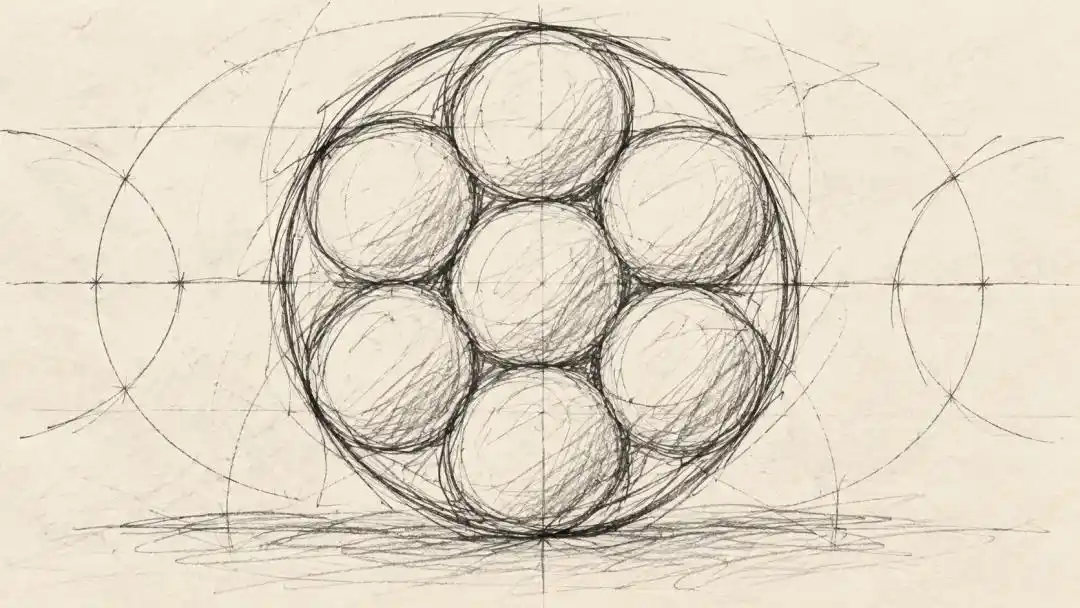
Given N disks of radius 1, how do you pack them into a large circle so that the radius of the large circle is as small as possible?
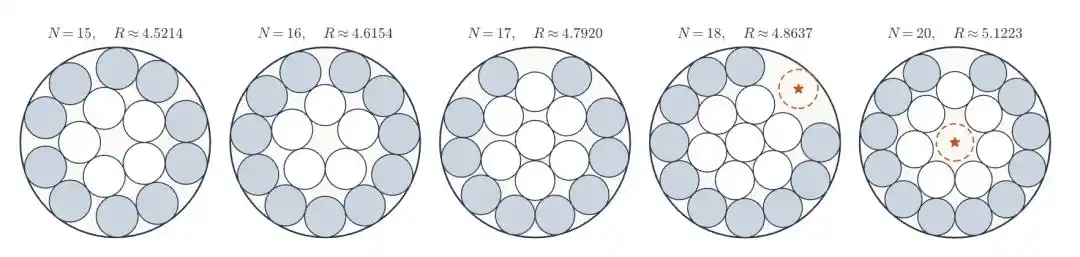
In fact, mathematicians did come up with beautiful packing arrangements back in 1969, but...... for 57 years, no one has been able to rigorously prove that they are the optimal solutions.

So this time, math enthusiast "nor" pulled out GPT-6 Astra...... and in one go, provided rigorous proofs for the 5 remaining cases for N≤20: namely N=15, 16, 17, 18, and 20......

Previously, only cases for N≤14 and N=19 had been verified.

Oh, and reaching N=20 is not the AI's limit; it's just that nor didn't intend to prove further cases......

A Proof Stalled for Half a Century

Let's first formalize this problem in a more mathematical way.

Assume there are N disks, each of radius 1, and a large circle of radius R.

Requirements:

All small disks must lie entirely inside the large circle; they can be tangent to the large circle's boundary but cannot extend beyond it.

Any two small disks cannot overlap internally, but they are allowed to be tangent to each other.

The small disks can be moved and arranged arbitrarily within the large circle, with no restrictions on the arrangement.

The question is: For a given positive integer N, what is the smallest possible radius R for the large circle?

It looks like a simple olympiad-style problem, but in reality, finding the optimal arrangement is just the first layer. The true difficulty lies in rigorously proving mathematically that the arrangement has reached its limit and that no better packing exists.

In 1968, American mathematician Ronald Graham proved the cases for N≤7.

In 1969, researcher Udo Pirl pushed the proven range to 10 disks and further studied packing schemes for 11-19 disks.

But it wasn't until around 2003 that cases for N≤14 and N=19 were rigorously proven.
nor is a technical writer who has long been involved in research on mathematics, machine learning, and optimization algorithms, and has frequently participated publicly in AI-assisted mathematics research.

He personally started following this problem over a decade ago, and indeed, there hasn't been much progress on it in the past ten-plus years......

So what else is there to say? Might as well toss it to GPT-6 Astra (bushi).

nor took a step-by-step approach: first had GPT-6 Astra handle the N=15 case; after the model solved it, he had it extend the same method to 16, 17, as well as 18 and 20...... GPT-6 Astra successfully provided proof results for all of them.

It's just that......

The proof process is, as always, obscure and difficult to understand.

Simply put, the core idea of GPT-6 Astra is:

Instead of directly searching for the optimal solution, it uses geometric constraints to reduce the infinite number of possible arrangements to a finite set of cases, then uses a computer to eliminate them one by one, ultimately rigorously proving that the classic arrangement is optimal.

The proof process consists of 5 steps:

Push outer disks towards the boundary. Proves that under specific conditions, disks near the outer circle can be pushed outward without causing overlap. This divides the disks into a group on the boundary and a group in the interior.

Use angular relations to eliminate many arrangements. Since disks cannot overlap, they must maintain a certain angular separation. If a certain arrangement requires a total angular sum exceeding 360°, it can be directly eliminated.

Let the computer enumerate remaining possibilities. Instead of searching for the specific coordinates of each disk, it checks the distance intervals of the disks from the center and their cyclic order.

Use geometric rigidity to prove precise optimality. The previous search can only prove that all feasible arrangements are very close to the known classic arrangement. Next, using contact constraints between disks, it proves that these arrangements cannot undergo permissible tiny deformations, thus elevating "very close" to "strictly identical". The case for 15 disks uses another odd-cycle argument.

Restore the original arrangement. Finally, it proves that in the original arrangement, at least one disk must be in contact with the outer circle's boundary. This means it's impossible to pack all disks into an outer circle with a smaller radius, thus completing the optimality proof.

It's worth emphasizing that it's not like nor gave a single prompt and Astra immediately proved everything in one go.

In his blog post, nor writes that his contributions as a human in this work included:

Determining problem feasibility, guiding the model, battling the buggy web user interface, enduring poor copywriting, fixing subtle issues, repeatedly refining explanations, manually verifying validity, and re-checking everything using Astra and Opus 5.5.

One More Thing

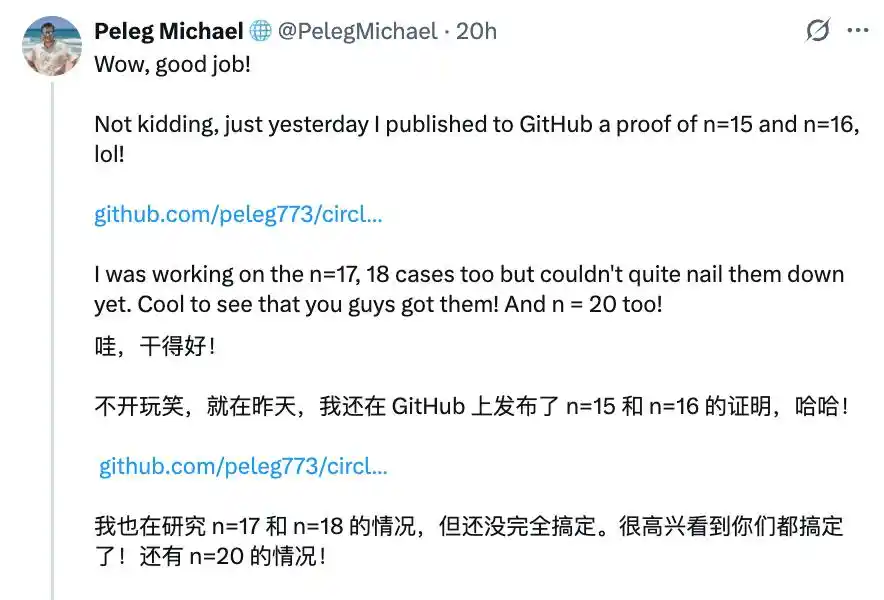
A rather interesting thing is that once nor posted the results, he found quite a few fellow travelers using AI to research the same problem.

Some netizens also commented that AI's breakthroughs are making mathematics easier to understand, "I had no idea the math community could have such a strong exploratory atmosphere."
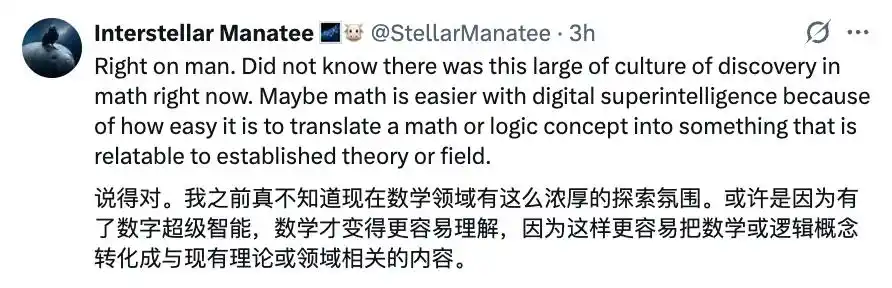
From the perspective of math enthusiasts, it's also a new phenomenon in the era of Mathematics 2.0.

Original links:

[1]https://nor-blog.pages.dev/posts/2026-10-11-circle-in-circle-packing-15-20/

[2]https://x.com/norxornor/status/2109078411251454017

This article is from the WeChat public account "QbitAI", author: Focus on Frontier Technology

Related Questions

QWhat is the main achievement described in the article regarding the use of GPT-6 Astra?

AThe article describes that a math enthusiast, using GPT-6 Astra, has successfully provided rigorous mathematical proofs for the optimal packing of N unit circles into a larger circle for the previously unproven cases of N = 15, 16, 17, 18, and 20, thereby advancing a 57-year-old mathematical problem.

QWhat is the 'circle packing' problem mentioned in the article?

AThe problem involves packing N unit circles (radius 1) into a larger circle of radius R. The goal is to find the smallest possible R such that all small circles lie completely inside the large circle without overlapping each other, though they can be tangent. The challenge is not only to find good arrangements but to mathematically prove they are optimal.

QWhat was the state of the problem before this AI-assisted proof?

ABefore this work, rigorous proofs existed only for N ≤ 14 and N = 19. The optimal arrangements for N = 15, 16, 17, 18, and 20, though conjectured, had not been formally proven to be the best possible for over five decades.

QWhat core strategy did GPT-6 Astra employ in its proof, according to the article?

AThe core strategy was to avoid a direct search for the optimal solution. Instead, GPT-6 Astra used geometric constraints to reduce the infinite set of possible arrangements to a finite number of cases. These remaining cases were then systematically eliminated using computer enumeration and geometric rigidity arguments to show the known classic arrangement must be optimal.

QWhat role did the human researcher 'nor' play in this project, as stated in the article?

AAccording to the article, 'nor' contributed by assessing the problem's feasibility, guiding the AI model, battling a buggy web interface, fixing subtle issues, repeatedly refining explanations, manually verifying the AI's output, and using both Astra and Opus 5.5 to double-check all the results.

Related Reads

Changing Gas Metering Could Break Smart Contracts? Ethereum Urgently Halts Hoodi Fork to Investigate Eight Major Security Risks

Ethereum core developers have paused the Hoodi testnet upgrade after security auditors found that two upcoming Gas improvement proposals could invalidate long-standing assumptions underpinning many deployed smart contracts. The proposals, EIP-8037 and EIP-8038, part of the Glamsterdam upgrade, aim to reprice state storage by decoupling state creation from state access and setting dynamic weights for certain opcodes, in order to curb unchecked growth of Ethereum's state data. However, this overhaul disrupts static Gas constants that developers have relied on as fixed system parameters. ChainSecurity identified eight invariant risks. Many contracts and off-chain infrastructure depend on hardcoded Gas limits, for example to prevent reentrancy or bound execution scope; higher costs could cause cross-contract calls to run out of Gas and revert. Other risks lie in error-handling logic that relies on precise prediction of inner execution costs, and in proxy contracts that forward Gas based on fixed ratios, potentially distorting execution paths or locking funds in incomplete state-machine branches. To avoid systemic compatibility failures and cascading disruptions across multisig wallets, bridges, and lending protocols, developers agreed at an ACD meeting not to hard-fork Hoodi until the affected contracts are fully mapped and compatibility guidance is issued. Because much logic lives off-chain in proprietary routing, settlement scripts, and liquidation bots, the Ethereum Foundation acknowledged it cannot audit the entire ecosystem alone. It has published a public repository detailing the eight affected invariants, sample problem code, and prompt templates for audit and scanning tools, so teams can check their own logic. Findings will be reviewed at next week's ACD meeting, when Hoodi activation conditions will be reassessed.

marsbit2h ago

Changing Gas Metering Could Break Smart Contracts? Ethereum Urgently Halts Hoodi Fork to Investigate Eight Major Security Risks

marsbit2h ago

What Exactly Drives the Value of Layer 1?

This analysis by Marc Arjoon, CFA, examines what actually drives Layer 1 valuation through time-series regression on major L1 assets. Short-term, all L1 price movements remain dominated by Bitcoin beta. Over longer horizons, Ethereum's market cap has fully decoupled from its own protocol revenue—a deliberate policy outcome of Dencun and higher gas limits rather than a demand collapse—with its 2025 rally driven instead by spot ETF and corporate treasury demand. Solana, by contrast, shows revenue and market cap moving in tandem, both rising ~15x since January 2023 and peaking the same week. Active addresses and DEX volumes show weak weekly correlations and large divergences despite long-cycle drift. Testing Metcalfe's Law, the fitted elasticity of market cap to active addresses is only 0.56 for Ethereum and 0.62 for Solana and BNB—closer to the square root of addresses than the square. None of six valuation multiples reliably mean-reverts; Mcap/REV is the only one that predicts positive 13-week returns from low valuation quantiles on Ethereum and TRON. No L1 has Bitcoin's deep holder base: only 4% of Solana and 10% of Ethereum supply has been dormant over three years versus 42% for Bitcoin. Ethereum's pricing anchors to peer capital share—59% of L1 market cap, 70% of DeFi TVL, 75% of tokenized RWA—rather than on-chain activity, where it holds just 5% of active addresses. Across chains, market cap rank correlates strongly with TVL (Spearman 0.87) and stablecoin supply (0.63) but weakly with transactions (0.17). The core conclusion: L1s are valued less as fee-generating businesses and more as monetary assets competing for capital settlement and liquidity share.

marsbit2h ago

What Exactly Drives the Value of Layer 1?

marsbit2h ago

Trading

Spot
活动图片