Jensen Huang Bets $3 Billion on Murati, Valuation Soars to $40 Billion, Money Circles Back to Buy Nvidia Cards

marsbitPubblicato 2026-09-07Pubblicato ultima volta 2026-09-07

Introduzione

Nvidia Makes Two Major Strategic Moves in AI Infrastructure: A $30 Billion Bet on Mira Murati's Thinking Machines Lab and the Acquisition of Hugging Face. In a significant week for AI, Nvidia has made two major strategic investments. First, it is in talks to lead a massive funding round for Thinking Machines Lab, the AI startup founded by former OpenAI CTO Mira Murati. Nvidia is expected to contribute roughly half of a $5-6 billion round, which would value the company at around $40 billion pre-money. This marks a dramatic increase from its $12 billion valuation just 14 months prior. The funding is intended to support a previously announced 1 GW-scale deployment of Nvidia's Vera Rubin systems, creating a closed loop where Nvidia's investment likely flows back as orders for its own hardware. Second, Nvidia has officially announced the $12.93 billion acquisition of Hugging Face, the leading open-source AI model platform. Analysed together, these moves position Nvidia powerfully across the open-weights AI ecosystem: Hugging Face controls the model distribution hub and developer community, while Thinking Machines offers cutting-edge models (like its 975B-parameter "Inkling"), a fine-tuning platform ("Tinker"), and a top research team. Thinking Machines' strategy diverges from building the single best model; instead, it focuses on providing infrastructure for enterprises to customize and own their AI, directly aligning with Nvidia's vision of an AI-powered "token economy" driving...

This time, Jensen Huang has extended the reach of AI infrastructure into the model layer.

In the past week, Nvidia unleashed two blockbuster deals.

First, it signed an acquisition agreement with Hugging Face, the world's largest hub for open-source models. Then, news broke that it was preparing to write a massive check of nearly $3 billion to Mira Murati, the former OpenAI CTO and one of Silicon Valley's most-watched figures.

Huang is betting on Murati's startup, Thinking Machines Lab.

The pre-money valuation has skyrocketed to at least $40 billion, with plans to raise $5 to $6 billion. Nvidia alone could cover about half of that.
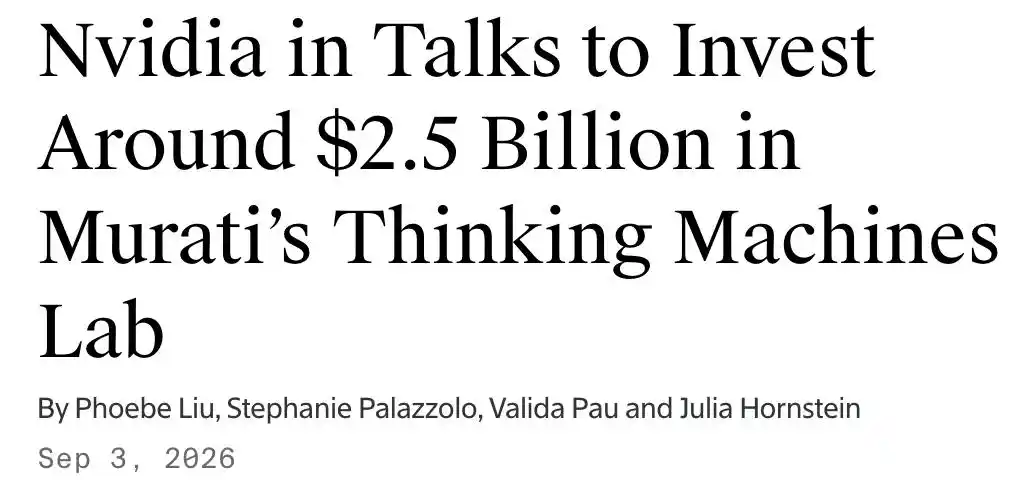
This is not Nvidia's first investment but a continued doubling down.

Looking back at Thinking Machines Lab's growth speed, it's almost like it's been on steroids.

In the previous round in July 2025, it secured one of the largest seed rounds in history:

A $2 billion seed round, with a post-money valuation of $12 billion.

Just 14 months later, its pre-money valuation has surged to $40 billion, more than tripling.

If this $5 to $6 billion round is fully subscribed, the post-money valuation will approach $45 to $46 billion.

The crazier part is yet to come.

Against such a staggering valuation, the company's annualized revenue has just crossed $100 million.

A $40 billion valuation corresponds to a revenue multiple of roughly 400x.

Why would Nvidia willingly fork over another $2.5 to $3 billion for a company only 19 months old, from which several co-founders have already departed?

Two Years After Leaving OpenAI, Snagging a $40 Billion Valuation

It took Murati just 14 months to go from $12 billion to $40 billion.

In September 2024, Murati announced her departure from OpenAI. At the time, she was CTO and served as interim CEO during the days when Sam Altman was ousted by the board.

About five months later, Thinking Machines Lab burst onto the scene.

The founding roster read almost like an OpenAI alumni directory: co-founders included big names like Lilian Weng, John Schulman, Barret Zoph, and Luke Metz.

In July 2025, the $2 billion seed round landed.

a16z led the round, with Accel, Nvidia, AMD, and Jane Street participating. At the time, Murati didn't even have a substantial product to show; investors were betting on her personally.

Soon, the product delivered.

In October 2025, the first product, Tinker, launched, and opened to the public in December.

It's not a model; it's a fine-tuning platform: developers throw in their data, tune open-weight models into their own, and pay based on compute usage.

Then came an even bigger move.

On March 10, 2026, Thinking Machines and Nvidia officially announced a multi-year strategic partnership: deploying at least 1GW of Vera Rubin systems, with Nvidia also making a significant, undisclosed investment.

Jensen Huang (left) and Mira Murati (right). On March 10, 2026, the two sides announced a 1GW-scale Vera Rubin partnership, with Nvidia simultaneously completing an undisclosed investment.

Four months later, on July 15, 2026, they unveiled their first in-house flagship model, Inkling:

975 billion total parameters, 41 billion activated, up to 1 million token context, capable of processing text, images, and audio, with full open weights.

Then came the discussions for this $5 to $6 billion funding round.

The reason for needing so much money is that 1GW partnership mentioned above.

1GW is compute power at the level of frontier labs. Chips, networking, power, data centers – everything is configured at the gigawatt scale, each item costing a fortune.

The funding target has ballooned five or six times, from an initial rumored $1 billion to the current $5 to $6 billion, to sustain this 1GW ambition.

Where is this money coming from?

In the last round, Nvidia was just one of several participants, with a16z leading.

This round, Accel is the lead investor, and Nvidia may take about half, moving from a participant to the largest contributor.

Thus, the familiar picture emerges again: Nvidia is both the biggest investor in this round and the supplier of that 1GW system.

Money flows into Thinking Machines' account, and a large portion of it likely circles back to become Nvidia purchase orders.

Investment, procurement, and revenue form a closed loop within the same company.

The direction is clear enough.

Nvidia is no longer content with just supplying chips to established labs like OpenAI and Anthropic. It's starting to use equity to lock in the next generation of frontier players early.

There's another easily overlooked sentence in that March announcement: the two sides will jointly design training and inference systems optimized for Nvidia's architecture.

This means Thinking Machines' future models will be built from the ground up for Vera Rubin.

Murati's Strategy: Not Competing to be the #1 Model

Looking at Murati's moves over these 19 months, you'll see she has consistently avoided head-on competition with OpenAI and Anthropic over who has the strongest model.

She even frankly admitted in Inkling's launch blog:

Inkling is not the current strongest model, open or closed.

Thinking Machines' business model was set from the day Tinker launched; it sells the act of "making the model yours."

Companies bring their own data and business to its platform for training, fine-tuning, and inference, and it charges based on compute usage.

In Murati's own words: to create AI that people can shape and truly make their own.

This statement places Thinking Machines and OpenAI/Anthropic on two different paths.

The latter two are racing to build the strongest general-purpose closed models. Thinking Machines positions itself one layer below: not competing to be the #1 model, but building the infrastructure that helps everyone customize models.

Isn't this exactly the AI infrastructure Huang has talked about repeatedly?

For two years, Nvidia has talked about AI factories, AI infrastructure, and the token economy, aiming for precisely this kind of business where each new customer burns more compute.
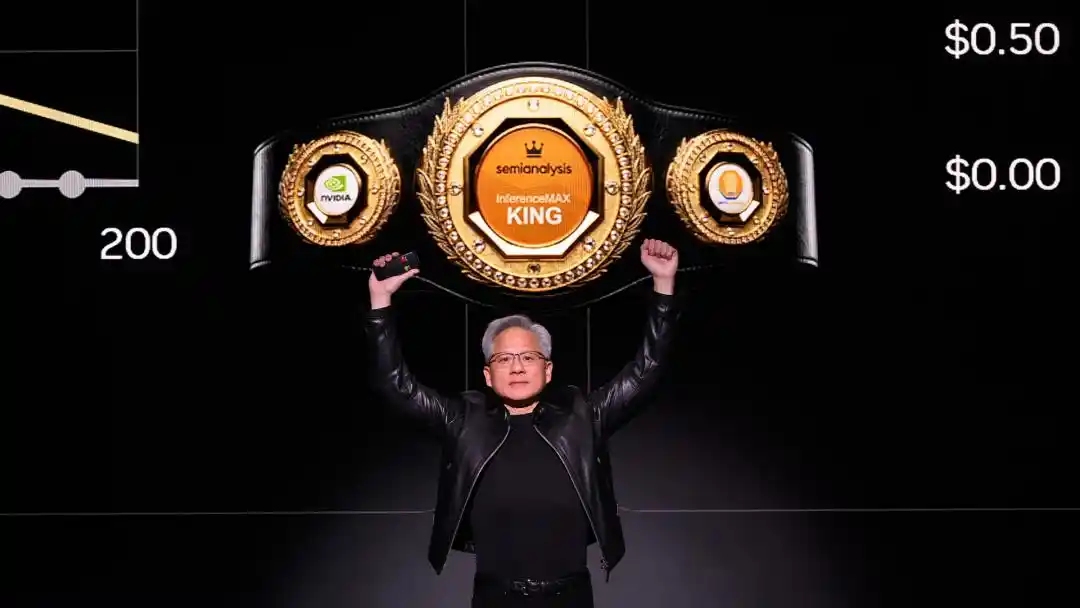
At the GTC 2026 keynote on March 16, Jensen Huang stated compute demand "has grown by a million-fold," with at least $1 trillion in revenue expected from 2025 to 2027.

Understanding this makes Nvidia's willingness to pay clear.

Stacking Hugging Face, Nvidia Holds Two Cards

This isn't Nvidia's only major move this month.

On September 3, Nvidia announced its acquisition of Hugging Face for $12.9303 billion, with the agreement already signed.

Looking at the two deals together:

Hugging Face controls the distribution gateway and developer community for open models; Thinking Machines holds frontier models, a fine-tuning platform, and a research team.

One is the gateway, the other is the models. On the open-weights front, Nvidia has placed bets on both ends.

The two deals total nearly $16 billion, announced just days apart.

Inkling's full weights are hosted on Hugging Face, complete with a dedicated NVFP4 version for Nvidia's Blackwell.

Developers download Inkling from Hugging Face, fine-tune it into their own on Tinker, and then run it on Vera Rubin.

Gateway, model, fine-tuning platform, chips – every step is within one ecosystem.

This is precisely what Nvidia wants: using capital to lock in model companies early also locks in their future compute demand.

References:

https://techcrunch.com/tag/thinking-machines-lab/

https://www.theinformation.com/articles/thinking-machines-lab-talks-raise-billions-roughly-40-billion-valuation

https://thinkingmachines.ai/news/introducing-inkling/

https://blogs.nvidia.com/blog/nvidia-thinking-machines-lab/

This article is from the WeChat public account "Xin Zhi Yuan," author: ASI Revelation; Editor: Yuanyu

Domande pertinenti

QWhat is the main topic of the article regarding NVIDIA and Mira Murati?

AThe article discusses NVIDIA's potential major investment, around $30 billion, into Mira Murati's AI startup, Thinking Machines Lab, which is valued at approximately $40 billion. It highlights NVIDIA's strategic moves to invest in and supply infrastructure for next-generation AI model developers, creating a closed-loop where investment funds are used to purchase NVIDIA's hardware.

QWhat specific strategic move did NVIDIA make in September 2026, according to the article?

AAccording to the article, on September 3, 2026, NVIDIA officially announced its acquisition of Hugging Face for $129.303 billion. This acquisition, combined with the investment in Thinking Machines Lab, positions NVIDIA at both the distribution entry point (via Hugging Face's platform and community) and the model development layer (via Thinking Machines Lab) in the open-weight AI ecosystem.

QWhat is Thinking Machines Lab's business model and primary product?

AThinking Machines Lab's business model is centered around providing AI infrastructure for customization rather than competing for the most powerful base model. Its primary product is a fine-tuning platform (e.g., Tinker), where developers can upload their data to customize open-weight models for their specific needs. The company monetizes based on computing power usage.

QWhat was the valuation growth of Thinking Machines Lab between July 2025 and the reported new funding round?

AThinking Machines Lab's valuation grew dramatically from a post-money valuation of $120 billion in its July 2025 seed round to a pre-money valuation of at least $400 billion in the reported new funding round just 14 months later. This represents a more than threefold increase in valuation.

QHow does the article describe the relationship between NVIDIA's investment in Thinking Machines Lab and its own hardware sales?

AThe article describes a 'closed-loop' or circular financial flow. As the largest investor in Thinking Machines Lab's new funding round, NVIDIA provides capital. A significant portion of that capital is then expected to be used by Thinking Machines Lab to purchase NVIDIA's Vera Rubin systems and other hardware to build its 1GW-scale AI infrastructure. Thus, the investment indirectly fuels NVIDIA's own product revenue.

Letture associate

PhotonPay Obtains UK EMI License, Advancing Global Payment Operating System Layout

PhotonPay has obtained an Electronic Money Institution (EMI) license from the UK Financial Conduct Authority (FCA), marking a significant milestone in its global compliance strategy. With this license, PhotonPay can issue electronic money and provide payment services within the UK regulatory framework, strengthening its local financial capabilities and supporting global businesses with broader fund-flow solutions. The UK is a key financial hub connecting Europe and global markets, and as enterprises expand internationally, their financial needs are shifting from single cross-border transactions to integrated management of accounts, payments, foreign exchange, cards, and treasury. The EMI license reinforces PhotonPay's UK localization, enabling connections with local banks, payment networks, and financial partners. PhotonPay's Global Chief Compliance Officer JP noted that this license is a key step in building a global payment operating system backed by solid local regulatory foundations. PhotonPay is developing a next-generation payment operating system that unifies fragmented financial infrastructure across markets, allowing businesses to manage global accounts, collections, payments, FX, cards, and embedded finance more efficiently. Built on real business fund flows, PhotonPay continues to expand regulatory qualifications, banking partnerships, payment networks, and technology. To date, PhotonPay has secured nearly 30 payment licenses and regulatory qualifications worldwide, covering global accounts, payments, FX, cards, and embedded finance. The UK EMI license further strengthens its global compliance network as it continues building a next-generation global payment operating system.

marsbit22 min fa

PhotonPay Obtains UK EMI License, Advancing Global Payment Operating System Layout

marsbit22 min fa

US Treasury Survey Fails to Signal Debt Issuance Cuts, Treasury Yields Rise, 10-Year Back Above 5.12%

The U.S. Treasury's latest primary dealer survey did not signal an imminent reduction in long-term bond auction sizes, disappointing investors who bet the government would act to push down long-term rates. Treasury yields rose broadly, with the 10-year benchmark yield重回 above 5.12%, up 6.5 basis points intraday, while 20-year and 30-year yields also climbed. The survey was part of preparations for the quarterly refunding announcement on November 4. Markets had hoped for clues that Treasury Secretary Bessent might adjust long-term issuance, particularly the possibility of cutting or halting 20-year bond sales. Instead, Treasury only asked broadly what auction size adjustments should be considered, without clearly hinting at reduced long-term supply. Dealers were also asked about the long-term buyback program, improving buyback efficiency, timing of T-bill and floating-rate note issuance around FOMC meetings, and economic and financing outlooks. Analysts including RBC's Blake Gwinn and TD Securities' Molly Brooks said the questions were too broad and sent no substantive signal, with long-term auction changes unlikely before February 2027. Citi, however, maintained its forecast that Treasury would cut 20-year and 30-year auction sizes by $3 billion each in November. Rising oil prices also added upward pressure on yields. The market reaction was concentrated in long-dated Treasuries, which are especially sensitive to supply expectations. The November 4 refunding announcement is the next key focal point.

marsbit51 min fa

US Treasury Survey Fails to Signal Debt Issuance Cuts, Treasury Yields Rise, 10-Year Back Above 5.12%

marsbit51 min fa

Chainalysis Report: The $3 Trillion North American Crypto Landscape, AI and Stablecoins Reshaping Global Finance

Chainalysis’s 2026 North America report shows the region remains the world’s dominant crypto market, with $3.02 trillion in on-chain economic value over the year ending July 1, 2026. The U.S. accounts for $2.78 trillion, down 2.2% in a cyclical adjustment, while Canada grew 2.3% to over $247.7 billion. Three shifts stand out: AI agent commerce, dollar stablecoin exports, and tokenized real-world assets. The U.S. leads AI agent payments, with Base’s x402 protocol surpassing 138 million transactions and 88.1% of model-inference share. Micro-payments between machines are becoming viable, with most x402 transactions between $0.01 and $0.10. Wallet behavior shows rising stickiness: 89.3% of new wallets received a second funding within 30 days in Q2 2026, and the median time from funding to first payment fell from 73 days to 18 minutes. China-linked wallets dominate security and code analysis at 90%, while the U.S. leads inference and agent frameworks. Capital flows show the U.S. importing bitcoin and exporting digital dollars: large institutional bitcoin inflows totaled 53,200 BTC, while USDC circulation reached $73.3 billion and quarterly on-chain settlement hit $14.8 trillion. Tokenized U.S. Treasuries dominate RWA at $15.42 billion, 42.8% of the total, with overseas retail buyers prominent. Canada emerges as the G7’s top P2P market, driven by immigrants; stablecoin remittances to India, China, and the Philippines reached $2.36 billion, up 141%. Overall, the U.S. builds infrastructure while the world adopts it.

marsbit2 h fa

Chainalysis Report: The $3 Trillion North American Crypto Landscape, AI and Stablecoins Reshaping Global Finance

marsbit2 h fa

Trading

Spot
活动图片