Hunter Biden confirms LAPTOP token ‘not a rug pull,’ just trolling Trumps

cointelegraphPublished on 2026-10-08Last updated on 2026-10-08

Abstract

Hunter Biden, son of President Joe Biden, has released data confirming the LAPTOP memecoin, based on his infamous laptop, was not a "rug pull." Blockchain records show the 300 million tokens allocated to founders have remained locked since the coin's September 9 launch. Biden stated the price chart initially mirrored a typical celebrity rug pull, with two hired market makers profiting significantly—one making $686,000 and the other $2.18 million—by withdrawing liquidity seconds after the price peak. A report by consultancy Groom Lake corroborated the rapid withdrawal of selling liquidity. Biden explained his motivation was to troll "max extraction" projects like former President Donald Trump's TRUMP memecoin by being transparent, locking team tokens, and publishing disclosures. He also aimed to support charities. He added the project continued partly to provoke Trump's sons and critics. The LAPTOP token references the laptop that became a contentious issue in the 2020 election. Biden has criticized the Trump family's crypto ventures as corrupt. Amid this, President Trump plans a dinner for top TRUMP tokenholders on November 22. An advocacy group estimates TRUMP investors have lost $3.2 billion since its 2025 launch.

Hunter Biden, son of former US President Joe Biden, released a full accounting of the memecoin he helped launch last month based on the reports of his infamous laptop.

In a series of X posts on Wednesday, Biden provided blockchain data confirming that 300 million tokens in wallets associated with the founders of the $LAPTOP memecoin “haven’t moved since launch.”

Biden added that charts tracking the price of the memecoin “looked like every celebrity rug ever” shortly after launch on Sept. 9, and the ones to benefit most were unnamed market makers — referred to as “two professional trading firms” hired by the project — that pulled their funds seconds after the peak price of about $317.

According to Biden’s posts, one market maker made $686,000 from liquidity positions on decentralized exchanges, while the other “took in about $2.18 million more than it spent“ through trading.

Similar data was published in a “launch report” prepared by Delaware-based intelligence consultancy Groom Lake and posted on the memecoin’s website.

“The money for sellers was pulled right after the peak,” said the report on $LAPTOP. “Eighty-four seconds after the price topped out, Market Maker 1 withdrew its money. The cash available to people trying to sell near the current price dropped from $16,157 to zero.”

Biden added:

“Here’s why I did this. Trump’s coin was max extraction, and I wanted to troll every grift like it. So we were transparent, committed the team to a lock up and published a MiCA disclosure. And I hoped it could help some charities I care about too.”
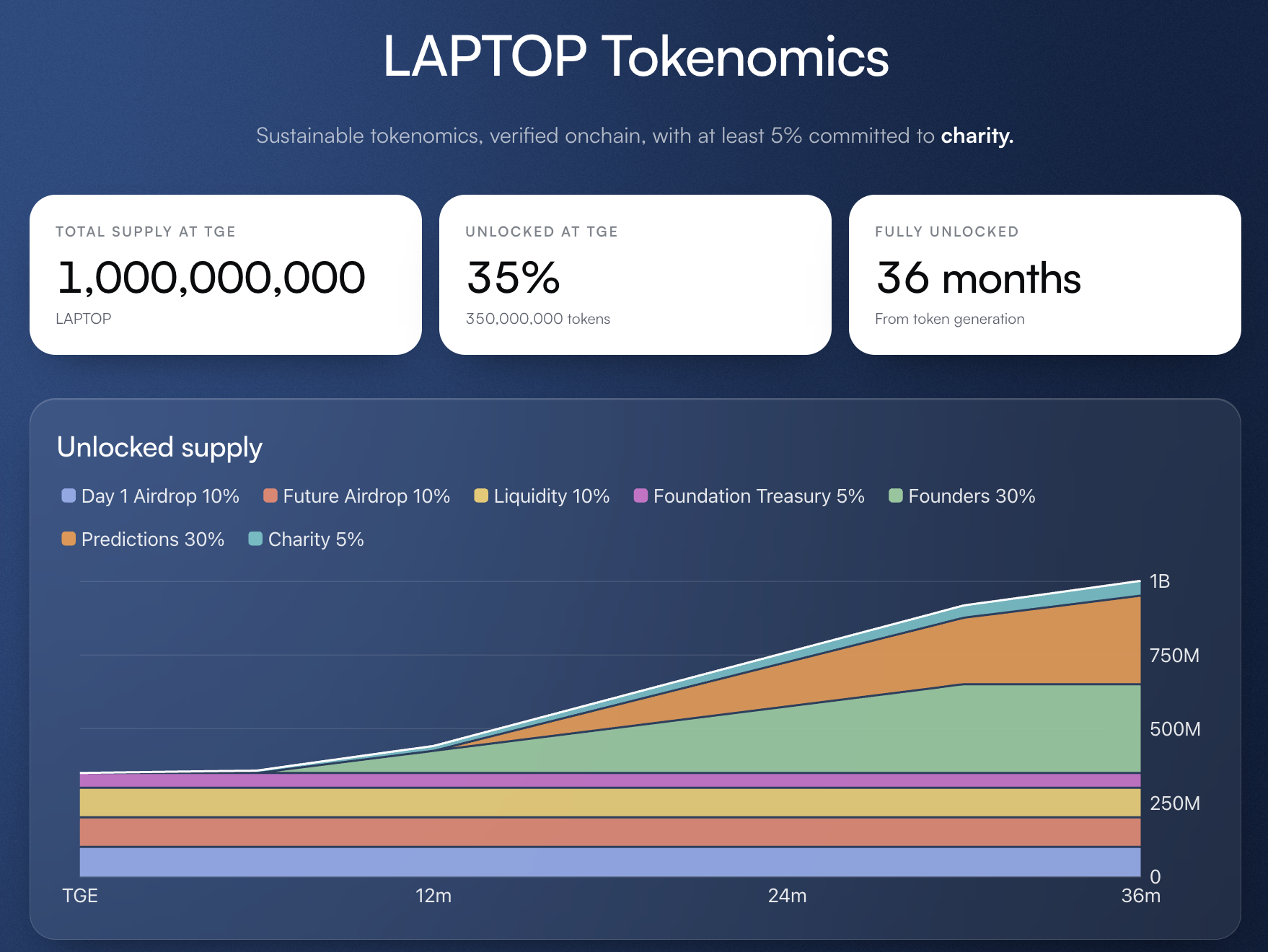
Data on Hunter Biden memecoin. Source: laptoptoken.com

While Biden said he intended to commit 5% of the tokens for charity, he added that he was incentivized to continue the project “just to piss off Don and Eric,” referring to Donald Trump Jr. and Eric Trump, sons of US President Donald Trump, and “every [Key Opinion Leader] who called it a scam because we refused to pay them.”

The basis for the memecoin’s namesake is Biden’s laptop computer, whose existence and contents were subject to intense media scrutiny ahead of the 2020 US Presidential election, in which Trump was running against his father. The laptop continues to be invoked by many right-wing figures and was the subject of two lawsuits filed by Biden over privacy laws.

Related: Hunter Biden’s laptop controversy gets a memecoin afterlife

Biden has been a vocal critic of the Trump family crypto company World Liberty Financial, calling it “corruption at a scale we’ve never seen” in August. The president also faces criticism for launching his memecoin, Official Trump (TRUMP) shortly before taking office in January 2025, which faces its own rug pull and corruption accusations.

According to Biden, the $LAPTOP founder memecoins will remain locked for six months after launch and the team will continue burning unclaimed tokens from airdrops.

President to host another memecoin event amid controversy

Biden’s token, whether launched to hold up a mirror for rug pull projects, a joke, or trolling the Trump family, could shine a spotlight on the president’s crypto ventures as he prepares to speak at another event for his memecoin holders.

Last week, the group behind the $TRUMP memecoin announced that the president will appear at his gold club in Washington, DC alongside three unnamed speakers and the top 185 tokenholders for a Nov. 22 dinner.

The nonprofit consumer advocacy organization Public Citizen estimated that $TRUMP memecoin investors lost $3.2 billion since its 2025 launch.

Magazine: Capital starting to rotate back to crypto from AI: Raoul Pal

Related Questions

QAccording to Hunter Biden, what was the main reason for launching the LAPTOP memecoin?

AHe stated that the main reason was to troll every 'grift' like Trump's coin, which he considered to be 'max extraction.' He also mentioned transparency, committing the team to a token lock-up, publishing a disclosure, and the hope of helping some charities he cares about.

QWhat did the launch report from Groom Lake indicate happened shortly after the $LAPTOP token's peak price?

AThe report indicated that the money for sellers was pulled right after the peak. Eighty-four seconds after the price topped out, a major market maker withdrew its money, causing the cash available for people trying to sell near the current price to drop from $16,157 to zero.

QHow does the article connect the launch of the LAPTOP memecoin to President Trump's crypto activities?

AThe article states that Hunter Biden is a vocal critic of the Trump family's crypto company, World Liberty Financial. It also mentions that President Trump launched his own memecoin, Official Trump (TRUMP), which faces its own rug pull and corruption accusations. Biden's coin is framed partly as a response to or trolling of Trump's crypto ventures.

QWhat upcoming event related to the $TRUMP memecoin is mentioned in the article?

AThe article mentions that the group behind the $TRUMP memecoin announced that President Trump will appear at his gold club in Washington, DC, alongside three unnamed speakers and the top 185 tokenholders for a dinner on November 22.

QWhat did Hunter Biden confirm about the 300 million tokens associated with the $LAPTOP founders' wallets?

AHe provided blockchain data confirming that 300 million tokens in wallets associated with the $LAPTOP founders 'haven’t moved since launch,' which he presented as evidence that the project is not a 'rug pull.'

Related Reads

Hyperliquid API Wallet Permissions Keep Expanding: Once an AI Agent Is Attacked, It Could Drain the Main Account

As personal AI agents take over everyday financial decisions, Hyperliquid is seen as an ideal decentralized trading foundation thanks to its deep liquidity and composability. However, the API wallets that underpin automated trading have quietly seen their security boundaries erode across network upgrades over the past year. Lacking fine-grained permission policies, a compromised API wallet can even trigger staking slashing, spot locking, and priority fee burning, exposing the main account to total loss. The article traces how API wallets—originally scoped to prevent direct withdrawals or external transfers—have accumulated expanded permissions through successive upgrades, with no cap on margin exposure. A maliciously altered API wallet controlling an account with over ~$40M could buy 500,000 HYPE, stake it, link it to a malicious HIP-3 market, invite slashing, and lock the main account's funds for 183 days. Because API wallets are now the default trading method across the Hyperliquid frontend and third-party apps, and agents must interact with untrusted internet environments, prompt injection or key leakage can let attackers drain funds without ever stealing a private key. Existing fine-grained control via HyperEVM smart contracts introduces too much latency for high-frequency trading, while custodial solutions outsource trust to centralized middleware. The proposed fix is a lightweight bitmap permission field set at API wallet creation, recording which operation types the wallet may trigger—mirroring the mechanism already used in HIP-3 deployer sub-lists. Validating the signer against the main account's bitmap adds negligible overhead, and critically, old API wallets would never auto-inherit new permissions from future L1 upgrades. This would safely unlock staking and transfer interfaces, remove reliance on centralized custody, and pave the way for large-scale personal AI agent adoption on HyperCore.

marsbit7m ago

Hyperliquid API Wallet Permissions Keep Expanding: Once an AI Agent Is Attacked, It Could Drain the Main Account

marsbit7m ago

Upbit and Bithumb Customer Deposits Plunge 31.86%, Falling $1.87 Billion in 2026

Customer deposits in South Korean won at Upbit and Bithumb, South Korea's two largest crypto exchanges, fell 31.86% in the first nine months of 2026, according to regulatory disclosures published November 17. The platforms held about ₩5.36 trillion ($4 billion) in customer cash at end-September, down from ₩7.87 trillion at end-2025—a reduction of roughly ₩2.51 trillion ($1.87 billion). Upbit operator Dunamu saw deposits drop 31.9% from ₩5.83 trillion to ₩3.97 trillion, while Bithumb fell 31.8% from ₩2.04 trillion to ₩1.39 trillion. The figures were disclosed via South Korea's Financial Supervisory Service electronic filing system. Customer crypto holdings also lost value: Upbit's book value fell 10.9% from ₩62.23 trillion to ₩55.46 trillion, and Bithumb declined 13.1% from ₩17.90 trillion to ₩15.56 trillion. However, quantities of several major cryptocurrencies held for customers increased despite lower valuations—Upbit added 13,259 Bitcoin, 337,609 Ether and 1.22 million Solana versus year-end levels, and Bithumb reported higher holdings of Bitcoin, Ether, XRP and Solana. The data indicate the deposit decline does not necessarily mean investors withdrew entirely from the crypto market; disclosures do not explain whether funds went to bank accounts, crypto purchases or elsewhere. The drop comes amid weaker trading activity in South Korea's digital asset market, adding pressure on major exchanges.

TheNewsCrypto38m ago

Upbit and Bithumb Customer Deposits Plunge 31.86%, Falling $1.87 Billion in 2026

TheNewsCrypto38m ago

Naxin Micro Plans to Acquire Geokong Smart for 487 Million Yuan: 268% Valuation Premium with Zero Performance Betting, Another Move in the Sensing Track | M&A Frontline

NOVOSENSE Microelectronics (688052.SH) announced on November 16 a cash acquisition of a 78.152% stake in Ningbo Geskong Intelligent Technology for a total consideration of RMB 487 million, marking its second M&A move in automotive electronics and intelligent sensing after acquiring Magtron in 2024. The deal values the target at an appraised value of RMB 635 million, a 268.40% premium over book net assets based on the income approach, with the transaction implying an overall valuation of about RMB 623 million. Notably, the deal includes no performance commitments or impairment compensation clauses; instead, it relies on deep equity binding of the core team, which will retain 21.85% of shares along with lock-up and mandatory transfer restrictions. Payment is entirely in cash, funded by own capital plus a planned bank acquisition loan of up to RMB 350 million over 10 years, with differentiated installment schedules for different shareholder types. Founded in 2017, Geskong Intelligent focuses on microwave/millimeter-wave radar sensing chips, covering 5.8GHz, 10.5GHz, 24GHz and 60GHz bands and extending toward the mainstream automotive 77GHz band. It remains loss-making, posting RMB 77.59 million in revenue and a net loss of RMB 56.43 million in 2025, and RMB 34.63 million in revenue with a RMB 14.32 million net loss in January-April 2026, largely due to heavy R&D spending on 77GHz automotive radar SoC chips now entering customer introduction. For NOVOSENSE, the acquisition aims to complete its intelligent sensing portfolio, strengthen millimeter-wave radar technology reserves, and create synergies with its sensor, signal chain and power management lines, while leveraging its channels to accelerate mass production. With about RMB 2.67 billion in cash and trading financial assets as of Q3 2026, the company can absorb the cost, though risks remain: without performance guarantees, the target's profitability depends entirely on integration and commercialization progress, and prolonged losses could drag on consolidated profits if 77GHz chip ramp-up or customer expansion falls short.

marsbit52m ago

Naxin Micro Plans to Acquire Geokong Smart for 487 Million Yuan: 268% Valuation Premium with Zero Performance Betting, Another Move in the Sensing Track | M&A Frontline

marsbit52m ago

Trading

Spot
活动图片