H-JEPA: LeCun's World Model Startup Delivers, Code and Weights Fully Open-Sourced

marsbitPublished on 2026-10-10Last updated on 2026-10-10

Abstract

Yann LeCun's AI startup, AMI (Advanced Machine Intelligence), along with researchers from NYU, INRIA Paris, and Brown University, has introduced H-JEPA, a hierarchical world model for visual planning. The model stacks multiple Joint-Embedding Predictive Architectures (JEPAs) in layers, each predicting future states over different time horizons in its own representational space. For planning, a high-level layer first formulates a coarse plan, then passes predicted intermediate states as sub-goals to lower layers, which refine them step-by-step into executable actions. This hierarchical approach allows the model to manage both long-term goals and immediate actions. In the Visual AntMaze navigation task, a three-layer H-JEPA achieved a 73% success rate, significantly outperforming a single-layer model at 18%. It also demonstrated better performance with less computational cost in other simulated tasks. The work embodies LeCun's long-held view that intelligent systems require hierarchical planning across different levels of abstraction and timescales. To address the issue of representational collapse in world model training, H-JEPA employs the SIGReg method from prior work. The team has open-sourced the code and pre-trained model weights, enabling researchers to reproduce the planning experiments. This release follows AMI's commitment to open research, announced when the company launched with $1.03 billion in funding at a $3.5 billion pre-money valuation earlier this year. The ...

LeCun's world model startup, AMI (Advanced Machine Intelligence), has just quietly delivered its answer.

In the latest paper, H-JEPA, researchers from AMI, New York University, INRIA Paris, and Brown University introduced a hierarchical world model for visual planning.
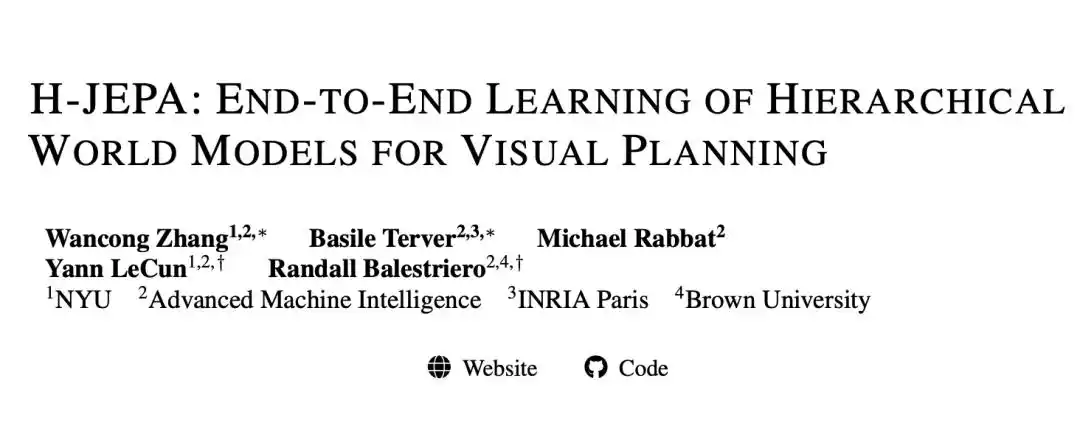
H-JEPA stacks multiple JEPAs (Joint Embedding Predictive Architectures) layer by layer, allowing each layer to predict the state after different time spans within its own representation space.

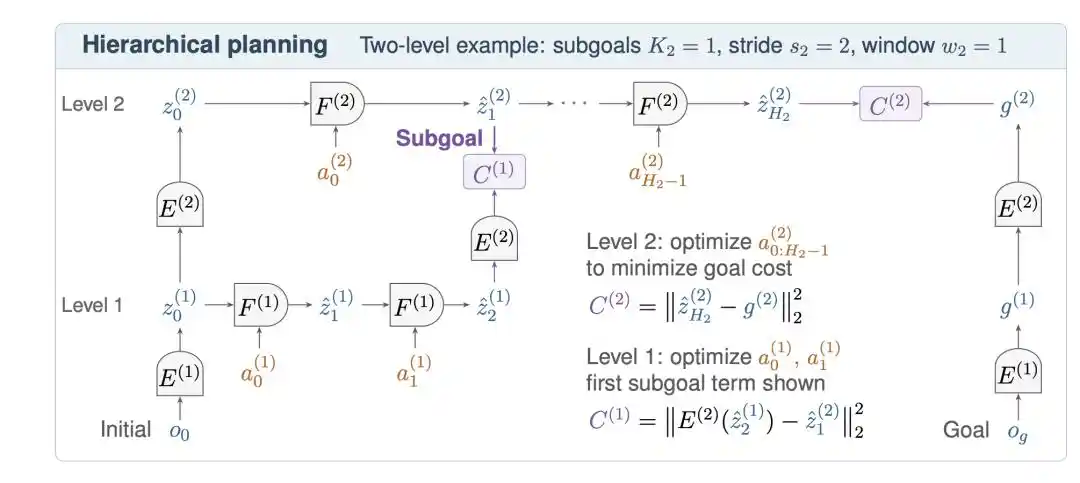
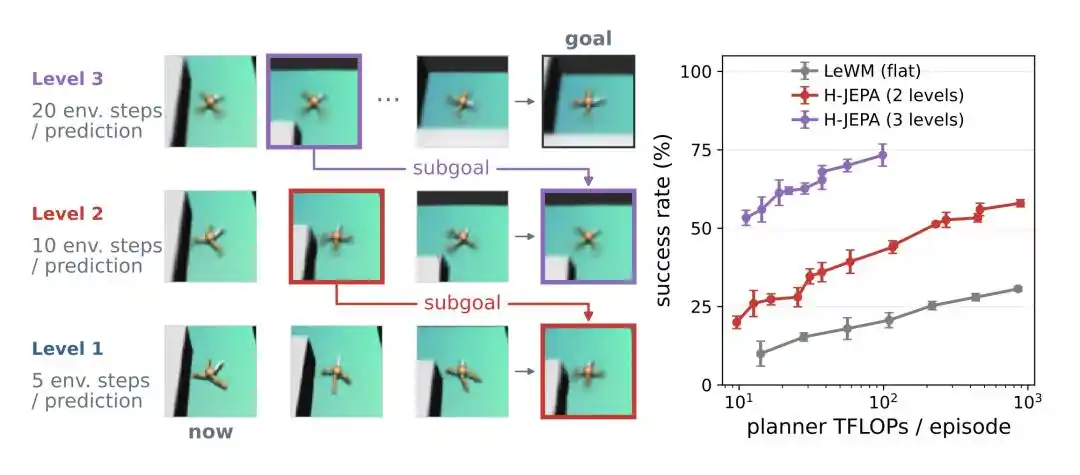
During planning, the high-level layer first formulates a rough plan, then passes the predicted intermediate states as subgoals to the low-level layer. The low-level layer takes over and refines the plan step by step, ultimately generating executable actions.

Through this division of labor, the world model can both plan for long-term goals and handle immediate actions.

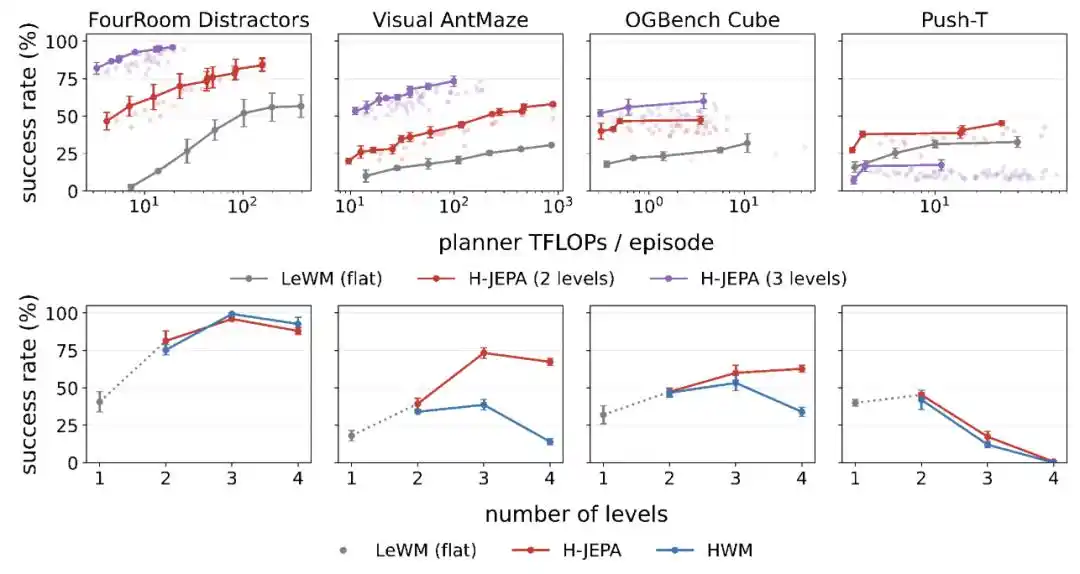
In the Visual AntMaze simulated maze task, the three-layer H-JEPA achieved a success rate of 73%, compared to 18% for the single-layer model.

Simultaneously, in several simulation tasks, the hierarchical model achieved better performance with less computational cost for planning.
Besides delivering tangible test results, H-JEPA also continues the open-source path that LeCun emphasized from the startup's inception.

The team has simultaneously open-sourced the code and pre-trained model weights, allowing researchers to directly load the model and replicate planning experiments.
Why Does a World Model Need Hierarchical Planning?

LeCun has actually been talking about this for a long time.

Back in 2022, while still serving as Chief AI Scientist at Meta, he proposed the concept of hierarchical JEPA:

Let the model predict at different levels of abstraction and time scales, and then implement complex goals as actions through hierarchical planning.
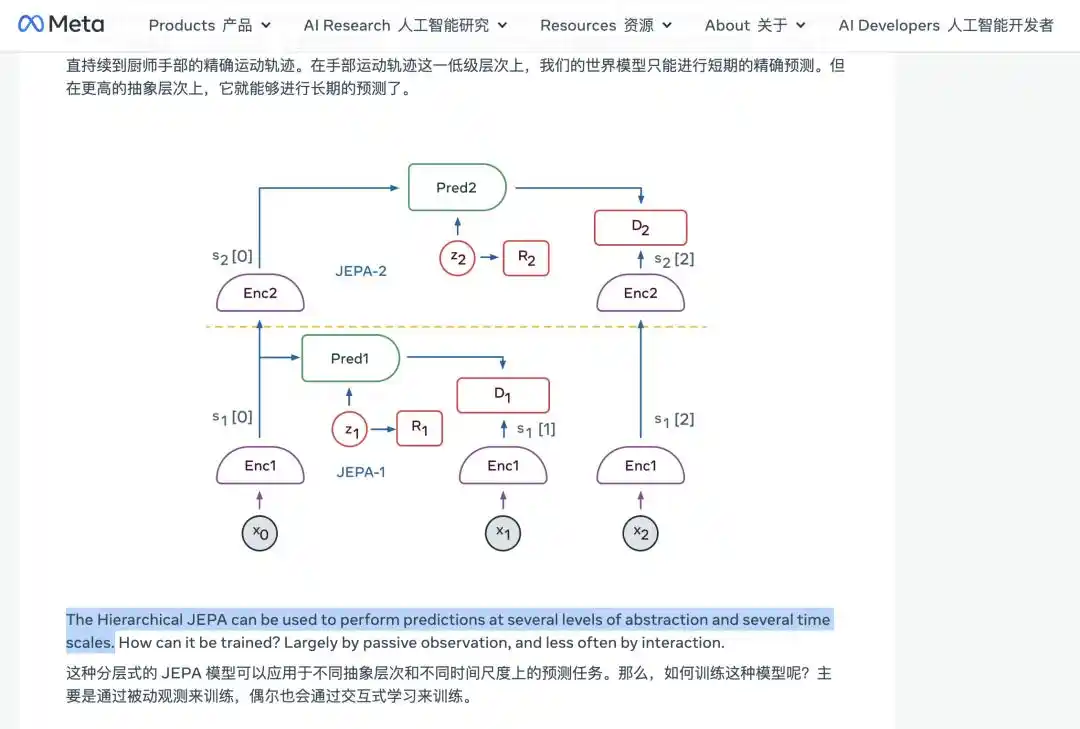
This might sound a bit abstract at first, but it's easy to understand using an example LeCun often cites.

Suppose you are sitting in your office at New York University, planning to go to Paris. When planning the entire trip, you focus on the destination, flights, and schedule.

After deciding on the itinerary, you start planning further: how to leave the office, go downstairs, and take a taxi to the airport.

When you actually walk out of the office, the information you focus on becomes the ground in front of you, the stairs, and where to place your next step, which foot to move first.

△

These planning levels cover different time spans and require different information. When planning the flight, the height of a specific step on a staircase is not important; when walking down the stairs, this detail directly determines how you should step.

This is not a characteristic unique to human planning. For robots, the high level needs to understand task objectives, environmental relationships, and future directions, while the low level needs to master specific actions and body control details.

For example, a quadruped robot may have already reached the target location, but if its leg posture differs from the target image, the model might still consider itself far from the goal due to these differences.
So, the question becomes:

How to let different levels learn information representations suitable for themselves, and then gradually implement high-level plans into low-level actions?

How Exactly Does H-JEPA Work?

Specifically, to solve the above problem, H-JEPA configures three components in each layer to handle state, action, and prediction respectively.
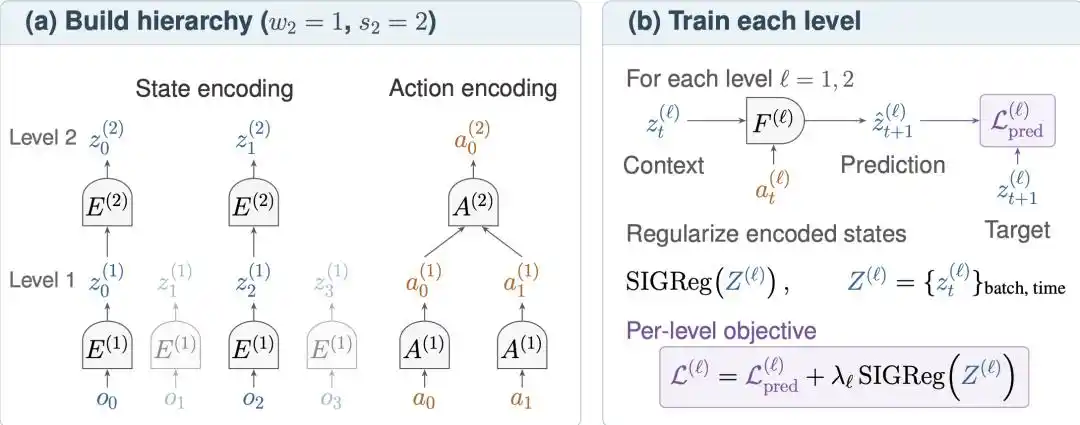
Among them, the state encoder is responsible for extracting the representation of the current environment. The lowest layer directly reads images, while higher layers further abstract based on lower-layer representations, retaining information more important at that time scale.

The action encoder is responsible for describing the changes brought about by actions. The low layer represents specific actions, while the high layer compresses a sequence of continuous actions into more coarse-grained changes.

The predictor combines the current state and action to predict future states. Different levels cover different time spans. In the paper's experiments, one step at a higher adjacent layer corresponds to two-step predictions at the lower layer.

Regarding model training, the layers above are learned jointly through end-to-end training, with different levels connected via subgoals.

The intermediate states predicted by the high level become subgoals for the low level. The low level transforms its predicted states into the high-level representation space, compares them with the subgoals specified by the high level, and then adjusts its actions accordingly.

However, when training the world model, there is a classic problem that needs to be addressed: representation collapse.

If the encoder compresses all inputs into the same vector, and the predictor only outputs this vector, it can achieve very low prediction error, but the model hasn't actually learned any useful information.

To address this, H-JEPA adopts the SIGReg proposed by LeCun's team in their previous LeJEPA work, constraining the representation distribution to prevent different states from being compressed into the same vector.
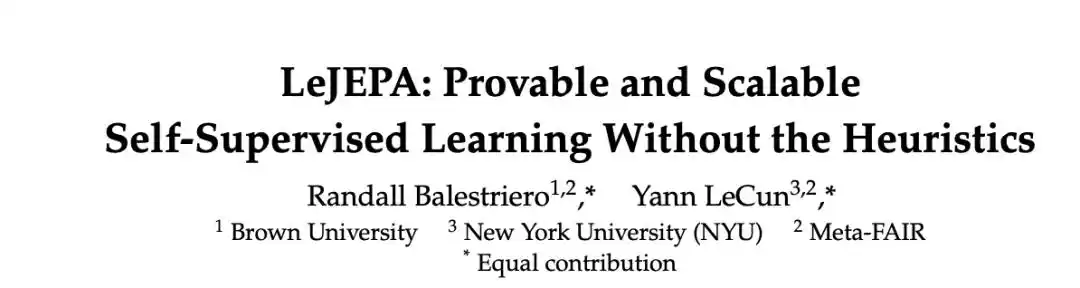
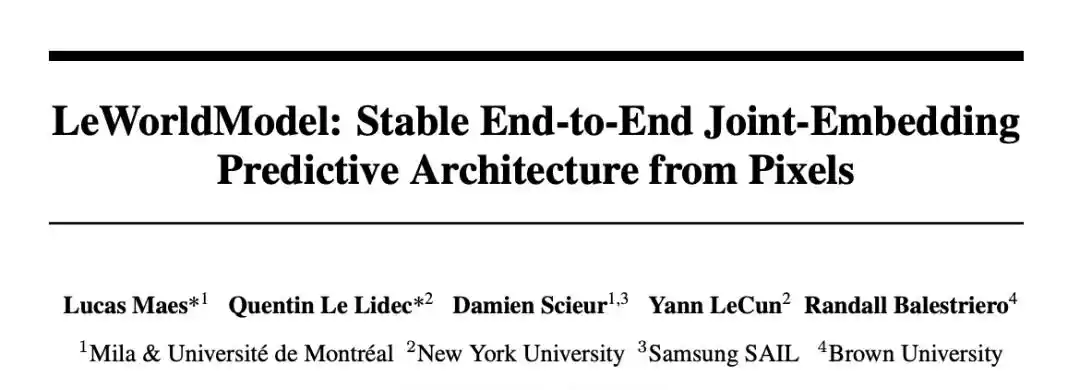
This year's LeWorldModel applied this method to world model training. H-JEPA builds upon it as the lowest layer, adding more JEPAs on top to form a structure trained jointly and planning from top to bottom.
In experiments, the researchers further observed information trade-offs at different levels. In the maze task, the high level gradually weakened the leg posture but still retained the robot's position information.
However, hierarchy also has its applicable conditions. The two-layer model performed well in the Push-T task, but adding a third and fourth layer led to decreased performance.

The paper suggests that shorter task trajectories might limit the training data available to higher layers.

LeCun, Still the Same LeCun

Overall, these designs of H-JEPA continue a fundamental proposition of JEPA: performing prediction in the representation space.

JEPA stands for "Joint Embedding Predictive Architecture." LLMs typically learn to generate content by predicting the next token; visual JEPA first encodes images or videos into internal representations, then predicts the representations of target parts, without needing to generate image pixels one by one.
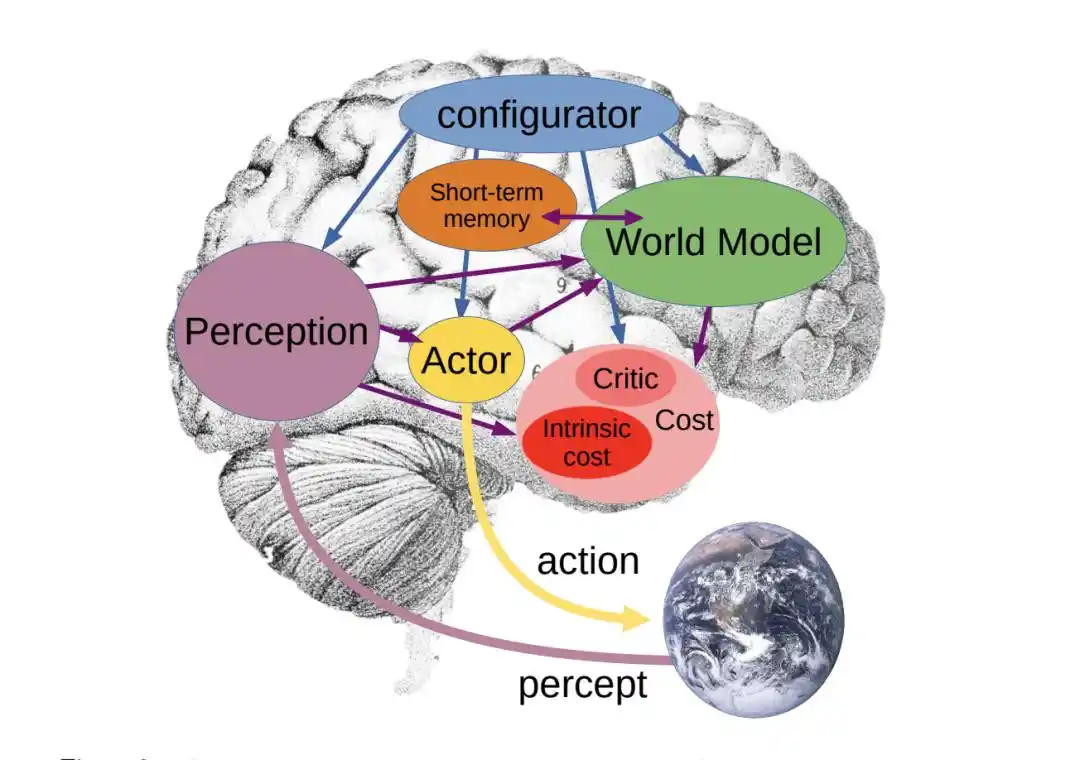
In world models like H-JEPA, the model also incorporates actions to predict the representations of future states. The planner then compares the consequences of different actions to find a path towards the goal.

LeCun has always believed that understanding the world, predicting the consequences of actions, and planning are essential capabilities for achieving human-level intelligence. His assessment of LLMs has always revolved around this point.

In September this year, at the EC CV conference in Malmö, Sweden, his presentation slides once again featured that familiar piece of advice:

If you are interested in human-level AI, don't work on LLMs.
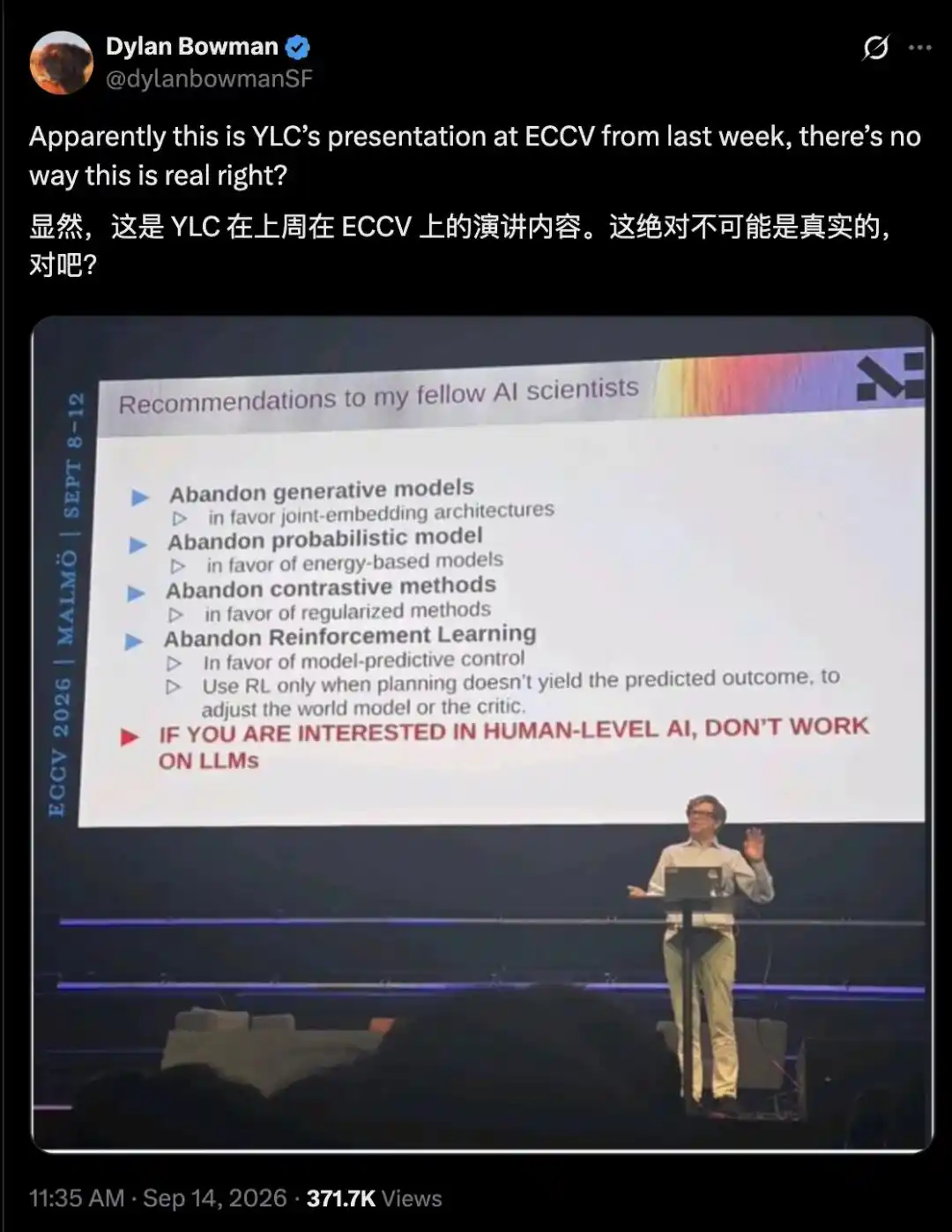
After this slide spread on social media, some doubted if it was fake. LeCun replied:

Guaranteed real.
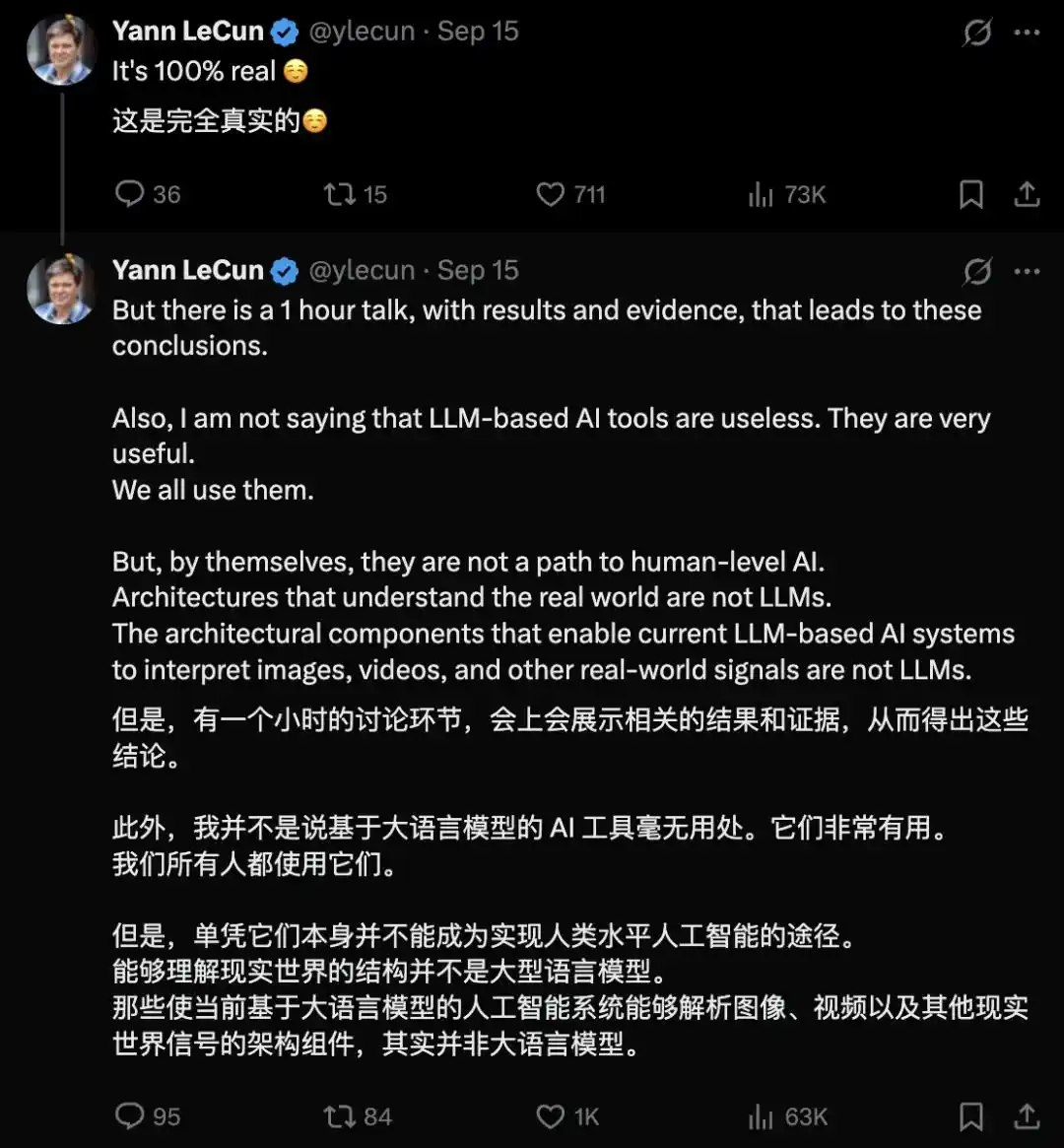
He later added that LLM-based AI tools are very useful and everyone is using them. But he believes that LLMs alone cannot lead to human-level intelligence.

Now, this research philosophy has also become AMI's entrepreneurial direction.

In March this year, AMI announced the completion of a $1.03 billion funding round, with a pre-money valuation of $3.5 billion.

The company is chaired by LeCun, with Alexandre LeBrun as CEO, Saining Xie as Chief Scientist, Pascale Fung responsible for Research and Innovation, and Michael Rabbat responsible for World Models. Rabbat is also one of the authors of this H-JEPA paper.

However, it must be said that while research results are research results, another expectation for AMI from the outside world remains its products.

At least from the current official website, the company primarily showcases its technical direction, team, and recruitment information, with no public-facing product portal visible yet.
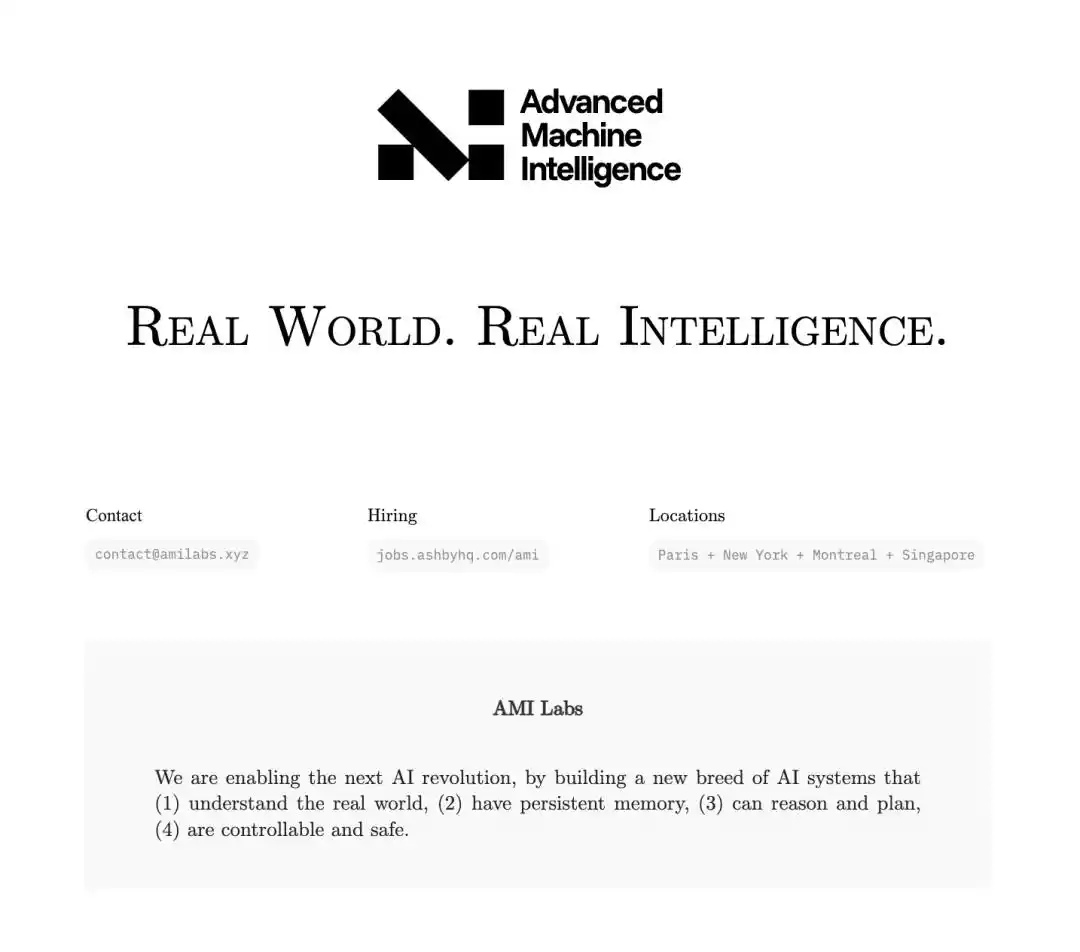
On the other hand, World Labs, which also bets on world models, has reached a new turning point.

On September 28th, AMD announced an all-stock acquisition agreement with World Labs, founded by Fei-Fei Li, worth approximately $8.2 billion.

It can be said that one side is moving towards integration with chip companies, while the other continues to advance along its own research path.

But with Fei-Fei Li's world model startup achieving a milestone, is Yann LeCun's major result also just a matter of time...?

References

[1]https://venturebeat.com/technology/h-jepa-teaches-world-models-to-plan-at-multiple-levels-of-abstraction

[2]https://arxiv.org/pdf/2610.06805

This article is from the WeChat public account "QbitAI", author: henry

Related Questions

QWhat is H-JEPA, and how does it differ from single-layer world models?

AH-JEPA is a Hierarchical Joint Embedding Predictive Architecture proposed by AMI (Advanced Machine Intelligence). It stacks multiple JEPA layers to enable planning at different levels of abstraction and temporal scales. In the Visual AntMaze task, its success rate was 73%, compared to 18% for a single-layer model, showcasing its superior ability to handle long-term goals and immediate actions through layered, hierarchical planning.

QWhy does LeCun advocate for a hierarchical approach in world models like H-JEPA?

ALeCun advocates for a hierarchical approach because he believes complex tasks, like a human planning a trip, require reasoning at different abstraction levels and time horizons. High levels handle overarching goals (e.g., booking a flight), while lower levels manage immediate actions (e.g., walking down stairs). This division allows models to both plan for the future and execute detailed, context-specific actions, which he considers essential for achieving human-level AI.

QHow does H-JEPA's training prevent the issue of representation collapse?

AH-JEPA prevents representation collapse by using a method called SIGReg (Sparse Information Gap Regularization), which was introduced in LeCun's prior work, LeJEPA. SIGReg constrains the distribution of representations, preventing the encoder from mapping different input states to the same vector. This ensures the model learns meaningful and distinct representations necessary for accurate prediction and planning.

QWhat significant business developments are mentioned regarding AMI and World Labs?

ATwo significant developments are mentioned: AMI, LeCun's startup, completed a $10.3 billion funding round with a pre-money valuation of $35 billion. Separately, AMD announced an all-stock acquisition agreement with World Labs, a company founded by Fei-Fei Li, valued at approximately $8.2 billion. This highlights the growing investment and strategic moves in the world model AI sector.

QWhat is LeCun's stance on large language models (LLMs) in relation to achieving human-level AI?

ALeCun believes LLMs alone are insufficient for achieving human-level AI. He has publicly stated, 'If you are interested in human-level AI, don't work on LLMs.' He acknowledges that LLM-based tools are useful, but argues that true intelligence requires capabilities like understanding the world, predicting action consequences, and hierarchical planning—areas where models like H-JEPA are focused.

Related Reads

Google says hackers use AI agents to find and exploit software flaws

Google Threat Intelligence Group (GTIG) has for the first time identified attackers using AI large language model frameworks to automate software vulnerability discovery and exploitation without step-by-step human direction. In a report published Monday, researchers described a tool found on an exposed staging server that compared software versions, identified potential flaws, and generated and executed exploit code. GTIG said threat actors used LLM frameworks to fully automate vulnerability discovery and exploitation without a human in the loop, hosting a multi-agent vulnerability research and weaponization framework designed to conduct continuous differential analysis comparing code before and after patch announcements on popular web applications, autonomously discovering and exploiting software vulnerabilities. Google warned these automated workflows give organizations less time to apply security patches before attackers develop ways to exploit vulnerable systems. Attackers are leveraging AI agent frameworks to automate patch reverse engineering via differential analysis and weaponizing N-day vulnerabilities. Vulnerability disclosures more than doubled between January and August, with exploited zero-days averaging eight per month in 2025 and 11 per month from January through August 2026, reaching 22 in August. Automated workflows also accelerate attackers' ability to move from initial access to domain administrator access, as cited in an August 2026 PaperCut campaign where attackers achieved that control within minutes. GTIG said two PHP vulnerabilities involved in exploitation attempts were discovered using LLM analysis. Anthropic also warned that AI-assisted attacks have evolved into multi-agent operations automating most of the cyberattack cycle from discovery to exploitation and data theft.

cointelegraph31m ago

Google says hackers use AI agents to find and exploit software flaws

cointelegraph31m ago

Coin-Stock Trend Indicator丨Third-largest BTC treasury company Twenty One Capital buys $10 million in BTC for the first time since July 2025; Bitmine total holdings value drops $2.5 billion in a week (November 17)

This week's crypto stock snapshot notes that the recent US equity move was merely an oversold rebound rather than a new high, with the impact of the Democratic midterm election win still spreading and Nvidia founder Jensen Huang's resignation controversy evolving into a broader AI-sector storm. The week's biggest US market event is Anthropic's IPO on November 19, though its fundraising and valuation fall short of SpaceX's record. Japanese stocks remain favored by Morgan Stanley analysts despite AI-related weakness, while Korean stocks fell 2.59% to 4,968.45, their lowest since February 2. In crypto stocks, last week's market crash hit DAT treasury companies hard, with ETH treasury firm Bitmine's holdings value dropping from $14.3 billion to $11.8 billion in a week, nearly all due to ETH's price decline. Listed companies (excluding miners) bought a net $51.86 million in Bitcoin last week, down 45.2% week-over-week. Strategy bought 485 BTC at $68,887 each for about $33.4 million, bringing total holdings to 850,849 BTC; Metaplanet bought none. Capital B bought 12 BTC at $77,500.2, holding 3,550 BTC; Strive bought 251 BTC at $69,853 for about $17.53 million, holding about 43,404 BTC. Total tracked holdings reached 1,171,317 BTC, up 0.04% week-over-week, worth about $75.53 billion, or 5.8% of Bitcoin's circulating market cap. Twenty One Capital bought 154.32 BTC for about $10 million in cash, its first purchase since July 2025, bringing holdings to about 43,700 BTC and making it the third-largest listed Bitcoin treasury; CEO Rapha Zagury said volatility creates opportunity and the firm bought the dip. BitMine added 7,653 ETH last week, holding 6,077,745 ETH (4.97% of total supply, 0.03% short of its 5% goal) plus 216 BTC, a $180 million investment in Beast Industries, $67 million in Eightco Holdings, and $448 million in cash and securities; its ETH holdings are worth about $11.1 billion at $1,823 per ETH. Chairman Tom Lee attributed ETH's 28% two-week drop to Nvidia-related turmoil triggering Asian margin selling and investors raising cash for Anthropic's reported November 18 IPO, saying it contradicts improving fundamentals. DeFi Development Corp. added 9,482 SOL, with Solana treasury holdings reaching about 2.62 million tokens, growing for a 10th straight week; its CHAD preferred stock raised enough to buy over 230 SOL today. CZ said Japan-listed ASIAN STAR will distribute 8 million yen worth of BNB to shareholders and pursue Japanese real estate tokenization on BNB Chain. DeFi Technologies reported Q3 2026 revenue of $18.3 million (down about 18% year-over-year), operating income of $7 million, and net profit of $22.3 million, with $53.4 million in cash and stablecoins and $48.2 million in digital assets. Ripple-backed Evernorth disclosed its 346 million XRP was booked at $342 million versus an initial $847 million record value, with cumulative impairments of $505 million, a nearly 60% decline.

marsbit56m ago

Coin-Stock Trend Indicator丨Third-largest BTC treasury company Twenty One Capital buys $10 million in BTC for the first time since July 2025; Bitmine total holdings value drops $2.5 billion in a week (November 17)

marsbit56m ago

SMIC Closes In on Global No. 2

SMIC is closing in on the global foundry industry's second place. In the first three quarters of 2026, the company reported revenue of 60.618 billion yuan (up 22.43% year-on-year) and net profit of 7.314 billion yuan (up 91.57%), with gross margin hitting a four-year high of 25.59%. In Q2, Samsung held 5.9% of the global foundry market versus SMIC's 5.4%—a gap of just 0.5 percentage points, down from 1.4 points the previous quarter. Revenue-wise, the two were only about $254 million apart in Q2, and SMIC's Q4 guidance of $3.32–3.38 billion would exceed Samsung's Q2 level. Growth is no longer driven mainly by smartphones, whose share of wafer revenue fell from 21.5% to 14.3%, amid a 15.2% decline in domestic smartphone shipments. Instead, industrial and automotive revenue nearly doubled, rising from 11.9% to 19.3% of revenue, while computer and tablet revenue grew about 55%. SMIC has invested in BCD processes covering battery management, digital isolation, and smart power switches, with some processes meeting Grade 0 automotive standards. AI demand is also creating new opportunities in mature-node chips such as power management, controllers, and specialty memory; customer pull for these AI-supporting chips exceeded expectations, prompting SMIC to trim engineering and R&D wafers to prioritize mass-production orders. Q3 wafer shipments exceeded 3 million 8-inch equivalent wafers for the first time, with utilization at 97.3%. A key financial inflection point: after tripling capacity over a decade (from 339,000 to 1.1168 million wafers per month), SMIC's capital expenditure is falling—Q3 capex dropped 56.5% year-on-year to 7.423 billion yuan, and cash paid for fixed assets fell over 30% versus 2024 and 2025. Major expansion projects in Shanghai, Beijing, Tianjin, and Shenzhen are 95–98% complete, with construction-in-progress declining from 92.619 billion to 62.652 billion yuan as projects transfer to fixed assets. However, management cautions that longer equipment lead times could disrupt capex pacing, and Q4 gross margin guidance of 26–28% is below Q3's 29.9% due to new capacity and R&D costs. The next decade's challenge is not just overtaking Samsung, but proving that past massive investments can steadily convert into real profits and cash flow.

marsbit1h ago

SMIC Closes In on Global No. 2

marsbit1h ago

Trading

Spot
活动图片