GPT-6.1 Sol Instantly Expands to 500k Context, Completely Free

marsbitPublished on 2026-10-13Last updated on 2026-10-13

Abstract

GPT-6.1 Sol has expanded its default context window to 500k tokens, an 80% increase from the previous 272k limit. This update aims to reduce the frequent and slow context compression that developers faced during long coding tasks, allowing the model to retain more details. When using subscription credits, OpenAI has also removed the additional long-context fee for this model, though standard credit consumption for tasks still applies, and API pricing remains separate. However, some developers question whether this is a substantial upgrade or merely a configuration change. Concerns remain about whether the larger context will lead to faster credit depletion due to increased cache reads, even without extra fees. Additionally, while GPT-6.1 Sol supports up to 1M tokens manually, its default 500k setting is positioned against competitors like Claude Code, whose Opus 5.5 and Sonnet 5.5 models already offer a default 1M context window with standard token pricing and their own compression strategies. OpenAI indicates plans for further context window expansions in the future.

GPT-6.1 Sol's default context window has surged directly to 500k!

With the OpenAI Day 7 update, the default window in Codex and ChatGPT Work expanded from 272k to 500k, a jump of about 80% in one go.
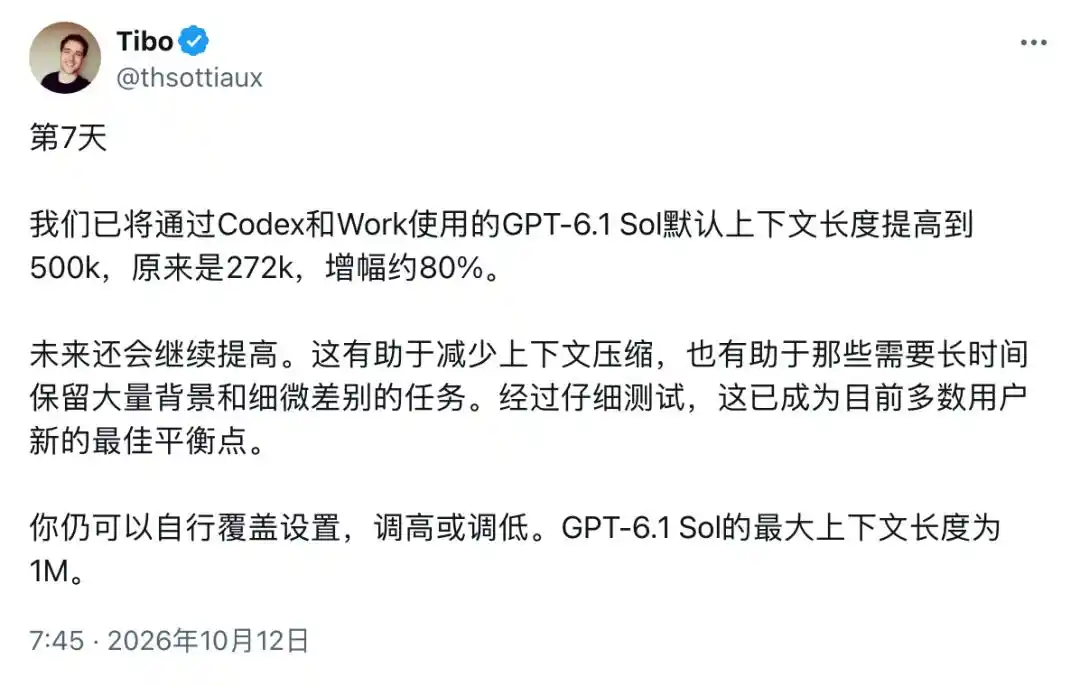
Immediately after, Tibo added another point: Using subscription credits to run GPT-6.1 Sol will not incur long-context surcharges.
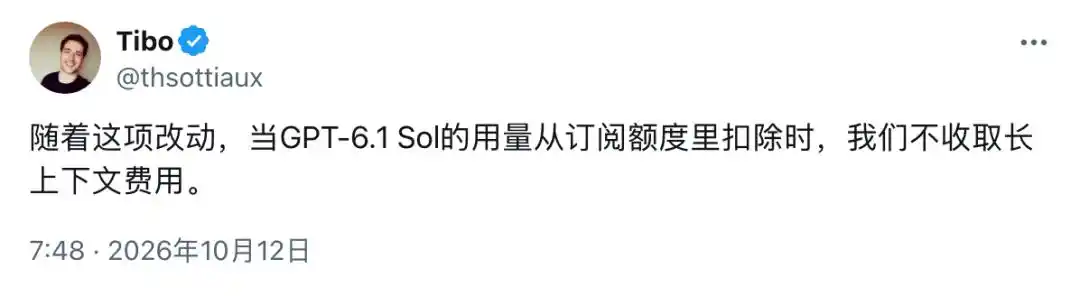
Tasks will still consume subscription credits as usual, but there will be no extra charge specifically for the longer context.

API calls are still billed according to the API pricing table.

However, developer Mhmd Hammoud countered in the comments: "Does tweaking a configuration now count as a real upgrade?"

GPT-6.1 Sol Roars to 500k, Wish Granted

Even before the default 500k was rolled out, developer Lasse was already fed up with waiting for compression.

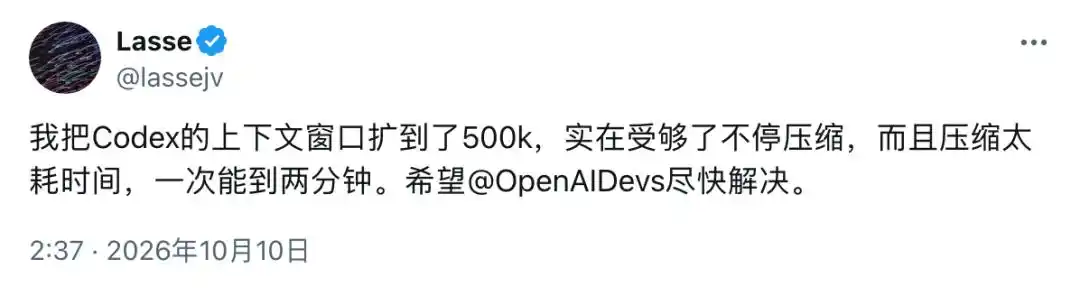
He once complained, "Codex compressing the context could make me wait up to two minutes at worst."

Two days before this update, he simply set his window to 500k himself, posted a screenshot of the status, and called on OpenAI to fix the slow compression issue quickly.

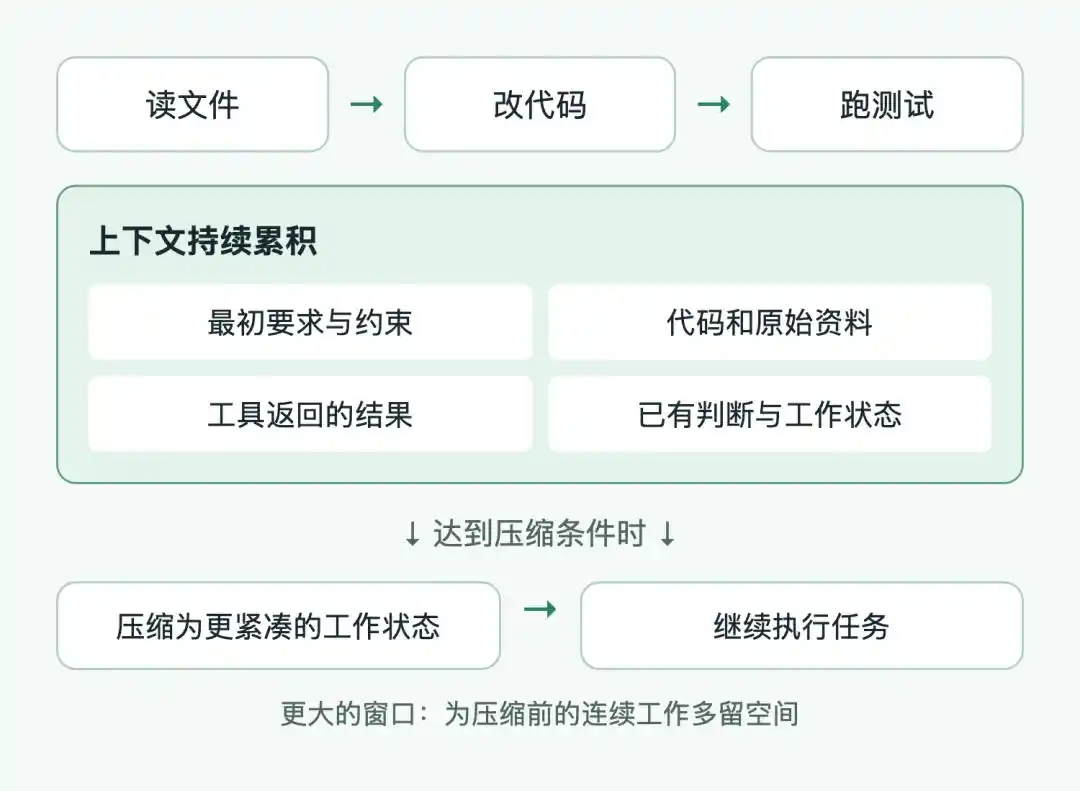
When asking Codex to review files, modify code, or run tests, the code read and errors encountered all occupy the context.

When the context is nearly full, it must first compress and organize the earlier conversation and progress to free up space before it can continue working.
After waiting for compression, you still have to check if it missed the initial requirements.

For example, you might have said, "This interface needs to be backward compatible." If it modifies a dozen files, the new feature works, but the old interface breaks, you'd end up having to fix it yourself.

Tibo stated that this expansion reduces the need for compression and allows the model to retain more details during long tasks.

Fewer waits for compression, fewer repeats of the same requirement – that's how the 500k truly helps.

Surcharge Waived, Credits Still Deducted

The biggest fear was that less compression might lead to credits depleting even faster. OpenAI had indeed stepped into this pitfall before.

In July of this year, OpenAI increased the context in their products from 272k to 372k for use with GPT-5.6 Sol.

The result was subscription usage being deducted more than expected, so the team rolled back to 272k. The capacity just added was promptly taken away.
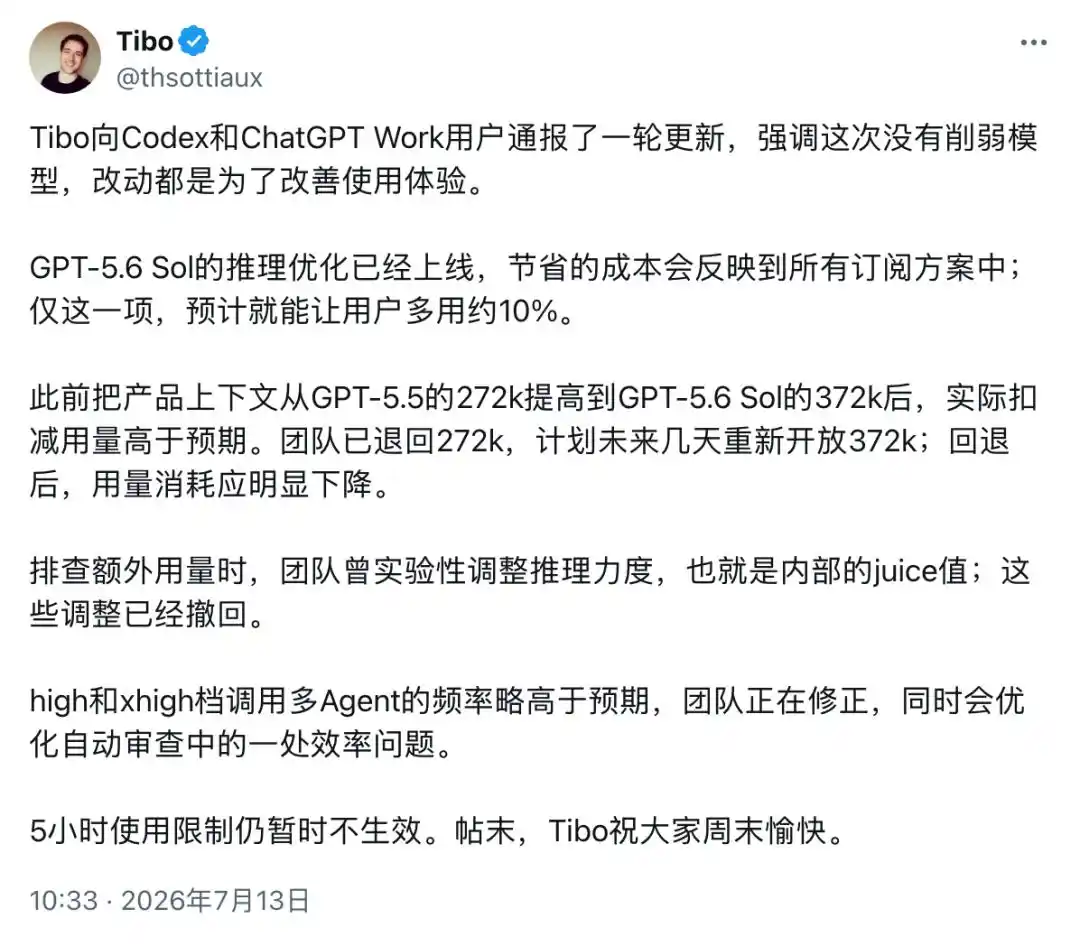
Developer Theo speculated at the time that it might be due to double charging for context exceeding 272k.

Tibo corrected this, saying that subscriptions back then also didn't have a long-context surcharge. The extra usage came from repeatedly reading more cached content.

You only typed "continue," but the Agent, needing to continue modifying code, still has to bring along the previously read files, test results, and requirements.

When subsequently calling tools and continuing reasoning, this content might be read repeatedly.

Caching allows reuse of already processed content at a lower read cost, but each read still counts towards usage. More content read and more frequent reads accumulate consumption.

Waiving the surcharge doesn't necessarily mean the same task will definitely use fewer credits.

Developers want to wait less for compression, but not run out of credits before the project is finished.

Claude Already Defaults to a Million

However, whether 500k is sufficient must be compared with Claude.

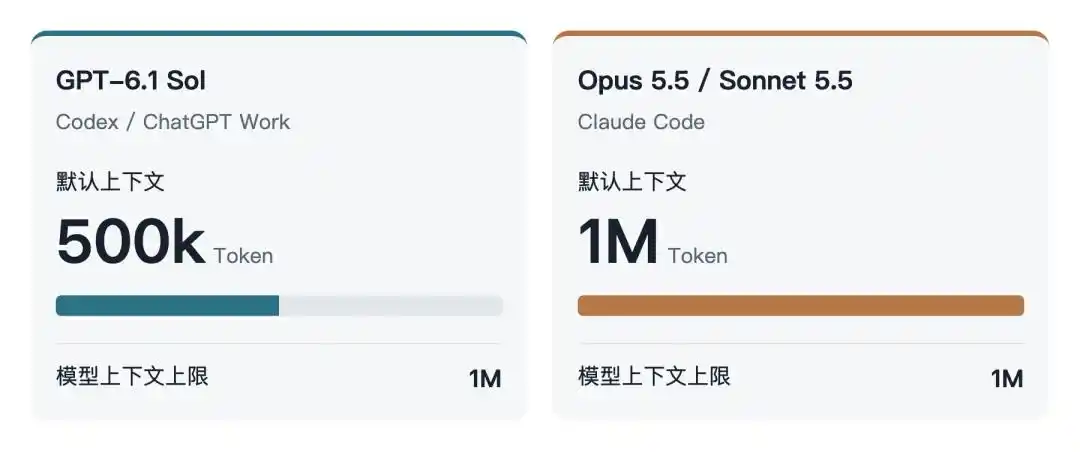
In Claude Code, Opus 5.5 and Sonnet 5.5 already have a default context of 1M, double the new default value of Codex.

In reality, GPT-6.1 Sol's upper limit can also reach 1M, and users can manually increase it.

However, OpenAI defaulted to 500k this time because, after testing, they believe this setting is more suitable for most users.

Regarding costs, when calling the API for these two Claude models, the standard token price applies within 1M, and the unit price doesn't increase with longer context.

What OpenAI waived this time is the long-context surcharge within subscription credits; API pricing is separate. Both sides are referring to different fee scopes.
Even with a 1M window, it can still fill up. In Claude Code, using these two models, the default auto-compression point is around 967k.

When nearing the limit, it first removes earlier tool outputs from the context, such as records from reading files or running commands.

If more space is needed, it then condenses the conversation into a summary, retaining the current requirements and key code, allowing the task to continue.

Sub-tasks like file lookups can be delegated to a sub-Agent. It has its own context, and after the lookup, it returns a summary of the results.

This way, the main Agent can proceed with the results without needing to stuff the entire lookup process into the main conversation.

OpenAI states that the default window will continue to increase in the future.

The window will grow larger, but developers' patience cannot expand alongside it. After handing code to AI, there should be fewer waits and fewer repeats of "I mentioned this requirement earlier."

References:

https://x.com/thsottiaux/status/2109430343346581527?s=20

This article is from the WeChat public account "新智元" (New Zhiyuan), author: Moses & Taozi

Trending Cryptos

Related Questions

QWhat is the new default context window size for GPT-6.1 Sol announced by OpenAI, and by what percentage was it increased?

AThe new default context window size for GPT-6.1 Sol is 500k, representing an increase of approximately 80% from the previous 272k.

QAccording to the article, what key change did OpenAI make regarding fees when using subscription credits to run GPT-6.1 Sol?

AOpenAI announced that using subscription credits to run GPT-6.1 Sol will no longer incur an additional long-context fee. Tasks consume the standard subscription credits but without an extra charge for the longer context.

QWhat was the primary user complaint that the expansion of the context window to 500k aimed to address?

AThe expansion aimed to address user frustration with slow context compression, where compressing the context could take up to two minutes, interrupting workflows and requiring users to re-state instructions.

QHow does the default context window of Claude's Opus 5.5 and Sonnet 5.5 models compare to GPT-6.1 Sol's new default?

AClaude's Opus 5.5 and Sonnet 5.5 models in Claude Code have a default context window of 1M (one million tokens), which is twice the size of GPT-6.1 Sol's new default of 500k.

QWhat was the reason given by OpenAI for setting the default context window to 500k instead of the maximum 1M that GPT-6.1 Sol supports?

AOpenAI set the default to 500k because, after testing, they determined this setting was more suitable for the majority of users, balancing performance and cost-effectiveness.

Related Reads

Changing Gas Metering Could Break Smart Contracts? Ethereum Urgently Halts Hoodi Fork to Investigate Eight Major Security Risks

Ethereum core developers have paused the Hoodi testnet upgrade after security auditors found that two upcoming Gas improvement proposals could invalidate long-standing assumptions underpinning many deployed smart contracts. The proposals, EIP-8037 and EIP-8038, part of the Glamsterdam upgrade, aim to reprice state storage by decoupling state creation from state access and setting dynamic weights for certain opcodes, in order to curb unchecked growth of Ethereum's state data. However, this overhaul disrupts static Gas constants that developers have relied on as fixed system parameters. ChainSecurity identified eight invariant risks. Many contracts and off-chain infrastructure depend on hardcoded Gas limits, for example to prevent reentrancy or bound execution scope; higher costs could cause cross-contract calls to run out of Gas and revert. Other risks lie in error-handling logic that relies on precise prediction of inner execution costs, and in proxy contracts that forward Gas based on fixed ratios, potentially distorting execution paths or locking funds in incomplete state-machine branches. To avoid systemic compatibility failures and cascading disruptions across multisig wallets, bridges, and lending protocols, developers agreed at an ACD meeting not to hard-fork Hoodi until the affected contracts are fully mapped and compatibility guidance is issued. Because much logic lives off-chain in proprietary routing, settlement scripts, and liquidation bots, the Ethereum Foundation acknowledged it cannot audit the entire ecosystem alone. It has published a public repository detailing the eight affected invariants, sample problem code, and prompt templates for audit and scanning tools, so teams can check their own logic. Findings will be reviewed at next week's ACD meeting, when Hoodi activation conditions will be reassessed.

marsbit2h ago

Changing Gas Metering Could Break Smart Contracts? Ethereum Urgently Halts Hoodi Fork to Investigate Eight Major Security Risks

marsbit2h ago

What Exactly Drives the Value of Layer 1?

This analysis by Marc Arjoon, CFA, examines what actually drives Layer 1 valuation through time-series regression on major L1 assets. Short-term, all L1 price movements remain dominated by Bitcoin beta. Over longer horizons, Ethereum's market cap has fully decoupled from its own protocol revenue—a deliberate policy outcome of Dencun and higher gas limits rather than a demand collapse—with its 2025 rally driven instead by spot ETF and corporate treasury demand. Solana, by contrast, shows revenue and market cap moving in tandem, both rising ~15x since January 2023 and peaking the same week. Active addresses and DEX volumes show weak weekly correlations and large divergences despite long-cycle drift. Testing Metcalfe's Law, the fitted elasticity of market cap to active addresses is only 0.56 for Ethereum and 0.62 for Solana and BNB—closer to the square root of addresses than the square. None of six valuation multiples reliably mean-reverts; Mcap/REV is the only one that predicts positive 13-week returns from low valuation quantiles on Ethereum and TRON. No L1 has Bitcoin's deep holder base: only 4% of Solana and 10% of Ethereum supply has been dormant over three years versus 42% for Bitcoin. Ethereum's pricing anchors to peer capital share—59% of L1 market cap, 70% of DeFi TVL, 75% of tokenized RWA—rather than on-chain activity, where it holds just 5% of active addresses. Across chains, market cap rank correlates strongly with TVL (Spearman 0.87) and stablecoin supply (0.63) but weakly with transactions (0.17). The core conclusion: L1s are valued less as fee-generating businesses and more as monetary assets competing for capital settlement and liquidity share.

marsbit2h ago

What Exactly Drives the Value of Layer 1?

marsbit2h ago

Trading

Spot

Hot Articles

Discussions

Welcome to the HTX Community. Here, you can stay informed about the latest platform developments and gain access to professional market insights. Users' opinions on the price of SOL (SOL) are presented below.

活动图片