Goertek Micro's IPO Terminated Again: Two Failed Attempts to Enter the Capital Market, Previously Raised 19.5 Billion

marsbitPublished on 2026-10-13Last updated on 2026-10-13

Abstract

Goertek Microelectronics' IPO has been terminated for the second time. Its parent company, Goertek Inc., announced the decision to halt the planned spin-off and listing of Goertek Microelectronics on the Hong Kong Stock Exchange Main Board. The decision was made after comprehensive consideration of external environmental changes and the companies' own development plans. This marks the second failed attempt by Goertek Microelectronics to go public. It had previously sought a listing on the Shenzhen Stock Exchange's ChiNext board in 2022, aiming to raise 3.19 billion yuan, but was unsuccessful. The company then switched its focus to the Hong Kong market in early 2025. Goertek Microelectronics is a semiconductor company primarily focused on the R&D, production, and sales of MEMS devices and microsystem modules. Financial data shows the company's revenue was 4.536 billion yuan in 2024, with an adjusted net profit of 365 million yuan. For Q1 2025, revenue grew 54% year-over-year to 1.12 billion yuan. The company had previously raised 1.95 billion yuan in a 2021 financing round. Goertek Inc. stated that the termination of the spin-off will not adversely affect the ongoing healthy development of either company, their future strategic plans, or their financial and operational performance. Goertek Microelectronics will continue operating as a subsidiary, focusing on business expansion in areas like sensing, interaction, and semiconductors.

On the 12th, Goertek Inc. announced that its board of directors agreed to terminate the spin-off and listing of its subsidiary, Goertek Micro Electronics Co., Ltd. ("Goertek Micro"), on the Main Board of The Stock Exchange of Hong Kong Limited.

Goertek Inc. stated that since the planning of this spin-off and listing initiative, the company has been advancing related matters, organizing intermediaries to conduct due diligence and other related work, and strictly fulfilling decision-making procedures and information disclosure obligations in accordance with the requirements of relevant laws, regulations, and normative documents.

Based on comprehensive consideration of changes in the external environment, as well as the development plans of both the company and Goertek Micro, and adhering to the principle of safeguarding shareholder interests and being responsible to shareholders, the company decided to terminate the spin-off and listing of Goertek Micro on the Main Board of the Hong Kong Stock Exchange after prudent discussion and evaluation.

Goertek Inc. emphasized that after the termination of this spin-off and listing, Goertek Micro will continue to actively expand its business in fields such as sensing and interaction, and semiconductors as a subsidiary of the company. The termination of this spin-off and listing will not affect the continued healthy development of the company and Goertek Micro, will not impact the implementation of the company's future strategic plans, and will not have any significant adverse effects on the company's production, operational activities, or financial condition.

Consecutive Failures in Attempting ChiNext and Hong Kong Stock Exchange Listings

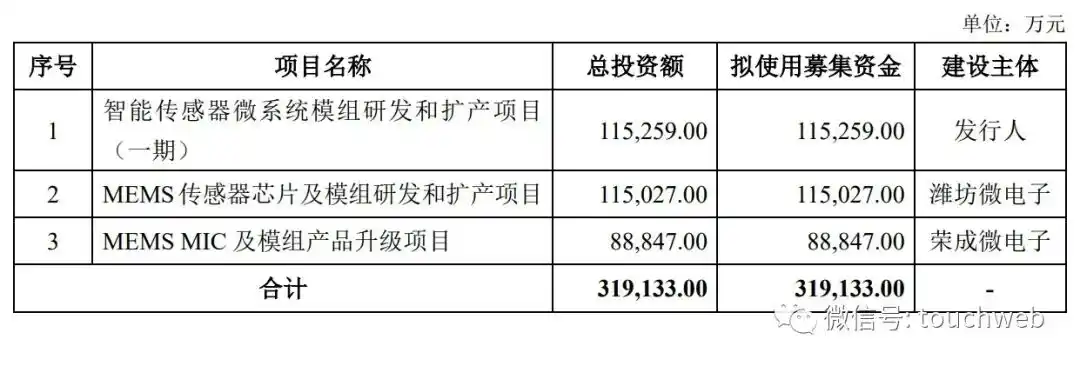
The listing journey of Goertek Micro has been tumultuous. It initially attempted to list on the Shenzhen Stock Exchange's ChiNext board. In October 2022, it even submitted a draft for the listing committee hearing, planning to raise 3.19 billion yuan, but ultimately did not succeed.
In January 2025, Goertek Micro shifted its focus to the Hong Kong Stock Exchange. After nearly two years, its listing attempt was terminated once again.

It is reported that in 2004, Goertek Micro Electronics started as a department within Goertek Inc., beginning its microelectronics business with the independent development of MEMS chips.
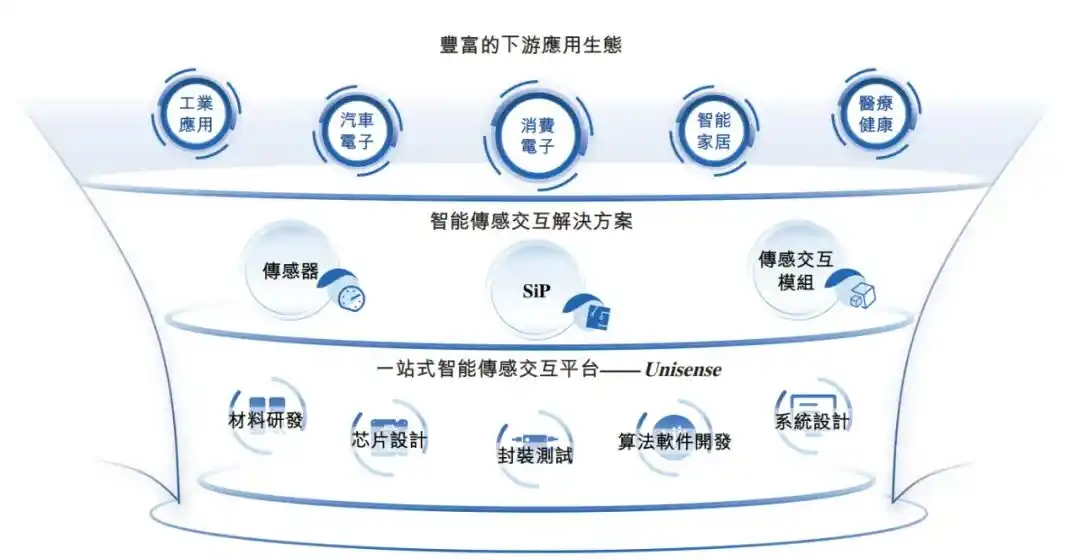
As the sole entity within the Goertek system engaged in microelectronics-related business, it is a semiconductor company primarily focused on the R&D, production, and sales of MEMS devices and microsystem modules. Its business covers key segments of the industry chain such as chip design, product development, packaging and testing, and system applications. Through vertical integration, it provides customers with a one-stop product solution of "chip + device + module".

The prospectus shows that Goertek Micro Electronics' revenue for 2022, 2023, and 2024 was 3.12 billion yuan, 3 billion yuan, and 4.536 billion yuan, respectively; gross profit was 577 million yuan, 517 million yuan, and 861 million yuan, respectively; operating profit was 306 million yuan, 213 million yuan, and 269 million yuan, respectively; profit for the period was 325 million yuan, 289 million yuan, and 309 million yuan, respectively.
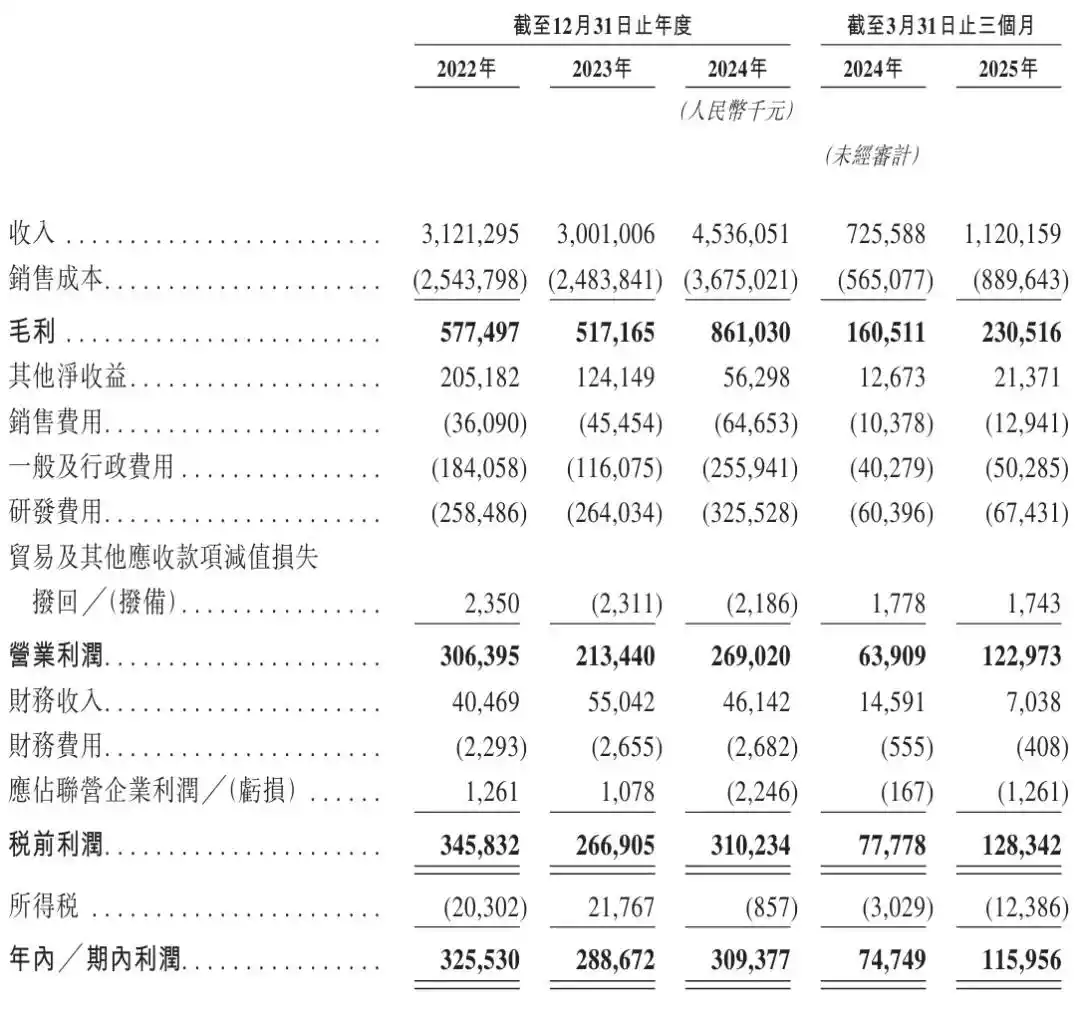
In the first quarter of 2025, Goertek Micro Electronics' revenue was 1.12 billion yuan, a 54% increase compared to 726 million yuan in the same period last year; gross profit was 230 million yuan, compared to 161 million yuan in the same period last year; operating profit was 123 million yuan, compared to 63.91 million yuan in operating profit in the same period last year; non-GAAP net profit was 116 million yuan, compared to 74.75 million yuan in non-GAAP net profit in the same period last year.

Goertek Micro Electronics' adjusted net profit for 2022, 2023, and 2024 was 379 million yuan, 254 million yuan, and 365 million yuan, respectively; the adjusted net profit for the first three months of 2025 was 133 million yuan, compared to 82.53 million yuan in adjusted net profit in the same period last year.
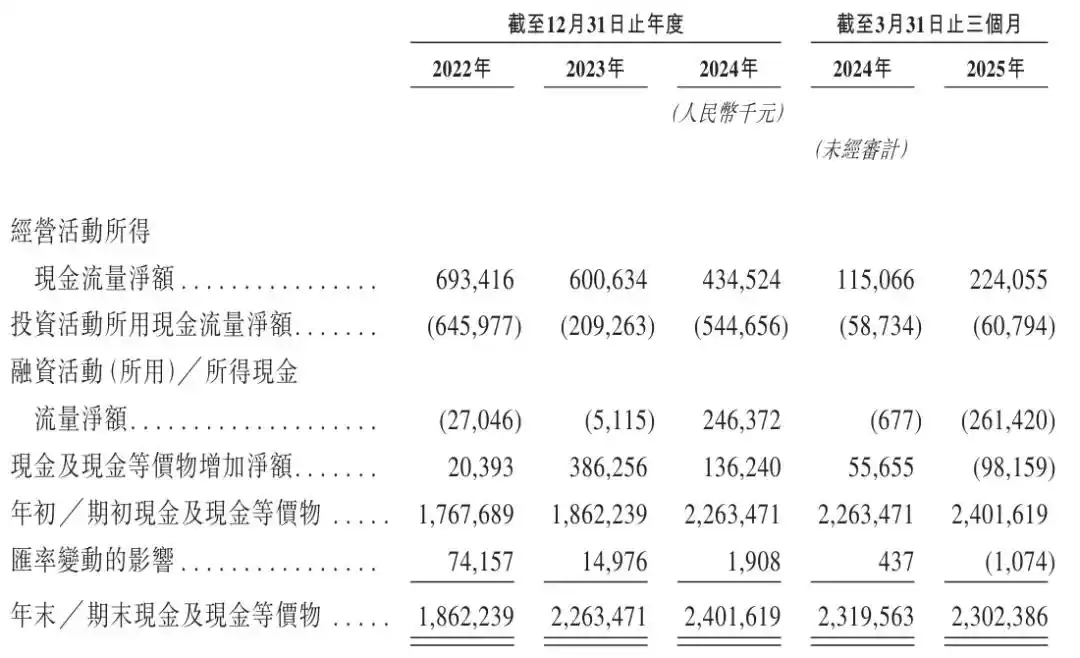
As of March 31, 2025, Goertek Micro Electronics held cash and cash equivalents of 2.3 billion yuan.

Previously Raised 19.5 Billion, Goertek Inc. is the Major Shareholder

The executive directors of Goertek Micro are Dr. Song and Ma Xinjiang; the non-executive directors are Jiang Xun and Li Yongzhi; the independent non-executive directors are Dr. Wang Qian, Dr. Peng Chunrong, and Ms. Chen Yuehua.

Goertek Micro Electronics raised 1.95 billion yuan in financing in March 2021. Among the investors, Gongqingchun Chunlin subscribed for 270 million yuan, Qingdao Henghuitai subscribed for 200 million yuan, Rongcheng Urban Construction, Shenzhen Linghui, and CITIC Securities each subscribed for 100 million yuan, Beijing Chunlin subscribed for 90 million yuan, Eden Media subscribed for 60 million yuan, CCB International Capital subscribed for 50 million yuan, CICC Qichen and China Electronics & CICC each subscribed for 45 million yuan, Guowei Runxin subscribed for 40 million yuan, and CCB Science and Technology Innovation subscribed for 20 million yuan.

The cost per share for these shareholders' subscriptions was 22.86 yuan. The actual controllers of Goertek Micro Electronics are Jiang Bin and Ms. Hu Shuangmei, who are husband and wife.

Financial reports show that Goertek Inc.'s revenue for the first half of 2026 was 40.046 billion yuan, an increase of 6.65% compared to 37.549 billion yuan in the same period last year.
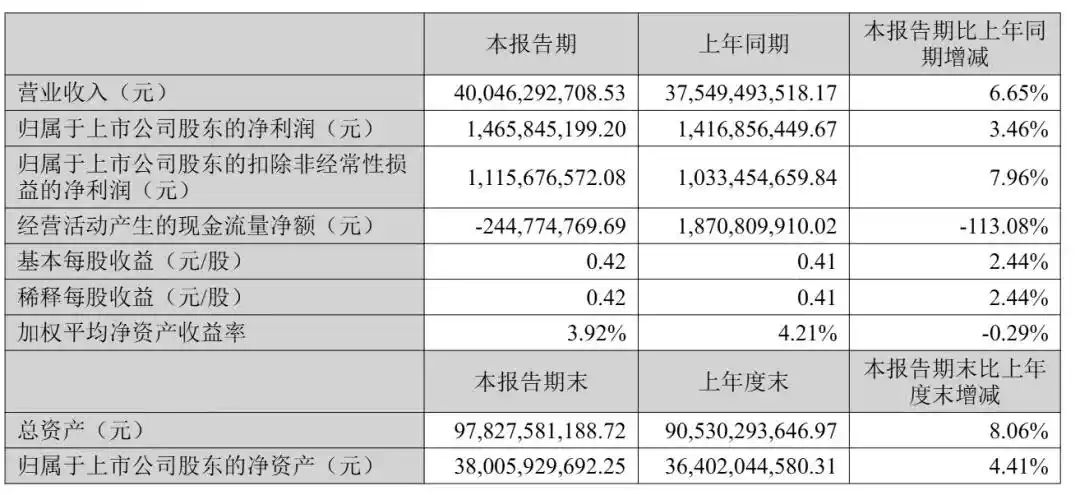
Goertek Inc.'s net profit for the first half of 2026 was 1.466 billion yuan, an increase of 3.46% compared to 1.417 billion yuan in the same period last year; non-GAAP net profit was 1.116 billion yuan, an increase of 8% compared to 1.033 billion yuan in the same period last year.

As of June 30, 2026, Goertek Group Co., Ltd. held 15.63% of the shares, Jiang Bin held 8.09%, Jiang Long held 7.05%, Hong Kong Securities Clearing Company Ltd. held 1.84%, Goertek Inc. - "Home 8" Employee Stock Ownership Plan held 1.06%, Goertek Inc. - "Home 6" Employee Stock Ownership Plan held 0.85%;
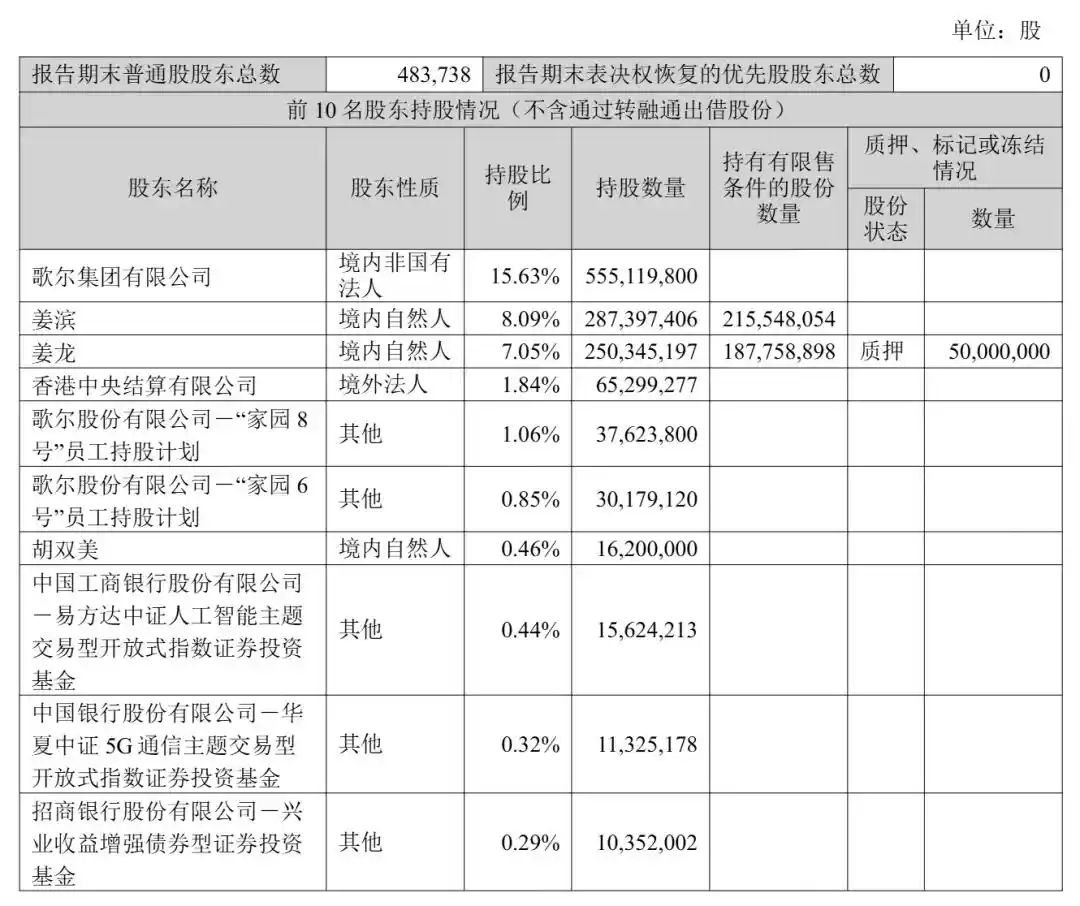
Goertek Shareholding Structure as of June 30, 2026

Hu Shuangmei held 0.46%, Industrial and Commercial Bank of China Limited - Huatai-PineBridge CSI 300 Exchange Traded Fund held 0.44%, Bank of China Limited - ChinaAMC CSI 5G Communication Theme Exchange Traded Fund held 0.32%, China Merchants Bank Co., Ltd. - Industrial Income Enhanced Bond Securities Investment Fund held 0.29%.

As of today's market close, Goertek Inc.'s stock price was 20.85 yuan, with a market capitalization of 74.2 billion yuan.

This article is from the WeChat public account "雷递" (ID: touchweb), author: Lei Jianping

Related Questions

QWhat was the primary reason given by Goertek Inc. for terminating the spinoff and listing of its subsidiary, Goertek Microelectronics, on the Hong Kong Stock Exchange?

AThe primary reason given was based on a comprehensive consideration of changes in the external environment and the development plans of both Goertek Inc. and Goertek Microelectronics, aiming to uphold the interests of shareholders and take responsibility for them.

QWhat are the two capital markets that Goertek Microelectronics has attempted and failed to list on?

AGoertek Microelectronics first attempted to list on the Shenzhen Stock Exchange's ChiNext board, and later on the Hong Kong Stock Exchange's main board, failing on both occasions.

QHow much did Goertek Microelectronics aim to raise during its 2022 attempt to list on the ChiNext board?

ADuring its 2022 attempt to list on the ChiNext board, Goertek Microelectronics aimed to raise 3.19 billion RMB.

QWhat was Goertek Microelectronics' revenue for the year 2024 according to its prospectus?

AAccording to its prospectus, Goertek Microelectronics' revenue for the year 2024 was 4.536 billion RMB.

QWho are the actual controlling persons of Goertek Microelectronics, and what is their relationship?

AThe actual controlling persons of Goertek Microelectronics are Jiang Bin and Hu Shuangmei, and they are husband and wife.

Related Reads

Strategy stock sheds 5% amid MSCI index removal, Bitcoin sell-off

Strategy (Michael Saylor's Bitcoin treasury company) fell 6.49% on Thursday to close at $114.41, after MSCI confirmed the company's removal from its global equity indexes, compounded by a broader crypto market sell-off. The removal takes effect after the Nov. 30 market close and could trigger selling by index-tracking funds; JPMorgan previously estimated roughly $2.8 billion in potential selling pressure. Ryan Kirkley, CEO of Global Settlement Network, said the decision could distinguish Bitcoin treasury companies from traditional operating businesses and limit indirect crypto exposure for passive investors, noting that index inclusion had given ordinary passive investors leveraged Bitcoin exposure they never chose. He added it raises questions about whether such companies should be classified alongside traditional operating businesses, arguing that buying and holding an asset isn't an operating business but rather a fund that doesn't follow fund rules. In its Aug. 31 response to MSCI's proposed rules, Strategy called the changes a pretext for targeting digital asset treasury companies and downplayed the impact, saying MSCI-linked funds held about 13 million of its shares, just 3.1% of basic shares outstanding. The decline coincided with a broader crypto sell-off, with Bitcoin near $71,340, down 4.3% in 24 hours, and total crypto market capitalization down 3% to about $2.49 trillion.

cointelegraph58m ago

Strategy stock sheds 5% amid MSCI index removal, Bitcoin sell-off

cointelegraph58m ago

US Justice Department, business groups and DeFi firms challenge Illinois crypto tax

The US Department of Justice, business and financial industry groups, and a coalition of DeFi firms have backed a legal challenge to Illinois' 0.2% digital asset tax, arguing it unfairly targets crypto transactions and could impose taxes even without profit. The Justice Department filed a statement of interest, while the US Chamber of Commerce and SIFMA submitted an amicus filing. A coalition including Andreessen Horowitz, Paradigm, Uniswap and Aave Labs also filed a brief. The law, enacted in June, taxes the value of digital assets exchanged, transferred or stored regardless of profit. The Digital Chamber sued Illinois officials in July, followed by a separate challenge from the Blockchain Association and Crypto Council for Innovation in August. Originally set for Jan. 1, 2027, the tax was delayed to July 1, 2027. Illinois projected $60 million in fiscal year 2027 revenue. SIFMA and the Chamber warned the tax would affect banks, broker-dealers, custodians and asset managers nationwide, exposing them to compliance costs and burdening customers—someone who loses money owes the same tax as someone who profits, and moving assets between accounts could trigger tax without a sale or gain. They argued it discriminates against digital assets and may violate federal internet tax protections and constitutional interstate commerce requirements. The DOJ said the tax undermines federal efforts to promote crypto innovation, citing the Strategic Bitcoin Reserve and GENIUS Act. The DeFi coalition warned the rules could impose obligations on software developers and blockchain participants lacking customer information or control over funds.

cointelegraph1h ago

US Justice Department, business groups and DeFi firms challenge Illinois crypto tax

cointelegraph1h ago

DTCC Plans Solana Expansion as Wallet Rules Limit Access

DTCC plans to connect its tokenization service to Solana in the second half of 2027, allowing certain securities held by its DTC subsidiary to be converted into digital tokens on the network. Analysts say the move could attract more traditional financial institutions to Solana, which is known for fast transactions and low fees and had about $4.94 billion in total value locked as of Nov. 12. However, the impact may be limited by US regulatory rules. Alex Lin of Reforge noted that Solana's experience handling memecoin trading served as a public stress test, giving the network credibility to handle retail-scale volume reliably. Still, under a December 2025 SEC no-action letter, DTC participants must register wallets to hold tokenized securities, and tokens can only be transferred between registered wallets. Lin said the near-term impact is overstated because the tokens remain in a walled garden, inaccessible to permissionless retail and DeFi liquidity until regulators allow these assets to function as true onchain collateral. DTCC launched its tokenization service on the Canton Network and its private Besu network on Oct. 28, with 20 DTC participants signed on, though it has not said whether any plan to use Solana. Kha Nguyen of Birdeye said Solana has already seen growing demand for tokenized stocks, with trading volume reaching around $4.9 billion in H1 2026 and over 1 million accounts holding tokenized stocks by late September. However, broader Solana activity has slowed, with transactions down nearly 40%, DEX volume down 34.4%, and fees down 39%, while tokenized RWA value rose almost 7% to $4.76 billion. Nguyen said DTCC's integration would need banks, brokers, and issuers to actively issue, trade, and settle on Solana, with enough liquidity for large trades. He stressed that assets must be active rather than idle—traded around the clock, used as collateral, and earning yield. Lin agreed that long-term impact depends on where assets are used for secondary trading and collateral activity, not where they are issued.

cointelegraph2h ago

DTCC Plans Solana Expansion as Wallet Rules Limit Access

cointelegraph2h ago

Trading

Spot
活动图片