Fitch Ratings flags risk for US banks with high crypto exposure

cointelegraphPubblicato 2025-12-09Pubblicato ultima volta 2025-12-09

Introduzione

Fitch Ratings warns that US banks with significant cryptocurrency exposure may face negative reassessments of their business models and risk profiles. While crypto integration can offer benefits like improved efficiency and new revenue streams, it also introduces reputational, liquidity, operational, and compliance risks. The agency notes that banks must adequately manage challenges such as crypto volatility, pseudonymity of owners, and security of digital assets. A downgrade from Fitch could lead to lower investor confidence and higher borrowing costs for these banks. The report also highlights systemic risks from the growing stablecoin market, which could impact the broader system and even the Treasury market if adoption expands sufficiently. Major banks like JPMorgan and Bank of America are mentioned as being involved in the sector.

International credit rating agency Fitch Ratings has warned that it may reassess US banks with “significant” cryptocurrency exposure negatively.

In a report posted on Sunday, Fitch Ratings argued that while crypto integrations can boost fees, yields and efficiency, they also pose “reputational, liquidity, operational and compliance” risks for banks.

“Stablecoin issuance, deposit tokenization and blockchain technology use give banks opportunities to improve customer service. They also let banks leverage blockchain speed and efficiency in areas such as payments and smart contracts,” Fitch said, adding:

“However, we may negatively re-assess the business models or risk profiles of U.S. banks with concentrated digital asset exposures.”

Fitch stated that while regulatory advancements in the US are paving the way for a safer cryptocurrency industry, banks still face several challenges when dealing with cryptocurrencies.

“However, banks would need to adequately address challenges around the volatility of cryptocurrency values, the pseudonymity of digital asset owners, and the protection of digital assets from loss or theft to adequately realize the earnings and franchise benefits,” said Fitch.
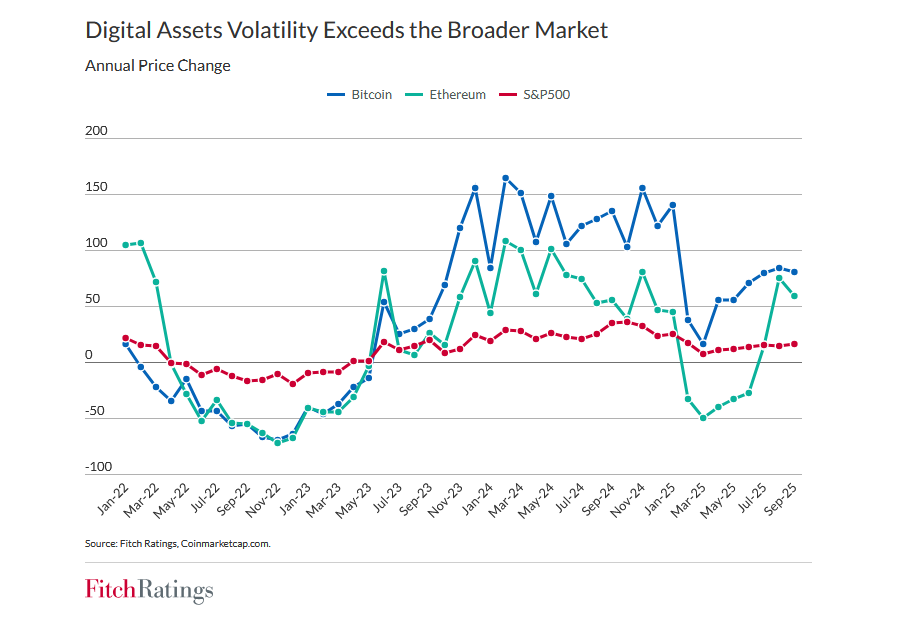
Bitcoin and Ether volatility vs S&P 500. Source: Fitch Ratings

Fitch Ratings is one of the “Big Three” credit rating agencies in the US alongside Moody’s and S&P Global Ratings.

The ratings from these firms — which can be controversial — carry significant weight in the financial world and impact how businesses are perceived or invested in from an economic viability perspective.

As such, Fitch’s downgrading the ratings of a bank with significant crypto exposure could result in lower investor confidence, higher borrowing costs and challenges to growth.

The report highlighted that several major banks, including JPMorgan Chase, Bank of America, Citigroup, and Wells Fargo, are involved in the crypto sector.

Fitch highlights systemic stablecoin risks

Fitch argued that another risk could come from the explosive growth of the stablecoin market, especially if it becomes large enough to influence other areas and institutions.

“Financial system risks could also increase if adoption of stablecoins expands, particularly if it reaches a level sufficient to influence the Treasury market.”

Related: Crypto, TradFi sentiment improves: Will Bitcoin traders clear shorts above $93K?

Moody’s also recently highlighted potential systemic risks of stablecoins in a report from late September, arguing that widespread adoption of stablecoins in the US could ultimately threaten the legitimacy of US dollar.

“High penetration of USD-linked stablecoins in particular can weaken monetary transmission, especially where pricing and settlement increasingly occur outside the domestic currency,” Moody’s said.

“This creates cryptoization pressures analogous to unofficial dollarization, but with greater opacity and less regulatory visibility,” it added.

Magazine: When privacy and AML laws conflict: Crypto projects’ impossible choice

Letture associate

JPMorgan's 2026 Global Investment Outlook: Economic 'K-Shaped Divergence' Continues; AI Adoption Soars

JPMorgan's 2026 Global Investment Outlook highlights a continued "K-shaped" economic divergence in the U.S., where high-income groups and technology sectors benefit significantly, while middle- and lower-income populations and interest-rate-sensitive industries face ongoing pressure. The U.S. economy is expected to remain resilient, supporting risk assets like equities and corporate credit, though cyclical momentum is limited. The Federal Reserve will continue normalizing interest rates cautiously amid potential volatility. Key investment themes include balancing portfolios across stocks, bonds, and alternative assets to capture structural opportunities and diversify returns. Three critical questions for investors are whether stocks are overvalued, if profits can remain strong, and whether AI-related stocks are in a bubble. Growth stocks, particularly in technology, remain attractive due to strong earnings, while consumer stocks lag due to tax and spending pressures. AI beneficiaries extend beyond innovators to enablers (industrials, utilities) and adopters (finance, healthcare). Fixed income investments should focus on high-quality assets, with longer-duration bonds offering potential upside if rates decline. Despite a recent increase in international equity allocations, U.S. equities remain overweighted. The "60/40" stock/bond model is evolving into "60/40+" by incorporating alternatives for lower correlation and reduced volatility. Structural improvements in international markets and a weaker dollar support non-U.S. equities. Investors are advised to emphasize selectivity, diversification, and active management in a complex macro environment.

cointelegraph_中文25 min fa

JPMorgan's 2026 Global Investment Outlook: Economic 'K-Shaped Divergence' Continues; AI Adoption Soars

cointelegraph_中文25 min fa

Trading

Spot
Futures
活动图片