Fields Medalist Cries: AI Has Destroyed My Research Field

marsbitPublished on 2026-10-12Last updated on 2026-10-12

Abstract

Fields Medalist Hugo Duminil-Copin expressed distress over OpenAI's recent public release of over 700 AI-generated mathematical manuscripts, which targeted 16 problems within his research area. He likened the impact of such AI proofs to a "nuclear blast" on the mathematical landscape. OpenAI published 722 manuscripts on GitHub, comprising 377 new proofs, with about a third addressing major conjectures. The results were generated by an internal model, with an average computational cost equivalent to ChatGPT Pro reasoning for three hours per result. Some manuscripts were later found to contain errors, leading to the withdrawal of three papers. The release raises concerns about the value of mathematical research, which traditionally involves the exploratory process of developing new concepts and tools. AI-generated proofs risk skipping this crucial creative and intuitive development phase. Furthermore, young mathematicians and PhD students, whose careers depend on solving specific problems, are particularly vulnerable if AI preempts their research topics. There are also fears that the culture of free academic exchange could diminish, as researchers may withhold preliminary ideas to prevent AI companies from leveraging them. Additionally, some AI proofs combine concepts in unconventional, "alien" ways that, while correct, differ from human intuition. This suggests a potential shift in how scientific knowledge is produced, moving beyond traditional human thought patterns.

"They have completely destroyed my research field."

Recently, Hugo Duminil-Copin, the 2022 Fields Medal-winning French mathematician, lost his composure.

"On Tuesday night, I cried and woke up my daughter."

The trigger was a batch of results released by OpenAI. Over 700 AI-generated mathematical manuscripts were made public. Among them were 16 problems in the very direction Hugo Duminil-Copin had been focusing on for a long time.

Before this, Hugo Duminil-Copin had likened the impact of AI-generated proofs to a "nuclear explosion." Each time AI solves a major problem, the landscape of mathematics suffers an impact, and the space for humans to continue exploring shrinks accordingly.

OpenAI's concentrated release of hundreds of results this time has been described by some mathematicians as a "carpet bombing."

A "Carpet Bombing"

On October 6, OpenAI publicly released 722 mathematical manuscripts on GitHub, belonging to 372 result families. A result family may include a core proof, supporting arguments, corollaries, and alternative proofs.

It was disclosed that this batch of manuscripts contains 377 new proofs. About one-third involve important conjectures of wide interest in the mathematical community, another third hold significant value in their respective sub-fields, and the remainder are mainly smaller results or variants of existing proofs.

OpenAI stated that the vast majority of these results were generated by the same yet-to-be-released internal model. The model began training on August 28, and the computational cost for each result is, on average, equivalent to ChatGPT Pro thinking for about 3 hours.

However, after the release, multiple mathematicians discovered that some manuscripts might not truly prove the conclusions they claimed. Even if a proof passes the Lean formal verification, it only indicates that the logic within the formalized proposition holds, and cannot automatically guarantee it accurately corresponds to the original argument in the natural language manuscript.

Two days after the release, OpenAI withdrew three papers containing errors; 719 papers remain in the repository.

How is the Value of Mathematical Research Measured?

The value of mathematical research has never been limited to the final proof.

In the process of searching for a proof, researchers propose new concepts, create new tools, and discover connections between different fields. A failed attempt may also open a doorway to another problem.

Hugo Duminil-Copin once mentioned that while tackling a certain probability theory conjecture, he experienced multiple failures. These failures generated a wealth of new ideas, later used in other research and leading to unforeseen discoveries.

AI directly providing proofs might skip this exploration process.

The 20th-century mathematician William Thurston reflected that after he quickly proved a batch of theorems, the related research direction gradually lost attention. As researchers left, the intuition, experience, and communication networks accumulated in that field also began to dissipate. In his view, mathematical knowledge exists not only in papers but also in the minds of researchers and within the academic community.

Young Mathematicians Are the First to Be Affected

In the past, supervisors would choose a problem for graduate students expected to be solvable within a few months. Students would train their intuition through repeated attempts, gradually learning to handle more abstract and complex research. Today, such problems used to train young researchers might be quickly completed by models.

Mathematicians with stable positions can change direction. PhD students and postdocs do not have the same ample time. Their dissertations, positions, and career prospects often rely on a few research problems. Once preempted by AI, years of accumulation may lose their value.

Open communication may also be affected. Mathematicians are accustomed to sharing immature ideas at conferences, in emails, and discussions. If AI companies can collect these clues and then have models concentrate on tackling them, researchers might reduce public discussion.

Hugo Duminil-Copin worries that the culture of free exchange upon which mathematics thrives is fracturing.

"Alien Mathematics"

While reviewing an AI-generated proof, one netizen also discovered that the model combined two ideas that were rarely connected before. The proof was completely correct and verifiable, but the line of reasoning seemed unfamiliar. Some called it "alien mathematics."

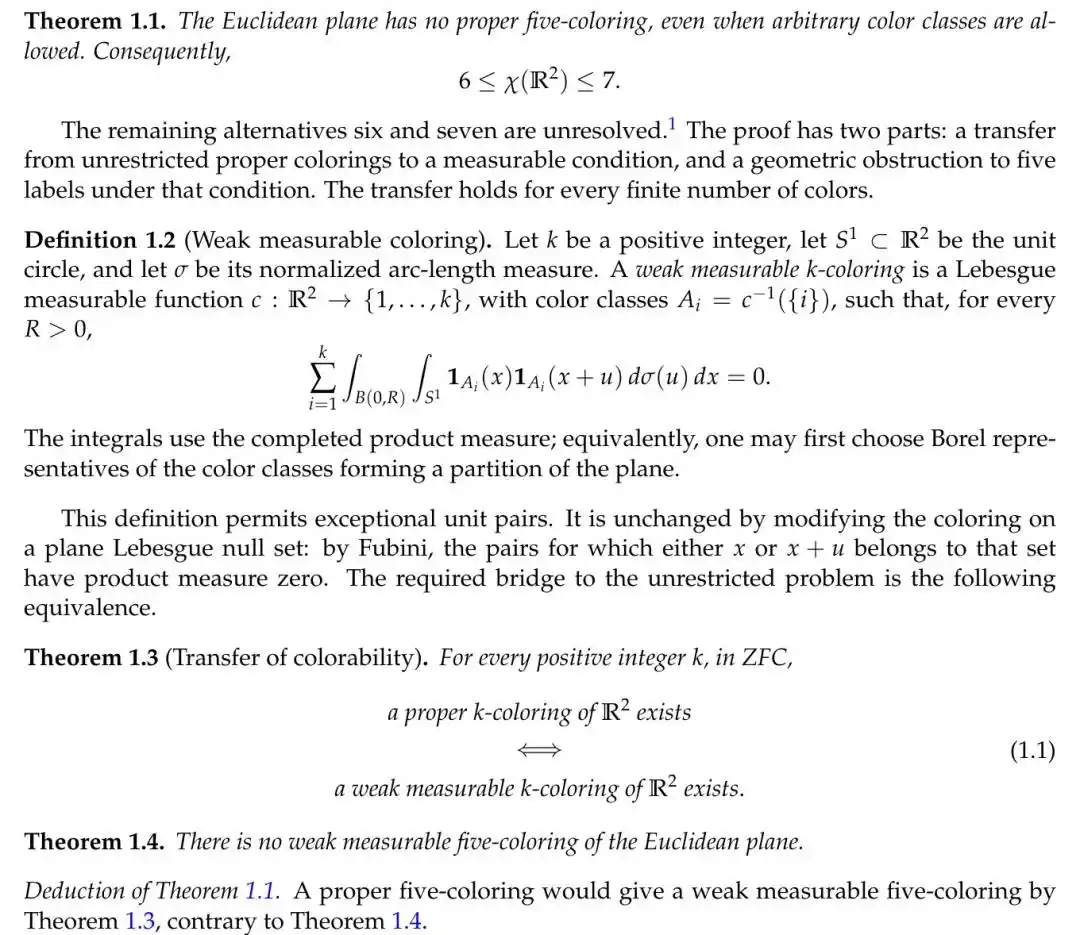
The netizen believes similar phenomena may soon appear in physics, chemistry, materials science, medicine, and engineering.
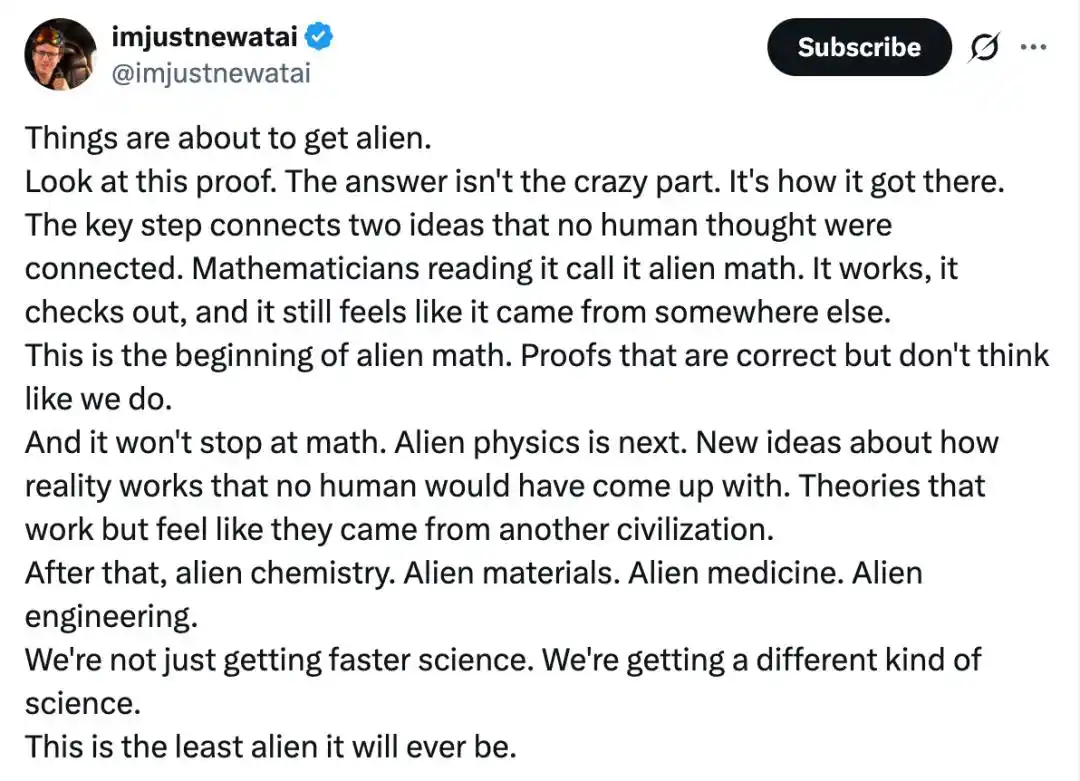
The mode of scientific output is changing, and new research paths may no longer completely follow existing human thought habits.

Today might be the least "alien" moment for science.

References:

https://www.theatlantic.com/technology/2026/10/openai-math-proofs-future/688940/

https://x.com/miniapeur/status/2109237567832949109

https://x.com/haider1/status/2109353337489 645622

https://x.com/imjustnewatai/status/2109102057885991250

This article is from the WeChat public account "Machine Heart" (ID: almosthuman2014), author: Yang Wen


Related Questions

QWhat caused mathematician Hugo Duminil-Copin to become emotional and cry?

AHugo Duminil-Copin, a Fields Medal winner, became emotional and cried after OpenAI publicly released over 700 AI-generated mathematical manuscripts, with 16 of the problems falling precisely within his long-term research area.

QHow did some mathematicians describe OpenAI's release of hundreds of mathematical results?

ASome mathematicians described OpenAI's concentrated release of hundreds of results as a 'carpet bombing' of the mathematical landscape.

QWhat potential negative impact does AI-generated proof have on young mathematicians and academic culture?

AAI-generated proofs threaten the training problems for young researchers like PhD students, potentially devaluing years of their work. It may also harm the free exchange of ideas, as researchers might become hesitant to share preliminary thoughts for fear of AI companies using those ideas to rapidly generate solutions.

QWhat was the term used to describe the unfamiliar reasoning style found in some AI-generated proofs?

AThe unfamiliar and surprising reasoning style found in some AI-generated proofs was referred to as 'alien mathematics'.

QAccording to the article, what did 20th-century mathematician William Thurston believe about mathematical knowledge beyond published papers?

AWilliam Thurston believed that mathematical knowledge is not only contained in published papers but also resides in the minds of researchers and within the academic community, encompassing intuition, experience, and communication networks.

Related Reads

Tech Veteran: Anthropic IPO Will Be the Peak of the US AI Rally, Will "Go Big on China AI" If Conditions Allow

Veteran tech investor Jack Selby, head of Copper Sky and managing partner of Peter Thiel's family office, warns that Anthropic's planned IPO—aiming to raise up to $100 billion—could mark the peak of the AI market rally. He cautions that if the highly anticipated IPO prices well below expectations, the expiry of lock-up periods could trigger significant selling pressure and a large-scale AI market correction. Selby names SoftBank and Oracle as "canaries in the coal mine," flagging Oracle's higher debt ratio as a bigger risk, and suggests investors needing AI exposure consider Google instead. Selby also questions Anthropic's fundamentals: over 80% of its revenue is non-recurring and vulnerable to competitors closing the technology gap within six to nine months. He notes the business is extremely capital-intensive—requiring costly data, energy, data centers, and chips—and that with interest rates no longer near zero, calling it a trillion-dollar company seems far-fetched. He further highlights Chinese competition, saying DeepSeek and other Chinese AI models trail Anthropic by only about six months, posing a direct threat. Selby says he would "aggressively go long on Chinese AI" if conditions allow, arguing that Anthropic cannot claim all its business must rely on U.S. models, since most AI use cases resemble basic tool applications, leaving room for Chinese alternatives.

marsbit2h ago

Tech Veteran: Anthropic IPO Will Be the Peak of the US AI Rally, Will "Go Big on China AI" If Conditions Allow

marsbit2h ago

Grayscale's $1 Million Sponsorship Can't Save It: Why ZEC, Once Hyped as the Belle of the Ball, Crashed Again?

Grayscale announced a $1 million ecosystem sponsorship for Zcash on November 10, pledging to return all first-year management fees from its Zcash ETF (ZCSH) to network development and marketing, with the first $100,000 distributed to four nonprofit organizations. Yet the same day, ZEC plunged 11.3% to around $1,043, extending its 30-day decline to nearly 20%. After two months of hype from overseas KOLs and institutions touting ZEC as a "second spring for old coins," the token quickly turned into a slow bleed under the weight of $2.3 billion in open interest. The article argues that Wall Street's narrative halo and Grayscale's PR subsidy have been exhausted, and ZEC—lacking fundamental support—has once again become an ATM for highly leveraged speculators to cash out on good news. Grayscale's pledge, while seemingly generous, is voluntary and can be modified or terminated at any time; only $400,000 of the $1 million has actually been paid, making it more brand marketing for its own ETF than genuine ecosystem donation. The sum is negligible relative to Zcash's market cap, and the Zcash ETF has not attracted sustained institutional capital the way Bitcoin or Ethereum ETFs did. Without new external liquidity, the inflated narrative cannot hold. The core problem is market structure: ZEC perpetual futures open interest stands at roughly $2.3 billion, dominated by high-volatility leveraged gamblers. The article contends that the earlier social media hype was a precise harvest of derivatives liquidity—promoters used the "first privacy ETF" theme to lure retail into leveraged longs, then exited as open interest peaked and the sponsorship news landed. Compounding this, Zcash's privacy pool suffered a critical vulnerability about three months before the ETF listing, halving the price and shattering conservative investors' confidence despite a July fix. The piece concludes that "old coin re-hype" follows a familiar script: find a traditional-finance-approved angle, package a grand revaluation narrative, use KOLs to drive retail buying, then distribute chips at peak liquidity. Those who hyped ZEC have largely cashed out, leaving behind a broken price and $2.3 billion in unsettled leverage. Grayscale's advertising cannot save Zcash; a real revival requires far more than Wall Street's charity.

marsbit3h ago

Grayscale's $1 Million Sponsorship Can't Save It: Why ZEC, Once Hyped as the Belle of the Ball, Crashed Again?

marsbit3h ago

Trading

Spot
活动图片