The Ethereum Foundation has identified two proposals that "must" be included in the Hegotá upgrade, prioritizing censorship resistance and more flexible account authentication as the scope of the hard fork is narrowed.
The evaluation considered 62 Ethereum Improvement Proposals (EIPs) with input from approximately 60 researchers and engineers from the Foundation's protocol guild. This is the first time the Foundation's protocol guild has published a unified view on proposed EIPs instead of separate opinions from different teams.
The two proposals that must be included are EIP-7805, known as FOCIL, and EIP-8141, or Frame Transactions. The Foundation called them key proposals for the consensus and execution layers of Hegotá, respectively.
FOCIL aims to enable users to include eligible transactions without relying on centralized block builders, enhancing Ethereum's resistance to transaction censorship.
Frame Transactions are intended to introduce native account abstraction and create a path to quantum computer attack-resistant authentication. Together with two related proposals, this change could also provide protocol building blocks for privacy applications.
The "must" designation means these two proposals essentially define the upgrade. The Foundation stated that if either is at risk, the Hegotá schedule should be adjusted before dropping the proposal.
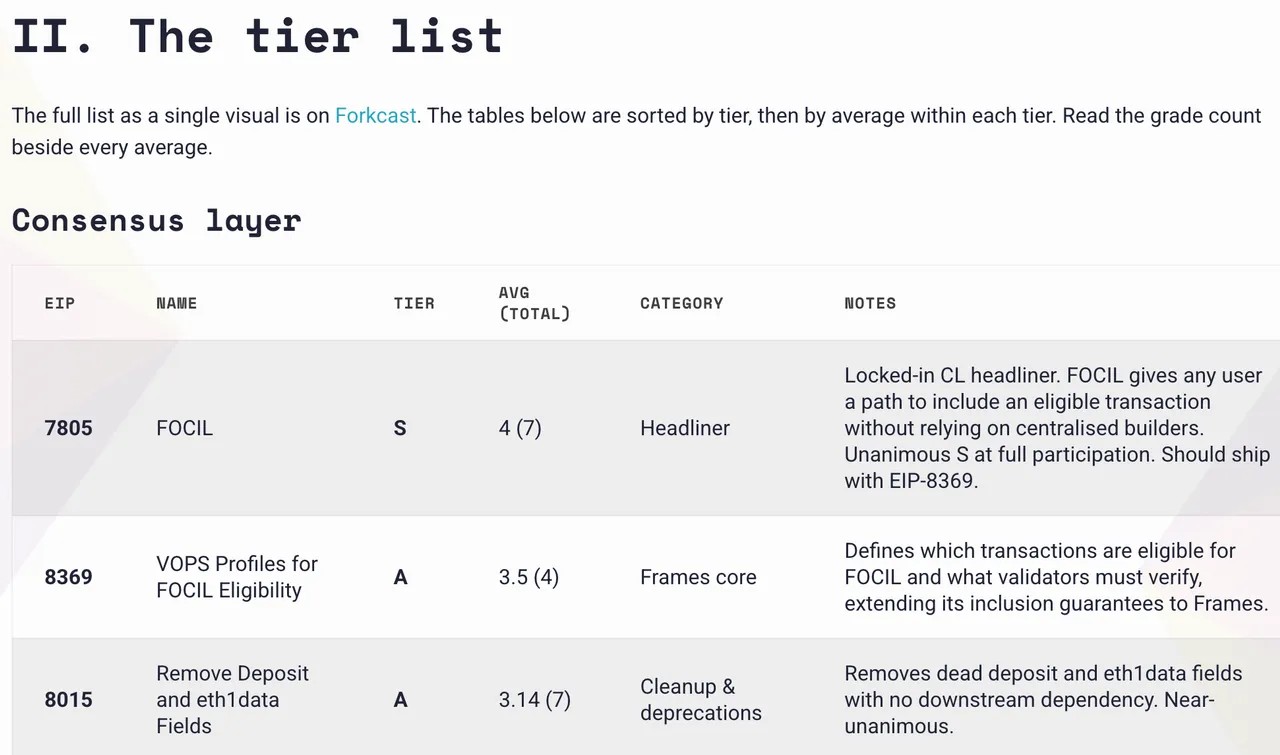
FOCIL tops the list of proposals for the Hegotá consensus layer. Source: Ethereum Foundation
Related: Bitmine Now Controls 4.9% of Ethereum Supply After Adding 53.5k $ETH
Hegotá Scope Still Being Refined
Beyond the two key proposals, the Foundation placed 15 proposals in Category A, meaning they are expected to be included unless development or testing constraints force the list to be shortened. Another eight remain candidates for inclusion, seven were placed below the line but not excluded, and 28 were rejected.
Two proposals have not yet been rated—pending data from mainnet regarding Glamsterdam, the Ethereum upgrade preceding Hegotá, aimed at enhancing scalability and strengthening the network's base layer. According to the Foundation, client teams could begin implementing Hegotá in late 2026, following Glamsterdam.
Ethereum's last major upgrade, Fusaka, launched on December 3, 2025, and brought the network a series of scalability and usability improvements. Its key feature, PeerDAS, changed how nodes handle rollup data, reducing the amount of data each node needs to download and upload while simultaneously increasing data throughput for Ethereum's Layer 2 networks.
Journal: BTC to Reach $1M by 2030... But Arthur Hayes Is Buying $ETH Instead
end-content