Author: Chainalysis Team
Compiled by: Shenchao TechFlow
Shenchao Introduction: As the world's most dominant crypto market, North America has accumulated a staggering $3.02 trillion on-chain economic volume over the past year. The North America chapter of Chainalysis's latest "2026 Global Crypto Geography Report" reveals three profound paradigm shifts: AI agent autonomous commerce, represented by the x402 protocol, is rapidly crossing from the experimental phase, with the United States firmly occupying the core with an 88.1% share of model inference; in terms of macro capital flows, the United States is exhibiting a two-way scissors gap of "large-scale net imports of Bitcoin and massive global exports of digital dollars"; meanwhile, Canada, driven by its large immigrant population, has risen to become the G7's largest P2P economy, with annual remittance volume surging 141%. The entire piece presents a grand panorama of "the United States building the underlying infrastructure, the world absorbing real demand" through detailed on-chain data.
Report Core Summary
1. Regional Dominance: In the rolling 12 months ending July 1, 2026, North America, with a total crypto economic value of $3.02 trillion, continues to hold its position as the world's most influential crypto center. Its breakthroughs in agentic commerce, dollar stablecoin exports, and real-world asset tokenization (RWA) are profoundly shaping the global landscape.
2. Divergent U.S.-Canada Performance: The U.S. crypto economy reached $2.78 trillion, with a modest year-over-year decline of 2.2% (fully in line with cyclical adjustment expectations); while Canada's crypto economy expanded against the trend by 2.3%, with a total exceeding $247.7 billion.
3. Agentic Commerce Explosion: The commercial form of AI agents using crypto rails for autonomous payments is experiencing explosive growth, with the United States providing the core technological construction hub in this wave.
4. Canada Leads G7 in P2P: Driven by the rigid demand of its large immigrant community, Canada has become the strongest peer-to-peer (P2P) crypto economy in the Group of Seven (G7). Stablecoin cross-border remittances to countries such as India, China, and the Philippines reached $2.36 billion in this period, surging 141% year-over-year.
North American Crypto Economy Panorama: $3 Trillion Scale and Institutional Resilience
In the 12-month statistical period ending July 1, 2026, North America remains the undisputed bellwether of the global crypto asset market. The United States' deep institutional investor base has supplied abundant capital, regulators have gradually streamlined rules, stablecoins provide a native circulating currency, and traditional financial giants are integrating crypto infrastructure into the mainstream with unprecedented depth. In Chainalysis's "Big-Money Index," which measures countries' absolute crypto strength, the United States and Canada unsurprisingly took the top spots. Together, they generated a total crypto economic value of $3.02 trillion, only a slight retracement of 1.9% from the previous cycle.
This slight decline is mainly due to a minor adjustment in the U.S. market. As the world's single largest crypto market, the United States' $2.78 trillion volume has demonstrated remarkable resilience amid a severe market cycle, almost completely preserving the massive gains from the near-doubling during the 2025 bull market cycle. The institutionalization of spot Bitcoin ETFs, the accelerated advancement of RWA tokenization, and the large-scale penetration of compliant stablecoins have built an unbreakable supporting force.
Chart: Evolution of North American crypto economic scale by statistical period. The 2026 cycle total scale reached $3.02 trillion.
Hoolie Tejwani, Head of Coinbase Ventures, pointed out: "Compared to 2025, what we are witnessing today is essentially deep industry maturation. The foundational building blocks laid in 2025 are fully transforming in 2026 into hardcore products with real active users, real liquidity, and real commercial markets."
This report deeply dissects the three pillar businesses incubated under U.S. leadership: AI commerce, dollar stablecoins, and tokenized assets; at the same time, it focuses on the Canadian market, revealing how its immigrant population has spawned a highly vibrant peer-to-peer cross-border financial system.
The U.S. Leads the On-Chain AI Economy: The Rise of Agentic Micropayments
The United States' absolute leading advantage in the AI R&D race is comprehensively spilling over and restructuring the underlying ecosystem of cryptocurrency. Autonomous software agents have already begun directly paying for computing power and services on the blockchain, and the United States has become their most core architectural builder. Domestic core enterprises including USDC issuer Circle and x402 protocol incubator Coinbase are working together to build the agentic financial network. Will Su, Head of Digital Asset Research at global asset management giant BlackRock, explicitly stated that BlackRock is closely watching this track, "AI agents have the potential to stimulate enormous real demand for 24/7, high-frequency, micro-payments on a global scale."
Statistics show that by the end of the 2026 cycle, on the Base network, the most mainstream public chain for agentic commerce, the cumulative number of x402 protocol transactions had officially surpassed 138 million.
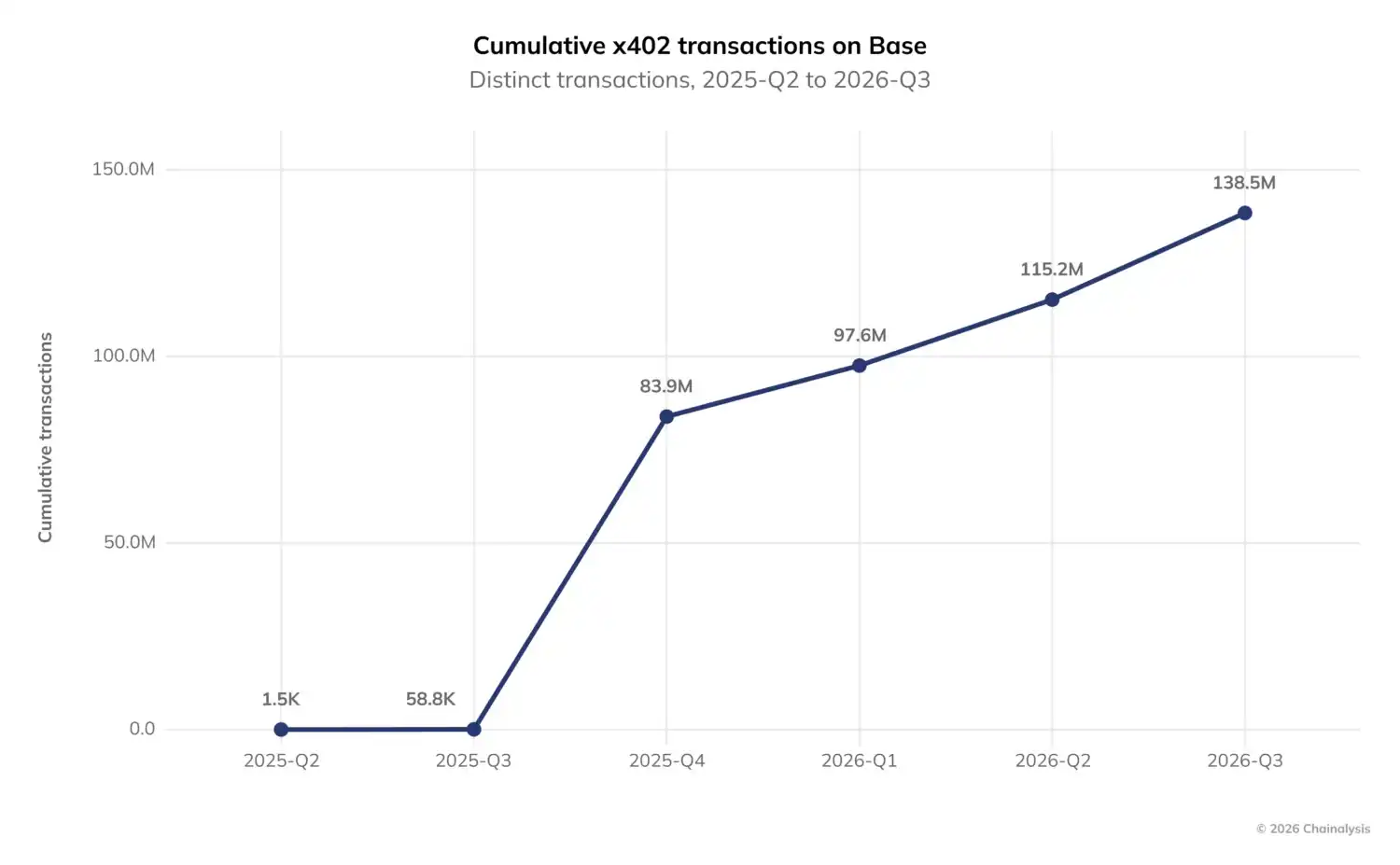
Chart: Cumulative x402 protocol transaction count growth curve on Base chain, surpassing the 138 million mark.
On-chain payments have completely activated micropayments that traditional bank card clearing networks cannot bear. In the traditional credit card ecosystem, transactions below $1, especially below 1 cent, are completely uneconomical as they cannot cover channel costs. However, in on-chain stablecoin networks where the per-transaction settlement cost is far below 1 cent, small-scale interactions between machines become entirely feasible, thereby opening a new era of massive on-demand data and API procurement.
Circle describes this new ecosystem as a clear binary division of labor: "Traditional card organization rails handle large-value consumer payments triggered by humans, while stablecoin rails specifically handle millisecond-level automatic clearing between machines for amounts too small for card networks."
Over the 16-month long period ending September 2026, more than 87% of x402 transaction amounts fell between 0.01 cents and 10 cents, with the most concentrated transaction amount range being 1 to 10 cents, exhibiting extremely pure micropayment characteristics.
From Trial to High Stickiness: The Qualitative Inflection Point of the AI Payment Ecosystem
Although agentic commerce is still in its early exploration stage, a series of on-chain indicators have clearly demonstrated its astonishing improvement in stickiness. In the early days of x402, users were mostly one-time trial experiences, leaving once tokens were depleted; now, this behavioral pattern has completely reversed.
We tracked agent wallets by cohort based on first funding time: among wallets first funded in Q3 2025, the proportion that received a second funding within 30 days was 70.6%; by the new wallet cohort in Q2 2026, this top-up ratio had surged to 89.3%. On-chain, recharging a wallet whose balance is running low is equivalent to a user choosing to actively renew a subscription after receiving their first bill. This indicates that more and more developers and institutions have found genuine essential value in the x402 protocol.
At the same time, the interval between wallet funding and usage has undergone dramatic time compression. At the end of 2025, the median time interval from a wallet receiving initial funding to first initiating an x402 payment was as high as 73 days; by Q3 2026, this interval had plummeted to an astonishing 18 minutes.
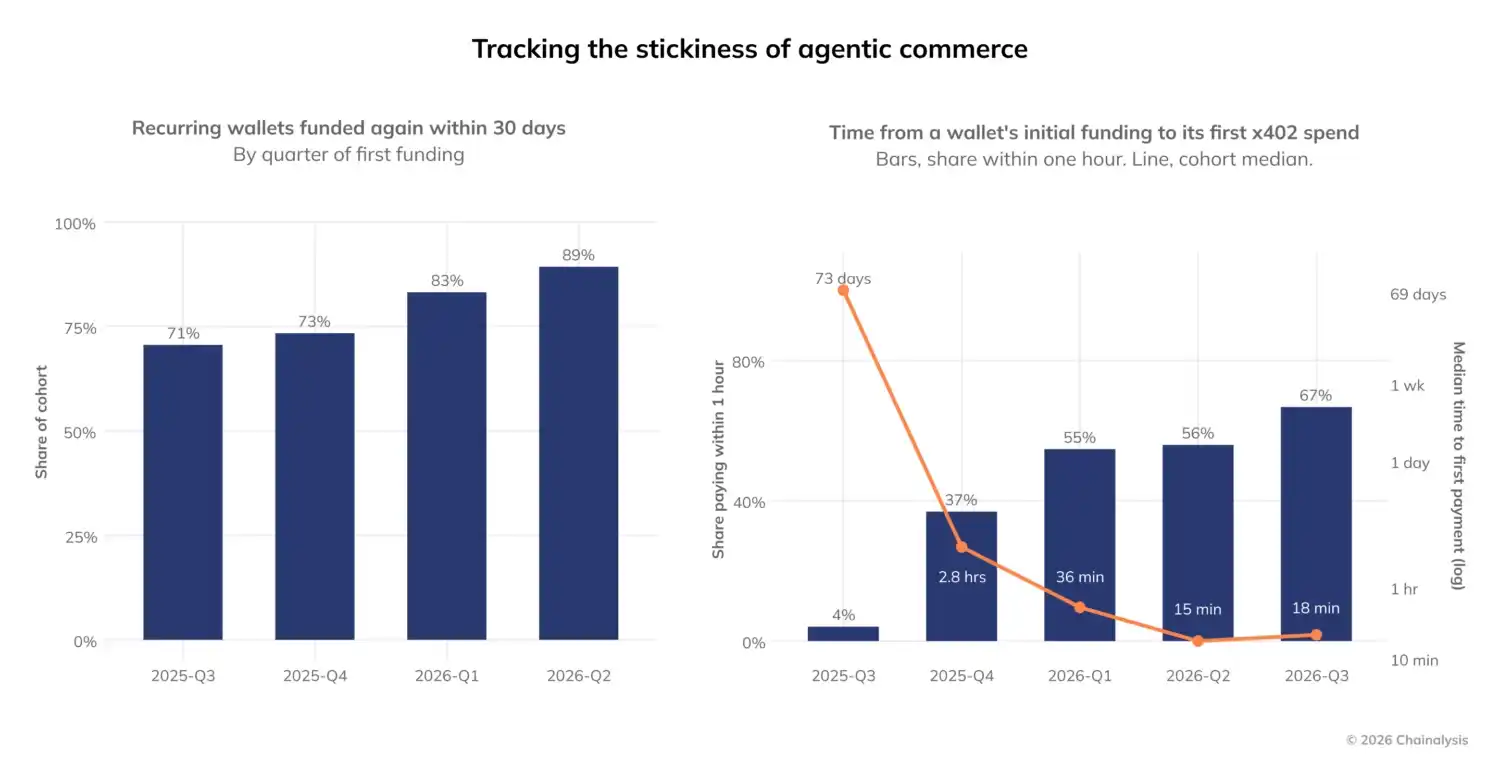
Chart: Evolution of agentic commerce stickiness: the proportion of wallets initiating consumption within 1 hour of first funding surged from 4% to 67%.
The proportion of wallets that immediately initiate calls within 1 hour of funding skyrocketed from only 4% a year ago to 67% today. A full two-thirds of new wallets begin operations the moment they receive funds. People are no longer funding to hoard coins or wait and see, but to execute specific productive tasks already queued up.
What Exactly Are AI Agents Buying? Model Inference and Code Auditing
Tejwani of Coinbase Ventures emphasized: "AI agents are evolving into completely independent economic actors, and each agent is essentially a brand new 'real user' of the blockchain network." So, where exactly are these bots spending their money on-chain?
Early on, there was a brief period filled with speculative token hype, but as the ecosystem evolved, funds now flow almost entirely to information-intensive professional services. Millions of on-chain micropayments flow precisely to code auditing, financial intelligence, and data and search API interfaces. Agents are extremely hungry for machine-readable structured data.
Particularly noteworthy is that bots are paying for bots: within the x402 protocol, one of the largest core expenditure categories is precisely "Model Inference."
The China-U.S. Landscape of AI-to-AI Commerce: The U.S. Monopolizes Inference, China Deepens Security
Among geographically traceable agent-to-services transactions, the United States ranks first globally with a 30% total share. In foundational model inference transactions, U.S. wallets exclusively hold an overwhelming 88.1% share of the entire network, 41.8% in agent frameworks and tool directories, and 23.2% in data and search APIs, firmly building the underlying technology stack for agentic software.
Chart: Horizontal comparison of U.S. and global transaction shares across various AI commerce sub-sectors.
In sharp contrast, agent wallets associated with China demonstrate extremely high dominance in the code security field: of the funds flowing into "security and code analysis," a full nine-tenths (90%) come from China-related wallets, with the majority flowing to AgentLISA, a service that uses large models to audit smart contracts. In addition, Chinese teams hold a 46.7% share in market financial intelligence and a 35% share in settlement rails. However, on the model inference payment side, Chinese wallets account for a negligible 0.1%.
This huge difference stems from AI localization ecosystems and economic realities: Chinese open-source models (such as DeepSeek and Qwen) are widely deployed locally for free domestically, while U.S. frontier closed-source large models (ChatGPT, Claude) charge strictly by token. Therefore, the market that needs to pay real money to call inference is mainly driven by Europe and America, while security auditing and arbitrage tools bloom globally.
At the regulatory compliance level, the ultra-high frequency and tiny amounts of machine transactions have completely overturned the traditional per-transaction anti-money laundering risk control system. Compliance logic must shift from transaction-by-transaction screening to a comprehensive systemic reshaping of agent deployers, funding events, API recipient reputation, and behavioral pattern anomaly identification.
The Great Capital Divide: The U.S. Imports Digital Gold, Exports Digital Dollars
Since the U.S. Congress passed the GENIUS Act in mid-2025, dollar stablecoins have officially become the globally legal digital dollar export channel. Over the past year, the United States has exhibited a distinct two-way flow characteristic: on one hand, it has massively exported dollar stablecoins globally; on the other hand, it has itself been massively buying and locking up Bitcoin.
Since spot ETFs were approved in early 2024, the United States' share of global Bitcoin flows has continued to climb. In contrast, stablecoins' proportion of U.S. domestic crypto activity has gradually narrowed, while in international markets outside the United States, stablecoin usage has been increasing exponentially.
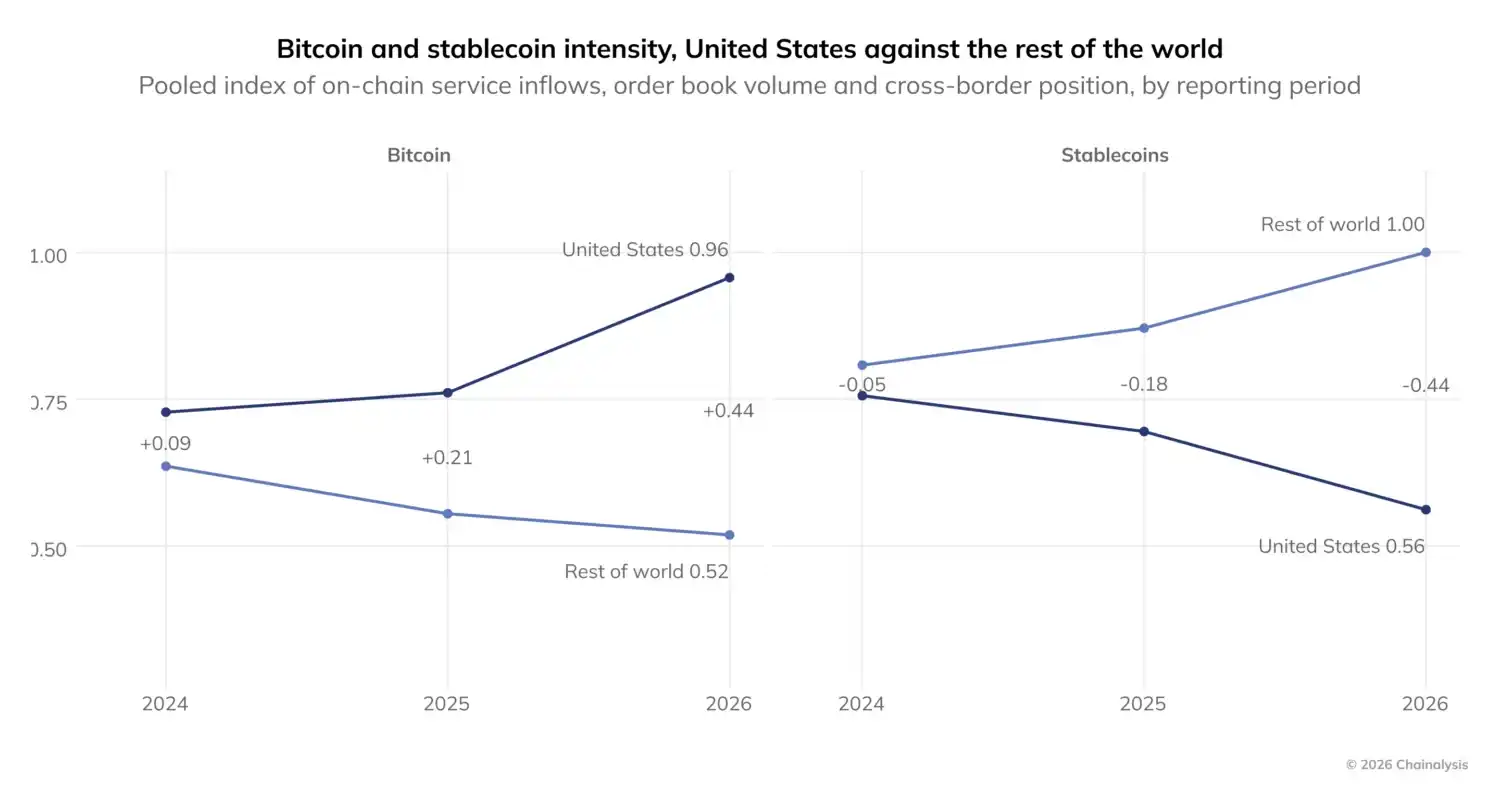
Chart: Bitcoin and stablecoin usage intensity divergence indicator. The U.S. domestically strengthens Bitcoin hoarding, while the overseas world fully embraces dollar stablecoins.
BlackRock's Will Su analyzed: "At a time when government debt and fiscal deficits across society are hitting historic highs, global investors' interest in viewing Bitcoin as a sovereign currency alternative has never been stronger."
Statistics show that in 2026, the United States became a net cross-border Bitcoin importer for the first time since 2022. Retail funds under $10,000 continue to flow outbound, but ultra-large institutional funds exceeding $10 million per transaction continue to flow back to the United States from abroad, with large inflows at the ten-million level alone accumulating 53,200 Bitcoins. This vividly confirms the pattern of "retail outflow, institutional concentration." Even the potential expectation of a Federal Reserve strategic Bitcoin reserve adds an implicit sovereign credit endorsement on top of private institutional demand.
In contrast, 99.1% of order book transactions across the entire network are denominated in dollars. Circle reported that its USDC circulation at the end of the quarter reached $73.3 billion, up 19% year-over-year, with single-quarter on-chain settlement volume exceeding $14.8 trillion. Stablecoins have become the core liquidity routing layer for allocating between global financial assets and sovereign fiat currencies. Although Europe introduced MiCA to support euro stablecoins, their transaction volume share is only a weak 0.45%. The dollar has undisputedly inherited its absolute hegemony in traditional finance on-chain.
The Black Hole of Tokenized U.S. Treasuries: Overseas Retail Funds Flowing into U.S. Government Bonds
In the tokenized real-world asset (RWA) track, the United States likewise occupies an absolute dominant position. Tokenized U.S. Treasuries, with an on-chain scale of $15.42 billion, alone account for 42.8% of the entire network's total RWA value. The total RWA scale across the network surpassed $36.07 billion at the end of the second quarter, recording a cross-cycle growth of 135%.
Chart: Expansion trajectory of the total tokenized RWA market value across the network.
Although corporate credit (up 3,156%) and private equity (up 1,340%) grew at astonishing rates, their absolute increments ranged from hundreds of millions to over a billion dollars; while tokenized U.S. Treasuries jumped directly from $6.86 billion to $15.42 billion, with a single-sector increment exceeding the sum of the next three sub-sectors combined.
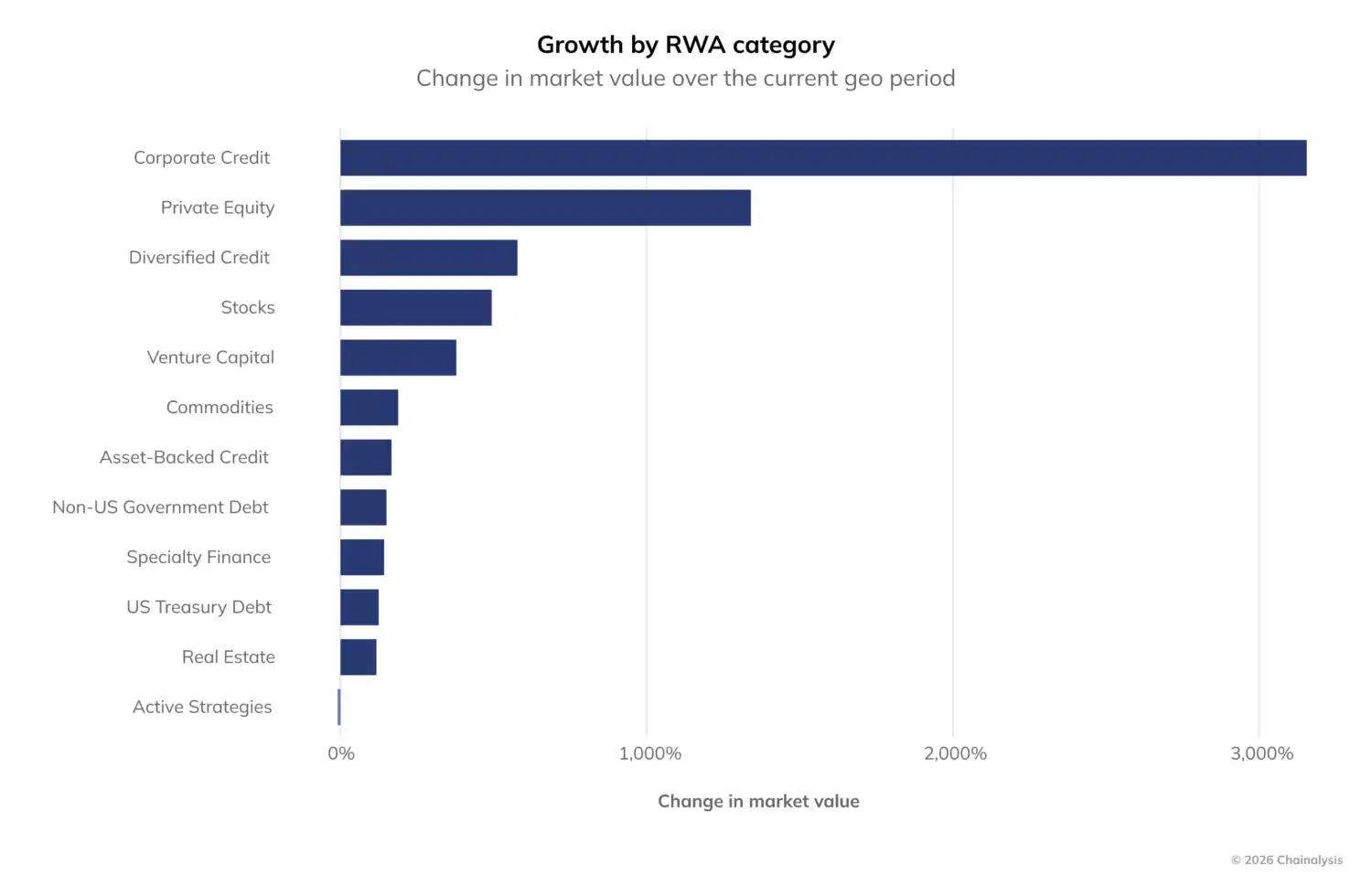
Chart: Scale growth comparison by RWA asset sub-category, with tokenized U.S. Treasuries occupying an absolute half of the total.
A more interesting phenomenon occurs in the geographic distribution of holders: by holdings amount, Italy holds 29.9% of tokenized U.S. Treasuries, ranking first globally, Portugal 18.8%, Singapore 18.2%, while the United States itself ranks fourth with only 10.5%; however, by number of holders, Japan ranks first with 16.4% of retail holders, but its holdings amount accounts for only 0.4%. This indicates that a small number of high-net-worth overseas entities contribute the majority of the amount, while a massive number of overseas retail investors are actively dollar-cost averaging.
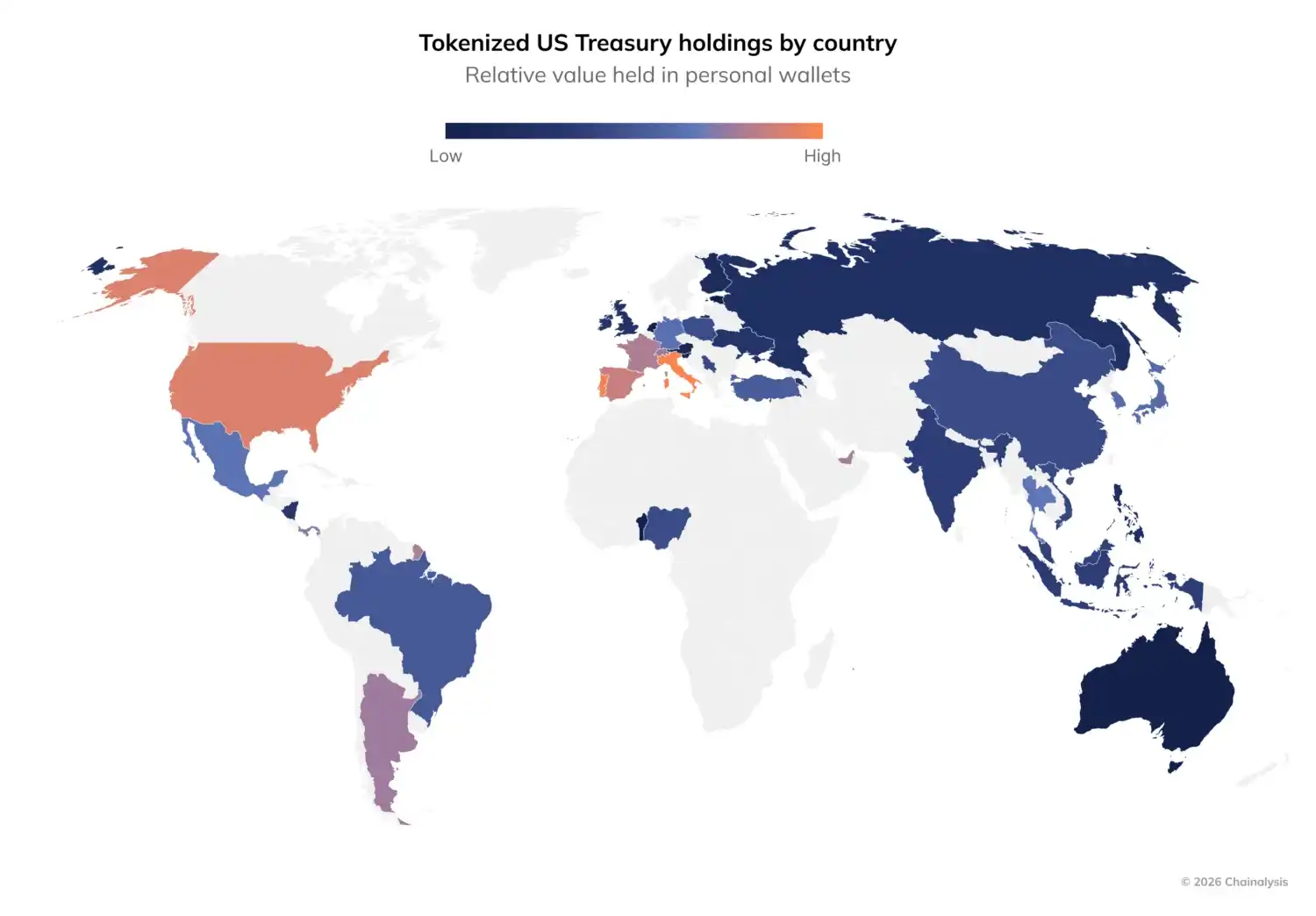
Chart: Distribution of tokenized U.S. Treasury holdings scale and number of holders by country. Overseas capital has become a new主力 force absorbing U.S. Treasuries.
Tokenization has greatly lowered the threshold for U.S. Treasury investment, enabling ordinary residents in Lisbon or Singapore to purchase with one click without opening a traditional U.S. brokerage account. Objectively, this technological evolution has converted global private capital into loyal buyers of U.S. government bonds.
Tokenization service provider Securitize pointed out: "The endgame is not to build an isolated crypto system parallel to traditional finance, but to thoroughly restructure the entire financial network with superior blockchain technology."
Canada's Rise: Immigration Wave Spawns the G7's Largest P2P Crypto Hub
Within the entire North American bloc, Canada has demonstrated an extremely unique development path: its total crypto economic value climbed against the trend by 2.3% to reach $247.7 billion, ranking 10th globally in the grassroots adoption index, and claiming the crown for overall P2P activity among G7 developed nations, ranking 7th globally in both domestic and cross-border flows.
Chart: Chainalysis Global Crypto Adoption Composite Ranking: Canada ranks first in P2P adoption among G7 countries.
Among Canadian traders' procurement preferences, stablecoins account for 44% (a significant jump from 30% a year ago), and the vast majority are dollar stablecoins, specifically USDC.
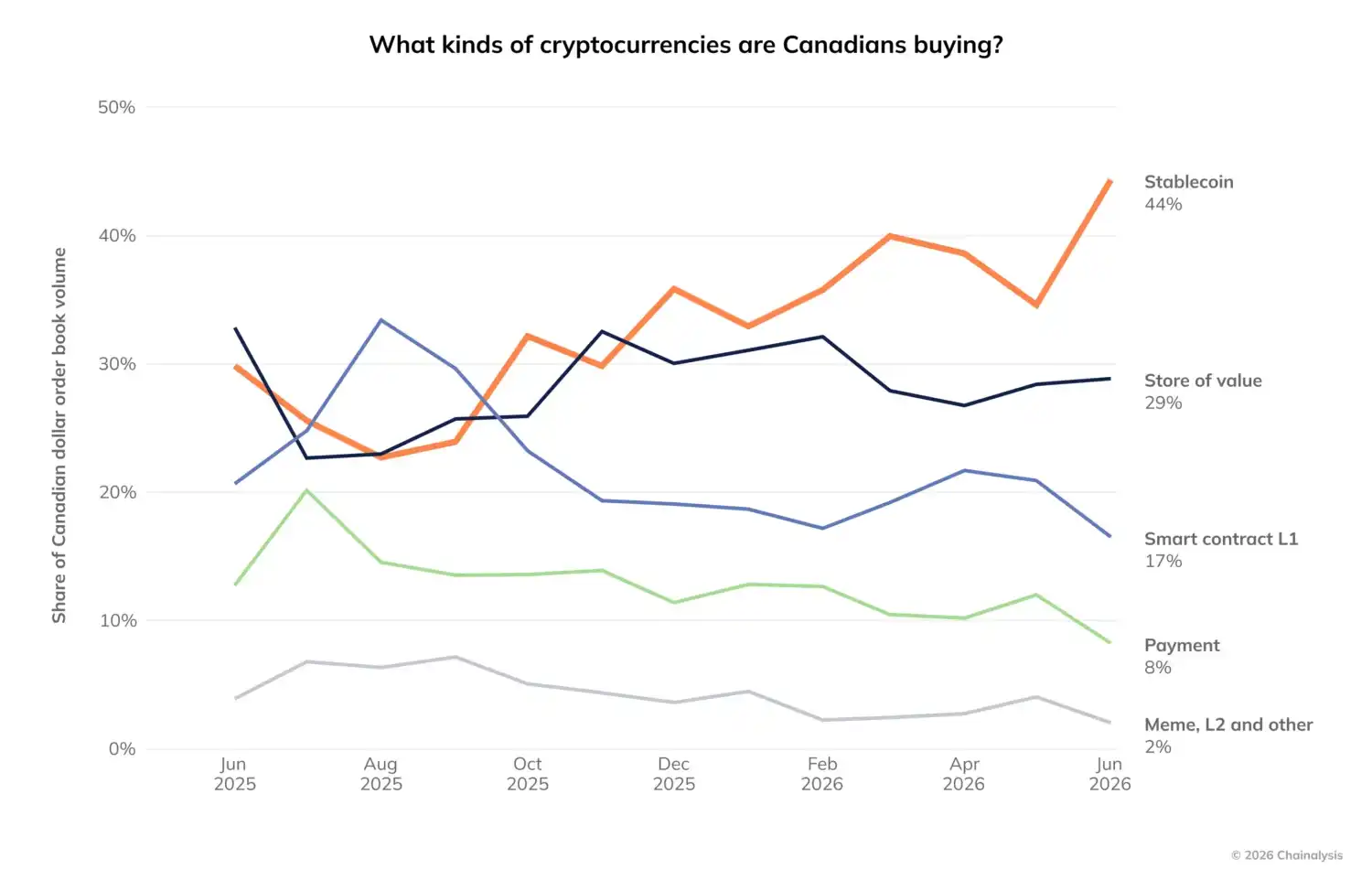
Chart: Changes in the proportion of Canadian users purchasing various crypto assets. Stablecoins have become the primary asset.
The core driver behind Canada's P2P and cross-border flow explosion is precisely its massive international immigrant population. Approximately 23% of Canada's resident population was born abroad, the highest proportion among G7 countries. Many residents face high cross-border remittance costs. World Bank data shows that the average traditional bank fee for remittances from Canada is as high as 6.7% to over 7%, while on-chain stablecoin settlement costs less than 1 cent.
Statistics show that the total personal cross-border remittances from Canada to India, the Philippines, and China reached $2.36 billion in this period, surging 141% year-over-year, distributed across 3.56 million transactions, with a monthly average of 75,100 independent remitters and an average single remittance amount of $663. On-chain stablecoins are rapidly eroding traditional offline remittance corridors with annual volumes in the tens of billions of dollars.
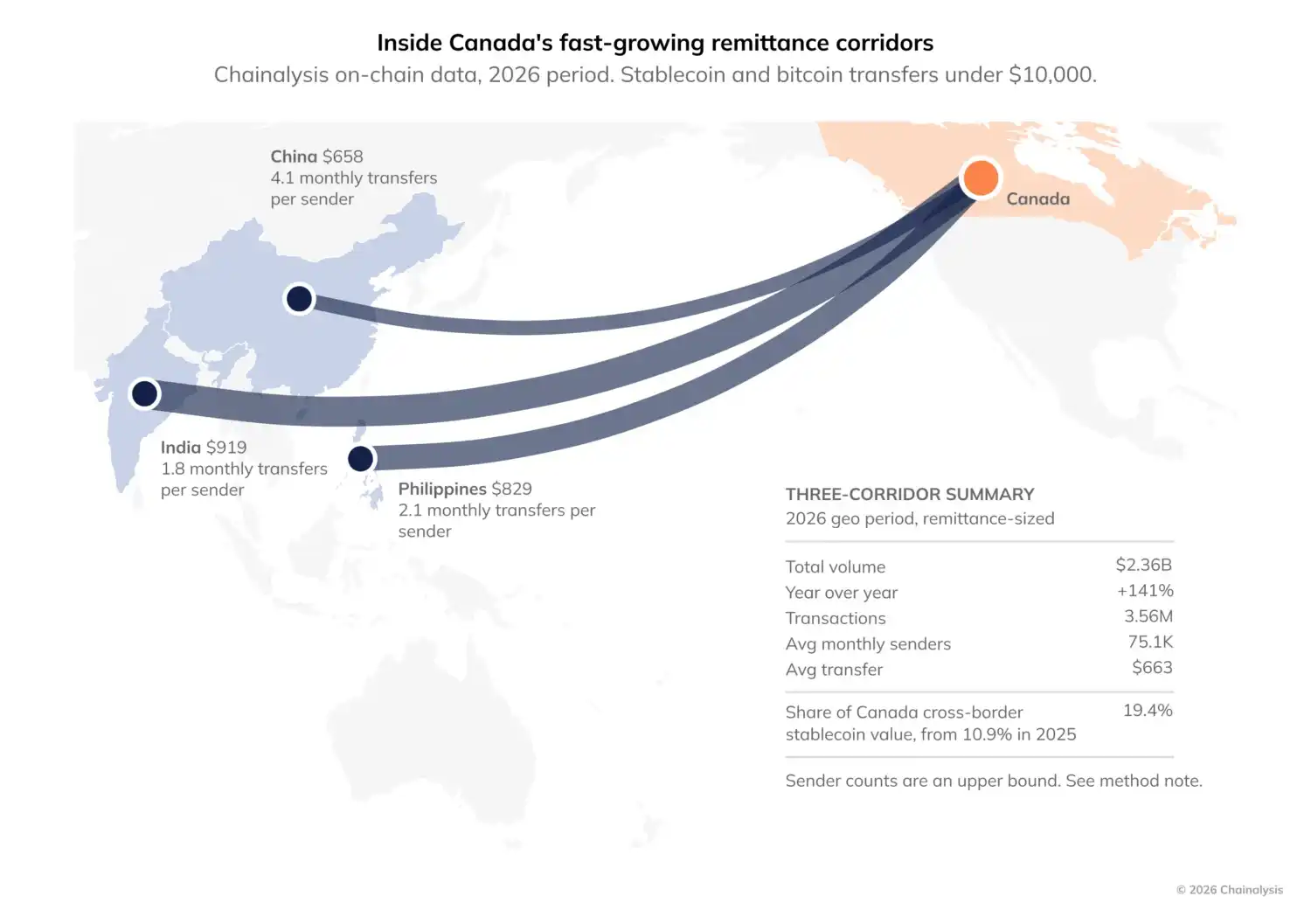
Chart: On-chain cross-border remittance scale from Canada to India, the Philippines, and China shows doubling explosive growth.
A more intuitive data correlation: the fluctuations in Canada's domestic P2P crypto trading volume show a highly consistent resonance with the scale of the country's temporary resident visa holders (study permits and work permits). When the foreign student and labor populations grow, crypto P2P activity simultaneously surges; when immigration quotas tighten, trading volume correspondingly declines. Landlords accepting Bitcoin for rent and residents using tokens to pay bills have become daily life in many Canadian communities.
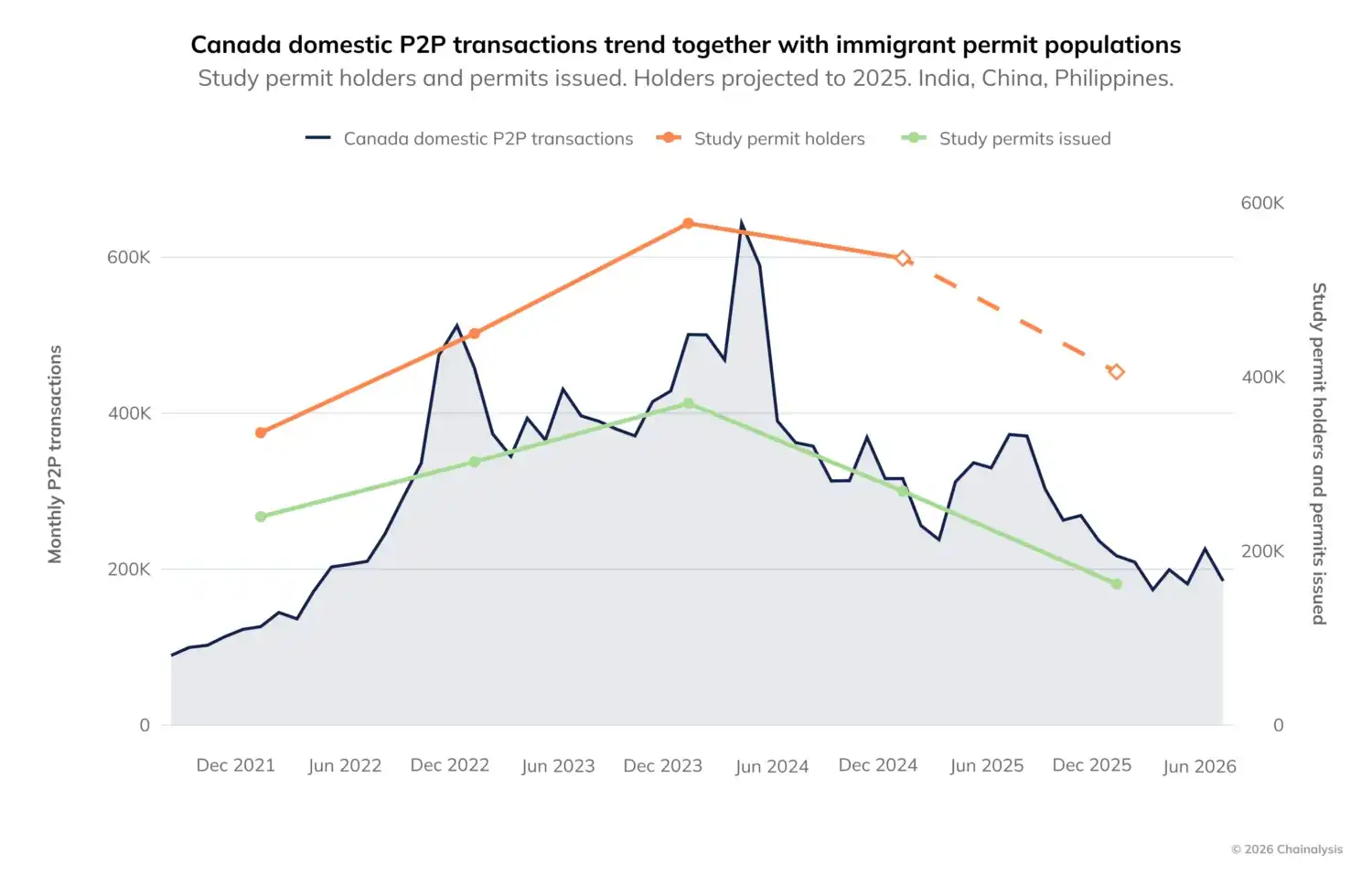
Chart: Canada's domestic P2P crypto trading volume shows a significant positive correlation trend with the number of temporary resident visa holders in the country.
Grand Summary: The U.S. Builds the Ecosystem, the World Absorbs the Applications
Looking across the 2026 North American crypto landscape, the most profound essence lies in the "globalization of division of labor":
U.S. institutions, issuers, and developers firmly hold the infrastructure monopoly over the three core on-chain pillars: tokenized U.S. Treasuries, dollar stablecoins, and AI agent commerce driven by x402. The United States controls the standard-setting power of underlying protocols and the pricing power of financial assets.
However, the end users who truly use these infrastructures at high frequency and drive real transaction demand are increasingly distributed abroad. Canada is a typical representative of using digital dollars for low-cost cross-border remittances, ordinary investors in Europe and Asia are using stablecoins to snap up on-chain U.S. Treasuries, and global developers are calling U.S. large-model agents through the Base chain.
Although the EU's MiCA, Singapore's stablecoin framework, and Brazil's digital real are actively exploring localized alternatives, the dollar network's powerful liquidity flywheel still firmly maintains its status as the global default currency. As agentic finance and tokenization compliance processes deepen, this symbiotic pattern of "the United States building infrastructure, the world integrating into the on-chain network" will profoundly reshape the new order of global finance in the coming years.