Capital Pours into Leading ETFs, But Why Is the Altcoin Season Still Nowhere in Sight?

marsbitPublished on 2026-09-11Last updated on 2026-09-11

Abstract

On September 9th, US ETFs tracking Ethereum, XRP, and Solana attracted nearly $59 million in inflows, while Bitcoin products saw outflows of $120.24 million, highlighting a rotation of capital among compliant crypto assets. However, this institutional shift has not translated into a broader market rally. The Altcoin Season Index remains at 37, far below the threshold of 75, indicating that most altcoins are still underperforming Bitcoin. This divergence is characteristic of the expanding crypto ETF market. While investors now have more channels to allocate to assets beyond Bitcoin, capital remains concentrated in a few top-tier products. Over the past 30 days, Bitcoin and Ethereum ETFs dominated inflows, followed distantly by Solana and XRP. All other approved crypto ETFs, such as those for Chainlink, Avalanche, and Dogecoin, have seen minimal or no net inflows, creating a steep hierarchy in assets under management. The article distinguishes between "ETF-level altcoin rotation" and a genuine "altcoin season." The former involves capital moving only among the largest, most institutional-friendly ETF assets (Bitcoin, Ethereum, Solana, XRP), without spilling over to the wider altcoin market. For a true altcoin season to occur, where 75% of the top 50 altcoins outperform Bitcoin over 90 days, capital needs to diffuse beyond this narrow ETF circle. The persistent outflows from Bitcoin ETFs present a key test: if the exiting capital continues to rotate only into other major ETF a...

Author: Oluwapelumi Adejumo

Compiled by: Saoirse, Foresight News

On September 9th, U.S. exchange-traded funds tracking Ethereum, XRP, and Solana attracted nearly $59 million in inflows, while Bitcoin-related products experienced $120.24 million in outflows. This phenomenon once again highlights the rotation of capital among compliant crypto assets.

However, the broader market has shown little sign of this rotation effect. The Altcoin Season Index tracked by BlockchainCenter registered a reading of 37, well below the threshold of 75. Reaching this threshold would indicate that three-quarters of the top 50 eligible tokens by market cap have outperformed Bitcoin over the past 90 days.

This divergence is becoming a typical characteristic of the expanding crypto ETF market. While investors now have more channels to allocate to assets beyond Bitcoin, capital remains concentrated in a handful of leading assets and has not spread to the wider token market.

Wall Street's Capital Rotation is Confined to a Narrow Inner Circle of ETFs

The market performance on September 9th illustrates that institutional-level altcoin trading can reach a significant scale, but it does not necessarily translate into a broad market rally.

Ethereum ETFs saw net inflows of $34.75 million, XRP products saw inflows of $12.29 million, and Solana attracted $11.73 million. At the same time, Bitcoin ETFs experienced outflows for the second consecutive trading day.

This data does not definitively prove that investors immediately bought the other three cryptocurrencies after redeeming their Bitcoin ETFs. However, it clearly indicates a divergence in market demand for leading compliant crypto assets.
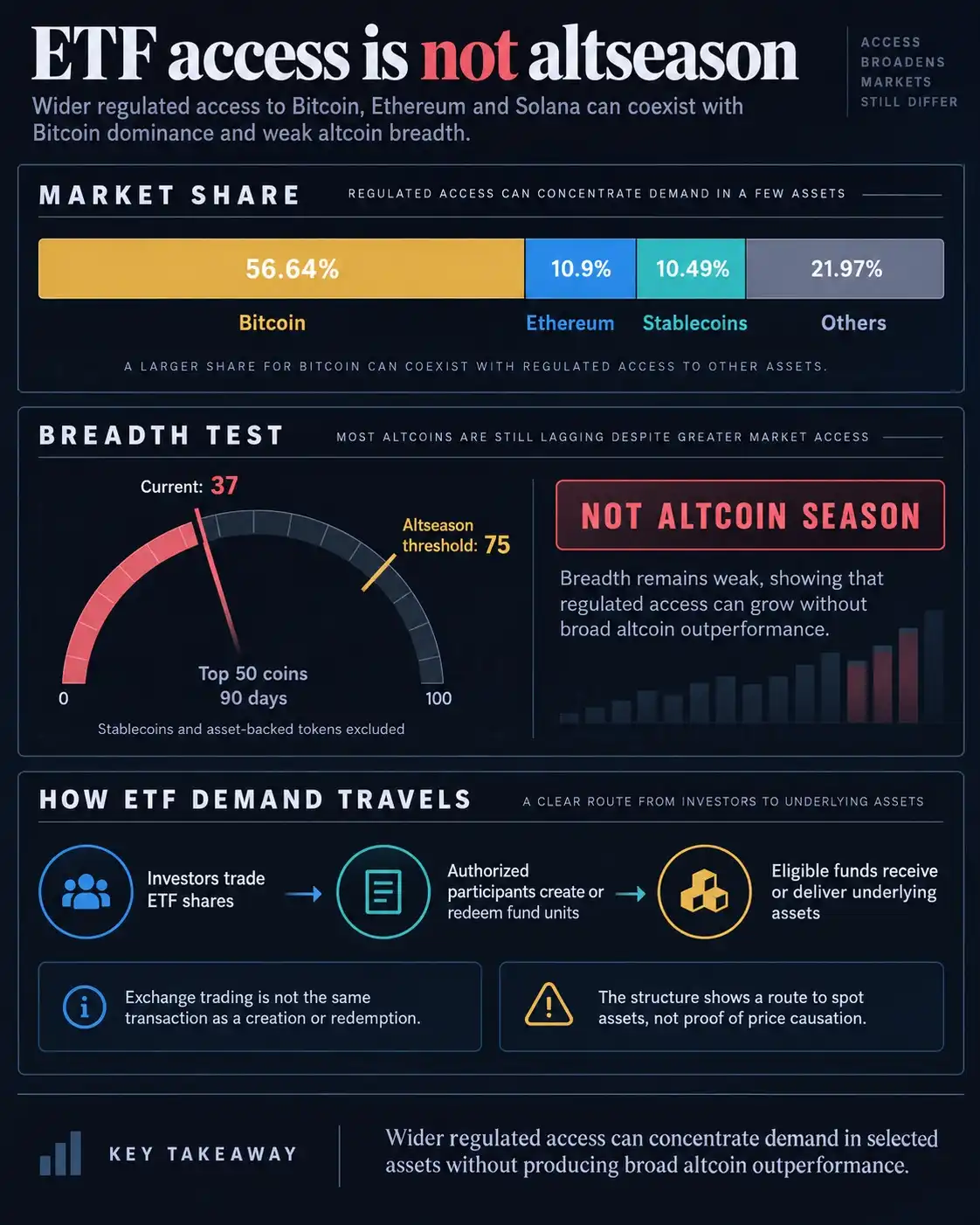
ETF Availability ≠ Altcoin Season. Even with compliant ETF channels for Bitcoin, Ethereum, and Solana, a scenario where Bitcoin dominates and most altcoins remain weak can still co-exist.

This pattern is not a one-day exception.

Over the past 30 days leading up to September 9th, Bitcoin ETFs continued to lead the pack with net inflows of $3.42 billion; Ethereum attracted $1.76 billion; while Solana and XRP recorded net inflows of $200.88 million and $185.32 million, respectively.

According to SoSoValue's data on listed spot crypto ETFs, total net inflows over 30 days amounted to $5.64 billion. Among these, the four categories of Bitcoin, Ethereum, XRP, and Solana accounted for a combined $5.57 billion.

The other products ranked behind them received only a minuscule portion of the capital.
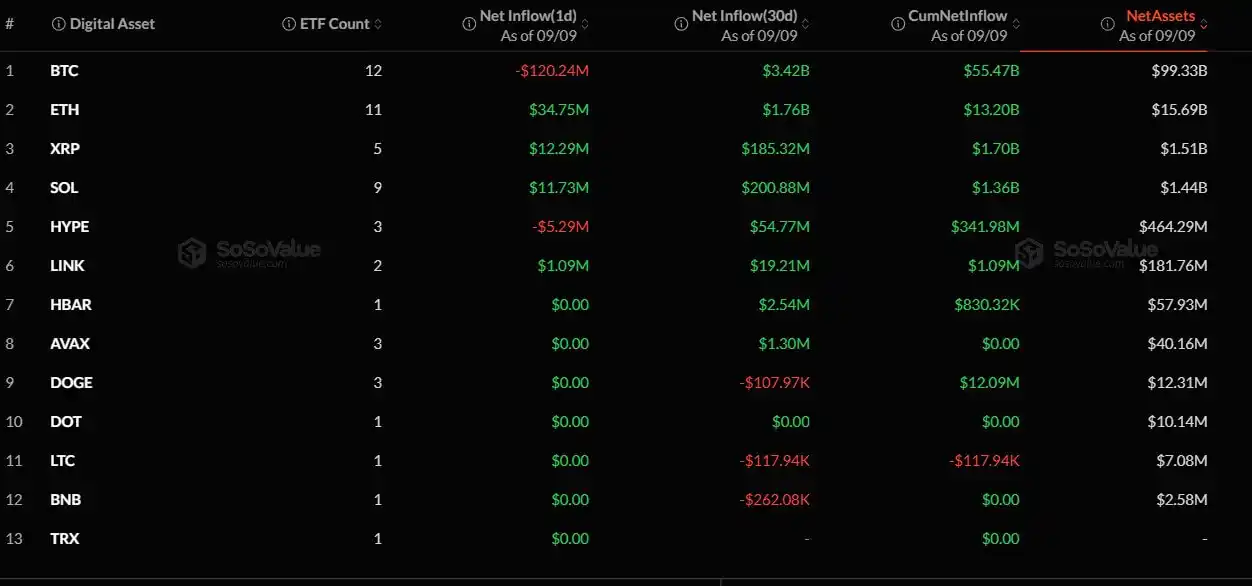
U.S. Cryptocurrency ETF Landscape (Source: SoSoValue)

During the same period, the Hyperliquid fund saw inflows of $54.77 million, and Chainlink attracted $19.21 million. Hedera saw inflows of $2.54 million, and Avalanche $1.30 million. Dogecoin, Litecoin, and BNB experienced minor net outflows, while Polkadot (DOT) had zero net inflows.

The gap is even more pronounced in terms of Assets Under Management (AUM). Bitcoin ETF AUM stands at $99.33 billion, and Ethereum ETF at $15.69 billion. XRP and Solana each hold around $1.5 billion.

Following them, Hyperliquid's AUM is approximately $464 million, and Chainlink's is less than $182 million. The AUM of all other listed products falls below $60 million.

This hierarchical structure allows investors to rotate from Bitcoin into other compliant assets without the need to venture further into the broader crypto token market.

In past market cycles, traders generally expected the Bitcoin rally's benefits to trickle down first to Ethereum, then to large-cap altcoins, and finally to various small-cap speculative tokens. However, ETFs have created a new path: institutional portfolios simply adjust positions among Bitcoin, Ethereum, XRP, and Solana, leaving the vast majority of the token market unaffected.

For a True Altcoin Season, Capital Needs to Diffuse Further Outward

Broad market data shows that this outward transmission of market momentum has yet to materialize.

BlockchainCenter defines an Altcoin Season as a 90-day period where 75% of the top 50 eligible cryptocurrencies by market cap outperform Bitcoin. The index reading of 37 on September 9th means fewer than half of the required tokens have met this criterion.

CoinGecko data shows Bitcoin's current dominance at 56.64% of the total crypto market capitalization. Compared to 56.02% three months ago and 56.54% a year ago, this figure has remained largely unchanged. Despite the launch of more compliant ETF products for altcoins, Bitcoin's market share has held steady.

Therefore, distinguishing between "Altcoin Rotation within ETFs" and a "Genuine Altcoin Season" becomes crucial.

Ethereum, XRP, and Solana can attract hundreds of millions in inflows, but this does little to spur momentum for tokens like Dogecoin, Avalanche, or Polkadot, which are less tied to institutional allocation logic.

Even as more ETF products gain approval, it does not guarantee a natural diffusion of capital outward. On September 9th, despite Bitcoin outflows and inflows into the three leading altcoins, the ETFs for Hedera, Avalanche, Dogecoin, Polkadot, Litecoin, and BNB all recorded zero net inflows.

For fund issuers, the core challenge is no longer just packaging new tokens into ETFs, but convincing institutions to look beyond their few preferred assets and allocate to a wider range.

Sustained redemptions from Bitcoin ETFs will serve as the ultimate stress test. If ETH, XRP, and Solana continue to absorb the outflowing capital while ETFs for mid- and small-cap tokens remain deserted, Wall Street will frequently witness localized altcoin rotations, but traders may continue to wait in vain for the comprehensive altcoin season they are eagerly anticipating.


Related Questions

QAccording to the article, what is a key indicator that suggests a 'altcoin season' is not currently happening?

AThe key indicator is the Altcoin Season Index reading of 37, which is well below the critical threshold of 75. An index reading above 75 means 75% of the top 50 cryptocurrencies have outperformed Bitcoin over the past 90 days.

QWhat does the September 9th flow data show about investor behavior regarding Bitcoin and altcoin ETFs?

AThe data shows a divergence in investor demand. Bitcoin ETFs experienced outflows of $120.24 million, while ETFs for Ethereum, XRP, and Solana collectively saw significant inflows of nearly $59 million, indicating a rotation of institutional capital among a narrow set of top, compliant crypto assets.

QWhy does the article suggest that the launch of new ETFs does not guarantee a broad altcoin season?

AThe article suggests that new ETFs don't guarantee a broad altcoin season because institutional capital, while able to rotate between approved assets like Bitcoin, Ethereum, XRP, and Solana, remains concentrated in these few top assets. It does not significantly diffuse into the wider altcoin market, leaving smaller or less mainstream tokens unaffected.

QWhat is the current distribution of assets under management (AUM) among the top cryptocurrency ETFs mentioned?

AThe AUM distribution is highly concentrated. Bitcoin ETFs dominate with $99.33 billion, followed by Ethereum at $15.69 billion. XRP and Solana ETFs each have around $1.5 billion. The next largest, Hyperliquid, has only about $464 million, highlighting the vast gap between the top few assets and the rest.

QWhat is the main challenge for fund issuers according to the article's conclusion?

AThe main challenge for fund issuers is no longer just packaging new tokens into ETFs, but convincing institutional investors to move beyond their preferred few assets (like BTC, ETH) and allocate capital to a broader range of other cryptocurrencies to stimulate a true, market-wide altcoin season.

Related Reads

Nobel Laureate Hassabis Delivers Another Masterpiece: AlphaGenome 2 Deciphers 98% of Human DNA 'Dark Matter'

DeepMind has unveiled AlphaGenome 2, a next-generation DNA foundation model led by Nobel laureate Demis Hassabis. While AlphaFold decoded only the 2% of the human genome that encodes proteins, AlphaGenome 2 targets the remaining 98% of non-coding "dark matter," which harbors gene-regulatory switches and over 90% of disease-causing mutations. Released alongside a 78-page technical report, the model delivers four major breakthroughs. First, it achieves single-cell resolution, trained on over 107 million single cells across 68 human tissues, doubling the rate at which it identifies pathogenic mutations—raising detection from 16% to 30% and directional accuracy from 23% to 43% on the TenK10K immune-cell benchmark. Second, it reproduces years of Nature-published research purely through computation: with zero wet-lab experiments, it correctly identified a distant regulatory mutation that over-activates ETS2 across 290,000 bases to cause inflammatory bowel disease, and precisely located the regulatory site and GATAA core sequence targeted by approved sickle-cell CRISPR therapy. Third, a new cell encoder lets the model interpret previously unseen diseases from just dozens of patient cells without retraining—identifying 41% of pathogenic mutations in unseen Parkinson's brain samples versus 17% for a specialized model, and uncovering a hidden severe-COVID mutation active only in immune-activated T cells. Finally, DeepMind released free databases covering 640 real human cell types and impact scores for nearly 7 million genetic variants across 510 cell states, with APIs and Colab tutorials open for non-commercial research. The model will soon be packaged as Skills and integrated into Google Antigravity for direct use by Gemini 4, promising to dramatically shorten the cycle of disease investigation and drug discovery.

marsbit34m ago

Nobel Laureate Hassabis Delivers Another Masterpiece: AlphaGenome 2 Deciphers 98% of Human DNA 'Dark Matter'

marsbit34m ago

Midterm Elections Settled, What Lies Ahead for the CLARITY Act?

The CLARITY Act (Digital Asset Market Clarity Act), which had already struggled before the election, now faces dim prospects after Democrats swept both chambers in the midterms. On September 15, a Senate cloture motion on the House-passed bill failed 49-50, eleven votes short of the 60-vote threshold. All 49 yes votes came from Republicans; the opposition included all Democrats present, two independents, and four Republicans (Collins, Hawley, Moran, Tillis). Even if absentee Democrat Coons had voted yes and the four Republicans had flipped, the tally would have reached only 54—still short. The bill's core compromise would make the CFTC the primary regulator for digital commodities and trading platforms while preserving clear SEC authority; jurisdictional division and added ethics provisions are the main disputes. Democrats will control both chambers when the new Congress opens January 3, 2027, leaving little incentive to cooperate during the lame-duck session. Only two theoretical paths remain before the 119th Congress ends: renegotiate the text and hold another cloture vote via Tillis's reconsideration motion, or attach crypto market structure provisions to must-pass December legislation such as government funding (expiring December 11) or the NDAA. Both are unlikely, given the tight legislative calendar and Democratic leverage. Stablecoin oversight continues separately under the GENIUS Act and OCC rulemaking. If the bill dies, it must be reintroduced in the 120th Congress, where Democrats—likely led by Elizabeth Warren and Maxine Waters—are expected to draft a very different framework expanding SEC authority and narrowing the CFTC's role. Key things to watch before January 3: any new cloture vote or revised text, any attempt to attach provisions to funding or defense bills, outstanding vote counts in Alaska, Mississippi, and House districts, and the incoming committee chair selections. Absent such developments, the CLARITY Act is effectively finished as a 2026 legislative project.

marsbit35m ago

Midterm Elections Settled, What Lies Ahead for the CLARITY Act?

marsbit35m ago

4.8 Billion Dollars: Tether's Hand Has Reached Into 13 U.S. Public Companies

Tether, the world's largest stablecoin issuer, holds roughly $4.8 billion in public-market exposure across 13 U.S.-listed companies, according to a Protos review of regulatory filings. Its holdings span a controversial video platform, gold royalty companies, a satellite firm, bitcoin miners, and a bitcoin treasury project. Key positions include a 50.3% stake (including warrants) in Rumble (RUM), though voting power is capped below 9.9%; Rumble has also acquired Tether's Northern Data and counts Tether as its most important advertising client, committed to $50 million annually for two years. Tether and Bitfinex are controlling shareholders of Twenty One Capital (XXI), with rights to nominate four of seven directors, including Tether CEO Paolo Ardoino; the company trades at about 60% of its bitcoin value. In gold, Tether holds about 27% of Elemental Royalty (ELE), 12.6% of Gold.com (GOLD), 12.6% of Versamet Royalties (VMET), 14.6% of Metalla (MTA), 14.4% of Gold Royalty (GROY), 12% of Aurelion (AURE), and about 8% of Antalpha (ANTA). It also holds 19.7% of Bitdeer (BTDR) and a stake in Adecoagro (AGRO), plus shares in Satellogic (SATL), 9.9% of SDEV (down about 99%), and a stake in VCI Global (VCIG) via Oobit. Powerlaw Corp (PWRL) claims roughly $20 million in Tether equity. The exposure is concentrated in a few large holdings—Twenty One, Rumble, and Adecoagro—showing Tether's growing role as a multi-sector financial institution that also places executives in key positions.

marsbit1h ago

4.8 Billion Dollars: Tether's Hand Has Reached Into 13 U.S. Public Companies

marsbit1h ago

Trading

Spot
活动图片