Bitcoin Volatility Halved Yet Extreme Days Exceed 2018: VaR Models May Underestimate Tail Risk

marsbitPublished on 2026-10-10Last updated on 2026-10-10

Abstract

Bitcoin's volatility has significantly decreased in 2026, with annualized volatility dropping to approximately 46% from around 84% in 2018. However, it has already recorded 10 "3-sigma" trading days this year—days where price moves deviate by at least three standard deviations from recent norms—surpassing the 8 such days observed in the entirety of 2018. This indicates that while average daily price swings are calmer, extreme outlier movements remain frequent, even surpassing the frequency seen in a previous bear market. This paradox presents a challenge for standard risk models like Value-at-Risk (VaR), which often rely on recent volatility to gauge risk. Lower volatility can misleadingly signal reduced risk, potentially encouraging larger positions while failing to adequately capture persistent "tail risk"—the potential for rare but severe losses. Experts note the industry is shifting towards metrics like Expected Shortfall to better account for these extreme outcomes. Market participants attribute the continued occurrence of these sharp swings to unpredictable macroeconomic shocks and highly leveraged options positions, particularly strategies like shorting volatility or call overwriting. These strategies can amplify price moves when unexpected news triggers a market shift. Despite the persistent volatility spikes, the market demonstrates greater resilience in absorbing them, attributed to increased institutional participation, deeper liquidity from ETFs, and improved o...

Author: Omkar Godbole

Translated by: TechFlow

TechFlow Introduction: CoinDesk calculations show that Bitcoin has already recorded 10 '3-sigma' trading days in 2026, exceeding the 8 such days in the entire 2018 bear market, while its annualized volatility has dropped from about 84% to around 46%. For VaR position models reliant on volatility, the seemingly calmer surface may precisely encourage increasing positions, yet miss the recurring tail shocks that are still happening.
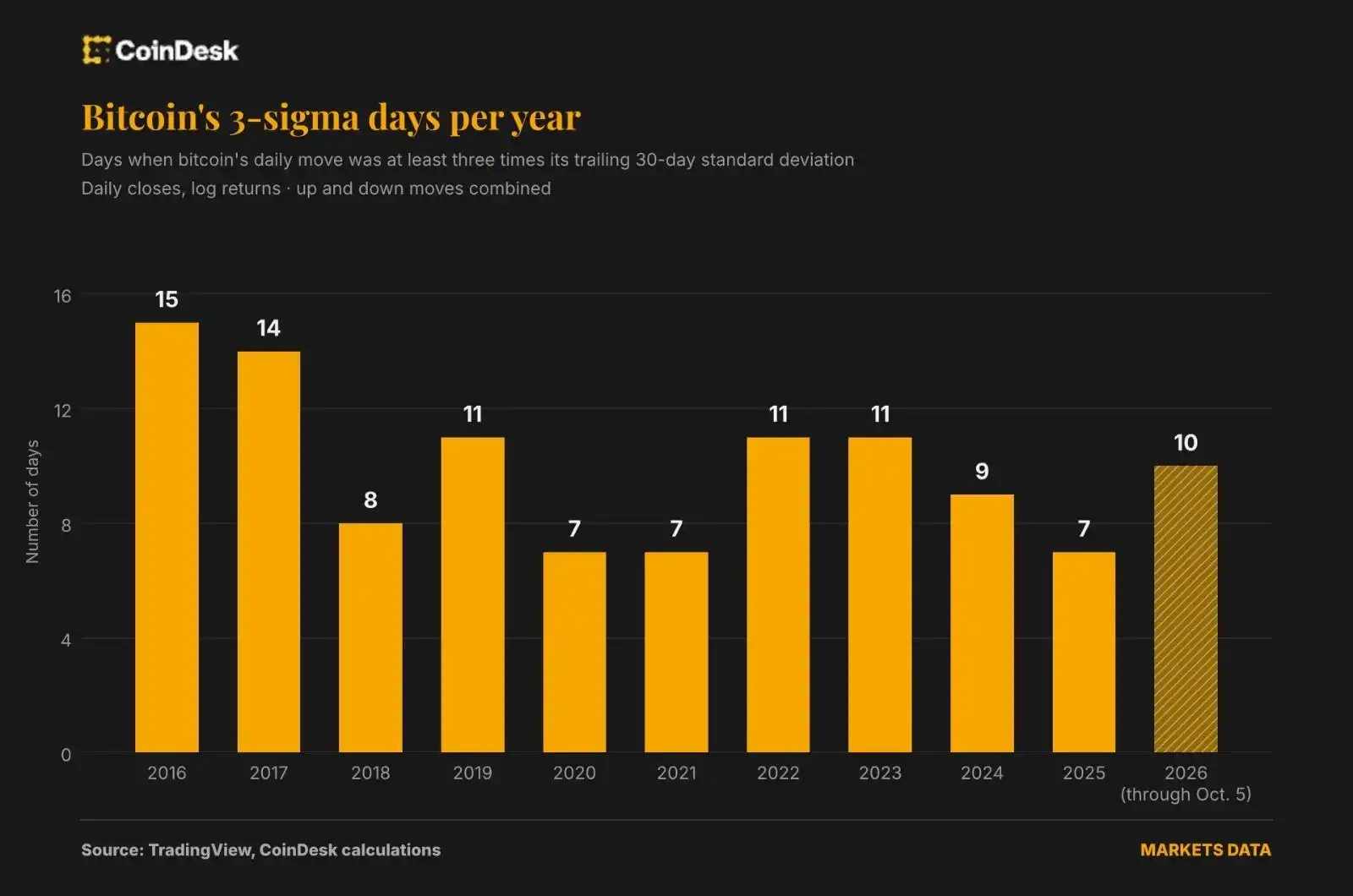
Bitcoin (BTC) has experienced more abnormally large price swings this year than during the 2018 bear market, even as its overall volatility has significantly declined — presenting a challenge for those relying on standard risk models.

According to CoinDesk's analysis, the largest cryptocurrency by market capitalization has recorded 10 trading days in 2026 where its price deviated from its recent trading pattern by at least three standard deviations. This surpasses the 8 such days recorded in all of 2018; a year in which Bitcoin's market value evaporated by 73%.

Traders use 'sigma' to measure these unusually large swings, signifying how far an asset's price has deviated from its normal behavior. To quantify these days, CoinDesk compared each trading day's price change with Bitcoin's 30-day realized volatility — a measure of how much the price typically moved daily over the past month. Any day where the move was at least three times that value (regardless of direction) was counted as a '3-sigma day'.

In a normal bell curve distribution, about 95% of moves fall within 2 sigma, and 99.7% within 3 sigma. Therefore, 3-sigma moves are inherently rare, and traders use them to mark exceptionally sharp swings. A high count suggests that even as overall volatility cools, the asset remains prone to sudden jolts.

These findings indicate that Bitcoin has indeed 'calmed down' over the years but still experiences extreme days, and this year they are occurring more frequently than in 2018. This implies: relative to its recent volatility, Bitcoin is undergoing more abnormally large swings, even though the absolute magnitude of these swings has become smaller. Bitcoin's annualized volatility this year is about 46%, compared to 84% in 2018; meanwhile, the average magnitude of its 3-sigma moves is about 7%, lower than the roughly 10% eight years ago.

"What hasn't changed is that Bitcoin still goes through long quiet periods followed by sudden repricing. The market has matured, with far more institutions, ETFs, and liquidity, so average days are calmer. But the shocks haven't disappeared: macro, leverage, positioning," said Nicolas Quatravaux, Head of Europe, Middle East, and Africa at Paradigm, a leading institutional liquidity network for crypto derivatives.

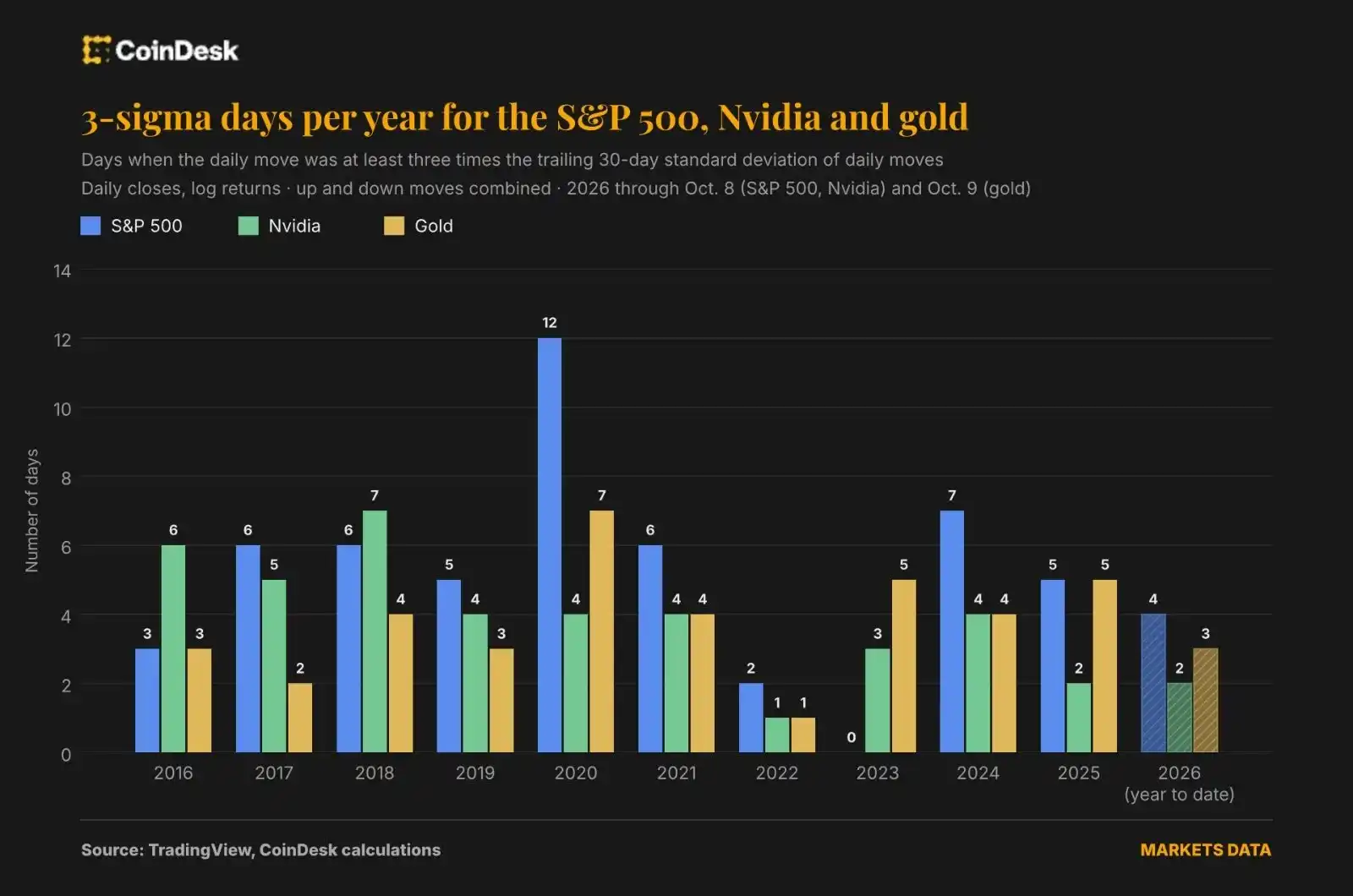
This contrast is evident even compared to other high-volatility assets. Since 2024, Bitcoin's volatility has been roughly comparable to Nvidia's, around 47%. But during the same period, it recorded 26 3-sigma days, while Nvidia had only 8; the S&P 500 had 16, and gold had 12.
How Declining Volatility Misleads Risk Models

The persistence of extreme volatility poses a challenge for investors who use volatility-based risk models to determine their Bitcoin positions.

A widely used metric is value-at-risk (VaR), which estimates how much a portfolio might lose on a bad trading day. Some VaR models heavily rely on recent price fluctuations, meaning an asset can appear less 'dangerous' if trading has been calm for an extended period.

Therefore, the decline in Bitcoin's 30-day, 90-day, and 180-day volatility metrics may encourage investors to increase their exposure. However, depending on how the model is constructed, this apparent decrease in risk may not adequately capture the potential for abnormally large losses.

It also estimates a loss threshold without telling investors how severe losses could be once that threshold is breached. This is known as tail risk — the potential for rare but exceptionally large losses that fall outside an asset's normal trading pattern. Bitcoin's recurring 3-sigma swings show that investors still need to factor in such extreme outcomes, even as day-to-day volatility decreases.

"Standard VaR metrics don't properly assess the full tail risk, which is one of the main reasons the industry is moving towards Expected Shortfall and similar metrics that do account for tail risk," said Luuk Strijers, CEO of crypto options exchange Deribit.

Expected Shortfall looks at how severe losses are on the worst trading days, not just how often such days occur. Unlike using VaR alone, this approach helps investors gauge the destructive power of those extreme losses.

"If the portfolio target doesn't account for tail risk, then a calmer Bitcoin would indeed encourage a larger allocation within the portfolio, making sudden price jumps more impactful for the portfolio," Strijers said.

He added that these 3-sigma risks can be hedged using Bitcoin options.

Why Sudden, Sharp Swings Still Recur

Market participants point to unpredictable macro shocks and highly leveraged options positioning as the dual drivers of these high-VaR trading days.

This year is a good example, said Paradigm's Quatravaux.

"Started slow, with rotation into tech stocks, and a string of DeFi hacks pushing people into selling volatility and structured products for yield. Then you hit Trump, Iran war, the Fed, and everyone is short volatility within a range. One headline is enough to give you an abnormal day," he said.

Essentially, risk builds when traders bet that prices will remain relatively stable. That positioning involves selling (shorting) options — essentially 'insurance' against large price moves — to collect premiums.

Such strategies work when markets are quiet. But when macro headlines hit and prices swing sharply, those sellers get caught on the wrong side, and their scramble to cover can amplify a move into a shock.

Alexander S. Blume, Co-founder and CEO of US SEC-registered investment adviser Two Prime, highlighted a particularly popular variation of this trade called call overwriting. Investors sell call options on Bitcoin they already own, giving up some upside potential in exchange for steady premium income from selling the calls.

"I believe the large increase in derivatives market positioning, despite the convergence in overall volatility, still enables outsized moves to occur relatively frequently. Currently, call overwriting is a highly crowded trade. When we see rallies like the past month, it creates a short squeeze and amplifies moves," Blume said.

A More Resilient Market?

The good news is the market is better equipped to absorb these jolts than before.

On September 21st — the day of Bitcoin's most recent 3-sigma jump — Paradigm facilitated a record $6.7 billion in options volume.

"This time we didn't see, nor hear of, any trading desks taking big losses," Quatravaux said.

"Participants are far more sophisticated than a few years ago, risk management has improved significantly, and there's more institutional money in the market. So a tough month is often just a tough month," he said.

Just don't expect these wild swings to stop.

"They're here to stay. Ten years of data show these days haven't disappeared as the market matured, because macro shocks aren't going anywhere," Quatravaux said.


Related Questions

QAccording to the article, how many '3-sigma' trading days has Bitcoin recorded in 2026 compared to the entire year of 2018?

ABitcoin has recorded 10 '3-sigma' trading days in 2026, exceeding the 8 recorded throughout the entire bear market year of 2018.

QWhat is a key limitation of standard Value-at-Risk (VaR) models highlighted in the article, and what alternative metric is suggested?

AA key limitation of standard VaR models is that they fail to adequately assess the full severity or 'tail risk' of extreme losses. The article suggests the alternative metric of Expected Shortfall, which considers how bad losses can be in the worst-case scenarios.

QWhat two main factors does the article cite as drivers for the continued occurrence of sudden, high-VaR price swings in Bitcoin?

AThe article cites unpredictable macro shocks and highly leveraged options positioning as the two main drivers for the continued occurrence of sudden, high-VaR price swings in Bitcoin.

QWhat specific, popular options trading strategy does Alexander S. Blume mention as contributing to amplified volatility during price rallies?

AAlexander S. Blume mentions the 'covered call' or 'call overwriting' strategy as a highly crowded trade that can create short squeezes and amplify volatility during price rallies like those seen in the past month.

QDespite the persistent extreme volatility, what positive development regarding market resilience does the article point out?

AThe article points out that the market's ability to absorb these shocks has improved. Participants are more mature, risk management has advanced significantly, and there is more institutional capital, meaning a difficult month is often just that, without causing major casualties like in the past.

Related Reads

Google says hackers use AI agents to find and exploit software flaws

Google Threat Intelligence Group (GTIG) has for the first time identified attackers using AI large language model frameworks to automate software vulnerability discovery and exploitation without step-by-step human direction. In a report published Monday, researchers described a tool found on an exposed staging server that compared software versions, identified potential flaws, and generated and executed exploit code. GTIG said threat actors used LLM frameworks to fully automate vulnerability discovery and exploitation without a human in the loop, hosting a multi-agent vulnerability research and weaponization framework designed to conduct continuous differential analysis comparing code before and after patch announcements on popular web applications, autonomously discovering and exploiting software vulnerabilities. Google warned these automated workflows give organizations less time to apply security patches before attackers develop ways to exploit vulnerable systems. Attackers are leveraging AI agent frameworks to automate patch reverse engineering via differential analysis and weaponizing N-day vulnerabilities. Vulnerability disclosures more than doubled between January and August, with exploited zero-days averaging eight per month in 2025 and 11 per month from January through August 2026, reaching 22 in August. Automated workflows also accelerate attackers' ability to move from initial access to domain administrator access, as cited in an August 2026 PaperCut campaign where attackers achieved that control within minutes. GTIG said two PHP vulnerabilities involved in exploitation attempts were discovered using LLM analysis. Anthropic also warned that AI-assisted attacks have evolved into multi-agent operations automating most of the cyberattack cycle from discovery to exploitation and data theft.

cointelegraph46m ago

Google says hackers use AI agents to find and exploit software flaws

cointelegraph46m ago

Coin-Stock Trend Indicator丨Third-largest BTC treasury company Twenty One Capital buys $10 million in BTC for the first time since July 2025; Bitmine total holdings value drops $2.5 billion in a week (November 17)

This week's crypto stock snapshot notes that the recent US equity move was merely an oversold rebound rather than a new high, with the impact of the Democratic midterm election win still spreading and Nvidia founder Jensen Huang's resignation controversy evolving into a broader AI-sector storm. The week's biggest US market event is Anthropic's IPO on November 19, though its fundraising and valuation fall short of SpaceX's record. Japanese stocks remain favored by Morgan Stanley analysts despite AI-related weakness, while Korean stocks fell 2.59% to 4,968.45, their lowest since February 2. In crypto stocks, last week's market crash hit DAT treasury companies hard, with ETH treasury firm Bitmine's holdings value dropping from $14.3 billion to $11.8 billion in a week, nearly all due to ETH's price decline. Listed companies (excluding miners) bought a net $51.86 million in Bitcoin last week, down 45.2% week-over-week. Strategy bought 485 BTC at $68,887 each for about $33.4 million, bringing total holdings to 850,849 BTC; Metaplanet bought none. Capital B bought 12 BTC at $77,500.2, holding 3,550 BTC; Strive bought 251 BTC at $69,853 for about $17.53 million, holding about 43,404 BTC. Total tracked holdings reached 1,171,317 BTC, up 0.04% week-over-week, worth about $75.53 billion, or 5.8% of Bitcoin's circulating market cap. Twenty One Capital bought 154.32 BTC for about $10 million in cash, its first purchase since July 2025, bringing holdings to about 43,700 BTC and making it the third-largest listed Bitcoin treasury; CEO Rapha Zagury said volatility creates opportunity and the firm bought the dip. BitMine added 7,653 ETH last week, holding 6,077,745 ETH (4.97% of total supply, 0.03% short of its 5% goal) plus 216 BTC, a $180 million investment in Beast Industries, $67 million in Eightco Holdings, and $448 million in cash and securities; its ETH holdings are worth about $11.1 billion at $1,823 per ETH. Chairman Tom Lee attributed ETH's 28% two-week drop to Nvidia-related turmoil triggering Asian margin selling and investors raising cash for Anthropic's reported November 18 IPO, saying it contradicts improving fundamentals. DeFi Development Corp. added 9,482 SOL, with Solana treasury holdings reaching about 2.62 million tokens, growing for a 10th straight week; its CHAD preferred stock raised enough to buy over 230 SOL today. CZ said Japan-listed ASIAN STAR will distribute 8 million yen worth of BNB to shareholders and pursue Japanese real estate tokenization on BNB Chain. DeFi Technologies reported Q3 2026 revenue of $18.3 million (down about 18% year-over-year), operating income of $7 million, and net profit of $22.3 million, with $53.4 million in cash and stablecoins and $48.2 million in digital assets. Ripple-backed Evernorth disclosed its 346 million XRP was booked at $342 million versus an initial $847 million record value, with cumulative impairments of $505 million, a nearly 60% decline.

marsbit1h ago

Coin-Stock Trend Indicator丨Third-largest BTC treasury company Twenty One Capital buys $10 million in BTC for the first time since July 2025; Bitmine total holdings value drops $2.5 billion in a week (November 17)

marsbit1h ago

Trading

Spot
活动图片